Content note. This page describes the murder of a 13-year-old boy and his younger brother, and a state-built story that presents a child's betrayal of his father as a virtue. It quotes the cult's own language ("hero," "traitor," "little swine") as evidence of the method, not as this archive's judgment of anyone named. Whether the denunciation at the centre of the story happened as told is a genuinely open historical question, covered in full below; this page does not treat it as settled fact in either direction.
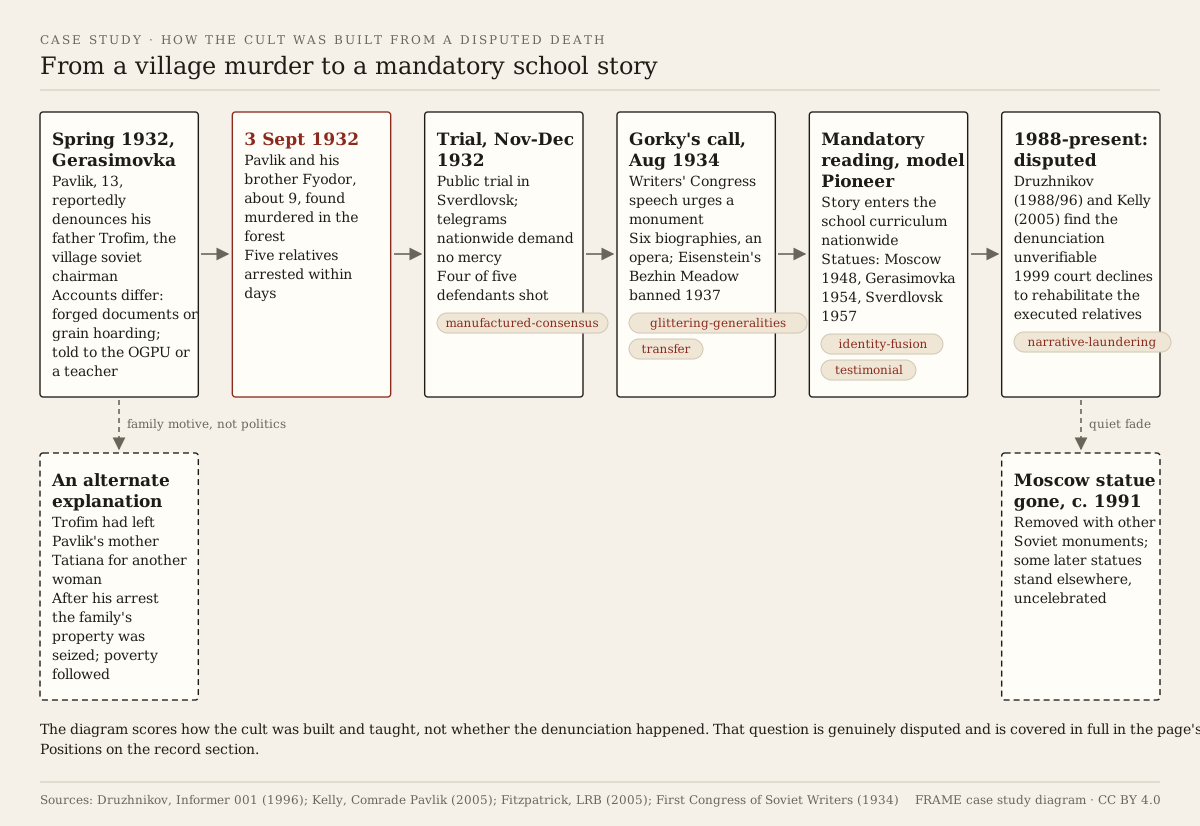
In one line: After 13-year-old Pavlik Morozov and his younger brother were murdered in the Ural village of Gerasimovka in September 1932, the Soviet Communist Party built a nationwide hero-cult in under two years around the story that Pavlik had denounced his own father to the authorities and died in revenge for it — statues, six official biographies, an opera and mandatory schoolbook reading followed — even though the fullest independent research since the Soviet collapse has found the denunciation story itself cannot be confirmed and was very likely embellished or invented outright.
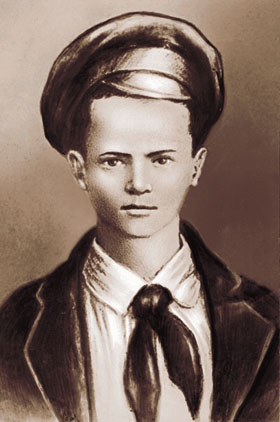
The portrait of Pavlik Morozov reproduced across Soviet publications from 1932 onward. Its authorship and exact origin are not documented on Wikimedia Commons, and Druzhnikov's research found that published images of "Pavlik" were inconsistent across Soviet sources, so this specific portrait's fidelity to the boy himself is not established; it is shown here as the image the cult itself circulated. Public domain (Commons licence tags PD-Russia and PD-1996, author unknown).
What happened
The family and the accusation, 1918-1932
- 14 November 1918 (as usually given). Pavel "Pavlik" Trofimovich Morozov is born in Gerasimovka, a small village in the Tavda district of what is now Sverdlovsk Oblast, in the Urals. His father, Trofim Sergeyevich Morozov, becomes chairman of the Gerasimovka village soviet. As set out below, even this birth date is one of the details that later independent research found inconsistent across the official record.
- By 1932. Trofim has left Pavlik's mother, Tatiana, for another woman in the village. Collectivization is under way in the district, with peasants classified as "kulaks" being dispossessed and some deported. Trofim, as the local soviet chairman, is positioned to help or hinder that process on paper.
- Spring 1932 (the official account). The Soviet story holds that Pavlik reported his father to the OGPU (the secret police), accusing him of forging documents — issuing papers that let deported "kulaks" pass as ordinary poor peasants — in exchange for payment. Accounts published across the Soviet period do not agree on the details: some give the charge as document forgery, others as grain hoarding; some have Pavlik informing the OGPU directly, others a schoolteacher or a village meeting. Trofim was arrested, tried and sentenced; sources used here differ on whether the sentence was ten years' forced labour, commuted afterward to death, or something else, and on whether Pavlik's mother Tatiana, angry at being left for another woman, pushed him toward the accusation.
The murder and the trial, September-December 1932
- 3 September 1932. Pavlik, 13, and his younger brother Fyodor (Fedya), about 9, are found murdered in the forest near Gerasimovka. The state seized Trofim's property after his conviction, and the family had reportedly been left near destitute.
- Within days. Five suspects are arrested: Pavlik's grandfather Sergei Morozov and grandmother Ksenia Morozova, both in their eighties; his 19-year-old cousin Danila Morozov; and one or two uncles, named inconsistently across sources as Arseny Kulukanov and/or Arseny Silin.
- A nationally publicised trial, November-December 1932 (sources differ on the month), Sverdlovsk. The case is tried as a public demonstration, reported across the Soviet press; contemporary accounts describe thousands of telegrams reaching the court demanding no leniency. Four of the five defendants are convicted and sentenced to "the highest measure of social defense" — death by firing squad; the fifth is treated differently in the record. The defendants' own statements, as later researchers note, were inconsistent with one another and with the physical evidence, and little independent evidence was presented at trial.
Building the cult, 1934-1953
- 17 August-1 September 1934. At the First All-Union Congress of Soviet Writers in Moscow, Maxim Gorky calls for a monument to the boy. Within a few years, six official biographies of Pavlik are commissioned and published, along with an opera, a symphonic poem and songs for schoolchildren.
- 1935-17 March 1937. Sergei Eisenstein, with Isaac Babel, begins filming Bezhin Meadow, a fictionalised version of the story (the boy renamed Stepok). The Chief Directorate of Soviet Cinema halts production permanently on 17 March 1937 and condemns the surviving cut as "inartistic and politically bankrupt," accusing Eisenstein of confusing class struggle with a struggle between good and evil in the abstract. Most of the footage is later destroyed; only single frames from each shot, preserved by Eisenstein's wife Pera Atasheva, survive to be reassembled into a 1967 reconstruction by Naum Kleiman and Sergei Yutkevich.
- 1939. A museum exhibition opens in the former Morozov family home in Gerasimovka.
- Nationwide, through the 1930s-1950s. Pavlik's story becomes standard, effectively mandatory, reading in Soviet schools, retold as the ideal of a child's loyalty to the Soviet state over his own family. Some schools set up dedicated "Pavlik Morozov halls" used for the ceremony admitting children into the Young Pioneers, the mass children's organisation covered on its own page, The All-Union Pioneer Organization: scouting rebuilt as a communist pipeline, 1922-1991; Pavlik was held up within it as the model Pioneer. Streets, a Moscow children's park and, in time, a Young Pioneer palace are named for him.
- Statues. Monuments are raised in Moscow (1948), in Gerasimovka itself (1954) and in Sverdlovsk (1957); smaller busts and memorial markers follow in other towns over the following decades.
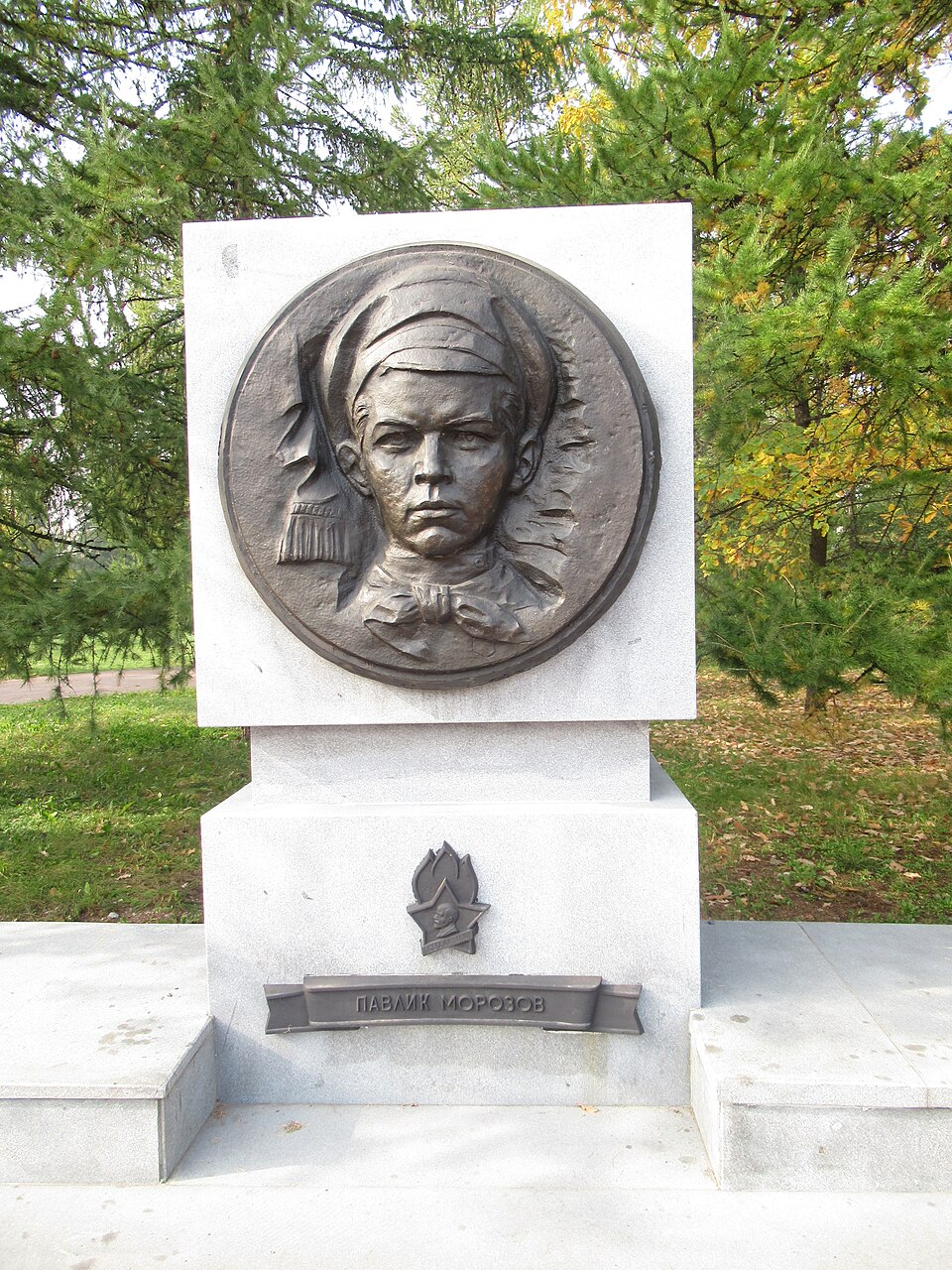
One of the smaller memorials that followed the main wave of statues: a relief plaque to Pavlik Morozov in the "Hero-Pioneers" urban square, Chelyabinsk, photographed in 2020. The Pioneer flame-and-star emblem beside his name ties the local marker directly to the Young Pioneer movement's own iconography (see The All-Union Pioneer Organization: scouting rebuilt as a communist pipeline, 1922-1991). Photograph by Lumaca, 1 October 2020. CC BY-SA 4.0, via Wikimedia Commons.
The record disputed, 1988-present
- 1988 (Russian samizdat, then published in London); 1996 (English translation). Yuri Druzhnikov, a Soviet writer expelled from the Writers' Union for his independent research, publishes Informer 001: The Myth of Pavlik Morozov, based on interviews with surviving villagers and Pavlik's own schoolteacher, and on archival documents gathered over more than a decade. Druzhnikov argues that most of the official story cannot be verified and was likely invented or exaggerated by Soviet propagandists after the fact; that Pavlik was probably not even a Young Pioneer at the time of his death; that his father's actual offence, if any, is unclear; and that the murder more plausibly grew out of an ordinary family conflict — Trofim's desertion of Tatiana, and the family's resulting poverty — than out of ideological revenge. Druzhnikov also documents that published photographs, ages and biographical details of "Pavlik" varied so much across Soviet encyclopedias, schoolbooks and postage stamps that some show different boys entirely, and that Pavlik's own former schoolteacher, Elena Pozdnina, kept what may be the only authentic photograph of him, from a class picture taken by a travelling photographer in 1930.
- 2005. Catriona Kelly's Comrade Pavlik: The Rise and Fall of a Soviet Boy Hero (Granta), the fullest scholarly study, agrees that the official version is "almost wholly fictional" but is explicitly sceptical of Druzhnikov's own counter-story too, arguing that it assumes the truth must be the opposite of the official myth and, on close reading of court and archival documents, is itself under-evidenced on some points (notably Druzhnikov's claim of direct OGPU involvement in staging the murder). In Kelly's account, once the propaganda is stripped away, "practically all certainties evaporate": Pavlik existed and was very likely murdered in the forest that September, but who killed him, and why, is not established by the surviving record.
- 1999. Relatives of the convicted, with the human-rights group Memorial, seek judicial review of the 1932 convictions. Russia's Prosecutor General's Office and courts decline to rehabilitate the four who were shot, finding the original convictions sound; the FSB (the KGB's successor) does not release the full case file.
- Around 1991. The Moscow statue disappears from its park during the wider removal and storage of Soviet-era monuments after the Union's collapse. Other statues to Pavlik — including ones in Kaliningrad, Chelyabinsk and Ukhta — remain standing into the 2010s and 2020s, but as local curiosities rather than a state-promoted model; none of the sources used here describes a coordinated national programme to remove them.
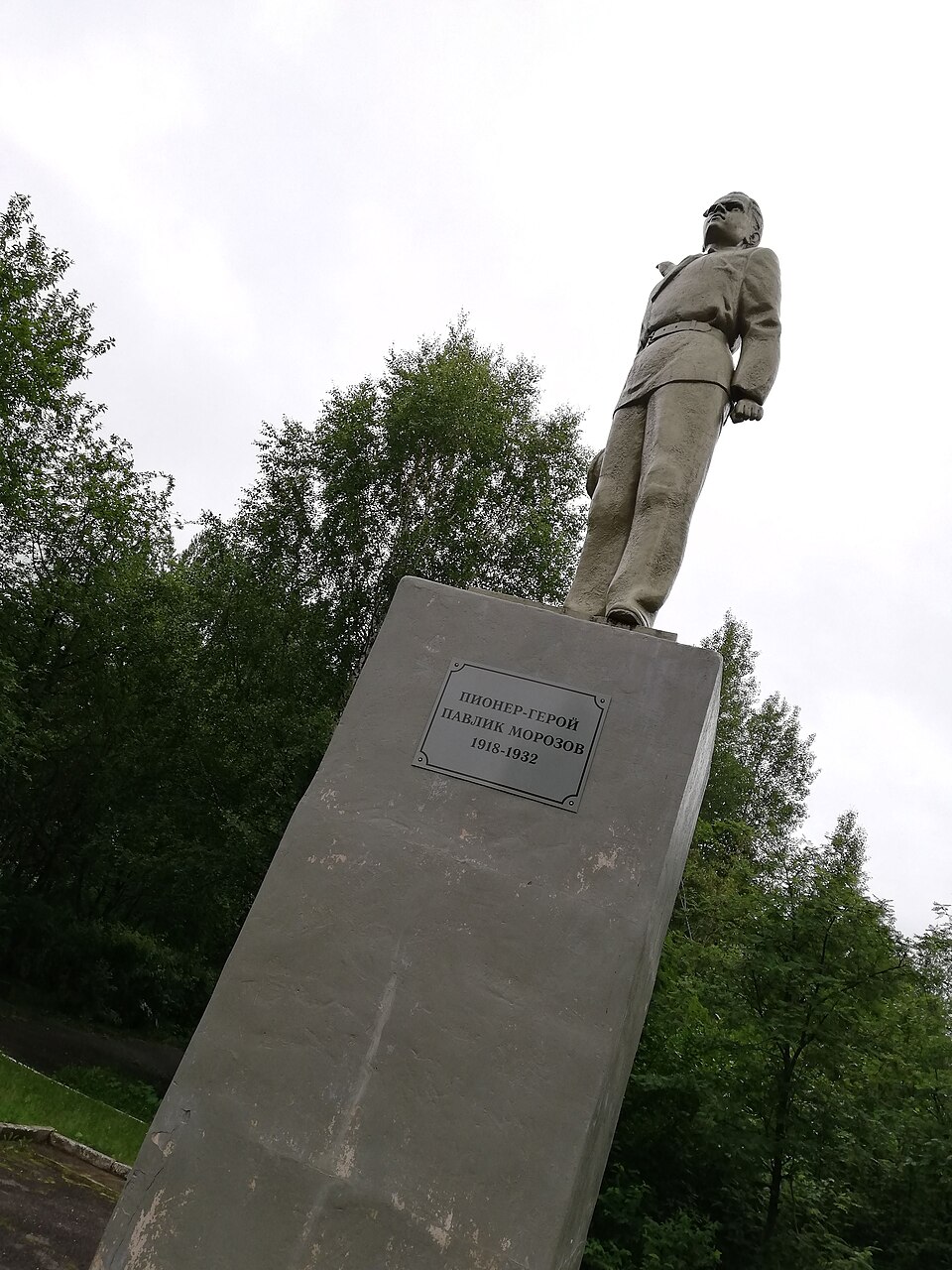
A surviving full-length statue to Pavlik Morozov in the Children's Park, Ukhta, Komi Republic, photographed in 2019 — still standing, but as a local memorial rather than a nationally promoted model, decades after the school curriculum built around him lapsed. The plinth gives his dates as 1918-1932, the dates this page follows while noting that even the birth year is one of the details later research found inconsistent. Photograph by Zverev Denis Pavlovich, 19 July 2019. CC BY-SA 4.0, via Wikimedia Commons.
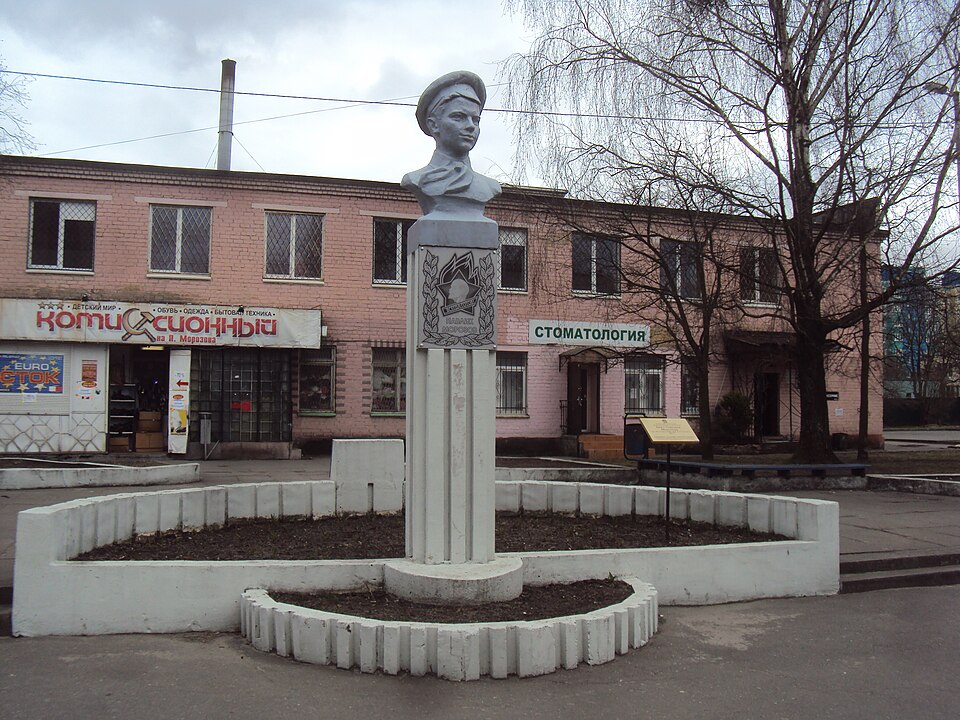
A bust of Pavlik Morozov at the corner of Kievskaya and P. Morozov streets, Kaliningrad — a street still carrying his name, photographed in 2016. Photograph by Kemal Kozbaev. CC BY-SA 4.0, via Wikimedia Commons.
How it works
- Testimonial: the cult presents Pavlik's supposed act as a real child's own choice, offered to other children as proof that a boy just like them could and did put the state above his family. Each of the six official biographies added corroborating, eyewitness-style detail — new quotations, new scenes — that had no basis in the trial record Druzhnikov and Kelly later examined.
- Glittering generalities: the vocabulary attached to Pavlik — "hero," "Pioneer-hero" (the words cast onto the Ukhta monument's plaque), "loyal son of the Soviet fatherland" — carries the conclusion the story wants without needing evidence for the underlying facts, which is why the accusation against Trofim could shift from forgery to grain-hoarding across retellings without anyone treating that as a problem: the specific charge mattered less than the label of loyalty it let the state attach to the son.
- Manufactured consensus: the appearance of admiration was engineered from the top, fast. A national wave of telegrams demanding execution reached the December 1932 trial before any of the substantive dispute over what happened was resolved; two years later Gorky's single speech at a writers' congress converted into six biographies, an opera and a state-commissioned film within a short span, presenting universal reverence as already settled rather than something that grew organically.
- Identity fusion: the story's explicit moral lesson fuses a child's personal and family identity into the collective one — loyalty to the state is framed as a higher duty than loyalty to a father, and the murdered boy's own family is recast as the story's villains, on trial and shot for defending kinship over the state's claim on the child.
- Transfer: the cult borrows the visual and emotional grammar of martyrdom — statues on plinths, an engraved bust, a name given to parks and a Pioneer palace — to transfer the prestige of established Bolshevik and revolutionary hero-worship onto a 13-year-old whose actual role in his father's arrest was never independently established.
- Narrative laundering: a village murder whose cause was genuinely unclear, and remains unclear, was passed through official channels (the trial, Gorky's speech, six sequential "authoritative" biographies, the school curriculum) until each new, uncorroborated detail came out the other side as settled national history. The technique is visible precisely because the specifics did not stay fixed: a story built on solid evidence does not need six rewritten versions of itself.
Then and now
Journalists and rights groups covering Russia's crackdown on anti-war dissent after its February 2022 invasion of Ukraine have repeatedly invoked Pavlik Morozov by name for a related but not identical mechanism: schools and teachers reporting children, rather than children reporting parents, for insufficiently loyal views, which then exposes the whole family to state pressure.
- 1 March 2023, Yefremov. Twelve-year-old Masha Moskalyova had drawn an anti-war picture at school in April 2022; the school reported her father, Aleksei Moskalyov, to the police. He was prosecuted for "discrediting the army," placed under house arrest, fled and was recaptured, and was sentenced to two years; Masha was placed in a state children's home during the case, an episode widely covered in Russian and Western media.
- 5 October 2022, Moscow. Ten-year-old Varvara Galkina was questioned by police over a pro-Ukraine anime image used as her WhatsApp profile picture.
- 2022 onward. Rights monitors including OVD-Info and Amnesty International record dozens of administrative and criminal cases against teachers for anti-war statements in class, and describe official encouragement of a "self-cleansing of society" in which lists of alleged "traitors" circulate online.
The parallel is limited and the differences matter. Pavlik's story has the child informing on a parent to the political police; the 2022-2025 cases mostly have a school or teacher informing on a child (and, through the child, the parent) to the police, with the state, not a family member, initiating the report. The later cases are documented in real time by named journalists, rights organisations and court records, not built retrospectively into a decades-long curriculum; and no equivalent statue-and-schoolbook cult has yet been built around any of them. What the two share is the underlying structure Pavlik's cult modelled first: a state apparatus that treats a child's report on family disloyalty, in whichever direction it runs, as a civic virtue.
Positions on the record
- The Soviet state's own account, 1932-1991. Official Soviet publications, from the 1932 trial coverage through six sequential biographies, presented Pavlik as a genuine martyr: a boy who chose Soviet law over a father guilty of sabotaging collectivization, and who was murdered by his own family in revenge. This account was never published with primary sources attached, and its specific details (the charge against Trofim, who Pavlik told, Pavlik's exact age) changed between versions without acknowledgment.
- Yuri Druzhnikov's account, 1988/1996. Druzhnikov, drawing on interviews with surviving witnesses and archival material gathered from the 1970s through the glasnost period, concluded that the denunciation story was very likely fabricated or heavily embellished after the fact, that Pavlik was probably not a Young Pioneer, and that the murder more plausibly stemmed from an ordinary family dispute than from political revenge.
- Catriona Kelly's account, 2005, and this archive's reading. Kelly's Comrade Pavlik agrees the official myth is "almost wholly fictional" but treats Druzhnikov's counter-narrative as its own act of myth-making, built on the assumption that the truth had to be the official story's opposite; she finds no solid evidence, for instance, for his claim that the OGPU staged the murder, while allowing that OGPU officials covered up or shaded some minor facts. Her own conclusion, endorsed here, is that beyond Pavlik's existence and his death in the forest that September, most of the specifics — who killed him, whether he denounced his father at all, and if so to whom and over what — are not established by the surviving documentary record. What is solidly documented, and is this page's actual subject, is the cult's construction: the trial's timing and outcome, Gorky's 1934 call, the biographies, the film, the statues and the curriculum are all independently attested by contemporary Soviet publications, archival records and, for the post-Soviet period, court filings and monument photographs. This page treats the denunciation-and-revenge story as a contested and probably partly invented propaganda narrative, not as settled fact, while treating the building of the cult around that narrative as solidly documented history in its own right.
Same-method test
Building a youth martyr-cult around a violent death, before the facts are settled, to model loyalty to a cause over family or community, recurs elsewhere. Scored by the same definitions:
- Nazi Germany, 1932-1945: Herbert Norkus. On 24 January 1932, 15-year-old Hitler Youth member Herbert Norkus was stabbed to death by Communist youths in Berlin's Beusselkiez while distributing leaflets for a Nazi rally. Within the year, Karl Aloys Schenzinger's novel Der Hitlerjunge Quex (written May-September 1932) fictionalised his death as a martyrdom for the movement; a 1933 film adaptation followed, and Norkus became a standard Hitler Youth reference point for self-sacrifice. Scale and method closely match the Soviet case: a real, violent death of a teenager, converted within roughly a year into mandatory youth-organisation martyrology via a commissioned novel and film, though the Norkus story centres on sacrifice for the movement in a street conflict rather than on betraying family.
- Maoist China: Lei Feng and other youth models. The Chinese Communist Party's own tradition of constructed youth-loyalty exemplars, including the soldier Lei Feng, is covered on The PLA's Political Commissar System: Dual Command, the General Political Department and PLA Daily rather than repeated here; the same core method — an obscure, disputed life turned into compulsory reading through top-down endorsement — recurs there.
The Soviet case differs from Norkus's in degree, not in kind: a state hero-cult raised within two years of a genuinely disputed death, taught nationwide for six decades, and revisited by serious historians only after the state that built it had fallen.
How to spot it
- A child or young person's violent death is turned into mandatory or near-mandatory reading within a year or two, before any independent inquiry into what happened has had time to run its course.
- The endorsement comes from the top down — a single prominent figure's speech, a party congress, a state commission — rather than growing from a local memorial or a family's own wish to be remembered.
- The specific facts of the story (the charge, the age, the exact words, even the photograph) shift between retellings without anyone acknowledging the change, because the moral lesson, not the record, is what is being protected.
- The story asks the audience to value loyalty to an institution over loyalty to family or community, and recasts anyone who defends the family side as the villain.
- Decades later, independent historians who go back to the primary sources find the specifics thin, inconsistent or simply absent, even where the underlying event (a death, a trial) is real.
Images
| Image | Source | Licence |
|---|---|---|
| Mechanism diagram (above) | Drawn for FRAME from the page's sourced facts (make_diagrams.py) |
CC BY 4.0, FRAME |
| Portrait of Pavlik Morozov, as reproduced from 1932 | Wikimedia Commons | Public domain (Commons licence tags: PD-Russia and PD-1996, author unknown) |
| Bust of Pavlik Morozov, corner of Kievskaya and P. Morozov streets, Kaliningrad (photographed 2016) | Wikimedia Commons | CC BY-SA 4.0, Kemal Kozbaev |
| Relief plaque, Hero-Pioneers urban square, Chelyabinsk (photographed 2020) | Wikimedia Commons | CC BY-SA 4.0, Lumaca |
| Full-length statue, Children's Park, Ukhta, Komi Republic, plaque reading "Pioneer-Hero Pavlik Morozov, 1918-1932" (photographed 2019) | Wikimedia Commons | CC BY-SA 4.0, Zverev Denis Pavlovich |


.jpg)

Image gaps
- The Moscow statue (1948, removed around 1991). No openly licensed photograph of it, before or after removal, was found.
- The Gerasimovka (1954) and Sverdlovsk (1957) monuments as originally built. Commons holds no clearly openly licensed period photograph; only later general-purpose photographs of the surviving Gerasimovka memorial complex were found, and their licensing could not be confirmed in this pass.
- The 1932 trial itself. No openly licensed photograph of the Sverdlovsk courtroom or the defendants was found.
- Elena Pozdnina's 1930 class photograph, which Druzhnikov argues may be the only authentic image of Pavlik. Reproduced in Druzhnikov's book and in some Russian press coverage; no openly licensed copy was found.
- Frames from Eisenstein's Bezhin Meadow (1937, reconstructed 1967). Held by Mosfilm/Gosfilmofond; not openly licensed.
- A photograph of the Masha Moskalyova case (2022-2023) for the Then-and-now section. Press photographs of Aleksei Moskalyov and his daughter are copyrighted news agency material; none openly licensed was found, so the section is not illustrated.
Sources
- Yuri Druzhnikov, Informer 001: The Myth of Pavlik Morozov (Transaction Publishers, 1996; first published in Russian, London, 1988).
- Catriona Kelly, Comrade Pavlik: The Rise and Fall of a Soviet Boy Hero (Granta Books, 2005).
- Sheila Fitzpatrick, "A Little Swine: On Snitching", London Review of Books, vol. 27 no. 21, 3 November 2005 (review of Kelly).
- Britannica, "Pavlik Morozov: Soviet martyr, child hero".
- "1933: The 'killers' of Pavlik Morozov", Executed Today, 7 April 2013 (trial and execution detail).
- First All-Union Congress of Soviet Writers, Moscow, 17 August-1 September 1934 (Gorky's address and the Congress's resolutions).
- Karl Aloys Schenzinger, Der Hitlerjunge Quex (1932); Hitlerjunge Quex (dir. Hans Steinhoff, 1933), for the Herbert Norkus comparison.
- Naum Kleiman and Sergei Yutkevich's 1967 reconstruction of Sergei Eisenstein's Bezhin Meadow (1937), and its production and suppression history as documented by the Eisenstein Museum/Gosfilmofond.
- Reporting on Russian schools and anti-war dissent, 2022-2025: The Moscow Times, "Russian Schoolchildren, Teachers Arrested Amid Crackdown on Anti-War Dissent" (11 April 2022) and "In Russian Schools, Teachers and Parents Pressured to Back War" (7 June 2022); Amnesty International, "Russia: Authorities targeting children in their crusade against anti-war dissent" (May 2024); Wikipedia, "Masha Moskalyova case", for the case's basic timeline, cross-checked against contemporary news reporting.
- Wikimedia Commons file pages cited in the Images table above, for provenance, licence tags, authorship and dates of the photographs used.