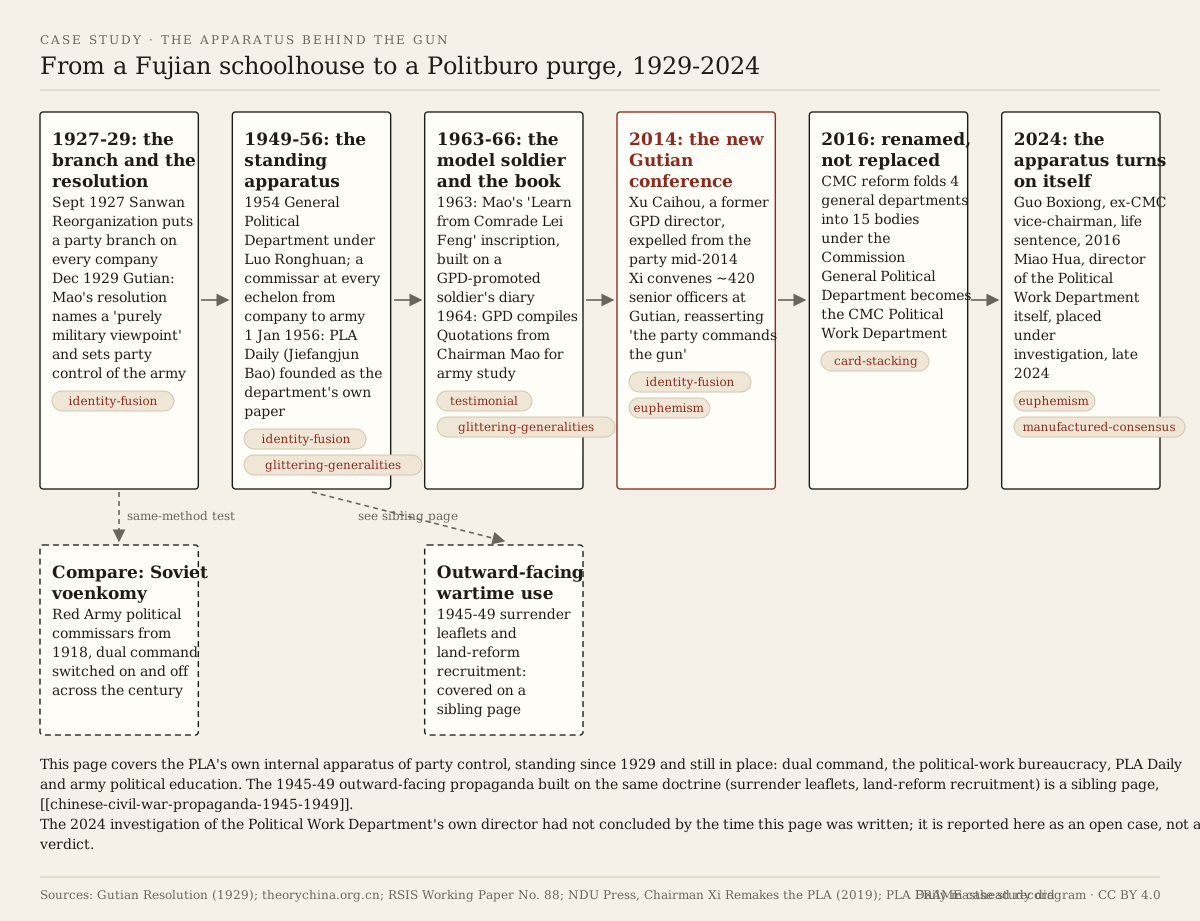
In one line: since the Chinese Red Army's Gutian Congress of December 1929 resolved that "the party commands the gun," every People's Liberation Army unit from company to theatre command has carried a party political officer alongside its military commander, a standing bureaucracy now called the Central Military Commission's Political Work Department has run army-wide political education and the PLA's own newspaper since 1956, and the system has twice, in 2014 and again in 2024, been used to discipline its own most senior officers, including the political department's own director.
What happened
Origins: the party branch and the Gutian Resolution, 1927-1929
- September 1927: the Sanwan Reorganization. After the failed Autumn Harvest Uprising, Mao Zedong reorganised his remaining forces at Sanwan, Jiangxi, establishing party branches at the company level and party representatives at each level of command — the origin of the principle later summarised as "the party branch is built on the company" (支部建在连上). This is the institutional root the sibling page Divide the land, label the enemy: propaganda and discipline in the Jiangxi Soviet (1927-1934) covers for the Jiangxi Soviet period generally; this page follows the political-officer institution specifically, through to the present day.
- 28-29 December 1929: the Gutian Congress. The Ninth Party Congress of the Fourth Red Army met at Gutian, in Shanghang County, western Fujian. Mao's resolution, "On Correcting Mistaken Ideas in the Party" (later known as the Gutian Resolution), criticised what it called a "purely military viewpoint" inside the Red Army — the idea that military tasks could be separated from, or take precedence over, the party's political line — along with ultra-democracy, absolute egalitarianism and other errors. It set out that the Red Army was not merely a fighting force but an instrument for carrying out the party's political tasks, and it fixed the principle, since repeated in every PLA political-work regulation, that the party must command the gun and the gun must never be allowed to command the party. The resolution is the doctrinal founding document of the political-commissar and political-department system that this page tracks forward to 2026.
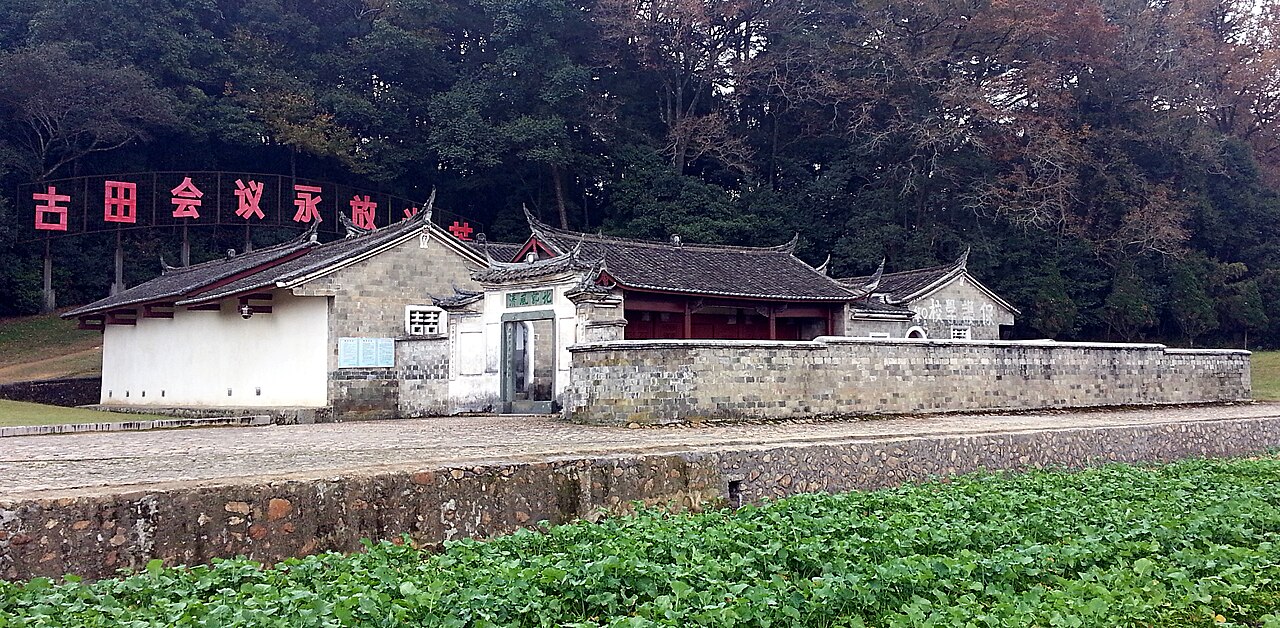
The compound at Gutian, Shanghang County, Fujian, where the Fourth Red Army's Ninth Party Congress met in December 1929, with a banner of red characters naming the Gutian Conference above the roofline. Photograph by Rolfmueller, 24 December 2012. CC BY-SA 3.0, via Wikimedia Commons.

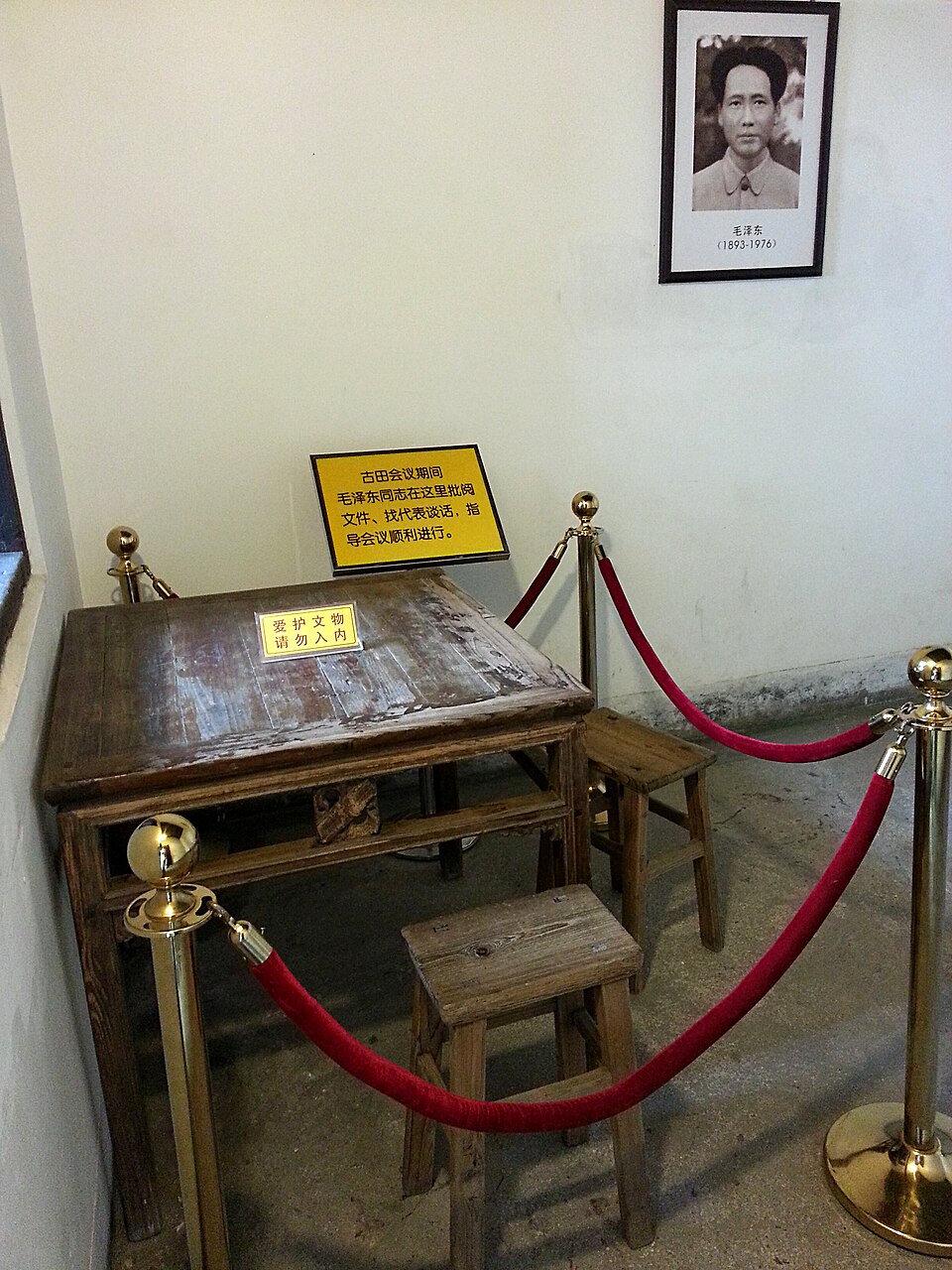
A wooden table and two stools preserved at the Gutian Congress site, behind a rope barrier. A yellow placard states that Mao Zedong reviewed documents, spoke with delegates and directed the proceedings of the Gutian Conference here; a framed portrait of Mao (1893-1976) hangs on the wall. Photograph by Rolfmueller, 24 December 2012. CC BY-SA 3.0, via Wikimedia Commons.

Building the standing apparatus, 1949-1956
- 1954: the General Political Department. With the PLA reorganised as the armed forces of a functioning state and the 1954 constitution and Ministry of National Defense in place, the General Political Department (GPD, 总政治部) was formally established as one of the PLA's top-level departments, tracing its lineage through the Red Army's wartime political organs back to Gutian. Marshal Luo Ronghuan served as its director from 1954 to 1956 and again from 1961 to 1963; a photograph of his appointment notice, naming him to the post over the signature of the party and state leadership, is held at the Military Museum of the Chinese People's Revolution in Beijing.
- Dual command at every echelon. Below the GPD, political officers ran in parallel with military commanders at every level: a political instructor (政治指导员) at company level, a political education officer (教导员) at battalion level, and a political commissar (政治委员, zhengwei) at regiment level and above. Political officers chaired the party committee at their level, with the military commander typically serving as the committee's deputy secretary; commander and commissar were formally described as jointly responsible for their unit's work under the collective leadership of that committee. Analysts differ on how much real operational authority this gave commissars relative to commanders in practice, a dispute discussed under Positions on the record below.
- 1 January 1956: PLA Daily founded. Jiefangjun Bao (解放军报, PLA Daily) began publication as the newspaper of the Central Military Commission, run through the General Political Department's propaganda organs (from 2016, the CMC Political Work Department). It carries military-affairs reporting, political education material and the party's line on defence policy to the PLA's own ranks, and its editorials and commentary pieces are read by outside analysts as one of the few open windows onto the leadership's thinking on military matters. It remains the PLA's central paper seven decades later.
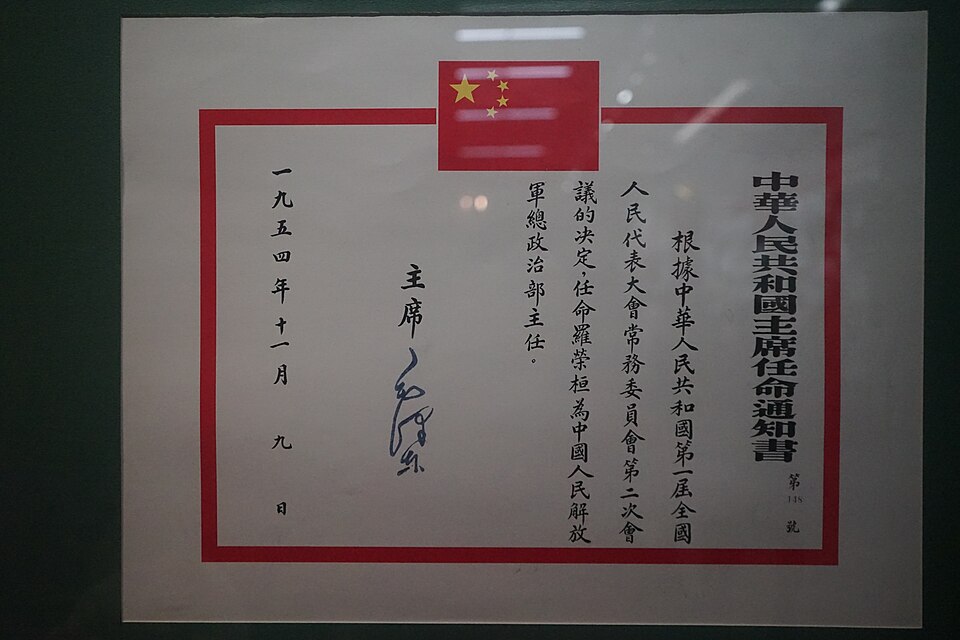
Appointment notice No. 148 of the Chairman of the People's Republic of China, dated 9 November 1954 and signed by the Chairman, naming Luo Ronghuan Director of the General Political Department of the People's Liberation Army, on display at the Military Museum of the Chinese People's Revolution, Beijing. Photograph by Huanokinhejo, 17 August 2017. CC BY-SA 4.0, via Wikimedia Commons.

The apparatus at work: model soldiers and the study text, 1963-1966
- 1963: the Lei Feng campaign. Lei Feng, a PLA truck-unit soldier, died in a road accident on 15 August 1962. His diary, entries in which record devotion to Mao and to selfless service, was promoted through military and party channels; on 5 March 1963 Mao's inscription "向雷锋同志学习" ("Learn from Comrade Lei Feng") was published in the party and PLA press, launching a nationwide model-soldier campaign that the PLA's political-work system helped organise and that continues to be marked annually in China on 5 March.
- 1964: Quotations from Chairman Mao. The General Political Department compiled a pocket book of Mao's sayings for army political study, first issued in 1964. Its later role as the "Little Red Book" of the mass Cultural Revolution, after Lin Biao's December 1966 foreword and its printing in the billions of copies, is covered in full on the sibling page Big-character posters: how the opening labels of China's Cultural Revolution did the work of charges (1966-68); this page notes only that the book began as the GPD's own internal political-education text, evidence of the department's routine peacetime function of producing standard study material for the whole army.
- Spring 1966: PLA Daily and the opening of the Cultural Revolution. With Lin Biao as defence minister exercising strong influence over the political-work system, PLA Daily ran editorials calling on readers to hold high the banner of Mao Zedong Thought weeks ahead of the People's Daily's own 1 June 1966 editorial marking the movement's public start (MacFarquhar and Schoenhals, Mao's Last Revolution, 2006). The episode shows the same institution that runs routine political education also serving, when its controlling officer chose to use it that way, as an early engine of a mass campaign the wider party leadership had not yet endorsed in public.
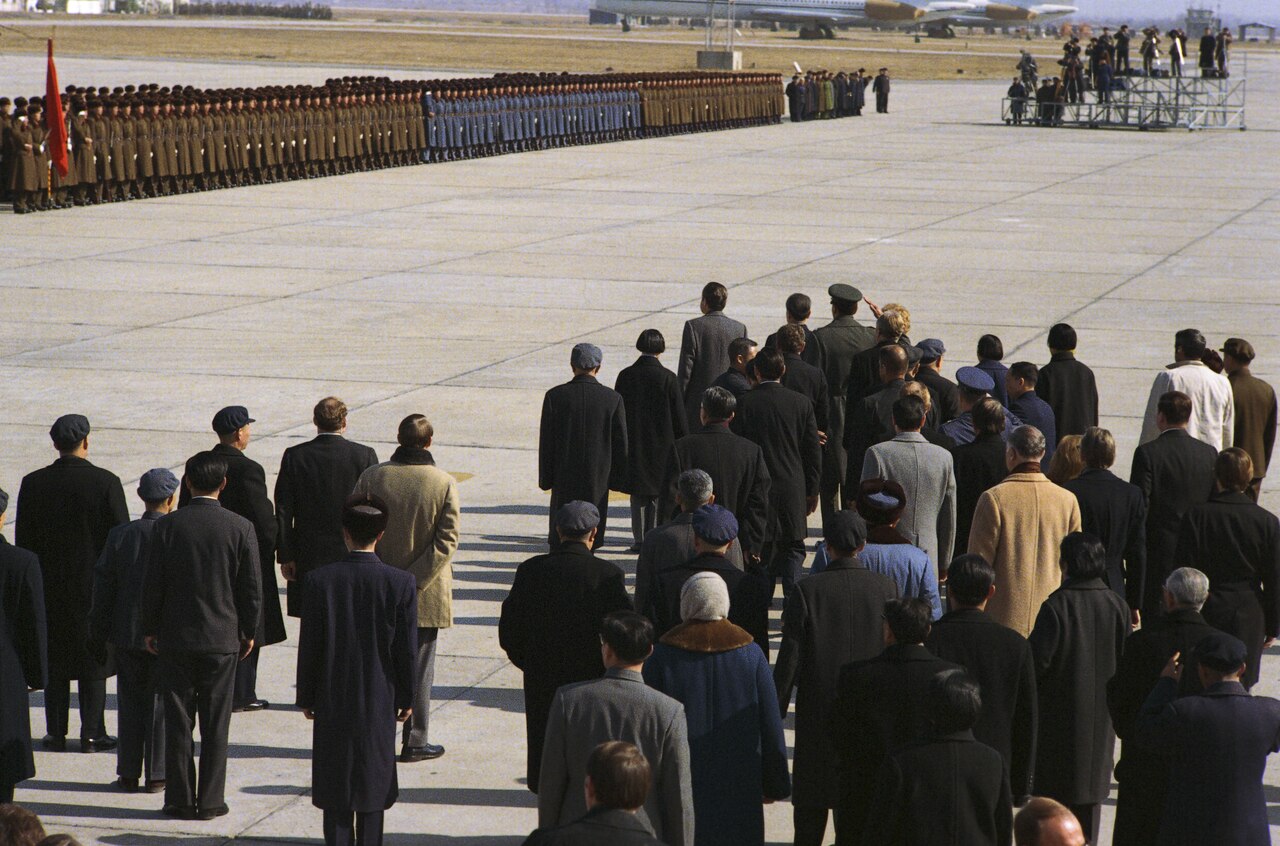
Ranks of Chinese service personnel drawn up as an honor guard at Capital Airport, Peking, with officials and other members of the reception party in the foreground, during the arrival ceremony for President Richard Nixon, 21 February 1972. Photograph by the White House Photo Office, National Archives (U.S. government work, public domain), via Wikimedia Commons.
Reorganisation and self-discipline, 2014-2026
- 2014: Xu Caihou's fall and the "new Gutian" conference. Xu Caihou, a former director of the General Political Department who went on to serve as a Central Military Commission vice-chairman, was investigated for corruption and expelled from the Chinese Communist Party in mid-2014; he died in March 2015 before any trial concluded. That October and November, Xi Jinping convened an All-Army Political Work Conference at Gutian itself, attended by roughly 420 senior officers, explicitly invoking the 1929 meeting 85 years on. Xi's own address reasserted "the party commands the gun" as the non-negotiable foundation of the armed forces and framed the political-work system's own failures, exemplified by Xu Caihou, as a reason to strengthen rather than loosen party control over it (Mulvenon, "Hotel Gutian: We Haven't Had That Spirit Here Since 1929," China Leadership Monitor, 2015).
- 2016: Guo Boxiong sentenced. Guo Boxiong, who served as a CMC vice-chairman alongside Xu Caihou, was convicted by a military court of taking bribes and, in July 2016, sentenced to life imprisonment, stripped of his military rank and had his personal assets confiscated.
- 31 December 2015 - 11 January 2016: the CMC reorganisation. As part of a wider restructuring of the PLA's top command, the Central Military Commission dissolved the PLA's four general departments — General Staff, General Political, General Logistics and General Armament — and replaced them with fifteen functional bodies reporting directly to the Commission. The General Political Department was renamed the CMC Political Work Department (中央军委政治工作部); it kept the department's core functions — political education, personnel and appointments, propaganda including PLA Daily, discipline and liaison work — under a new name and a flatter reporting line to Xi Jinping as CMC chairman.
- Late 2024: Miao Hua investigated. Admiral Miao Hua, director of the CMC Political Work Department and a member of the Central Military Commission itself, was announced by China's Ministry of National Defense to be under investigation for "serious violations of discipline" — the standard party phrase for a corruption inquiry — becoming, a decade after Xu Caihou and eight years after the department's renaming, the second consecutive senior officer to have run the PLA's political-control apparatus removed from it under investigation. As with the Xu Caihou case above, this page records the announced investigation, not a verdict; no public trial record had concluded by the time this page was written.
How it works
- Identity fusion: the Gutian Resolution's charge that a "purely military viewpoint" separated soldiering from politics fused the two permanently: a PLA officer's professional standing has, since 1929, been formally inseparable from a parallel judgement of political reliability, made by a commissar who sits on the same committee and can report upward independently of the chain of command the commissar shares.
- Glittering generalities: "the party commands the gun" and the standing PLA slogan "political work is the lifeline of the army" (政治工作是我军的生命线) are repeated in doctrine, regulation and Xi's own 2014 Gutian address without being cashed out into a specific, checkable claim; the phrase can license almost any exercise of the political apparatus's authority, from routine study sessions to a purge, under the same banner.
- Testimonial: Lei Feng's diary and the campaign built on it presented one soldier's promoted, GPD-endorsed devotion as proof that the whole army felt the same way; the format recurs in later PLA "model soldier" campaigns that this page does not itemise individually.
- Card stacking: PLA Daily's seven decades of coverage have consistently reported the army's political education, training and equipment in a positive register while omitting internal corruption and factional problems until the party leadership itself chose to disclose them, as with Xu Caihou, Guo Boxiong and Miao Hua — each surfaced only once a CMC-level decision to move against them had already been made, not as ordinary investigative reporting.
- Manufactured consensus: army-wide political study campaigns — the 1964 Quotations, the annual Lei Feng anniversary, and today's mandatory study of Xi Jinping Thought on Socialism with Chinese Characteristics for a New Era, including through party-run study apps used across the PLA as well as civilian life — are organised top-down through the same political-department chain at every unit simultaneously, producing an appearance of organic, unanimous belief across a conscript and volunteer force of roughly two million.
- Euphemism / doublespeak: "serious violations of discipline" (严重违纪违法), the fixed phrase used to announce the Miao Hua investigation and others like it, discloses that a senior officer has fallen without disclosing what he is accused of having done; the same apparatus that produces this phrase is also the one under investigation when it is used against one of its own.
Colour. The system is white: the party branch, the political commissar, the General Political Department/CMC Political Work Department and PLA Daily all speak and publish as themselves, under their own name and institutional seal, and the doctrine behind them (the Gutian Resolution, the political-work regulations) is published, not concealed. What is not disclosed is not the institution's existence but the content of specific internal decisions — investigations, appointments, factional disputes — which the institution controls the timing and framing of when it does disclose them.
Then and now
The system this page describes continues today under two names, and its leadership has described it as continuous: in 2014 Xi Jinping held the Gutian conference at the 1929 site and told roughly 420 senior officers that the resolution adopted there 85 years earlier remained the army's foundation. The Gutian compound still stands and is preserved as a heritage site, and Luo Ronghuan's 1954 appointment as the reorganised department's first director is preserved as a museum artefact in Beijing; both are pictured on this page and listed in the Images table below.
The clearest evidence that the apparatus still functions, rather than merely still exists on paper, is that it continues to be used against the people who run it. Xu Caihou, who had headed the General Political Department itself before rising to the Commission's vice-chairmanship, was purged in 2014; a decade later, in late 2024, Miao Hua, director of the department's 2016 successor body, was placed under investigation in turn. Both men held the specific job — the one this page is about — of running the PLA's political-loyalty machinery, and both were removed from it by that same machinery, or by the party leadership standing above it. Whether this shows the system working as intended (party control reaching even its own senior political officers) or shows the system's persistent vulnerability to exactly the personal loyalty networks it exists to prevent is a live and unresolved question among the analysts cited below, not a question this archive resolves.
Positions on the record
- The party's and the PLA's own rationale. From the Gutian Resolution onward, the system has been presented as necessary to keep a mass army of peasant and, later, conscript and volunteer soldiers disciplined, loyal to the party's political line rather than to any individual commander, and safe from the "warlordism" the CCP's own founding generation associated with Republican-era Chinese militaries. Xi Jinping's 2014 Gutian address, and the CMC's own account of the 2015-16 reform, present continued and strengthened political work, including its use against senior officers, as evidence the system is working rather than failing.
- Analysts' reading. Comparative and military-studies scholarship (Jamestown Foundation; the RAND-adjacent RSIS Working Paper series on China's political commissars and commanders; James Mulvenon's China Leadership Monitor essays; the National Defense University Press volume Chairman Xi Remakes the PLA, 2019) generally agrees on the institutional facts set out above, and divides chiefly over two questions: how much genuine operational veto power a commissar holds over an equal-ranking commander in a real crisis, a scenario the PLA has not faced in large-scale combat since 1979; and whether the corruption purges of 2014-2024 mainly demonstrate the party's capacity to discipline its own military elite, or mainly demonstrate that the political-loyalty apparatus itself had become a vehicle for patronage and factional consolidation under Xu Caihou and Guo Boxiong specifically, an interpretation some of this literature favours.
- What is documented. The Sanwan and Gutian dates and texts; the 1954 GPD establishment and Luo Ronghuan's directorship; the 1956 founding of PLA Daily; the Lei Feng and Quotations from Chairman Mao episodes and their institutional origin in the political-work system (the mass Cultural Revolution use of the Quotations is separately documented on the cited sibling page); the 2014 Gutian conference and its stated scale; the Xu Caihou and Guo Boxiong cases and their outcomes; the 2015-16 CMC reorganisation and the department's renaming; the announced Miao Hua investigation.
- What is contested or unresolved. The precise operational balance of authority between a commander and a commissar of equal formal rank; how far political education measurably shapes soldiers' behaviour or loyalty as opposed to producing compliant reporting of it; the outcome and full basis of the Miao Hua case, unresolved at the time of writing.
- Not ruled on here. Whether the political-commissar system makes the PLA more or less combat-effective than a professional military without a parallel political command structure — a genuinely contested question in the cited literature — and whether any individual purge reflects a real anti-corruption finding, an internal factional struggle, or both. This page scores how the apparatus is built and used, not whether its verdicts on its own officers are correct.
Same-method test
- The Soviet Red Army's political commissars (voenkomy), 1918-1942. From 1918 the Bolshevik Red Army placed a political commissar beside every commander, initially to watch over former Tsarist officers ("military specialists") the new regime needed but did not fully trust; the commissar's countersignature was required on orders. Unlike the PLA's system, which was built into a party-founded army from the start, the Soviet dual-command structure was switched on and off according to the leadership's confidence in its officer corps: it was abolished for unified command (edinonachaliye) in 1925 as officers proved themselves, reinstated in 1937 amid the purge of the officer corps that followed Marshal Tukhachevsky's execution, abolished again in 1940, reinstated after the German invasion in 1941, and abolished a final time in October 1942, when commissars became deputy commanders for political affairs (zampolit) without a command veto, as the wartime leadership judged unified command more urgent than political surveillance. Wartime political control ran through the Red Army's Main Political Administration, summarised for its Second World War role in the sibling page Soviet wartime propaganda, 1939-1945: Sovinformburo, Agitprop and the Red Army press. The PLA's commissar system has never been suspended this way; it has been renamed and reorganised, but dual command as a principle has run continuously since 1929.
- The Wehrmacht's Propagandakompanien, 1938-1945. The Reich Ministry of Public Enlightenment and Propaganda, 1933-1945 describes the German army's wartime propaganda companies: uniformed soldiers who were writers, photographers and cameramen embedded in combat units and answerable to a Wehrmacht propaganda branch, feeding material to the Reich Ministry of Public Enlightenment and Propaganda and the press. The comparison sharpens what is distinctive about the PLA's institution: the Propagandakompanien produced propaganda about the army for an outside audience, but held no parallel command authority over it, and no permanent, doctrinally fixed presence at every unit down to company level reporting on the political reliability of that unit's own commander. The PLA's political officer does both of the things the German unit did not: he sits inside the chain of command with formal, continuous authority, not merely embedded reporting access.
- Where they differ. The Soviet system was a tool applied to a military the party did not originally build and intermittently distrusted; the PLA's was built into the army from its first years as a party-founded force, and its founding resolution treats political control not as a check on outsiders but as the army's basic purpose. The German case had no dual-command structure at all. All three states nonetheless converge on one same-method point: each built a standing institution, staffed by its own personnel and reporting through its own chain, to keep the army's messaging and, for the Soviet and Chinese cases, its command decisions aligned with the political leadership's current line.
How to spot it
- Ask whether a military spokesperson or officer answers only to the command chain, or also to a separate structure that outranks that chain on political questions; the second is a commissar system whether or not the word is used.
- When an official announcement uses a fixed, contentless phrase such as "serious violations of discipline" to explain why a senior official has fallen, note what it discloses (that someone fell) against what it withholds (what they are accused of doing).
- When a military press consistently reports positive news and is silent on a scandal until the leadership itself announces it, the silence is evidence of an editorial chain of command, not of an absence of problems.
- Watch for army-wide "spontaneous" study or model-soldier campaigns that appear simultaneously across every unit; check whether a single political-department directive, not organic sentiment, set the timing.
- A system built to police loyalty can itself become a target of the power it protects. When the officer running an anti-corruption or loyalty apparatus is later investigated by the same apparatus, ask who, if anyone, checks the checker.
Images
| Image | Source | Licence |
|---|---|---|
| Mechanism diagram (above) | Drawn for FRAME from this page's sourced facts (make_diagrams_apparatus_pla.py) |
CC BY 4.0, FRAME |
| Gutian Congress site, Fujian, 2012 | Wikimedia Commons, Rolfmueller | CC BY-SA 3.0 (photographer's own work) |
| Table, stools, placard and portrait at the Gutian site, 2012 | Wikimedia Commons, Rolfmueller | CC BY-SA 3.0 (photographer's own work) |
| Luo Ronghuan appointment notice, 1954 (photographed 2017) | Wikimedia Commons, Huanokinhejo | CC BY-SA 4.0 (photographer's own work; photograph of an official appointment document on museum display) |
| Chinese honor guard, Capital Airport, Peking, 1972 | Wikimedia Commons, White House Photo Office (U.S. federal government) | Public domain (U.S. government work, White House Photo Office; NARA rights statement "No Copyright - United States") |
Image gaps
- The 1964 first-edition cover of Quotations from Chairman Mao (General Political Department edition). A scan of the plain red cover is on Wikimedia Commons (File:Cover of Quotations From Chairman Mao (1964, 1st ed. red binding).jpg), tagged public domain in the United States only on a "simple text and shapes" rationale, with an unknown author and a rare-book dealer as source. That rationale was judged too thin for hosting under this project's licensing bar; the file is linked here, not hosted.
- PLA Daily front pages or masthead, any date. No openly licensed image was found on Wikimedia Commons; PLA Daily is a current PRC state publication and its pages carry an active copyright the archive has no license to reproduce. Not fillable under this project's sourcing rule without a specific CC-licensed or U.S.-government-held copy, which was not located.
- A photograph of a political commissar and commander together, or of a company-level political instructor conducting a study session. No image meeting this project's licensing bar was found. Contemporary PLA photography is Xinhua or PLA-copyrighted; period photographs from the 1950s-1980s located on Commons carry only a PD-China tag, which this archive treats as an unresolved U.S. copyright question under the URAA and does not host, following the same rule applied on Big-character posters: how the opening labels of China's Cultural Revolution did the work of charges (1966-68), The Mao cult before the state: 'Mao Zedong Thought' and 'The East Is Red', 1943-1949 and Propaganda of the Chinese Civil War, 1945-1949: land reform, surrender leaflets and the fall of the mainland (for example, a 1953 photograph of Luo Ronghuan with Xiao Jinguang and Xiao Hua exists on Commons tagged PD-China only, sourced to people.com.cn with no named photographer, and was excluded on that basis).
- Lei Feng, in uniform or from his diary. Widely reproduced in PRC media; no image with a clear, verifiable CC or U.S. public-domain license was located from Commons or loc.gov in the time available. Could be filled by a Library of Congress or NARA-held copy if one surfaces.
- Xu Caihou, Guo Boxiong or Miao Hua. As serving or former senior PLA officers, their photographs are Xinhua or PLA-copyrighted; none was found under an open license.
- A page of the Gutian Resolution or the Political Work Regulations themselves. Held in party and PLA archives; not located online under an open license.
.jpg)
Sources
- Mao Zedong, "On Correcting Mistaken Ideas in the Party" (the Gutian Resolution, December 1929), in Selected Works, vol. 1 (Foreign Languages Press); also cited via this archive's sibling page Divide the land, label the enemy: propaganda and discipline in the Jiangxi Soviet (1927-1934), which covers the Sanwan Reorganization and the Gutian Resolution's role in the Jiangxi Soviet period.
- Gutian Congress — Wikipedia; Political commissar — Wikipedia; People's Liberation Army Daily — Wikipedia; History of the People's Liberation Army — Wikipedia.
- "The fundamental principle of military political work established in the Gutian Conference has played a decisive role in the survival and development of our army," Party history platform (idcpc.gov.cn).
- TheoryChina, "Keywords in Party History: The Gutian Meeting" (en.theorychina.org.cn).
- James C. Mulvenon, "Hotel Gutian: We Haven't Had That Spirit Here Since 1929," China Leadership Monitor 46 (2015) (Hoover Institution).
- James C. Mulvenon, Statement before the U.S.-China Economic and Security Review Commission, on PLA political work and discipline.
- Phillip C. Saunders et al. (eds.), Chairman Xi Remakes the PLA: Assessing Chinese Military Reforms (National Defense University Press, 2019).
- RSIS Working Paper No. 88, China's Political Commissars and Commanders: Trends and Dynamics (S. Rajaratnam School of International Studies).
- The Jamestown Foundation, "China's Military Political Commissar System in Comparative Perspective".
- Roderick MacFarquhar and Michael Schoenhals, Mao's Last Revolution (Harvard University Press, 2006), on PLA Daily's spring 1966 editorials and the Quotations from Chairman Mao's origin in the General Political Department; also cited on the sibling page Big-character posters: how the opening labels of China's Cultural Revolution did the work of charges (1966-68).
- Alexander C. Cook (ed.), Mao's Little Red Book: A Global History (Cambridge University Press, 2014).
- This archive's sibling pages Propaganda of the Chinese Civil War, 1945-1949: land reform, surrender leaflets and the fall of the mainland (1945-49 outward-facing CCP and PLA wartime messaging, not repeated here), The Yan'an Rectification Movement: doctrine, self-criticism and the Rescue Campaign (1942-1945) and The Mao cult before the state: 'Mao Zedong Thought' and 'The East Is Red', 1943-1949 (the party's parallel internal-loyalty and personality-cult machinery of the same decades), and Soviet wartime propaganda, 1939-1945: Sovinformburo, Agitprop and the Red Army press (the Red Army's Main Political Administration, for the Soviet comparison above).