4 de Julio Independence Day poster (Spanish photo-sheet poster distributed in Latin America)
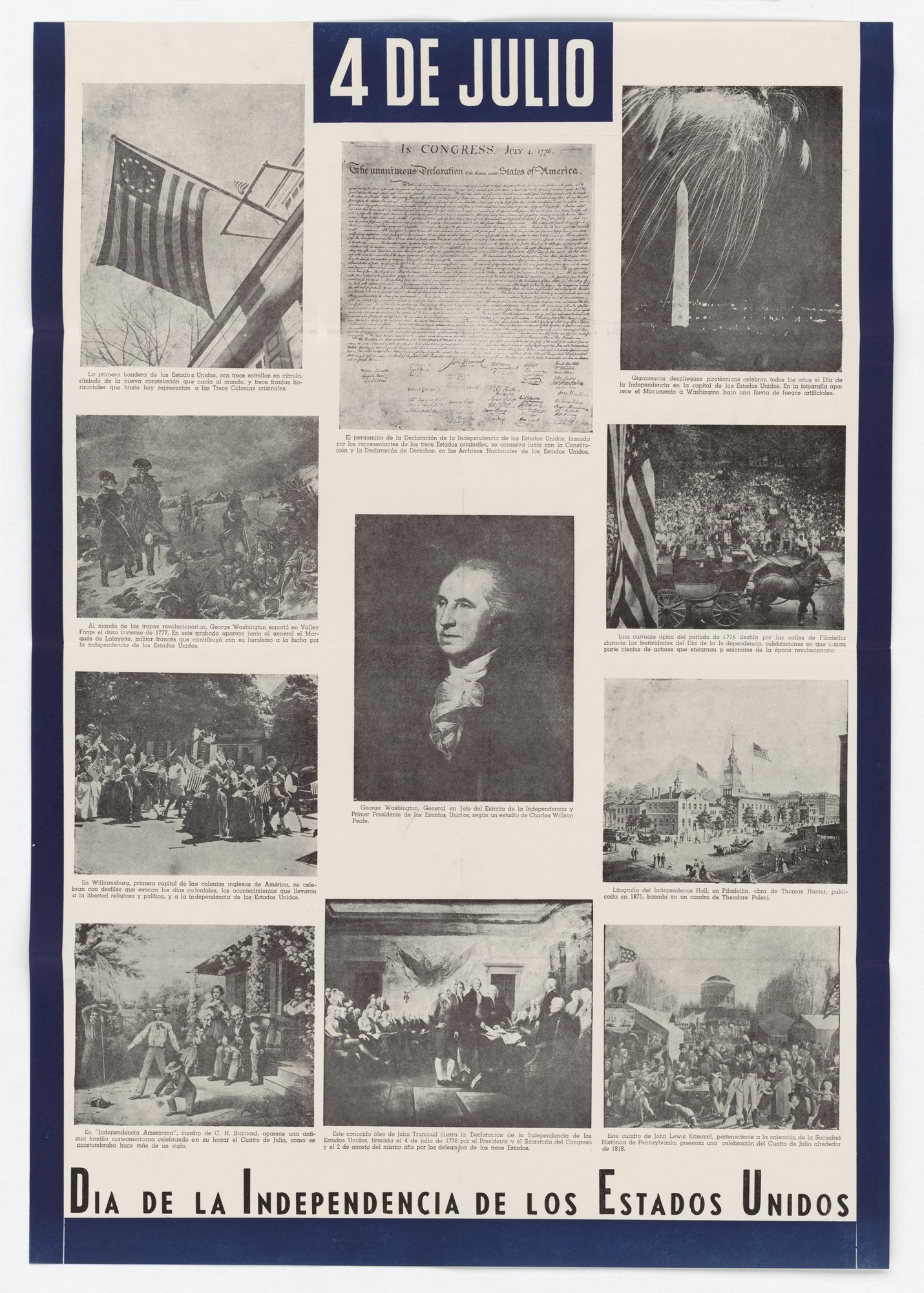
A Spanish-language photo sheet for United States Independence Day. Eleven captioned images surround the headline 4 DE JULIO: the first flag, the Declaration of Independence, Washington National Monument fireworks, Washington at Valley Forge, a Peale portrait of Washington, pageants in Philadelphia and Williamsburg, and paintings of the signing and of early Fourth of July scenes. The tell is transfer: founding-era symbols are attached to the holiday.
Propaganda techniques used in this poster
- Date
- 1958
- Period
- Cold War
- Made by
- U.S. Information Agency (predecessor: State Department International Information and Educational Exchange Program), Propaganda Posters Distributed in Asia, Latin America and the Middle East series
- Region
- North America
- Country
- United States
- Medium
- Poster
- Issuer type
- State
- Regime
- Eisenhower Administration
- Leader
- Dwight D. Eisenhower
- Audience
- Foreign public
- Purpose
- Commemorate
- Themes
- War and the military, Elections and party politics
- Event
- Cold War
- Source
- Unidentified Source blurred: contractors, cutouts, buried disclosure
- Source
- U.S. National Archives (NARA), RG 306, Posters Distributed in Asia, Latin America, Middle East, retrieved October 4, 2026
- Rights
- Public domain (U.S. government work; NARA RG 306)
U.S. Information Agency / Department of State, 1958. National Archives, Record Group 306 (NAID 6948893, 306-PPB-70).
Text on the object
4 DE JULIO

La primera bandera de los Estados Unidos, con trece estrellas en círculo, símbolo de la nueva constelación que nacía al mundo, y trece franjas horizontales que hasta hoy representan a las Trece Colonias originales.

El pergamino de la Declaración de la Independencia de los Estados Unidos, firmada por los representantes de los trece Estados originales, se conserva junto con la Constitución y la Declaración de Derechos, en los Archivos Nacionales de los Estados Unidos.

Gigantescos despliegues pirotécnicos celebran todos los años el Día de la Independencia en la capital de los Estados Unidos. En la fotografía aparece el Monumento a Washington bajo una lluvia de fuegos artificiales.

Al mando de las tropas revolucionarias, George Washington soportó en Valley Forge el duro invierno de 1777. En este grabado aparece junto al general el Marqués de Lafayette, militar francés que contribuyó con su heroísmo a la lucha por la independencia de los Estados Unidos.

George Washington, General en Jefe del Ejército de la Independencia y Primer Presidente de los Estados Unidos, según un estudio de Charles Willson Peale.

Una carruaje típico del período de 1776 desfila por las calles de Filadelfia durante las festividades del Día de la Independencia, celebraciones en que toman parte cientos de actores que encarnan personajes de la época revolucionaria.

En Williamsburg, primera capital de las colonias inglesas de América, se celebran con desfiles que evocan los días coloniales, los acontecimientos que llevaron a la libertad religiosa y política, y a la independencia de los Estados Unidos.

Litografía del Independence Hall, en Filadelfia, obra de Thomas Hunter, publicada en 1875, basada en un cuadro de Theodore Poleni.

En "Independencia Americana", cuadro de C. H. Brainard, aparece una antigua familia norteamericana celebrando en su hogar el Cuatro de Julio, como se acostumbraba hace más de un siglo.

Este conocido óleo de John Trumbull ilustra la Declaración de la Independencia de los Estados Unidos, firmada el 4 de julio de 1776 por el Presidente y el Secretario del Congreso y el 2 de agosto del mismo año por los delegados de los trece Estados.

Este cuadro de John Lewis Krimmel, perteneciente a la colección de la Sociedad Histórica de Pensilvania, presenta una celebración del Cuatro de Julio alrededor de 1818.

DIA DE LA INDEPENDENCIA DE LOS ESTADOS UNIDOS
4 JULY

The first flag of the United States, with thirteen stars in a circle, symbol of the new constellation that was being born to the world, and thirteen horizontal stripes that to this day represent the original Thirteen Colonies. [Remaining captions: the parchment Declaration of Independence kept with the Constitution and Bill of Rights in the U.S. National Archives; fireworks over the Washington Monument; Washington and Lafayette at Valley Forge in the winter of 1777; Washington after Charles Willson Peale; a period carriage in Philadelphia festivities with hundreds of costumed actors; Williamsburg parades evoking colonial days; an 1875 Thomas Hunter lithograph of Independence Hall; C. H. Brainard's 'American Independence' showing a family celebrating the Fourth; John Trumbull's painting of the Declaration, signed 4 July 1776 by the President and Secretary of Congress and on 2 August by the delegates of the thirteen States; John Lewis Krimmel's c. 1818 Fourth of July scene.] Title line: INDEPENDENCE DAY OF THE UNITED STATES
Spacing glitches in the printed captions (for example 'Estado s', 'In dependencia') are normalised in the transcription; 'Una carruaje' is as printed. The translation of the first caption is literal and the rest is summarised.