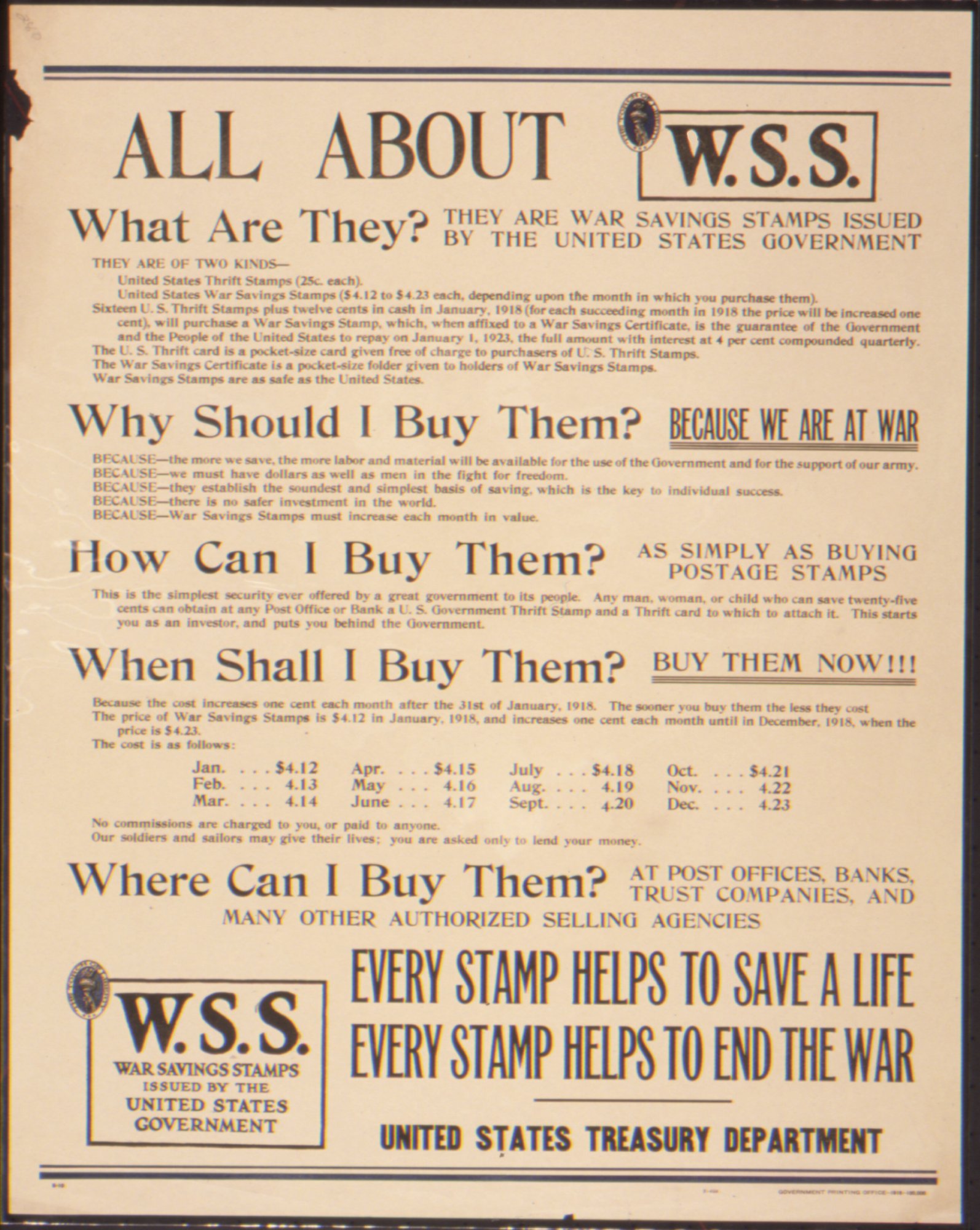
All About W.S.S.: Every Stamp Helps to Save a Life, Every Stamp Helps to End the War
A text-only sheet answers four questions about War Savings Stamps (what, why, how, where) with prices, a monthly cost table and the guarantee of repayment in 1923. The persuasion rests on practical detail plus moral framing, closing with 'Every stamp helps to save a life' and the note that soldiers 'may give their lives; you are asked only to lend your money.'
Propaganda techniques used in this poster
- Date
- 1918
- Period
- First World War
- Made by
- U.S. Treasury Department (War Savings Stamps)
- Region
- North America
- Country
- United States
- Medium
- Poster
- Issuer type
- State
- Regime
- Wilson Administration
- Leader
- Woodrow Wilson
- Audience
- Domestic public
- Purpose
- Fundraise
- Themes
- Economy and finance, Home front, War and the military
- Event
- World War I
- Regime
- Wilson administration
- Leader
- Woodrow Wilson
- Source
- Identified Openly sourced: the speaker is who they say they are
- Source
- U.S. National Archives (NARA), RG 4 (U.S. Food Administration), World War I Posters (NAID 512439), retrieved October 3, 2026
- Rights
- NARA Unrestricted; hosted by owner decision
U.S. Treasury Department (War Savings Stamps). National Archives and Records Administration, 4-P-280.
Text on the object
ALL ABOUT W.S.S.
What Are They? THEY ARE WAR SAVINGS STAMPS ISSUED BY THE UNITED STATES GOVERNMENT
THEY ARE OF TWO KINDS-
United States Thrift Stamps (25c. each).
United States War Savings Stamps ($4.12 to $4.23 each, depending upon the month in which you purchase them).
Sixteen U. S. Thrift Stamps plus twelve cents in cash in January, 1918 (for each succeeding month in 1918 the price will be increased one cent), will purchase a War Savings Stamp, which, when affixed to a War Savings Certificate, is the guarantee of the Government and the People of the United States to repay on January 1, 1923, the full amount with interest at 4 per cent compounded quarterly.
The U. S. Thrift card is a pocket-size card given free of charge to purchasers of U. S. Thrift Stamps.
The War Savings Certificate is a pocket-size folder given to holders of War Savings Stamps.
War Savings Stamps are as safe as the United States.
Why Should I Buy Them? BECAUSE WE ARE AT WAR
BECAUSE-the more we save, the more labor and material will be available for the use of the Government and for the support of our army.
BECAUSE-we must have dollars as well as men in the fight for freedom.
BECAUSE-they establish the soundest and simplest basis of saving, which is the key to individual success.
BECAUSE-there is no safer investment in the world.
BECAUSE-War Savings Stamps must increase each month in value.
How Can I Buy Them? AS SIMPLY AS BUYING POSTAGE STAMPS
This is the simplest security ever offered by a great government to its people. Any man, woman, or child who can save twenty-five cents can obtain at any Post Office or Bank a U. S. Government Thrift Stamp and a Thrift card to which to attach it. This starts you as an investor, and puts you behind the Government.
When Shall I Buy Them? BUY THEM NOW!!!
Because the cost increases one cent each month after the 31st of January, 1918. The sooner you buy them the less they cost
The price of War Savings Stamps is $4.12 in January, 1918, and increases one cent each month until in December, 1918, when the price is $4.23.
The cost is as follows:
Jan. . . . $4.12   Apr. . . . $4.15   July . . . $4.18   Oct. . . . $4.21
Feb. . . . 4.13    May . . . 4.16     Aug. . . . 4.19     Nov. . . . 4.22
Mar. . . . 4.14    June . . . 4.17    Sept. . . . 4.20    Dec. . . . 4.23
No commissions are charged to you, or paid to anyone.
Our soldiers and sailors may give their lives; you are asked only to lend your money.
Where Can I Buy Them? AT POST OFFICES, BANKS, TRUST COMPANIES, AND MANY OTHER AUTHORIZED SELLING AGENCIES
W.S.S. WAR SAVINGS STAMPS ISSUED BY THE UNITED STATES GOVERNMENT
EVERY STAMP HELPS TO SAVE A LIFE
EVERY STAMP HELPS TO END THE WAR
UNITED STATES TREASURY DEPARTMENT
GOVERNMENT PRINTING OFFICE-1918-[illegible]
The two small W.S.S. seals (Statue of Liberty) carry tiny text that is illegible. Small codes at the bottom edge ('9-10', '7-xxx') are not transcribed. The table is laid out in four columns in the original.