Anba' Moussawarah (Pictorial News) No. 18/54: News in Pictures (illustrated news sheet distributed in Beirut)
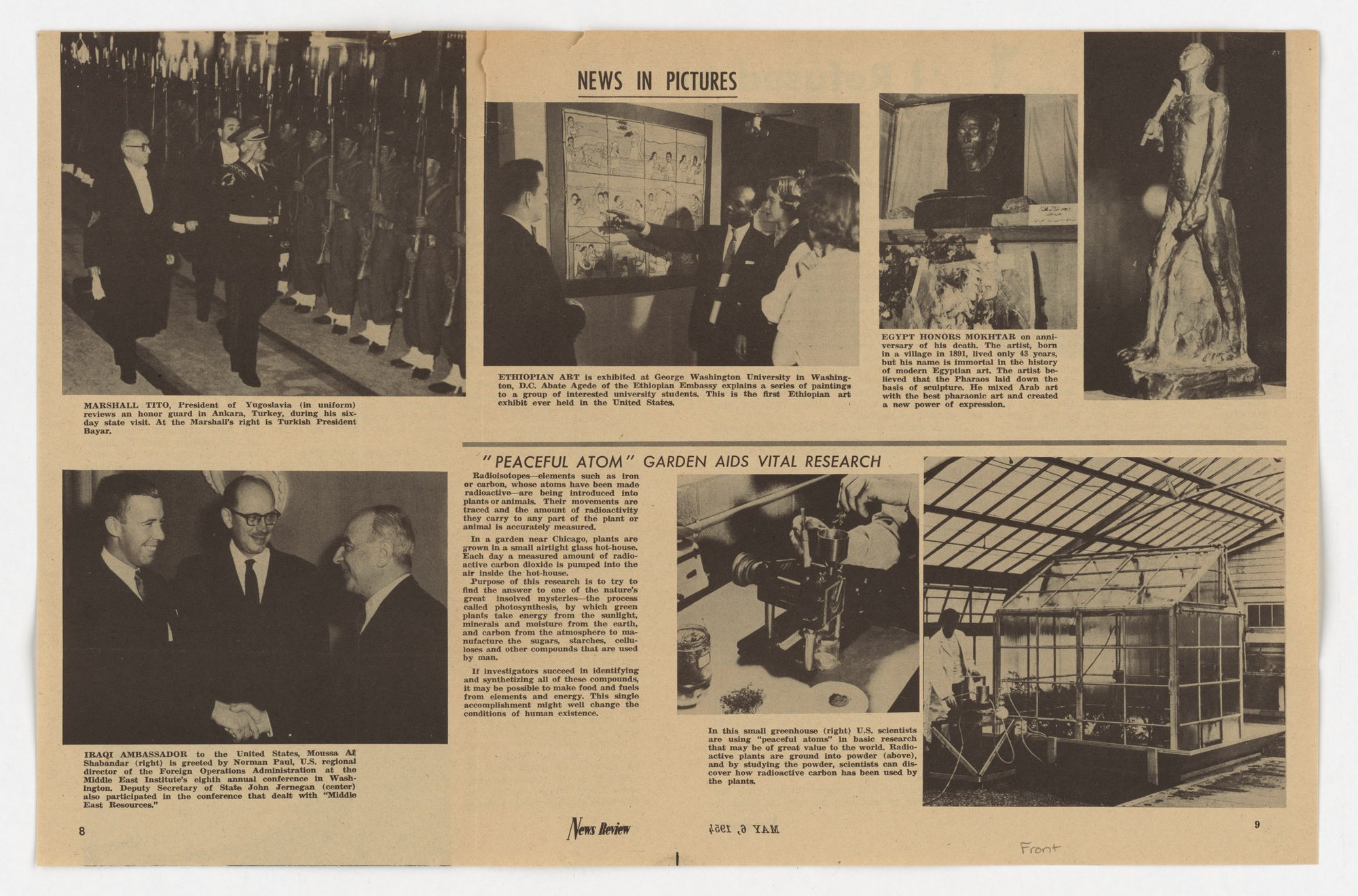
A paste-up photo page headed 'News in Pictures', footer dated May 6, 1954: Marshal Tito reviewing a guard in Ankara, an Ethiopian art show at George Washington University, Egypt honouring the sculptor Mokhtar, an Iraqi ambassador greeted by a U.S. official, and a 'Peaceful Atom' garden. The tell is card-stacking: scientific, cultural and diplomatic items are selected to frame the U.S. as a partner and a source of 'peaceful atoms'.
Propaganda techniques used in this poster
- Date
- June 4, 1954
- Period
- Cold War
- Made by
- U.S. Information Agency (predecessor: State Department International Information and Educational Exchange Program), Propaganda Posters Distributed in Asia, Latin America and the Middle East series
- Region
- North America
- Country
- United States
- Medium
- Poster
- Issuer type
- State
- Regime
- Eisenhower Administration
- Leader
- Dwight D. Eisenhower
- Audience
- Foreign public
- Purpose
- Persuade or win support
- Themes
- Science and technology, Media and information
- Event
- Cold War
- Source
- Unidentified Source blurred: contractors, cutouts, buried disclosure
- Source
- U.S. National Archives (NARA), RG 306, Propaganda Posters Distributed in Asia, Latin America and the Middle East, retrieved October 3, 2026
- Rights
- Public domain (U.S. government work; NARA RG 306)
U.S. Information Agency / Department of State, June 4, 1954. National Archives, Record Group 306 (NAID 6948761, 306-PPB-15a).
Text on the object
NEWS IN PICTURES

MARSHALL TITO, President of Yugoslavia (in uniform) reviews an honor guard in Ankara, Turkey, during his six-day state visit. At the Marshall's right is Turkish President Bayar.

ETHIOPIAN ART is exhibited at George Washington University in Washington, D.C. Abate Agede of the Ethiopian Embassy explains a series of paintings to a group of interested university students. This is the first Ethiopian art exhibit ever held in the United States.

EGYPT HONORS MOKHTAR on anniversary of his death. The artist, born in a village in 1891, lived only 43 years, but his name is immortal in the history of modern Egyptian art. The artist believed that the Pharaos laid down the basis of sculpture. He mixed Arab art with the best pharaonic art and created a new power of expression.

IRAQI AMBASSADOR to the United States, Moussa Ali Shabandar (right) is greeted by Norman Paul, U.S. regional director of the Foreign Operations Administration at the Middle East Institute's eighth annual conference in Washington. Deputy Secretary of State John Jernegan (center) also participated in the conference that dealt with "Middle East Resources."

"PEACEFUL ATOM" GARDEN AIDS VITAL RESEARCH

Radioisotopes--elements such as iron or carbon, whose atoms have been made radioactive--are being introduced into plants or animals. Their movements are traced and the amount of radioactivity they carry to any part of the plant or animal is accurately measured.
In a garden near Chicago, plants are grown in a small airtight glass hot-house. Each day a measured amount of radioactive carbon dioxide is pumped into the air inside the hot-house.
Purpose of this research is to try to find the answer to one of the nature's great insolved mysteries--the process called photosynthesis, by which green plants take energy from the sunlight, minerals and moisture from the earth, and carbon from the atmosphere to manufacture the sugars, starches, celluloses and other compounds that are used by man.
If investigators succeed in identifying and synthetizing all of these compounds, it may be possible to make food and fuels from elements and energy. This single accomplishment might well change the conditions of human existence.

In this small greenhouse (right) U.S. scientists are using "peaceful atoms" in basic research that may be of great value to the world. Radioactive plants are ground into powder (above), and by studying the powder, scientists can discover how radioactive carbon has been used by the plants.

8     News Review     MAY 6, 1954     9

[handwritten:] Front
Captions only, with the printed spelling ('Pharaos', 'insolved') kept. The footer date is printed upside down on the scan. One Arabic label in a photograph is not transcribed.