Content note: Contains a head of state's speech labelling people who sought to leave Cuba 'lumpens', 'thugs', 'delinquents' and 'scum', with the crowd chanting 'scum'. This object is shown as it was published. Why
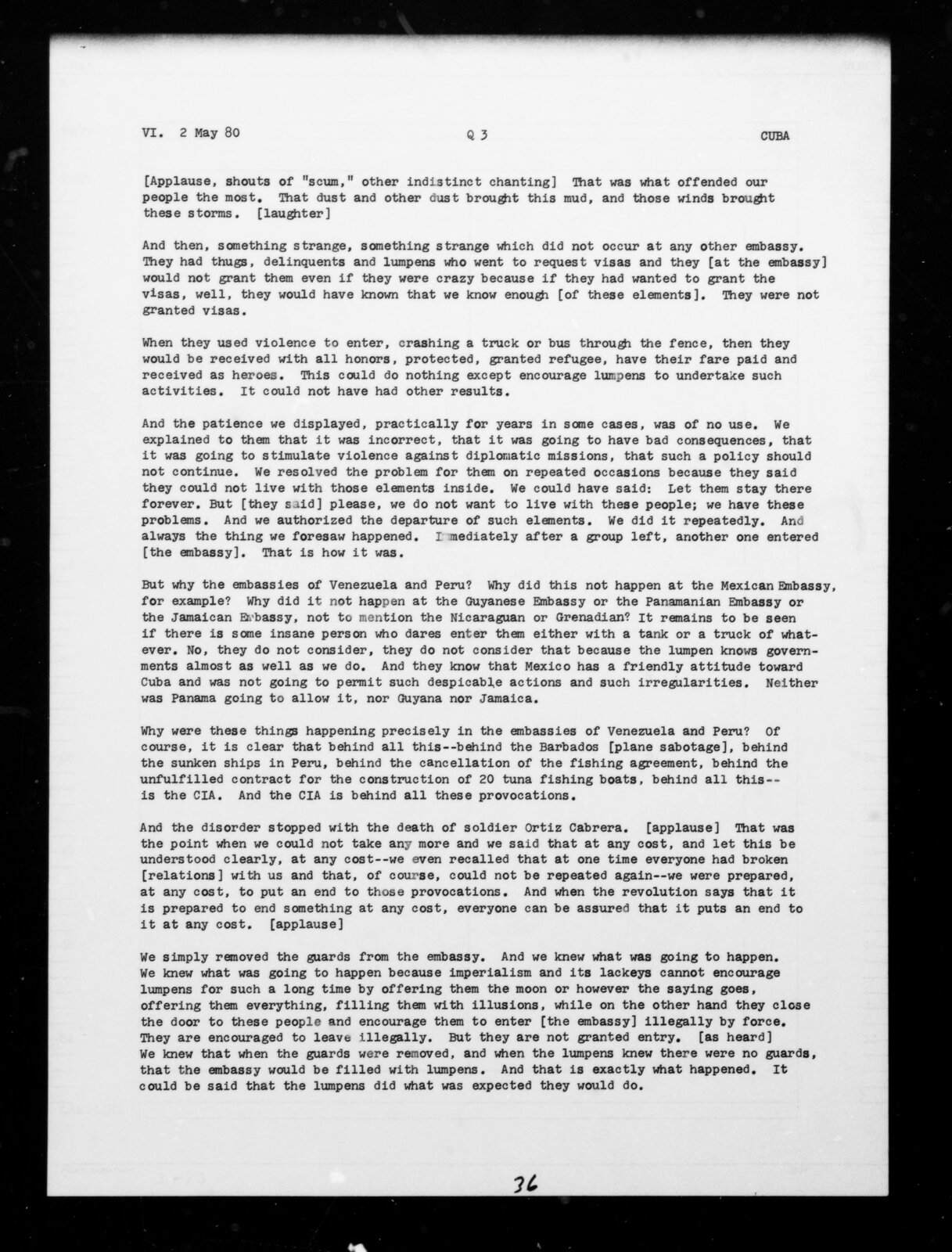
FBIS Daily Report: Castro's May Day speech on the Peruvian embassy exodus ('lumpens', 'scum')
Page Q 3 of the U.S. FBIS Daily Report (Latin America, 2 May 1980), translating Fidel Castro's 1 May 1980 speech in Havana's Plaza de la Revolucion about the crowd that entered the Peruvian embassy. Castro repeatedly labels those who sought to leave as 'lumpens', 'thugs' and 'delinquents', the crowd answers with shouts of 'scum', and he states that the CIA is 'behind all these provocations'. The label is applied to a whole group of roughly ten thousand people who entered the embassy, without examining individual cases.
- Date
- May 1, 1980
- Period
- Cold War
- Made by
- Cuban government (Havana Domestic Service, Fidel Castro speech); FBIS (U.S.) translation
- Region
- Latin America
- Country
- Cuba
- Medium
- Broadcast
- Issuer type
- State
- Regime
- Fidel Castro Government
- Leader
- Fidel Castro
- Audience
- Mixed
- Event
- Mariel Boatlift 1980
- Techniques
- Name-callingScapegoating
- Source
- Identified Openly sourced: the speaker is who they say they are
- Source
- Internet Archive (U.S. Government Publishing Office microfiche collection), retrieved October 2, 2026
- Rights
- Public domain (U.S. government work)
FBIS Daily Report, U.S. government work (public domain); Internet Archive scan from the US GPO microfiche collection, no usage restriction shown. FBIS-LAM-80-087 (PrEx 7.10:FBIS-LAM-80-087), Latin America Vol. VI No. 087, p. Q 3.
Text on the object
VI. 2 May 80 Q 3 CUBA
[Applause, shouts of "scum," other indistinct chanting] That was what offended our people the most. That dust and other dust brought this mud, and those winds brought these storms. [laughter]
And then, something strange, something strange which did not occur at any other embassy. They had thugs, delinquents and lumpens who went to request visas and they [at the embassy] would not grant them even if they were crazy because if they had wanted to grant the visas, well, they would have known that we know enough [of these elements]. They were not granted visas.
When they used violence to enter, crashing a truck or bus through the fence, then they would be received with all honors, protected, granted refugee, have their fare paid and received as heroes. This could do nothing except encourage lumpens to undertake such activities. It could not have had other results.
And the patience we displayed, practically for years in some cases, was of no use. We explained to them that it was incorrect, that it was going to have bad consequences, that it was going to stimulate violence against diplomatic missions, that such a policy should not continue. We resolved the problem for them on repeated occasions because they said they could not live with those elements inside. We could have said: Let them stay there forever. But [they said] please, we do not want to live with these people; we have these problems. And we authorized the departure of such elements. We did it repeatedly. And always the thing we foresaw happened. Immediately after a group left, another one entered [the embassy]. That is how it was.
But why the embassies of Venezuela and Peru? Why did this not happen at the Mexican Embassy, for example? Why did it not happen at the Guyanese Embassy or the Panamanian Embassy or the Jamaican Embassy, not to mention the Nicaraguan or Grenadian? It remains to be seen if there is some insane person who dares enter them either with a tank or a truck of whatever. No, they do not consider, they do not consider that because the lumpen knows governments almost as well as we do. And they know that Mexico has a friendly attitude toward Cuba and was not going to permit such despicable actions and such irregularities. Neither was Panama going to allow it, nor Guyana nor Jamaica.
Why were these things happening precisely in the embassies of Venezuela and Peru? Of course, it is clear that behind all this--behind the Barbados [plane sabotage], behind the sunken ships in Peru, behind the cancellation of the fishing agreement, behind the unfulfilled contract for the construction of 20 tuna fishing boats, behind all this-- is the CIA. And the CIA is behind all these provocations.
The page is itself an FBIS English translation of a Spanish-language speech by Fidel Castro (Havana Domestic Service, 1 May 1980); no further translation is needed. The Spanish original is not on the page.
Read against the page image, with OCR as an aid. A letter obscured by the scan was restored in two places ('Immediately', 'Embassy'). Bracketed words are FBIS's own. The last three paragraphs of the page (from 'And the disorder stopped with the death of soldier Ortiz Cabrera', on removing the guards and the lumpens' response) are not transcribed here for length. A handwritten leaf number (36) and a page-margin tick are on the scan and are not text of the report.