Also called Demagogy, Rabble-rousing, Loyalty-test politics
Political leadership that wins support by turning a public's fears and resentments against an out-group or the leader's critics, and casts policy questions as loyalty tests.
How to spot Demagoguery: the tell
Every issue becomes us versus them; the leader alone speaks for 'the people'; opponents are traitors, not rivals.
What Demagoguery is not
Forceful or populist rhetoric that still argues policy and accepts opponents as legitimate.
History and effect of Demagoguery propaganda
The Greek word demagogos meant a leader of the people and was not at first an insult. It became one in Athens in the late fifth century BCE, when speakers who rose through the Assembly rather than through family standing were attacked by writers such as Thucydides and Aristophanes. The word has been used against leaders on every side since, which is why this page defines the technique by method and not by label. Patricia Roberts-Miller, in Demagoguery and Democracy (Patrick Hill Press, 2017) and Rhetoric and Demagoguery (Southern Illinois University Press, 2019), locates demagoguery in a kind of discourse, not in a type of person. She defines it as "a discourse that promises stability, certainty, and escape from the responsibilities of rhetoric", one that frames policy around how and how much to punish an out-group, not whether to. She also says it is not marked by emotionalism or populism, and that it can appear in elite and apparently rational speech.
Explain moreShow less
The emotional effect is relief. A frightened or resentful audience is given a cause (the out-group), a champion (the speaker) and a test of belonging (agreeing). Disagreement then feels like disloyalty, which is where the technique meets Identity fusion.
Because the label is contested, especially for living politicians, each case below reports what was said and done, with the source, and does not score the person. Where a case argued policy as well, that is stated.
Lineage: Ancient Greek demagogos (Cleon); Roberts-Miller (2017)
How Demagoguery propaganda works
Four moves recur, and each can be checked against the text of a speech.
Explain moreShow less
First, a binary. The audience is "the people", "real citizens", "the nation"; the other side is a named group or the speaker's critics. Roberts-Miller lists binary paired terms, treating identity as a form of logic, and presenting the in-group as wronged as features of the pattern.
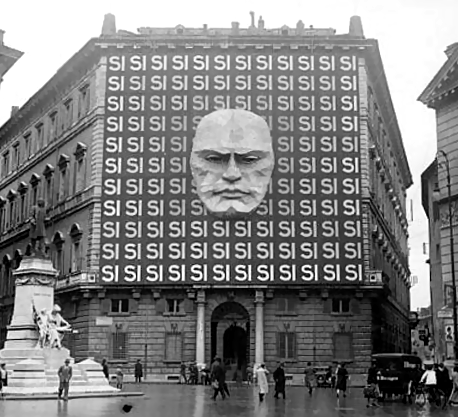
Second, the leader as sole voice. The speaker claims to say what the people want, so opposing the speaker is opposing the people. Compare Cult of personality, which builds the same figure through images and ritual.
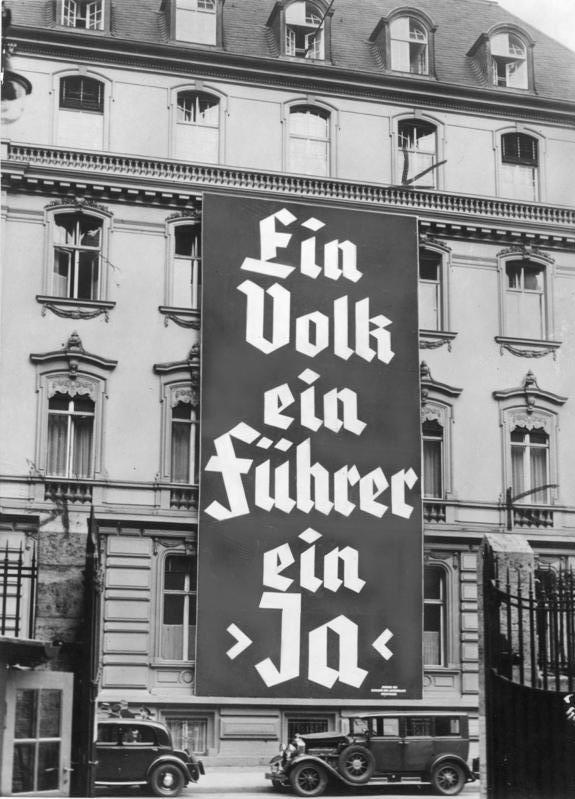
Third, a loyalty test in place of a policy question. The choice is framed so that how one answers shows which side one is on, and the merits of the policy are not discussed. Referendums and rally questions can work this way, as in Ein Volk, ein Führer, ein Ja (One People, One Leader, One Yes).
Fourth, labels for opponents: traitor, parasite, scum, vermin, fascist. These are Name-calling and, when a whole group is targeted for the audience's troubles, Scapegoating. Roberts-Miller notes that metaphors linking the out-group to disease, vermin or disorder are common; at their extreme they become Dehumanization.
Why Demagoguery propaganda works
Fear and resentment narrow attention to a threat and a culprit (Fear messaging, Moral outrage). Group membership makes the leader's side the side one belongs to (Social identity), and people see members of the other group as more alike and more culpable than members of their own (Out-group homogeneity). A simple story of wronged us and guilty them is easier to hold than a policy trade-off. The test used here is the same for every speaker: what the text asks the audience to feel, whom it blames, and whether any answer other than agreement is allowed.

Demagoguery propaganda examples across eras and sides
- Athens, 427 BCE (Cleon). After the revolt of Mytilene, the Athenian Assembly voted to put the city's men to death. The next day it reconsidered. Thucydides describes Cleon, son of Cleaenetus, as "the most violent man at Athens, and at that time by far the most powerful with the commons" (Crawley translation, Book 3). Cleon opened by saying "I have often before now been convinced that a democracy is incapable of empire" and told the Assembly "your empire is a despotism and your subjects disaffected conspirators". The vote on the opposing motion, from Diodotus, was nearly equal, and it carried. The Constitution of Athens ascribed to Aristotle says Cleon "was the first to use unseemly shouting and coarse abuse on the Bema" and to harangue the people "with his cloak girt up short about him" (Kenyon translation). Most accounts of Cleon are unfriendly: Aristophanes mocked him in The Knights (424 BCE). His speech also argued a policy, deterring revolt in the empire, which is the strongest case for treating him as a forceful speaker and not only a demagogue.
- United States, 1934 (Huey Long). In a radio address on 23 February 1934 Senator Huey Long of Louisiana set out "Share Our Wealth": a guarantee of about $5,000 per family and a cap on any one fortune, with the motto "every man a king". In a 1935 circular he blamed "the organized 600 families who control the wealth of America". The proposals were specific and were argued as policy, which is the main reason his rhetoric is contested. The demagogue label comes from his critics, including President Franklin Roosevelt, and from his methods in Louisiana, where he was impeached by the state House in 1929 and, when a legislator doubted he knew the state constitution, said, "I'm the Constitution around here now" (Wikipedia, citing Kane, Brinkley and others). He was shot in the State Capitol on 8 September 1935 and died on 10 September.
- United States, 1950 to 1954 (Joseph McCarthy). At Wheeling, West Virginia, on 9 February 1950, Senator McCarthy said, in the text of the speech, "I have here in my hand a list of 205" people in the State Department known as Communist Party members. Two days later his telegram to President Truman said he had the names of 57. On 20 February he presented 81 numbered "cases". He said "the bright young men who are born with silver spoons in their mouths are the ones who have been most traitorous" and called the contest "a final, all-out battle between communistic atheism and Christianity". Soviet espionage in the US government in the 1940s is documented; the numbers and the method are what this page scores, not the existence of spying. On 9 June 1954, in the Army hearings, lawyer Joseph Welch said to him, "Let us not assassinate this lad further, senator. You have done enough. Have you no sense of decency?" On 2 December 1954 the Senate censured him, 67 to 22, for "abuse" of two Senate committees. See McCarthy's numbers: 205, 57, 81 and the move from 'card-carrying Communists' to 'security risks' (1950-54).
Show all 8Show fewer
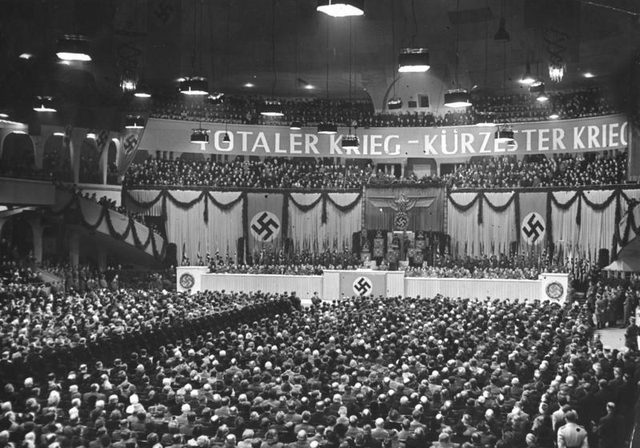
- Germany, 18 February 1943 (Joseph Goebbels). Three weeks after the German surrender at Stalingrad, the propaganda minister spoke at the Berlin Sportpalast to a selected audience and put ten questions to it, the fourth being "Do you want total war?" The audience's shouted "yes" was broadcast as the answer of the German people. The speech told the audience that "the goal of Bolshevism is Jewish world revolution", casting a military crisis as a struggle against a named group. In a dictatorship with no legal opposition, the questions were built to be answered only with yes. See nazi-germany and Totaler Krieg – kürzester Krieg (Total War – Shortest War): the Sportpalast rally of 18 February 1943.
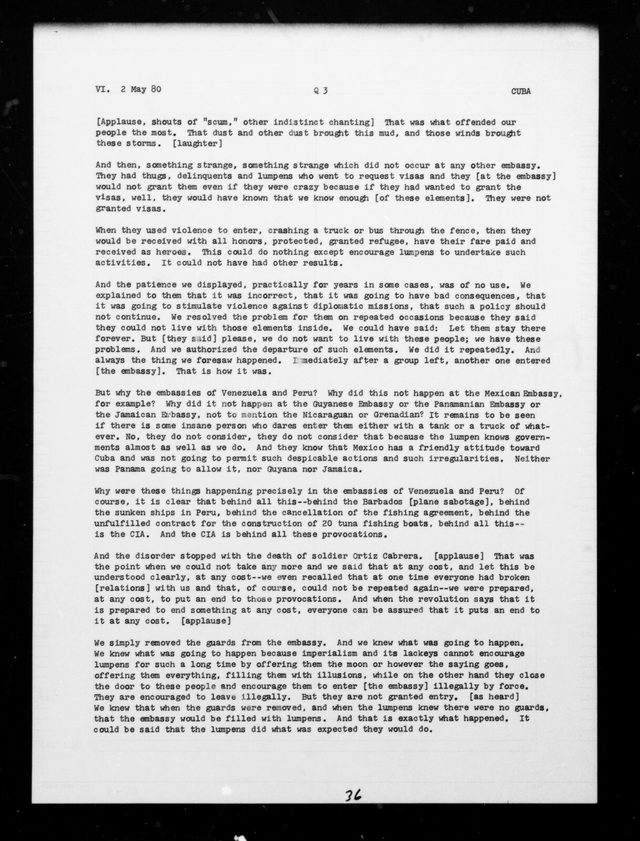
- Cuba, 1 May 1980 (Fidel Castro). In a May Day speech in Havana's Plaza of the Revolution after about 10,000 people entered the Peruvian embassy, Castro called those who sought to leave "thugs, delinquents and lumpens", the crowd shouted "scum", and he said the CIA was "behind all these provocations", offering no evidence in the text (FBIS translation). Some 125,000 Cubans left from Mariel between April and October 1980. The speech did make a policy argument, that embassies were receiving people who used violence while turning away others, and applied the label to a whole group of thousands without examining individual cases. See castro-cuba and Havana Domestic Service, Castro's May Day speech on the Peruvian embassy exodus ('lumpens', 'scum'), broadcast (Havana, May 1, 1980).
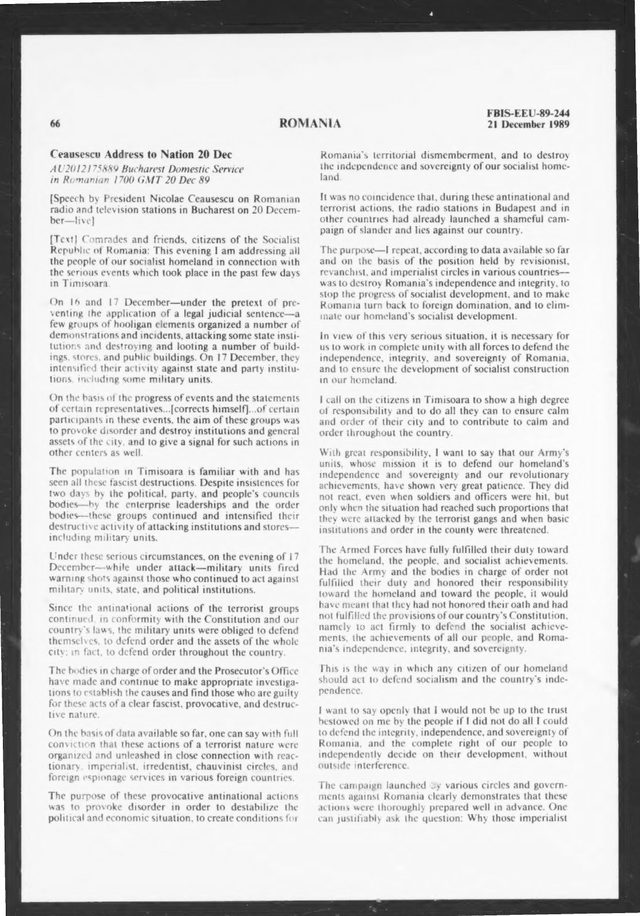
- Romania, 20 December 1989 (Nicolae Ceaușescu). In a live address on the Timișoara protests, Ceaușescu called the demonstrators "hooligan elements", described their acts as "fascist destructions" and named foreign services as organisers. The next day a crowd in Bucharest interrupted his speech, and he fled the capital on 22 December. See ceausescu-romania and Bucharest Domestic Service: Ceausescu's address on the Timisoara events, FBIS Daily Report, 21 December 1989.
- Venezuela, 1999 to 2013 (Hugo Chávez). Chávez, elected president in 1998, described his opponents as "oligarchs" and escuálidos, "the squalid people", and is quoted as saying "Oligarchs, tremble!" (FRONTLINE/World, August 2003, author's description). In November 2007, answering King Juan Carlos's "Why don't you shut up?" at a summit in Santiago, he accused Spain's former prime minister José María Aznar of backing the 2002 coup against him and of having repeatedly called him a "fascist" (NBC News). The 2002 coup attempt was real, and his government's account is that opponents were tied to it; the labels were applied to a wider opposition, which included parties that took part in elections. This page states the words and does not rate the person. Cuba (1980) above is a post-1945 non-Western case.
- United States, 2016 and 2023 (Donald Trump). At the Republican convention on 21 July 2016 Trump said, "Nobody knows the system better than me, which is why I alone can fix it." FactCheck.org reported that in the same speech he went on to say he would work with others on crime, terrorism and the economy, and that a Clinton ad omitted that context. At the CPAC conference on 4 March 2023, he said: "In 2016, I declared I am your voice. Today, I add I am your warrior, I am your justice. And for those who have been wronged and betrayed, I am your retribution." In the same speech he called "our enemies" "lunatics and maniacs" and promised to "totally obliterate the deep state". He linked the pledge to officials who, he said, had "weaponized our justice system", and NBC News headlined the speech as vowing "retribution" for his enemies. This page states the words and the setting and does not rate the speaker. He spoke as a candidate in a system where courts, a free press and opposing parties responded openly, which is a difference of scale and safeguards from the dictatorships above. See trump-administration.
How to spot Demagoguery propaganda
- Does each issue come back to who is loyal and who is a traitor, or can the policy be discussed on its merits?
- Does the speaker say that only he or she speaks for "the people", and are critics described as outside "the people"?
- What would count as a way out? If no answer to the speaker's question is permitted except yes, it is a test and not a debate.
Show all 6Show fewer
- Which groups are named as the cause of the audience's troubles, and is evidence given for the charge?
- Are opponents' arguments answered, or are their motives and loyalty attacked?
- Is the same standard applied to the speaker's own side? Roberts-Miller's test of identity as logic is whether the in-group's faults are excused and the out-group's are proof of its nature.
Where Demagoguery propaganda ends: edge cases and legitimate persuasion
5 items · Strong rhetoric is not the technique. A speaker can be angry, blunt and populist and…
- Strong rhetoric is not the technique. A speaker can be angry, blunt and populist and still argue a policy, cite evidence and accept that opponents are legitimate. Long's specific wealth proposals and Cleon's deterrence argument sit at that boundary.
- Naming a real wrong and a responsible party is not the technique. Speakers who document abuses by named officials are persuading with facts; the device begins when a whole group is made the cause, or when critics are called traitors for criticising.
- Context matters. A democratic politician faces open competition, courts, a press and elections; a minister in a one-party state does not. The same words weigh differently, as the Castro and Trump cases show.
- The label is itself used as a weapon. Calling an opponent a demagogue can be an ad hominem (Ad hominem) when no method is shown. Use the checklist above on the text, not the reputation.
- Overlaps: Scapegoating when a group is blamed, Fear appeal when fear is the lever, False dilemma when only two options are allowed, Cult of personality when the leader is built into an infallible figure.
Sources and further reading
Sources
10 items · Roberts-Miller, Patricia. Demagoguery and Democracy . Patrick Hill Press, 2017; Rhetoric…
- Roberts-Miller, Patricia. Demagoguery and Democracy. Patrick Hill Press, 2017; Rhetoric and Demagoguery. Southern Illinois University Press, 2019. Summary of characteristics: "Characteristics of Demagoguery," https://www.patriciarobertsmiller.com/characteristics-of-demagoguery/.
- Thucydides. History of the Peloponnesian War, Book 3 (Mytilene debate). Translated by Richard Crawley, http://classics.mit.edu/Thucydides/pelopwar.3.third.html.
- Aristotle (attributed). Constitution of the Athenians, ch. 28. Translated by Sir Frederic G. Kenyon, http://classics.mit.edu/Aristotle/athenian_const.mb.txt.
- Long, Huey P. "Every Man a King" (radio address, 23 February 1934) and "Share Our Wealth" (1935 circular). The American Yawp reader, https://www.americanyawp.com/reader/23-the-great-depression/huey-p-long-every-man-a-king-and-share-our-wealth-1934/; Wikipedia, "Huey Long," https://en.wikipedia.org/wiki/Huey_Long (impeachment, "Kingfish", "I'm the Constitution around here now", assassination dates; cites Kane 1971, Brinkley and others).
- McCarthy, Joseph. Wheeling speech, 9 February 1950, text at https://pages.uoregon.edu/eherman/teaching/texts/McCarthy_Wheeling_Speech.pdf; U.S. Senate Historical Office, "Have You No Sense of Decency?", https://www.senate.gov/about/powers-procedures/investigations/mccarthy-hearings/have-you-no-sense-of-decency.htm; U.S. Senate, censure of Joseph McCarthy, 2 December 1954, https://www.senate.gov/about/powers-procedures/censure.htm; the archive's case study McCarthy's numbers: 205, 57, 81 and the move from 'card-carrying Communists' to 'security risks' (1950-54) lists the primary documents (telegram of 11 February 1950, Congressional Record, 20 February 1950).
- Goebbels, Joseph. "Nation, Rise Up, and Let the Storm Break Loose" (speech of 18 February 1943). Translated by Randall Bytwerk, German Propaganda Archive, Calvin University, https://research.calvin.edu/german-propaganda-archive/goeb36.htm; Bundesarchiv, Bild 183-J05235, as recorded in the archive entry Totaler Krieg – kürzester Krieg (Total War – Shortest War): the Sportpalast rally of 18 February 1943.
- Castro, Fidel. May Day speech, Havana, 1 May 1980. U.S. Foreign Broadcast Information Service, Daily Report: Latin America, vol. VI, no. 087, 2 May 1980, p. Q 3, https://archive.org/details/micro_IA1176905_0403.
- Ceaușescu, Nicolae. Address of 20 December 1989. FBIS, Daily Report: East Europe, FBIS-EEU-89-244, 21 December 1989, p. 66, https://archive.org/details/micro_IA1176903_1454.
- "The Hugo Chavez Comes to Power", FRONTLINE/World Fellows, August 2003, https://www.pbs.org/frontlineworld/fellows/venezuela0803/2.html; "Venezuela's Chavez lashes back at Spanish king," NBC News, November 2007, https://www.nbcnews.com/news/amp/wbna21742622 (date not shown on the page).
- Trump, Donald. Speech at the Republican National Convention, 21 July 2016, as quoted and put in context by FactCheck.org, "Clinton misrepresents Trump quote," September 2016, https://www.factcheck.org/2016/09/clinton-misrepresents-trump-quote. Speech at CPAC, 4 March 2023: Rev transcript, https://www.rev.com/transcripts/trump-speaks-at-cpac-2023-transcript; NBC News, "Trump trolls Ron DeSantis in CPAC speech while vowing 'retribution' for his enemies," 4 March 2023, https://www.nbcnews.com/politics/donald-trump/trump-trolls-ron-desantis-cpac-speech-rcna73385.
Sourcing note (7 October 2026): the quotations were checked against the pages linked above as retrieved on this date. The Huey Long biographical details were checked against Wikipedia's summary of its sources, not the books. The Roberts-Miller definition is quoted from her website summary; her books were not opened. The NBC News page was identified by search and not opened.
Gaps. No case from Asia, Africa or the Middle East after 1945 is included, and the Chávez case is sourced to a journalist's description and one news report, not a transcript. The definition applies unchanged, and sourced cases will be added when found.
The science
Research on the psychology this technique relies on, from the Learn library:
Research on the psychology this technique relies on, from the Learn library:
- Fear messaging — Fear messaging
- Moral outrage — Moral outrage
- Social identity — Social identity
- Out-group homogeneity — Out-group homogeneity