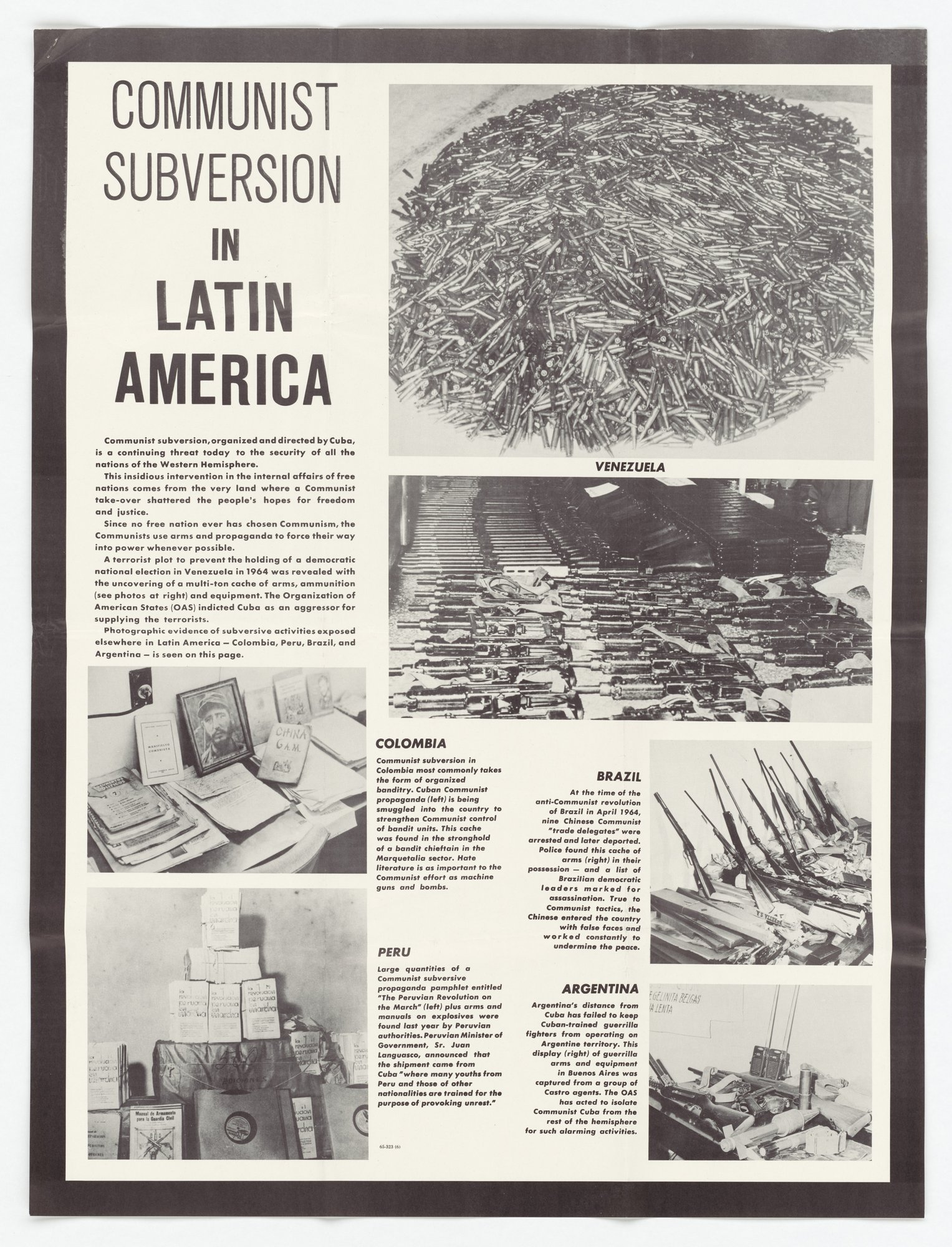
Communist Subversion in Latin America poster, 65-323 (English poster distributed in Beirut)
A photo-and-text sheet presenting seized weapons, ammunition and literature from Venezuela, Colombia, Peru, Brazil and Argentina as evidence that Cuba directs 'Communist subversion' in Latin America. The tell is fear-appeal and card-stacking: piles of arms photographs and attributions to Cuba carry the argument, with loaded terms such as 'insidious' and 'terrorist', and no counter-view or sourcing beyond the captions.
Propaganda techniques used in this poster
- Date
- May 29, 1965
- Period
- Cold War
- Made by
- U.S. Information Agency (predecessor: State Department International Information and Educational Exchange Program), Propaganda Posters Distributed in Asia, Latin America and the Middle East series
- Region
- North America
- Country
- United States
- Medium
- Poster
- Issuer type
- State
- Regime
- Johnson Administration
- Leader
- Lyndon B. Johnson
- Audience
- Foreign public
- Purpose
- Persuade or win support
- Themes
- War and the military, Security and surveillance
- Event
- Cold War
- Source
- Unidentified Source blurred: contractors, cutouts, buried disclosure
- Source
- U.S. National Archives (NARA), Record Group 306, Posters in Asia, Latin America, Middle East, retrieved October 4, 2026
- Rights
- Public domain (U.S. government work; NARA RG 306)
U.S. Information Agency / Department of State, May 29, 1965. National Archives, Record Group 306 (NAID 6949176, 306-PPB-252).
Text on the object
COMMUNIST
SUBVERSION
IN
LATIN
AMERICA

Communist subversion, organized and directed by Cuba, is a continuing threat today to the security of all the nations of the Western Hemisphere.
This insidious intervention in the internal affairs of free nations comes from the very land where a Communist take-over shattered the people's hopes for freedom and justice.
Since no free nation ever has chosen Communism, the Communists use arms and propaganda to force their way into power whenever possible.
A terrorist plot to prevent the holding of a democratic national election in Venezuela in 1964 was revealed with the uncovering of a multi-ton cache of arms, ammunition (see photos at right) and equipment. The Organization of American States (OAS) indicted Cuba as an aggressor for supplying the terrorists.
Photographic evidence of subversive activities exposed elsewhere in Latin America - Colombia, Peru, Brazil, and Argentina - is seen on this page.

VENEZUELA

COLOMBIA
Communist subversion in Colombia most commonly takes the form of organized banditry. Cuban Communist propaganda (left) is being smuggled into the country to strengthen Communist control of bandit units. This cache was found in the stronghold of a bandit chieftain in the Marquetalia sector. Hate literature is as important to the Communist effort as machine guns and bombs.

BRAZIL
At the time of the anti-Communist revolution of Brazil in April 1964, nine Chinese Communist "trade delegates" were arrested and later deported. Police found this cache of arms (right) in their possession - and a list of Brazilian democratic leaders marked for assassination. True to Communist tactics, the Chinese entered the country with false faces and worked constantly to undermine the peace.

PERU
Large quantities of a Communist subversive propaganda pamphlet entitled "The Peruvian Revolution on the March" (left) plus arms and manuals on explosives were found last year by Peruvian authorities. Peruvian Minister of Government, Sr. Juan Languasco, announced that the shipment came from Cuba "where many youths from Peru and those of other nationalities are trained for the purpose of provoking unrest."

ARGENTINA
Argentina's distance from Cuba has failed to keep Cuban-trained guerrilla fighters from operating on Argentine territory. This display (right) of guerrilla arms and equipment in Buenos Aires was captured from a group of Castro agents. The OAS has acted to isolate Communist Cuba from the rest of the hemisphere for such alarming activities.

65-323 (6)
Small lettering inside the photographs (book covers, a wall sign) is not transcribed.