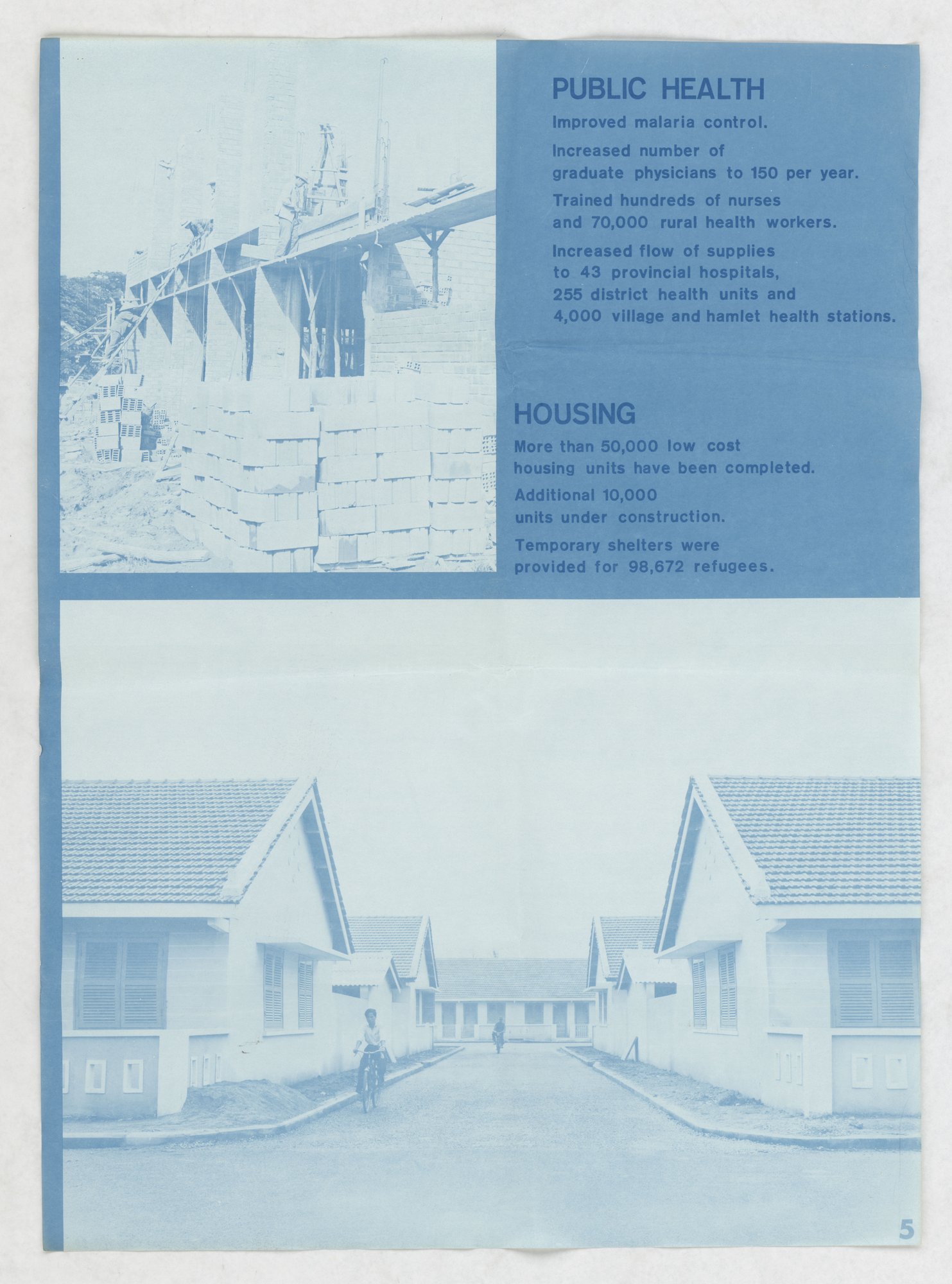
Evolution in South Vietnam: Public Health and Housing
An English-language sheet on blue paper lists public-health and housing figures for South Vietnam: 150 physicians a year, 70,000 rural health workers, over 50,000 low-cost housing units and shelter for 98,672 refugees. Photographs show a brick building under construction and a street of finished tile-roofed houses with cyclists. A column of precise numbers, with no baseline or source, stands in for evidence of progress.
Propaganda techniques used in this poster
- Date
- 1965
- Period
- Cold War
- Made by
- Joint U.S. Public Affairs Office (JUSPAO) psychological-operations output, as placed by the National Archives series; no issuing body printed on the sheet
- Region
- North America
- Country
- United States
- Medium
- Poster
- Issuer type
- State
- Regime
- Johnson Administration
- Leader
- Lyndon B. Johnson
- Audience
- Foreign public
- Purpose
- Persuade or win support
- Themes
- Health, Economy and finance
- Event
- Vietnam War
- Source
- Identified Openly sourced: the speaker is who they say they are
- Source
- U.S. National Archives (NARA), RG 306, Psychological Warfare Posters, Vietnam War (NAID 561393), retrieved October 3, 2026
- Rights
- NARA Unrestricted; hosted by owner decision
Joint U.S. Public Affairs Office (JUSPAO). National Archives and Records Administration, 306-VP-011-50.
Text on the object
PUBLIC HEALTH
Improved malaria control.
Increased number of graduate physicians to 150 per year.
Trained hundreds of nurses and 70,000 rural health workers.
Increased flow of supplies to 43 provincial hospitals, 255 district health units and 4,000 village and hamlet health stations.

HOUSING
More than 50,000 low cost housing units have been completed.
Additional 10,000 units under construction.
Temporary shelters were provided for 98,672 refugees.