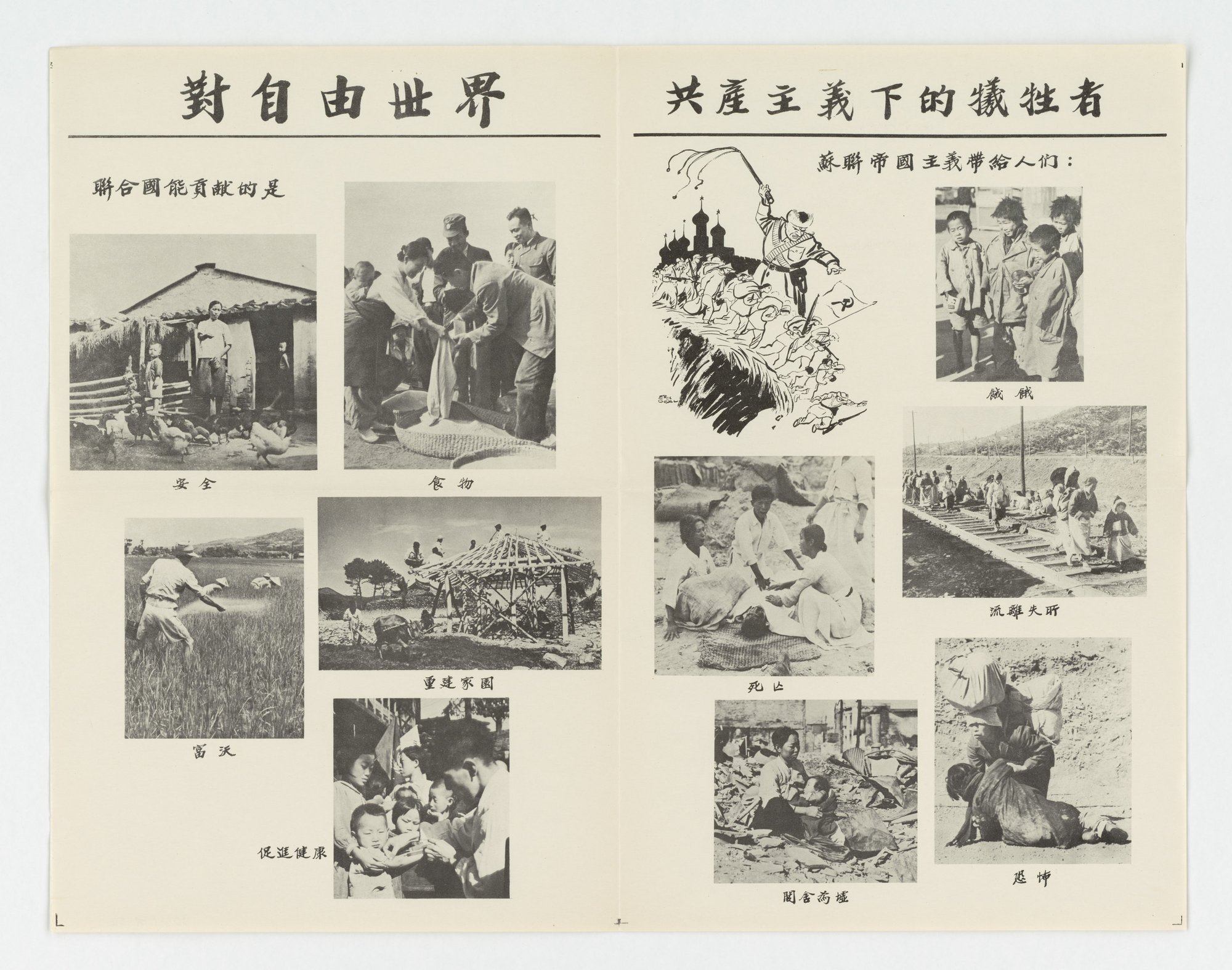
對自由世界 / 共產主義下的犧牲者 (For a Free World / Victims of Communism; Chinese poster distributed in Asia)
A two-panel sheet. The left panel, 'For a Free World / United Nations offers', shows photographs captioned security, food, improved land, rebuilt homes and better health. The right panel, 'Victims of Communism / Soviet Imperialism brings to Korea', shows a whip-wielding figure driving a column of people past onion-domed towers, and photographs captioned starvation, flight, death, broken homes and terror. The tell is card-stacking, pairing benefit photographs with suffering photographs, and name-calling in 'Soviet Imperialism'; no photograph is dated or sourced.
Propaganda techniques used in this poster
- Date
- February 14, 1952
- Period
- Cold War
- Made by
- U.S. Information Agency (predecessor: State Department International Information and Educational Exchange Program), Propaganda Posters Distributed in Asia series
- Region
- North America
- Country
- United States
- Medium
- Poster
- Issuer type
- State
- Regime
- Truman Administration
- Leader
- Harry S. Truman
- Audience
- Foreign public
- Purpose
- Persuade or win support
- Theme
- War and the military
- Event
- Korean War
- Source
- Unidentified Source blurred: contractors, cutouts, buried disclosure
- Source
- U.S. National Archives (NARA), Record Group 306, Propaganda Posters Distributed in Asia, retrieved October 3, 2026
- Rights
- Public domain (U.S. government work; NARA RG 306)
U.S. Information Agency / Department of State, February 14, 1952. National Archives, Record Group 306 (NAID 5729952, 306-PPA-52).
Text on the object
對自由世界
共產主義下的犧牲者

聯合國能貢獻的是
安全
食物
富沃
重建家園
促進健康

蘇聯帝國主義帶給人们:
飢餓
流離失所
死亡
閤舍為墟
恐怖

[signature on drawing:] ERIC GOAL
For a free world / Victims under Communism. What the United Nations can contribute: security; food; fertile land; rebuilding homes; promoting health. What Soviet imperialism brings to people: hunger; displacement and loss of home; death; homes in ruins; terror.
Two captions (the 'hunger' and 'homes in ruins' captions) are small and read with some uncertainty. The right-hand text has the character for 'people' printed in a simplified form (们).