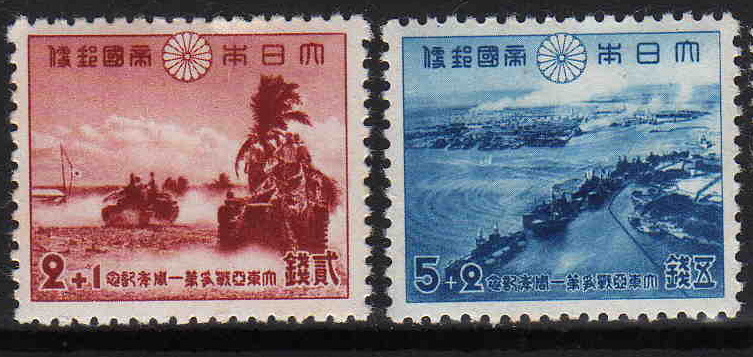
Stamps for the first anniversary of the Greater East Asia War, 2+1 sen and 5+2 sen (1942)
Two Japanese surcharged commemorative stamps side by side. The red-brown 2+1 sen shows two tanks moving along a shoreline past palm trees and a sailboat; the blue 5+2 sen shows a harbour with ships moored along a quay and a built-up shore beyond. Each carries the imperial chrysanthemum crest at top centre and an inscription marking the first anniversary of the Greater East Asia War. The tag rests on the crest and the anniversary inscription set over military scenes (transfer): the imperial symbol and the war's name frame the images as one commemorated event.
- Date
- December 8, 1942
- Period
- Second World War
- Made by
- Imperial Japanese Ministry of Communications (逓信省), postal authority of the Empire of Japan
- Region
- East Asia
- Country
- Empire of Japan
- Medium
- Stamp
- Issuer type
- State
- Regime
- Showa Japan
- Leader
- Hideki Tojo
- Audience
- Domestic public
- Purpose
- Commemorate
- Themes
- War and the military, Home front
- Event
- World War II
- Techniques
- Transfer
- Leader
- Hideki Tōjō
- Source
- Identified Openly sourced: the speaker is who they say they are
- Source
- Wikimedia Commons (scan of the stamps, stamp collection of the uploader), retrieved October 2, 2026
- Rights
- Public domain (Commons: PD-Japan-organization + PD-1996; 1942 stamps of a Japanese ministry)
Imperial Japanese Ministry of Communications, Greater East Asia War first anniversary stamps, 1942, public domain, via Wikimedia Commons
Text on the object
大日本帝國郵便
大東亞戰爭一周年記念
2+1
貳錢
大日本帝國郵便
大東亞戰爭一周年記念
5+2
五錢
Great Japan Imperial Postage
Commemoration of the first anniversary of the Greater East Asia War
2+1
Two sen
Great Japan Imperial Postage
Commemoration of the first anniversary of the Greater East Asia War
5+2
Five sen
Read from the 753 by 357 pixel scan; left stamp first, then right. On each stamp the top inscription runs right to left across the crest (大日本 to its right, 帝國郵便 to its left) and the commemoration text runs along the foot between the two figures; the denomination character (貳錢, 五錢) is at the foot right. Characters at this resolution are legible but small, so the commemoration line is read with moderate confidence. The translation is machine-made and not checked by a fluent reader of Japanese.