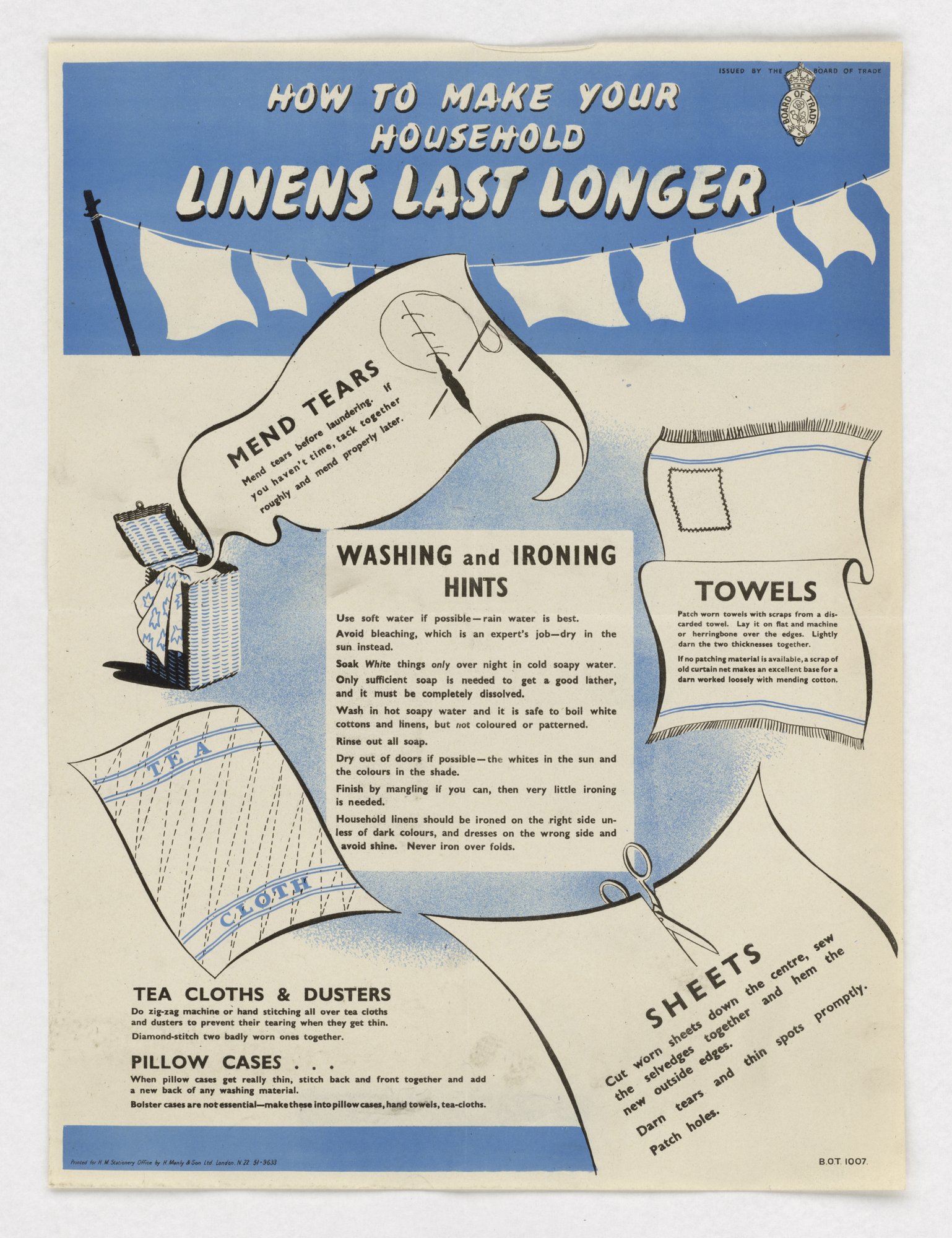
How to Make Your Household Linens Last Longer
A practical sheet of mending and washing hints, with drawn sheets, towels and tea cloths around a central 'Washing and Ironing Hints' panel. The only persuasive device is the Board of Trade crest and 'Issued by the Board of Trade', which lends official authority to household advice (transfer).
Propaganda techniques used in this poster
- Date
- 1941
- Period
- Second World War
- Made by
- British Board of Trade, printed for H.M. Stationery Office by H. Manly & Son Ltd., London
- Region
- Western and Central Europe
- Country
- United Kingdom
- Medium
- Poster
- Issuer type
- State
- Regime
- Churchill Government
- Leader
- Winston Churchill
- Audience
- Domestic public
- Purpose
- Mobilize or secure compliance
- Themes
- Home front, Economy and finance
- Event
- World War II
- Leader
- Winston Churchill
- Source
- Identified Openly sourced: the speaker is who they say they are
- Source
- U.S. National Archives and Records Administration, Record Group 44, World War II Foreign Posters, retrieved October 3, 2026
- Rights
- Public domain (UK Crown copyright, 50 years from publication, expired before 1996; no URAA restoration)
British Board of Trade, printed for H.M. Stationery Office by H. Manly & Son Ltd., London. National Archives and Records Administration, WWII Foreign Posters (NAID 44266650, 44-PF-225).
Text on the object
ISSUED BY THE BOARD OF TRADE
HOW TO MAKE YOUR HOUSEHOLD LINENS LAST LONGER
MEND TEARS
Mend tears before laundering. If you haven't time, tack together roughly and mend properly later.
WASHING and IRONING HINTS
Use soft water if possible—rain water is best.
Avoid bleaching, which is an expert's job—dry in the sun instead.
Soak White things only over night in cold soapy water.
Only sufficient soap is needed to get a good lather, and it must be completely dissolved.
Wash in hot soapy water and it is safe to boil white cottons and linens, but not coloured or patterned.
Rinse out all soap.
Dry out of doors if possible—the whites in the sun and the colours in the shade.
Finish by mangling if you can, then very little ironing is needed.
Household linens should be ironed on the right side unless of dark colours, and dresses on the wrong side and avoid shine. Never iron over folds.
TOWELS
Patch worn towels with scraps from a discarded towel. Lay it on flat and machine or herringbone over the edges. Lightly darn the two thicknesses together.
If no patching material is available, a scrap of old curtain net makes an excellent base for a darn worked loosely with mending cotton.
TEA CLOTHS & DUSTERS
Do zig-zag machine or hand stitching all over tea cloths and dusters to prevent their tearing when they get thin.
Diamond-stitch two badly worn ones together.
PILLOW CASES . . .
When pillow cases get really thin, stitch back and front together and add a new back of any washing material.
Bolster cases are not essential—make these into pillow cases, hand towels, tea-cloths.
SHEETS
Cut worn sheets down the centre, sew the selvedges together and hem the new outside edges.
Darn tears and thin spots promptly. Patch holes.
Printed for H.M. Stationery Office by H. Manly & Son Ltd. London, N.22 51-9633
B.O.T. 1007.