How to Recap With F Grade Capping Stock
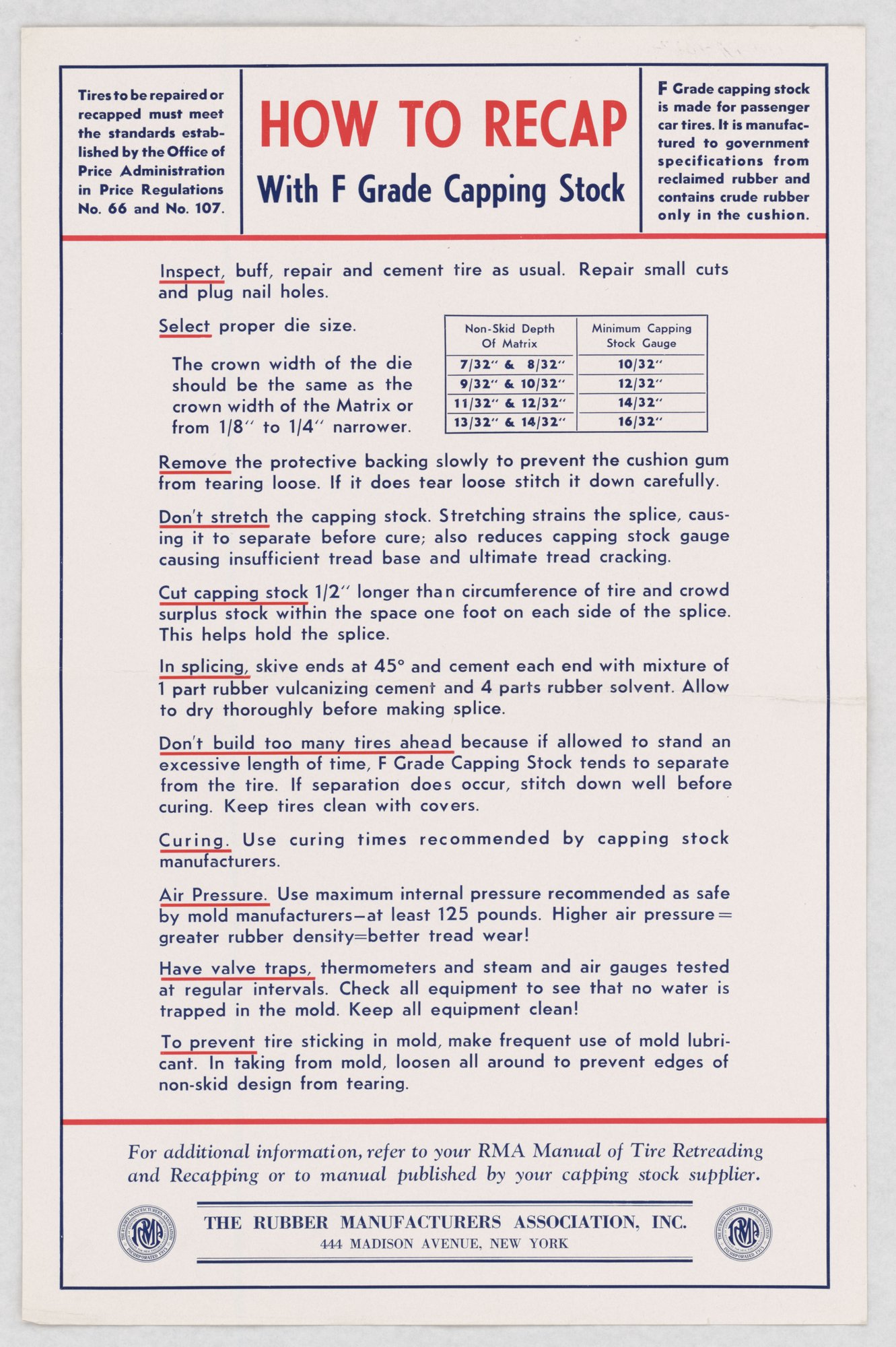
Text-only trade instruction sheet for tire recappers, with a gauge table and a list of underlined procedure steps. It opens by citing Office of Price Administration price regulations and government specifications. The technique is faint: the government standards named in the margins lend official authority to an industry how-to.
Propaganda techniques used in this poster
- Date
- 1941
- Period
- Second World War
- Made by
- The Rubber Manufacturers Association, Inc.
- Region
- North America
- Country
- United States
- Medium
- Poster
- Issuer type
- Corporation
- Regime
- Roosevelt Administration
- Leader
- Franklin D. Roosevelt
- Audience
- Domestic public
- Purpose
- Warn or inform
- Themes
- Economy and finance, Science and technology
- Event
- World War II
- Regime
- Roosevelt administration
- Leader
- Franklin D. Roosevelt
- Source
- Identified Openly sourced: the speaker is who they say they are
- Source
- U.S. National Archives and Records Administration, Record Group 44, World War II Posters, retrieved October 4, 2026
- Rights
- Public domain (U.S. government work)
The Rubber Manufacturers Association, Inc.. National Archives and Records Administration, RG 44, 44-PA-1022 (NAID 514548).
Text on the object
Tires to be repaired or recapped must meet the standards established by the Office of Price Administration in Price Regulations No. 66 and No. 107.
HOW TO RECAP With F Grade Capping Stock
F Grade capping stock is made for passenger car tires. It is manufactured to government specifications from reclaimed rubber and contains crude rubber only in the cushion.
Inspect, buff, repair and cement tire as usual. Repair small cuts and plug nail holes.
Select proper die size.
The crown width of the die should be the same as the crown width of the Matrix or from 1/8" to 1/4" narrower.
Non-Skid Depth Of Matrix | Minimum Capping Stock Gauge
7/32" & 8/32" | 10/32"
9/32" & 10/32" | 12/32"
11/32" & 12/32" | 14/32"
13/32" & 14/32" | 16/32"
Remove the protective backing slowly to prevent the cushion gum from tearing loose. If it does tear loose stitch it down carefully.
Don't stretch the capping stock. Stretching strains the splice, causing it to separate before cure; also reduces capping stock gauge causing insufficient tread base and ultimate tread cracking.
Cut capping stock 1/2" longer than circumference of tire and crowd surplus stock within the space one foot on each side of the splice. This helps hold the splice.
In splicing, skive ends at 45 degrees and cement each end with mixture of 1 part rubber vulcanizing cement and 4 parts rubber solvent. Allow to dry thoroughly before making splice.
Don't build too many tires ahead because if allowed to stand an excessive length of time, F Grade Capping Stock tends to separate from the tire. If separation does occur, stitch down well before curing. Keep tires clean with covers.
Curing. Use curing times recommended by capping stock manufacturers.
Air Pressure. Use maximum internal pressure recommended as safe by mold manufacturers---at least 125 pounds. Higher air pressure = greater rubber density = better tread wear!
Have valve traps, thermometers and steam and air gauges tested at regular intervals. Check all equipment to see that no water is trapped in the mold. Keep all equipment clean!
To prevent tire sticking in mold, make frequent use of mold lubricant. In taking from mold, loosen all around to prevent edges of non-skid design from tearing.
For additional information, refer to your RMA Manual of Tire Retreading and Recapping or to manual published by your capping stock supplier.
THE RUBBER MANUFACTURERS ASSOCIATION, INC.
444 MADISON AVENUE, NEW YORK
[seal:] THE RUBBER MANUFACTURERS ASSOCIATION INCORPORATED 1915