In Who's Cup?
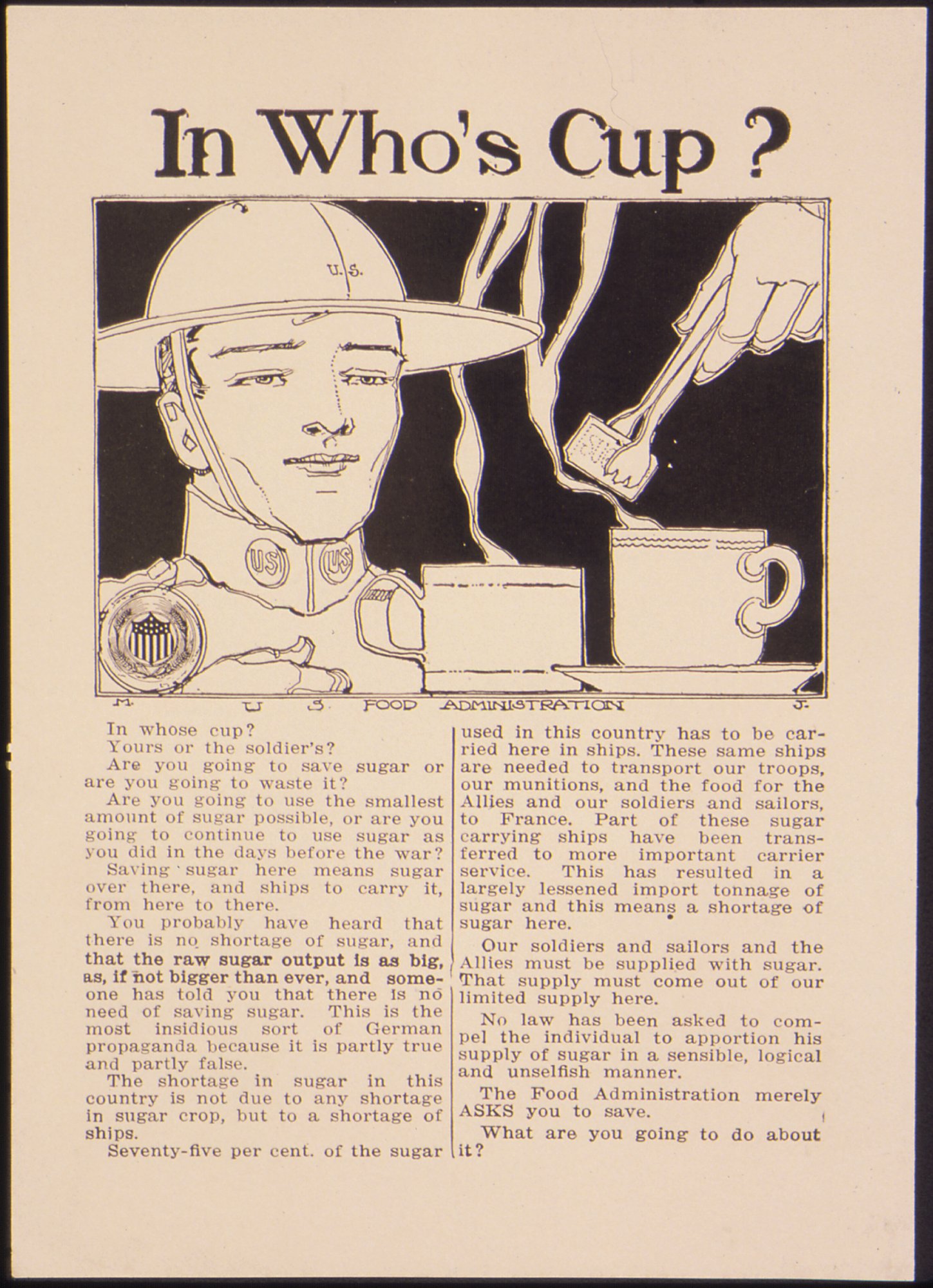
A black-and-white drawing shows a U.S. soldier in a helmet beside two cups, one of which receives a sugar lump held in tongs, under the question 'In Who's Cup?' The text argues that sugar saved at home means sugar and shipping for the troops and Allies, and that no law compels saving: the Food Administration 'merely ASKS.' The tell is the pairing of the soldier's face with the household sugar bowl, and the description of the claim that there is no shortage as 'German propaganda' that is 'partly true and partly false.'
Propaganda techniques used in this poster
- Date
- 1917
- Period
- First World War
- Made by
- U.S. Food Administration
- Region
- North America
- Country
- United States
- Medium
- Poster
- Issuer type
- State
- Regime
- Wilson Administration
- Leader
- Woodrow Wilson
- Audience
- Domestic public
- Purpose
- Mobilize or secure compliance
- Themes
- Home front, War and the military
- Event
- World War I
- Regime
- Wilson administration
- Leader
- Woodrow Wilson
- Source
- Identified Openly sourced: the speaker is who they say they are
- Source
- U.S. National Archives (NARA), RG 4 (U.S. Food Administration), World War I Posters (NAID 512439), retrieved October 3, 2026
- Rights
- NARA Unrestricted; hosted by owner decision
U.S. Food Administration. National Archives and Records Administration, 4-P-274.
Text on the object
In Who's Cup ?

M.   U S FOOD ADMINISTRATION   J.

In whose cup?
Yours or the soldier's?
Are you going to save sugar or are you going to waste it?
Are you going to use the smallest amount of sugar possible, or are you going to continue to use sugar as you did in the days before the war?
Saving sugar here means sugar over there, and ships to carry it, from here to there.
You probably have heard that there is no shortage of sugar, and that the raw sugar output is as big, as, if not bigger than ever, and someone has told you that there is no need of saving sugar. This is the most insidious sort of German propaganda because it is partly true and partly false.
The shortage in sugar in this country is not due to any shortage in sugar crop, but to a shortage of ships.
Seventy-five per cent. of the sugar used in this country has to be carried here in ships. These same ships are needed to transport our troops, our munitions, and the food for the Allies and our soldiers and sailors, to France. Part of these sugar carrying ships have been transferred to more important carrier service. This has resulted in a largely lessened import tonnage of sugar and this means a shortage of sugar here.
Our soldiers and sailors and the Allies must be supplied with sugar. That supply must come out of our limited supply here.
No law has been asked to compel the individual to apportion his supply of sugar in a sensible, logical and unselfish manner.
The Food Administration merely ASKS you to save.
What are you going to do about it?
Text on the sugar cube ('SU') and the 'U.S.' helmet and collar insignia are part of the drawing. The bold passage in the original ('that the raw sugar output is as big, as, if not bigger than ever, and some-one has told you that there is no need of saving sugar') is not marked here.