Content note: Insurgent newspaper issued during the 1916 Easter Rising, comparing British rule in Ireland to Prussian occupation. This object is shown as it was published. Why
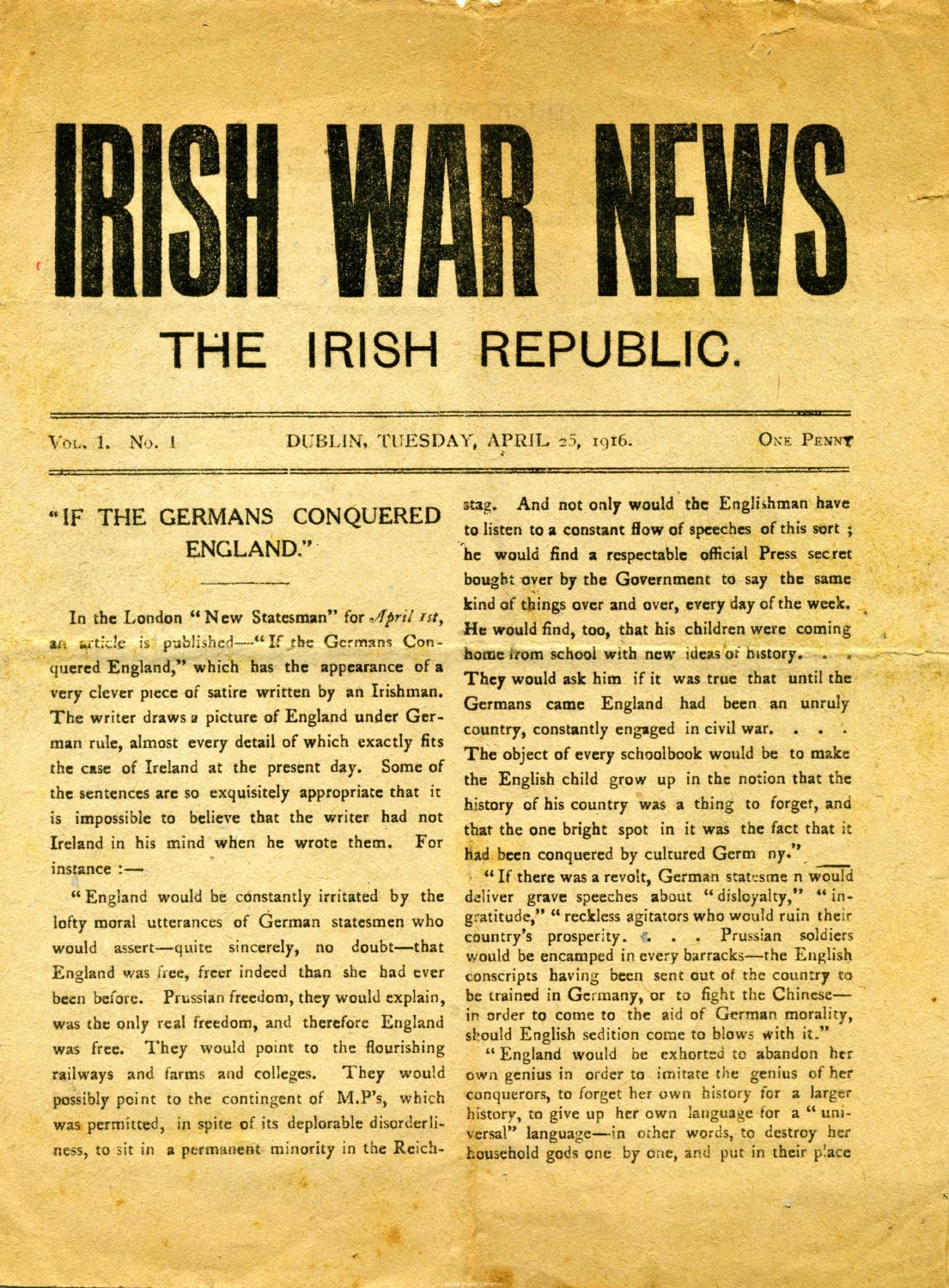
Irish War News, Vol. 1 No. 1, Dublin, 25 April 1916
Front page of the single-sheet news bulletin issued on the second day of the Easter Rising, headed 'The Irish Republic'. Lead article reprints passages from a London New Statesman satire, 'If the Germans Conquered England', and applies them to Ireland. Tell: the stigma of Prussian occupation, the enemy Britain was fighting, is pasted onto British rule by quoting a British journal.
- Date
- April 25, 1916
- Period
- First World War
- Made by
- Insurgent leadership of the Easter Rising (Provisional Government of the Irish Republic), Dublin
- Country
- United Kingdom
- Medium
- Newspaper pages
- Issuer type
- Movement
- Regime
- Asquith Government
- Leader
- Herbert Henry Asquith
- Audience
- Domestic public
- Purpose
- Persuade or win support
- Event
- Easter Rising
- Techniques
- Transfer
- Regime
- Asquith government
- Leader
- H. H. Asquith
- Source
- Identified Openly sourced: the speaker is who they say they are
- Source
- Internet Archive (Irish Republican Digital Archive; scan bears a South Dublin Libraries watermark), retrieved October 2, 2026
- Rights
- Public domain (published in Dublin 25 April 1916, before 1931; US PD by date)
Irish War News, Dublin, 25 April 1916; scan via the Irish Republican Digital Archive on the Internet Archive. The Internet Archive item page carries no rights statement; the basis is the publication date.
Text on the object
IRISH WAR NEWS
THE IRISH REPUBLIC.
Vol. 1.  No. 1.     DUBLIN, TUESDAY, APRIL 25, 1916.     One Penny

"IF THE GERMANS CONQUERED ENGLAND."

In the London "New Statesman" for April 1st, an article is published—"If the Germans Conquered England," which has the appearance of a very clever piece of satire written by an Irishman. The writer draws a picture of England under German rule, almost every detail of which exactly fits the case of Ireland at the present day. Some of the sentences are so exquisitely appropriate that it is impossible to believe that the writer had not Ireland in his mind when he wrote them. For instance :—

"England would be constantly irritated by the lofty moral utterances of German statesmen who would assert—quite sincerely, no doubt—that England was free, freer indeed than she had ever been before. Prussian freedom, they would explain, was the only real freedom, and therefore England was free. [...]"

[remainder of the page, a continuation of the quoted passages in the second column, not transcribed]
Masthead, dateline and the opening paragraphs read clearly; the second column continues the quotation and is not transcribed in full. The word 'Germany' at the end of the second column is damaged in the original.