Content note: Wartime British caption labelling German troops 'Huns' and describing the burning of Louvain, over a photograph of the town's skyline. This object is shown as it was published. Why
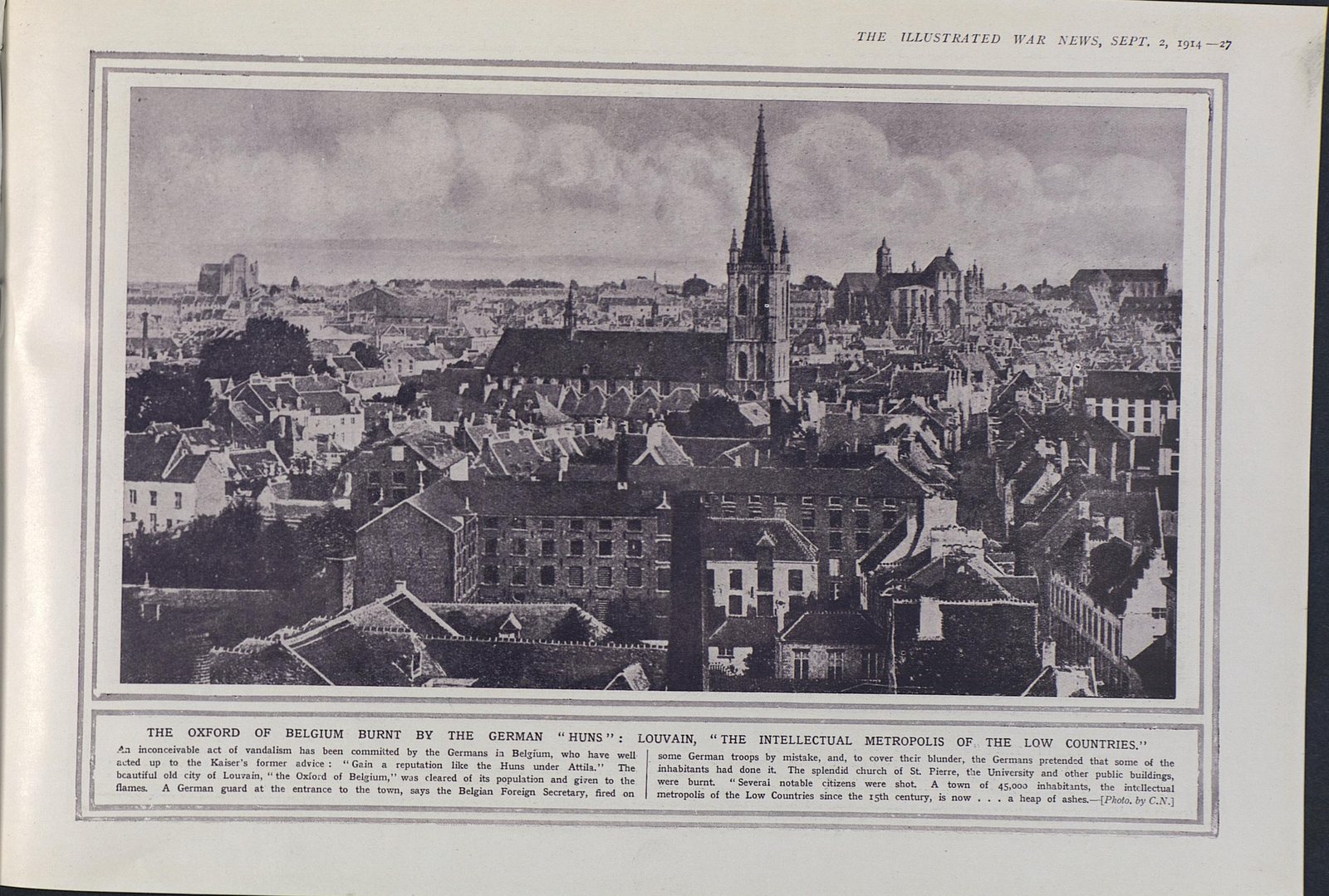
The Illustrated War News, 2 September 1914: "The Oxford of Belgium burnt by the German 'Huns'" (Louvain)
A full-page photograph of a town skyline under the headline 'The Oxford of Belgium burnt by the German "Huns"'. The caption quotes the Kaiser's 'Gain a reputation like the Huns under Attila' and applies the label to German troops. Tells: the loaded label sits in the headline; the photograph shows roofs and spires with no visible fire damage, so the image does not itself show the burning the headline states.
- Date
- September 2, 1914
- Period
- First World War
- Made by
- The Illustrated War News (Illustrated London News and Sketch, London)
- Country
- United Kingdom
- Medium
- Newspaper pages
- Issuer type
- Media
- Regime
- Asquith Government
- Leader
- Herbert Henry Asquith
- Audience
- Domestic public
- Purpose
- Demonize
- Event
- World War I
- Techniques
- Name-callingTransfer
- Regime
- Asquith government
- Leader
- H. H. Asquith
- Source
- Identified Openly sourced: the speaker is who they say they are
- Source
- Internet Archive (University of Florida Digital Collections copy), retrieved October 2, 2026
- Rights
- Out of copyright per IA/UF staff review; published London 1914 (before 1931)
The Illustrated War News (Illustrated London News and Sketch, London), 2 September 1914, p. 27. Internet Archive item illustratedwarne1121lond, digitised by the University of Florida; item rights field: 'Copyright status reviewed by UF staff - Out of copyright'.
Text on the object
THE ILLUSTRATED WAR NEWS, SEPT. 2, 1914.—27

THE OXFORD OF BELGIUM BURNT BY THE GERMAN "HUNS": LOUVAIN, "THE INTELLECTUAL METROPOLIS OF THE LOW COUNTRIES."

An inconceivable act of vandalism has been committed by the Germans in Belgium, who have well acted up to the Kaiser's former advice: "Gain a reputation like the Huns under Attila." The beautiful old city of Louvain, "the Oxford of Belgium," was cleared of its population and given to the flames. A German guard at the entrance to the town, says the Belgian Foreign Secretary, fired on some German troops by mistake, and, to cover their blunder, the Germans pretended that some of the inhabitants had done it. The splendid church of St. Pierre, the University and other public buildings, were burnt. "Several notable citizens were shot. A town of 45,000 inhabitants, the intellectual metropolis of the Low Countries since the 15th century, is now . . . a heap of ashes."—[Photo. by C.N.]
Caption read from a 1600-pixel crop; the printed text is clear. The photograph itself carries no text.