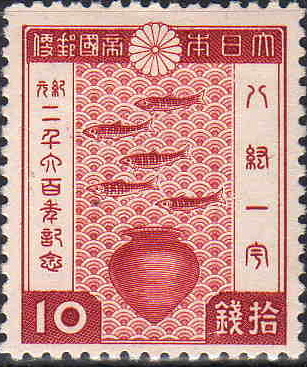
10 sen stamp for the 2600th year of the imperial era, inscribed 八紘一宇 (Hakkō ichiu) (1940)
A red Japanese 10 sen stamp for the 2600th year of the imperial era. The imperial chrysanthemum crest sits at top centre, five fish swim above a jar on a wave pattern, and the slogan 八紘一宇 (hakkō ichiu) runs down the right-hand panel. The tags rest on the crest and founding-myth imagery placed beside the slogan (transfer) and on the slogan itself, a virtue phrase that names no testable aim (glittering generalities).
- Date
- 1940
- Period
- Second World War
- Made by
- Imperial Japanese Ministry of Communications (逓信省), postal authority of the Empire of Japan
- Region
- East Asia
- Country
- Empire of Japan
- Medium
- Stamp
- Issuer type
- State
- Regime
- Showa Japan
- Leader
- Mitsumasa Yonai
- Audience
- Domestic public
- Purpose
- Commemorate
- Themes
- Empire and colonialism, Religion
- Event
- Kigen 2600 Celebrations
- Techniques
- TransferGlittering generalities
- Source
- Identified Openly sourced: the speaker is who they say they are
- Source
- Wikimedia Commons (scan of the stamp, own stamp collection of the uploader), retrieved September 29, 2026
- Rights
- Public domain (Commons: PD-Japan-organization + PD-1996; 1940 stamp of a Japanese government body)
Japan Post (Imperial Ministry of Communications), 2600th year of the Japanese Imperial Calendar 10 sen stamp, 1940, public domain, via Wikimedia Commons
Text on the object
大日本帝國郵便
八紘一宇
紀元二千六百年記念
10
拾錢
Great Japan Imperial Postage
Hakkō ichiu (roughly: the eight directions under one roof)
Commemoration of the 2600th year of the imperial era
10
Ten sen
Read from the 307 by 367 pixel scan. The top inscription runs right to left across the chrysanthemum crest (大日本 to the right of it, 帝國郵便 to the left); the slogan and the commemoration text run top to bottom in the side panels. The translation is machine-made and not checked by a fluent reader of Japanese.