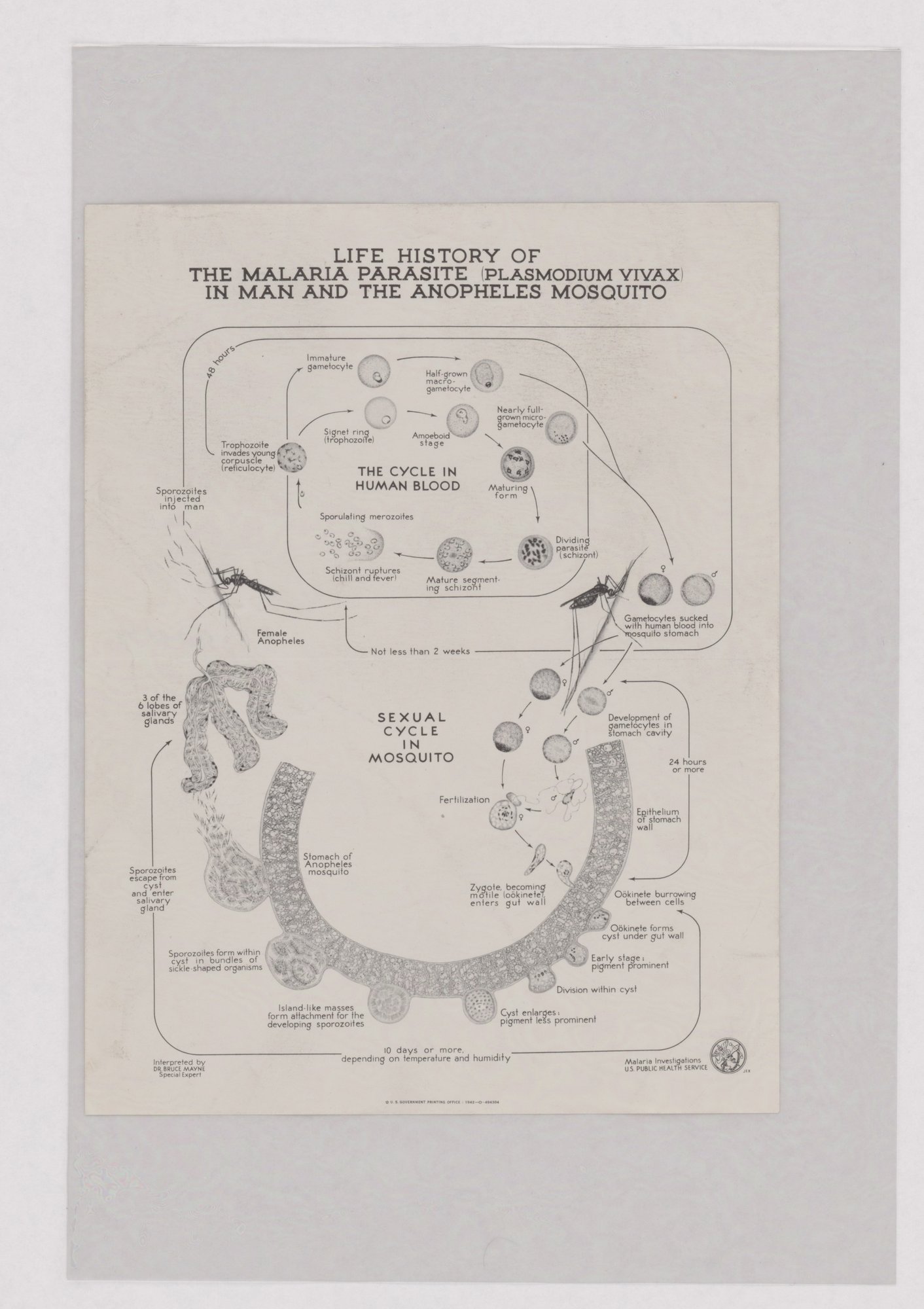
Life history of the malaria parasite (Plasmodium vivax) in man and the Anopheles mosquito
Black-and-white scientific chart tracing the malaria parasite through a human blood cycle and a sexual cycle in the mosquito, with arrows, time spans and labelled stages. It is an explanatory diagram rather than a persuasion piece; the technique is faint, limited to the borrowed authority of the Public Health Service seal and a named expert.
Propaganda techniques used in this poster
- Date
- 1942
- Period
- Second World War
- Made by
- U.S. Public Health Service, Malaria Investigations (interpreted by Dr. Bruce Mayne)
- Region
- North America
- Country
- United States
- Medium
- Poster
- Issuer type
- State
- Regime
- Roosevelt Administration
- Leader
- Franklin D. Roosevelt
- Audience
- Mixed
- Purpose
- Warn or inform
- Themes
- Health, Science and technology
- Event
- World War II
- Regime
- Roosevelt administration
- Leader
- Franklin D. Roosevelt
- Source
- Identified Openly sourced: the speaker is who they say they are
- Source
- U.S. National Archives and Records Administration, Record Group 44, World War II Posters, retrieved October 4, 2026
- Rights
- Public domain (U.S. government work)
U.S. Public Health Service, Malaria Investigations. National Archives and Records Administration, RG 44, 44-PA-1286 (NAID 514892).
Text on the object
LIFE HISTORY OF
THE MALARIA PARASITE (PLASMODIUM VIVAX)
IN MAN AND THE ANOPHELES MOSQUITO

The cycle in human blood
48 hours
Immature gametocyte
Half-grown macro-gametocyte
Nearly full-grown micro-gametocyte
Trophozoite invades young corpuscle (reticulocyte)
Signet ring (trophozoite)
Amoeboid stage
Maturing form
Dividing parasite (schizont)
Sporulating merozoites
Schizont ruptures (chill and fever)
Mature segmenting schizont
Sporozoites injected into man
Female Anopheles
Not less than 2 weeks
Gametocytes sucked with human blood into mosquito stomach

SEXUAL CYCLE IN MOSQUITO
Development of gametocytes in stomach cavity
24 hours or more
Fertilization
Epithelium of stomach wall
Zygote, becoming motile (ookinete), enters gut wall
Ookinete burrowing between cells
Ookinete forms cyst under gut wall
Early stage; pigment prominent
Division within cyst
Cyst enlarges; pigment less prominent
Island-like masses form attachment for the developing sporozoites
Sporozoites form within cyst in bundles of sickle-shaped organisms
Stomach of Anopheles mosquito
Sporozoites escape from cyst and enter salivary gland
3 of the 6 lobes of salivary glands
10 days or more, depending on temperature and humidity

Interpreted by
DR. BRUCE MAYNE
Special Expert

Malaria Investigations
U.S. PUBLIC HEALTH SERVICE

[imprint:] U. S. GOVERNMENT PRINTING OFFICE : 1942-O-494304