Loose Lips Might Sink Ships
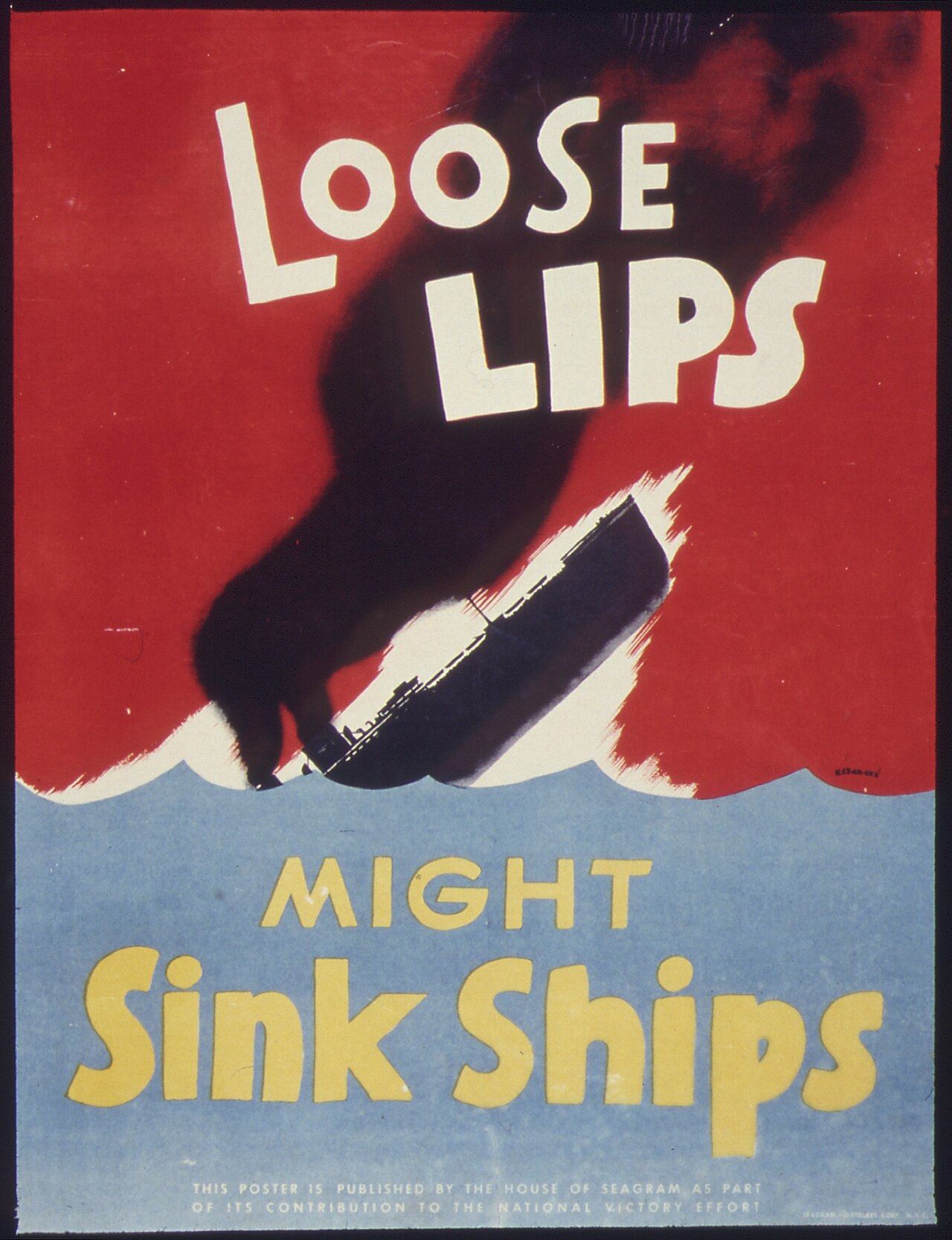
A sinking, burning ship fills the frame under a slogan warning that idle conversation causes naval losses. The claim collapses the many real causes of a sinking (U-boats, weather, mechanical failure) into one attributable cause the viewer can personally control by staying silent.
A 1942 U.S. home-front security poster, published by the House of Seagram (Seagram-Distillers Corp., New York) as its stated contribution to the national victory effort. A sinking, burning ship fills the frame under the slogan 'Loose Lips Might Sink Ships'. It asks civilians to avoid idle talk. The fear appeal is built on a burning ship, and card stacking is tagged because the sinking is attributed to one cause, careless talk.
Propaganda techniques used in this poster
- Date
- 1942
- Period
- Second World War
- Made by
- U.S. government home-front security campaign
Full record
Region, Country, Medium, Issuer type, Regime, Leader, Audience, Purpose, Themes, Event, Source, Rights
- Region
- North America
- Country
- United States
- Medium
- Poster
- Issuer type
- State
- Regime
- Roosevelt Administration
- Leader
- Franklin D. Roosevelt
- Audience
- Domestic public
- Purpose
- Warn or inform
- Themes
- Security and surveillance, Home front, War and the military
- Event
- World War II
- Regime
- Roosevelt administration
- Leader
- Franklin D. Roosevelt
- Source
- Identified Openly sourced: the speaker is who they say they are
- Source
- U.S. National Archives and Records Administration (NARA), via Wikimedia Commons, retrieved September 25, 2026
- Rights
- Public domain (U.S. government work)
U.S. National Archives and Records Administration, War and Conflict Number 830 (1941-1945).
Text on the object
Original (English) · read from the image, not independently checked
LOOSE LIPS

MIGHT
Sink Ships

THIS POSTER IS PUBLISHED BY THE HOUSE OF SEAGRAM AS PART OF ITS CONTRIBUTION TO THE NATIONAL VICTORY EFFORT

SEAGRAM-DISTILLERS CORP., N.Y.C.
The last line (bottom right corner, in very small print) is faint in this scan; read with reasonable but not full confidence.