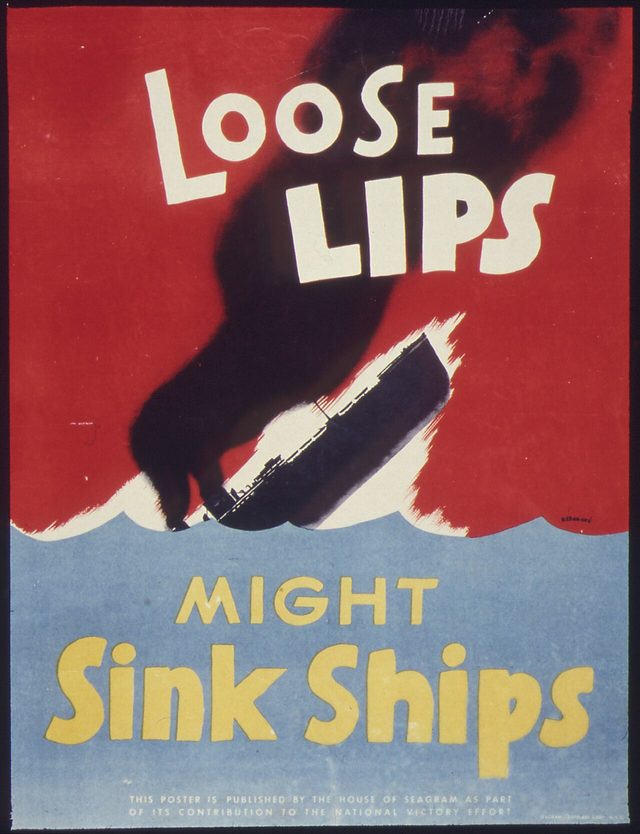
Also called Thought-stopper, Semantic stop-sign, Conversation-stopper, Language of non-thought, Slogan as argument
A short, familiar, definitive-sounding phrase offered in place of an answer, so that a question or objection ends instead of being examined.
How to spot Thought-terminating cliché: the tell
The phrase is given in reply to an objection and contains no reason; asked for the evidence, the speaker can only repeat it.
What Thought-terminating cliché is not
A short slogan that summarises a case already made, comforts the grieving, or rallies a group, and that the speaker will still unpack when asked.
History and effect of Thought-terminating cliché propaganda
Lineage: Robert Jay Lifton, Thought Reform and the Psychology of Totalism (1961), 'loading the language'
Where the term comes from
The term was made by the American psychiatrist Robert Jay Lifton in Thought Reform and the Psychology of Totalism (W. W. Norton, 1961). The book grew out of interviews, in the early 1950s, with people who had been through Chinese Communist indoctrination programmes, including Chinese university students and Westerners who had been held in China. In its twenty-second chapter, "Ideological Totalism", Lifton listed eight features of an environment that tries to control how people think. The sixth he called "loading the language". Its central passage reads: "The language of the totalist environment is characterized by the thought-terminating cliché. The most far-reaching and complex of human problems are compressed into brief, highly reductive, definitive-sounding phrases, easily memorized and easily expressed. They become the start and finish of any ideological analysis" (Lifton 1961, p. 429). He also called this style "the language of non-thought".
Explain moreShow less
Two things follow from the wording. First, the cliché is defined by its job, not by its content: it is the phrase that is "the start and finish" of the analysis. Second, the book was a study of one setting, Chinese thought reform. Since then the term has been used much more widely, for religious and self-help groups, for political movements of every kind and for everyday conversation, and it has been applied in retrospect to the language Orwell imagined in Nineteen Eighty-Four and to Hannah Arendt's account of Adolf Eichmann (Wikipedia, "Thought-terminating cliché", summarising these uses). That spread is also the technique's main hazard as a label: it is easy to call any phrase one dislikes a thought-terminating cliché. This page therefore keeps to the narrow test above and marks as contested every modern case where the two sides of an argument each say the other is doing it.
How Thought-terminating cliché propaganda works
A speaker compresses a complicated question into a few words that most listeners in the audience already accept. When a listener raises an objection, the speaker says the phrase instead of the reasons behind it. The phrase works if the audience hears it as a conclusion that everyone present already shares, so that repeating the objection looks naive, disloyal or rude.
Explain moreShow less
Four features recur across the cases below.
- Brevity and familiarity. The phrase is short enough to be repeated at once and familiar enough that it needs no explanation. Repetition and the illusory truth effect is what makes it familiar.
- Finality. It is phrased as a closed verdict ("is always right", "no alternative", "it is what it is"), not as a claim with a reason.
- A place in the conversation. It is deployed at the point where an objection is raised. The same words used as a banner or a toast are a slogan; the same words used to answer "why?" are the cliché.
- A social cost for continuing. After the phrase, asking again costs the asker something: standing in the group, a charge of disloyalty, or a reputation for being obtuse.
The technique is close to several neighbours. Loaded language charges individual words with feeling; a thought-terminating cliché is a whole phrase working as a full stop. Glittering generalities are virtue words few would reject; they become clichés in this sense when they are used to shut out a question, as in "support the troops". False dilemma is often built into the phrase ("love it or leave it", "better dead than red"), so one phrase can be both. Semantic hijacking changes what a word means; the cliché uses a word's existing meaning as a wall. Identity fusion gives the phrase its force: when the group's identity is bound up with the line, questioning the line feels like leaving the group. Name-calling ends a debate by attacking a person; the cliché ends it by invoking a settled truth.
Why Thought-terminating cliché propaganda works
Several well-studied features of ordinary thinking make short phrases effective stoppers. People tend to prefer a quick, fluent answer to an open question, and a phrase heard many times feels more true because it is easy to process. Belonging matters too: where a group's members share a phrase, repeating it signals membership, and objecting to it signals the opposite. The research on this is summarised in the Learn library under Cognitive biases and heuristics and Group identity. A phrase also saves effort for everyone in the exchange, including a speaker who has no reason to give. This is why the technique appears in democracies and dictatorships alike, and why its use by sincere speakers cannot be separated from its use by calculating ones from the words alone.
Explain moreShow less
Scale differs sharply between settings. In the Soviet, Nazi, Italian and Chinese cases below, the phrase was backed by a state that controlled the press, the schools and the courts, and a person who kept asking could lose employment, liberty or life. In the modern democratic cases, an unpersuaded listener can answer back, publish a rebuttal or vote against the speaker. The mechanism is the same in kind. The cost of not accepting it is not.
Thought-terminating cliché propaganda examples across eras and sides
- China, 1966 (Chinese Communist Party leadership). On 1 August 1966 Mao Zedong wrote a letter to the Red Guards of the middle school attached to Tsinghua University, saying he enthusiastically supported their rebellion against reactionaries and that it was right to rebel; the letter appears in the Marxists Internet Archive's edition of his Selected Works, volume 9. Historians describe it as an endorsement that sharply escalated Red Guard violence in the weeks that followed, a period often called "Red August" (Alpha History; The China Project, 16 August 2023). The letter is a leader's endorsement used as a warrant, not a cliché in itself; it is included because Lifton's category was formed from the language of Chinese Communist thought reform, and the later period's stock phrasing is visible in the Xinjiang poster "We never stop praising the thoughts of our Chairman Mao" (museum title), Xinjiang poster.
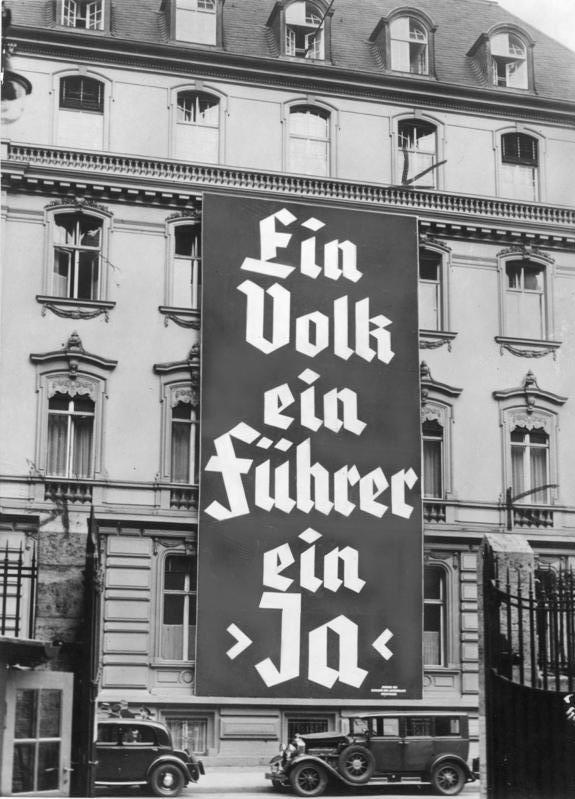
- Nazi Germany, 1941 (NSDAP propaganda department). "Der Führer hat immer recht" ("The Führer is always right") was one of the weekly slogans issued by the Reichspropagandaleitung in its Wochenspruch series, which ran from July 1937 to April 1945 and was posted in offices, schools, hospitals and restaurants (University of Groningen library note; Wikimedia Commons file "Der Führer Hat Immer Recht", 1941). The phrase answers any doubt about a policy by pointing at the person who set it. The 1933 banner "Ein Volk, ein Führer, ein Ja" (below) uses the same logic for a vote.
- Fascist Italy, 1930s (National Fascist Party). "Mussolini ha sempre ragione" ("Mussolini is always right") was a standard slogan of the regime, appearing in fascist decalogues and painted or displayed on walls and at exhibitions, including at the entrance of an autarky exhibition in Rome (Carlo Galeotti, Mussolini ha sempre ragione: I decaloghi del fascismo, Garzanti, 2000; Italian Ministry of Culture catalogue record for a propaganda poster with the motto). Which decalogue first used the line is unclear in the sources found, so none is named here. The school photograph "Credere Obbedire Combattere": a school group photograph, Mirandola, 1938 shows the companion slogan "Credere, obbedire, combattere" ("Believe, obey, fight") in a classroom setting.
Show all 12Show fewer
- Soviet Union, 1970s (Communist Party of the Soviet Union). Rooftop and banner slogans such as "Да здравствует Коммунистическая партия Советского Союза!" ("Long live the Communist Party of the Soviet Union!") filled the visual space of Soviet cities (Fortepan photographs, below and Slogan banners at a rally on Lenin Square, Gomel: "Слава КПСС!" (Glory to the CPSU!)). On their own they are acclamation, not argument, and this page does not call a banner a thought-terminating cliché. They are the stock of phrases that officials could cite when a question about policy was raised, which is where the technique begins.
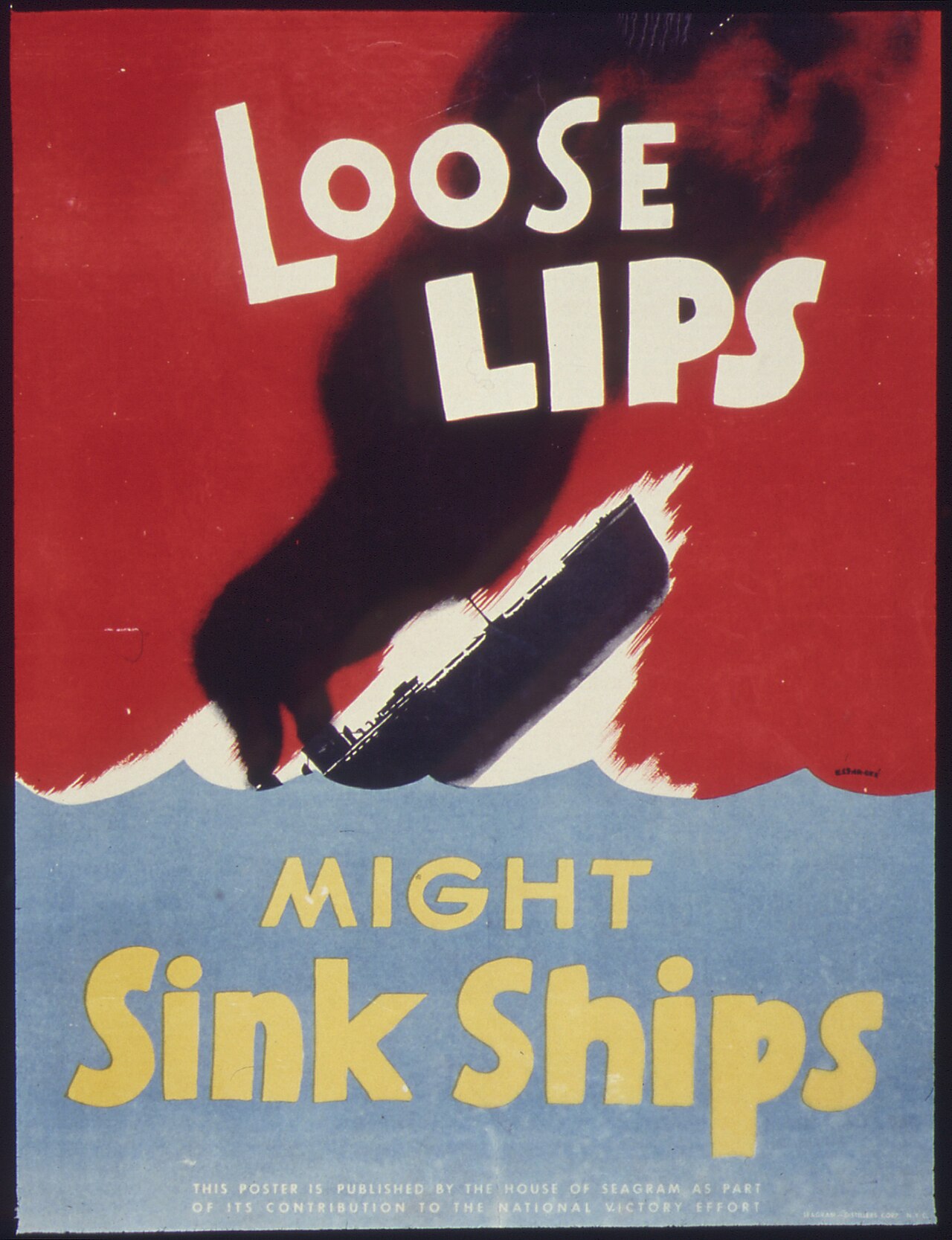
- United States, 1942 (federal home-front security campaign). "Loose lips might sink ships" (poster below) was one of several wartime security slogans in the United States and Britain (see also Your Talk May Kill Your Comrades and Don't Kill Americans by Careless Talk!). It is brief and final, and it was used to stop casual talk about ship movements. It is also the clearest example in this archive of the edge case discussed below: the instruction rested on a real security concern, the speaker could explain it if asked, and the stakes of ending the talk were stated on the poster. The archive entry notes that the poster compresses the several real causes of a sinking into one that the viewer can control by staying silent.
- United States, c. 1970 (private citizens, bumper stickers). "America, love it or leave it" was a bumper-sticker slogan of the Vietnam period, directed at anti-war protesters; the Smithsonian's National Museum of American History holds a c. 1970 sticker and describes this use. Its origin is murky and some sources trace it back to the McCarthy era (Smithsonian object record; Washington Times, 17 July 2019). The phrase turns a criticism of a policy into a disloyalty test with two exits, stay or leave, and the wording lists no third option such as staying and objecting.
- Cold War, 1950s and after (anti-communists and the nuclear disarmament movement). "Better dead than red" and its reply "Better red than dead" compress the whole question of nuclear policy into a single choice between two outcomes. The anti-communist version became popular in the United States in the McCarthy era (the first known English use, in 1930, was sarcastic); the reply was taken up by the Campaign for Nuclear Disarmament, though Bertrand Russell, often credited with it, attributed it in a 1961 book to "West German friends of peace" (Wikipedia, "Better dead than red", for both). Each slogan, used as an answer to the other side's reasons, ends the discussion. This is the only example here where the same device is documented on both sides of one dispute.
- United Kingdom and Germany, 1980 and 2010 (Conservative government; Christian Democratic chancellor). Margaret Thatcher said to the Conservative Women's Conference on 21 May 1980 that she believed "people accept there's no real alternative"; the line gave rise to the nickname "TINA" (coined, according to Wikipedia, by the Conservative minister Norman St John-Stevas). In 2001 Susan George proposed the opposing slogan "another world is possible". In Germany the word alternativlos ("without alternative"), which Chancellor Angela Merkel had used about aid to Greece, was named the 2010 "Unwort des Jahres" (un-word of the year). The jury's stated reason was that it suggests decisions have no alternatives, so that discussion and argument become unnecessary, which it said can feed disenchantment with politics (jury announcement of 18 January 2011, reported by Stuttgarter Zeitung and others; jury named no person). Thatcher presented her support for markets as a moral argument about freedom of choice; the claim of "no alternative" has also been made about austerity by David Cameron (2013) and by Christine Lagarde (May 2013) (Wikipedia, "There is no alternative").
- United States and elsewhere, 2020 to 2022 (officials of several governments; contested). "Follow the science" was invoked by political leaders in the United States, Canada, Australia and the United Kingdom to justify pandemic rules. A peer-reviewed analysis (MacAulay and others) of the use in Australia, Canada and the United Kingdom in March to September 2020 found it often deflected responsibility onto process and experts (Policy and Politics, 2023). Commentators across the spectrum, including the physician and CNN analyst Leana Wen, wrote that the slogan fuels distrust, and a Rutgers law professor, Jacob Hale Russell, said it came to mean "our policy is the right policy and there is no alternative" (Washington Post and Dominion Post, 2022). This page labels the case contested: public health officials and many scientists regard "follow the science" as a fair shorthand for relying on evidence, and the criticism is of how some politicians used it, not of the principle. The phrase is also thrown back with sarcasm by opponents of the same policies, which is the same cliché in reverse.
- Online communities, 2010s and after (several online communities across the political spectrum; contested). "Do your own research" has been used in reply to requests for evidence. A study in the Harvard Kennedy School Misinformation Review found that support for doing one's own research was associated with COVID-19 misperceptions and mistrust of science, and the University of Wisconsin summary warned that such messages can "promote skepticism in the guise of being informed and independent". A study in Nature (Aslett and colleagues, vol. 625, 2024) found that searching online to check a false article raised the chance of believing it, because searchers could land in "data voids". Against the stereotype, a philosophy paper notes that contrarian theorists are in fact likely to do their own research, and that the label "conspiracy theorist" is itself contested. The phrase is a cliché when it replaces the source the speaker could name; it is ordinary advice when a source is named.
- Everyday speech, any country (contested). "It is what it is" is listed in the Wikipedia article on the term as a tautology implying that nothing more can usefully be said. "Let's agree to disagree" and "here we go again" are listed alongside it. Each is useful when two people have genuinely reached the end of a conversation, and each is a stopper when it is said in the middle of an argument that has not ended. This is where the technique shades into the ordinary politeness of closing a conversation.
- United States, 2007 to 2023 (politicians and critics; contested). "Our thoughts and prayers are with the victims" is a standard response after disasters and mass shootings, used by politicians of both parties including Barack Obama through most of his presidency. In October 2015, after the Umpqua Community College shooting, Obama said "thoughts and prayers are not enough". Critics, among them Katrina vanden Heuvel (The Nation, 2007), Senator Chris Murphy (December 2015) and New Jersey governor Phil Murphy (May 2022), argue that the phrase ends debate about legislation. Defenders, among them Katelyn Beaty (The Atlantic, October 2017) and Mike Huckabee (August 2019), argue that it is a sincere expression of grief and that critics politicise tragedy (Wikipedia, "Thoughts and prayers", citing these). Critics use the shorthand "now is not the time" for the related move of deferring policy talk. The reply "move beyond thoughts and prayers" is itself a short phrase that can be used to stop a conversation about prayer, and this page does not decide which use is sincere in a given case.

Explain moreShow less
"Loose Lips Might Sink Ships", U.S. government home-front security campaign poster, 1942. U.S. National Archives and Records Administration (War and Conflict Number 830), via Wikimedia Commons. Public domain (U.S. government work). The slogan is short, final and aimed at stopping talk; the security concern behind it was real, which is why this page treats it as an edge case.
"Ein Volk, ein Führer, ein Ja" ("One people, one leader, one Yes"), NSDAP banner on Voßstraße, Berlin, for the single-list Reichstag election and referendum of 12 November 1933. Bundesarchiv, Bild 183-K0930-502. CC BY-SA 3.0 DE. The slogan makes a No vote read as a break with the nation.
"Да здравствует Коммунистическая партия Советского Союза!" ("Long live the Communist Party of the Soviet Union!"), rooftop lettering on an apartment block beside the Moskva River, Moscow, 1975. Fortepan / Urbán Tamás, ID 89340. CC BY-SA 3.0. An acclamation that makes no testable claim; it shows the stock of phrases the technique draws on, not a cliché used in an argument.
Gaps. No sourced case from Latin America, the Arab world, South or Southeast Asia, or Africa is included yet; the definition applies unchanged and sourced cases will be added when found. The modern list is uneven: it has more traced cases from right-leaning and from non-partisan sources than from the left, because the left-coded slogans that critics call thought-terminating (for example "silence is violence" or "check your privilege") were not traced to a documented primary source in this pass. The same test applies to them, and they will be added when sourced, under the same contested label.
How to spot Thought-terminating cliché propaganda
- The answer test. After the phrase, ask "and what is the evidence for that?" If the speaker can unpack the phrase into reasons and sources, it was shorthand. If the only reply is to say the phrase again, or to question the asker's motives, it was a stopper.
- The placement test. Note when it is said. A phrase offered after a question is a different thing from the same phrase on a banner.
- The expansion test. Rewrite the phrase as an open claim with a number, a name or a date in it. If that rewrite is easy, the phrase was a summary. If the claim falls apart when it has to stand on its own, the phrase was doing the work.
Show all 7Show fewer
- The swap-sides test. Imagine the same phrase used by the opposing side about the opposing side's position, and ask whether you would accept it as a full answer. If not, you should not accept it from your own side either.
- The cost test. Check what it costs the asker to go on. In a free setting the cost is social embarrassment. In a controlled one it can be a job or worse, and that difference should be stated whenever the two are compared.
- The exits test. Does the phrase leave the listener only two ways out (agree, or be outside the group)? If so, see also False dilemma.
- Apply the same tests to phrases from your own side and your own team.
Where Thought-terminating cliché propaganda ends: edge cases and legitimate persuasion
8 items · A short slogan is not a thought-terminating cliché. A slogan that summarises a case…
- A short slogan is not a thought-terminating cliché. A slogan that summarises a case already made ("Remember the Alamo", "Votes for women") is a label for an argument that exists. The test is whether the argument can still be produced on request.
- Summaries are allowed. "Wash your hands" is short, final and a complete instruction, and the evidence behind it is easy to give. Brevity is not the problem; refusing to give the reason when asked is.
- Comfort is not argument. "Everything happens for a reason", "I'm sorry for your loss" and "our thoughts are with you" are often meant as comfort, not as a way of closing a discussion, and a grieving person may want nothing more. Treating every such phrase as a stopper confuses a social ritual with a technique. Whether a phrase is comfort or evasion often depends on what the speaker does next, which the text alone cannot show.
- Ending a conversation can be legitimate. "Let's agree to disagree" and "it is what it is" are appropriate when two people have exhausted a disagreement or when a fact cannot be changed. The technique is the case where the phrase is used before the reasons have been given.
- Security and safety rules can be absolute for good reason. "Loose lips might sink ships" asked people not to talk, on the strength of a concern that was real and could be explained after the fact. A rule of that kind is not a cliché in Lifton's sense unless the explanation is withheld and questions are punished.
- Expert shorthand. "Trust the evidence" or "follow the science" can be fair shorthand when the speaker is ready to cite the studies. The use of the phrase is what this page examines, not the principle.
- Dissent is also compressed. Protest chants and the slogans of opposition movements are short too. A chant that stands in for an argument and is directed at silencing a question belongs under the same test, whatever its politics.
- Neighbouring techniques. If the issue is that a single word is charged, see Loaded language. If a phrase offers only two options, see False dilemma. If a virtue word is offered with no content, see Glittering generalities. If a mild word hides a harsh fact, see Euphemism / doublespeak.
Sources and further reading
Sources
13 items · Lifton, Robert Jay. Thought Reform and the Psychology of Totalism: A Study of…
- Lifton, Robert Jay. Thought Reform and the Psychology of Totalism: A Study of "Brainwashing" in China. W. W. Norton, 1961; University of North Carolina Press reprint, 1989. Chapter 22, "Ideological Totalism" (the passage on the thought-terminating cliché is on p. 429 as cited in the secondary sources below; the book itself was not opened for this page).
- Wikipedia. "Thought-terminating cliché" (Lifton quotation and page; later applications by Bufe 1997, Delgado 1978, Bennett 2017, Taylor 2004; examples and caveats). https://en.wikipedia.org/wiki/Thought-terminating_clich%C3%A9
- Wikipedia. "Thought Reform and the Psychology of Totalism" (the eight criteria, in order, with "loading the language" sixth; publisher and year). https://en.wikipedia.org/wiki/Thought_Reform_and_the_Psychology_of_Totalism
- Mao Zedong. "A Letter to the Red Guards of Tsinghua University Middle School", 1 August 1966. Marxists Internet Archive, Selected Works vol. 9. https://www.marxists.org/reference/archive/mao/selected-works/volume-9/mswv9_60.htm ; Alpha History, "Mao's letter to Red Guards at Qinghua School (1966)". https://alphahistory.com/chineserevolution/mao-letter-red-guards-qinghau-1966/ ; The China Project, "Mao's Cultural Revolution turns deadly", 16 August 2023. https://thechinaproject.com/2023/08/16/maos-cultural-revolution-turns-deadly/
- University of Groningen Library. "Nazi Propaganda in the UB" (the NSDAP weekly slogan series, July 1937 to April 1945). https://www.rug.nl/library/gauronica/blogposts/nazi-propaganda ; Wikimedia Commons, "File:Der Führer Hat Immer Recht.jpg" (Reichspropagandaleitung, Wochenspruch der NSDAP, 1941). https://commons.wikimedia.org/wiki/File:Der_F%C3%BChrer_Hat_Immer_Recht.jpg
- Decaloghi del fascismo. Garzanti, 2000 (the US Holocaust Memorial Museum catalogue confirms this Garzanti title; the author and subtitle attribution to Carlo Galeotti is as given in the Italian catalogue and was not independently confirmed). Italian Ministry of Culture, General Catalogue of Cultural Heritage, record for a propaganda poster with the motto "Mussolini ha sempre ragione". https://catalogo.beniculturali.it/detail/HistoricOrArtisticProperty/0500655692
- Smithsonian National Museum of American History. "Bumper Sticker, 'America, Love it or Leave it'" (c. 1970). https://americanhistory.si.edu/collections/object/nmah_1423537 ; Washington Times, "America, love it or leave it (again)", 17 July 2019. https://www.washingtontimes.com/news/2019/jul/17/america-love-it-or-leave-it-again/
- Wikipedia. "Better dead than red" (Russell's 1961 attribution; spread of both slogans). https://en.wikipedia.org/wiki/Better_dead_than_red
- Wikipedia. "There is no alternative" (Thatcher, 21 May 1980; St John-Stevas; Susan George 2001; Cameron and Lagarde 2013). https://en.wikipedia.org/wiki/There_is_no_alternative
- Jury "Unwort des Jahres". Announcement of "alternativlos" as Unwort des Jahres 2010, 18 January 2011, and its reasoning, as reported in Stuttgarter Zeitung and Wikinews (German). https://de.wikinews.org/wiki/Deutsche_Sprache:Das%E2%80%9EUnwort_des_Jahres_2010%E2%80%9C_lautet_%E2%80%9Ealternativlos%E2%80%9C
- MacAulay, Margaret, Patrick Fafard, Adèle Cassola and Michèle Palkovits. Policy & Politics (2023), "Analysing the 'follow the science' rhetoric of government responses to COVID-19" (2023). https://bristoluniversitypressdigital.com/view/journals/pp/51/3/article-p466.xml ; Wen, Leana, in the Washington Post, as reported by Fox News; Dominion Post, "'Follow the science' is a slogan, not policy", 26 February 2022. https://www.dominionpost.com/2022/02/26/follow-the-science-is-a-slogan-not-policy/
- Harvard Kennedy School Misinformation Review. "Support for 'doing your own research' is associated with COVID-19 misperceptions and scientific mistrust." https://misinforeview.hks.harvard.edu/article/support-for-doing-your-own-research-is-associated-with-covid-19-misperceptions-and-scientific-mistrust/ ; Aslett, Kevin, and others. "Online searches to evaluate misinformation can increase its perceived veracity." Nature 625, 2024. https://www.nature.com/articles/s41586-023-06883-y
- Wikipedia. "Thoughts and prayers" (Obama 2015; vanden Heuvel 2007; Murphy 2015 and 2022; Beaty 2017; Huckabee 2019). https://en.wikipedia.org/wiki/Thoughts_and_prayers
Sourcing note (11 October 2026): search results and Wikipedia pages cited above were read; the Lifton page number, the Mao letter text, the Aslett study, the Policy and Politics article, the Misinformation Review study, the Groningen blog and the Galeotti book (its author attribution is unconfirmed) were not opened in full, and rest on the summaries and records named. Which decalogue first carried the Mussolini slogan, the origin of "love it or leave it" and Trotsky's reported 1924 remark that the Party is always right could not be confirmed; the first two are marked unclear and the third is left out. No claim is made about Soviet speeches beyond the banners shown. The bias panel has not been run on this draft.
The science
Research on the psychology this technique relies on, from the Learn library:
Research on the psychology this technique relies on, from the Learn library:
- Cognitive biases and heuristics — Cognitive biases
- Group identity — Group identity