Content note: 1863 insurgent proclamation that calls the ruling power an 'invading government' and ends by contrasting European civilization with the 'wild barbarism of Asia', language aimed at Russians. This object is shown as it was published. Why
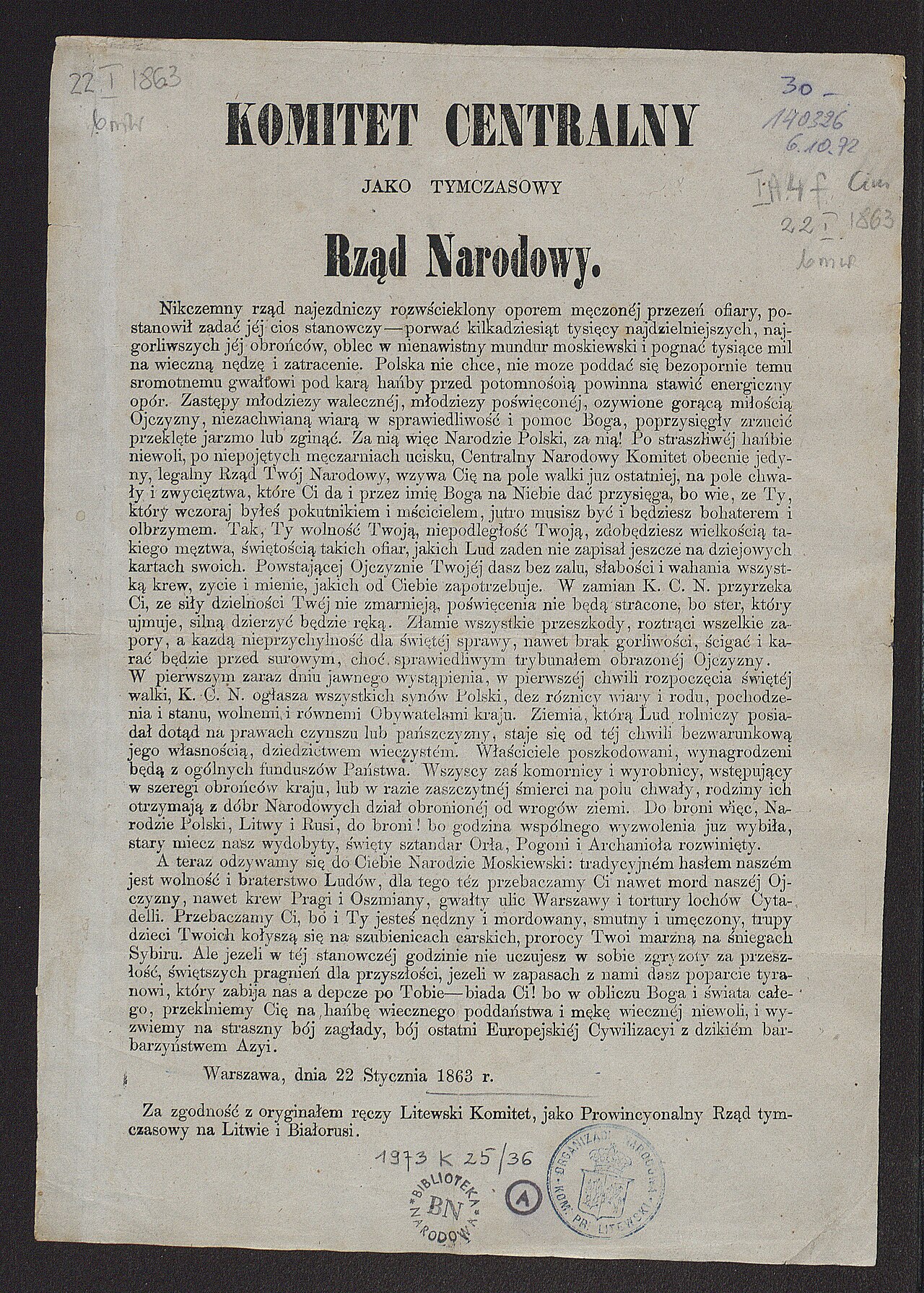
Komitet Centralny jako Tymczasowy Rząd Narodowy: Manifest (Central Committee as Provisional National Government: Manifesto of 22 January 1863)
A single printed sheet in Polish, headed 'Central Committee as Provisional National Government', calls the 'People of Poland, Lithuania and Rus' to arms, declares all inhabitants free and equal citizens and promises peasants their land, then addresses the Russian people directly. It labels the ruling power a 'vile invading government' and ends by framing the fight as a last battle of European Civilization against the 'wild barbarism of Asia'.
- Date
- January 22, 1863
- Period
- Pre-1914
- Made by
- Central National Committee (Komitet Centralny Narodowy), acting as the Provisional National Government of the January Uprising; this copy certified by the Lithuanian Committee
- Country
- Russian Empire
- Medium
- Leaflet
- Issuer type
- Movement
- Regime
- Russian Empire
- Leader
- Alexander II
- Audience
- Mixed
- Event
- January Uprising
- Techniques
- Name-callingGlittering generalities
- Source
- Identified Openly sourced: the speaker is who they say they are
- Source
- Wikimedia Commons (scan from Polona, National Library of Poland), retrieved October 2, 2026
- Rights
- Public domain (published 1863; Commons: PD-old, Public Domain Mark; copy from the National Library of Poland via Polona)
Central National Committee (Komitet Centralny Narodowy), Warsaw, 22 January 1863; copy held by the National Library of Poland (Biblioteka Narodowa), via Polona and Wikimedia Commons.
Text on the object
KOMITET CENTRALNY
JAKO TYMCZASOWY
Rząd Narodowy.

Nikczemny rząd najezdniczy rozwścieklony oporem męczonéj przezeń ofiary, postanowił zadać jéj cios stanowczy — porwać kilkadziesiąt tysięcy najdzielniejszych, najgorliwszych jéj obrońców, oblec w nienawistny mundur moskiewski i pognać tysiące mil na wieczną nędzę i zatracenie. Polska nie chce, nie może poddać się bezopornie temu sromotnemu gwałtowi pod karą hańby przed potomnością powinna stawić energiczny opór. Zastępy młodzieży walecznéj, młodzieży poświęconéj, ożywione gorącą miłością Ojczyzny, niezachwianą wiarą w sprawiedliwość i pomoc Boga, poprzysięgły zrzucić przeklęte jarzmo lub zginąć. Za nią więc Narodzie Polski, za nią! Po straszliwéj hańbie niewoli, po niepojętych męczarniach ucisku, Centralny Narodowy Komitet obecnie jedyny, legalny Rząd Twój Narodowy, wzywa Cię na pole walki już ostatniéj, na pole chwały i zwycięstwa, które Ci da i przez imię Boga na Niebie dać przysięga, bo wie, że Ty, który wczoraj byłeś pokutnikiem i mścicielem, jutro musisz być i będziesz bohaterem i olbrzymem. Tak, Ty wolność Twoją, niepodległość Twoją, zdobędziesz wielkością takiego męztwa, świętością takich ofiar, jakich Lud żaden nie zapisał jeszcze na dziejowych kartach swoich. Powstającéj Ojczyznie Twojéj dasz bez żalu, słabości i wahania wszystką krew, życie i mienie, jakich od Ciebie zapotrzebuje. W zamian K. C. N. przyrzeka Ci, że siły dzielności Twéj nie zmarnieją, poświęcenia nie będą stracone, bo ster, który ujmuje, silną dzierzyć będzie ręką. Złamie wszystkie przeszkody, roztrąci wszelkie zapory, a każdą nieprzychylność dla świętéj sprawy, nawet brak gorliwości, ścigać i karać będzie przed surowym, choć sprawiedliwym trybunałem obrażonéj Ojczyzny.
W pierwszym zaraz dniu jawnego wystąpienia, w pierwszéj chwili rozpoczęcia świętéj walki, K. C. N. ogłasza wszystkich synów Polski, dez różnicy wiary i rodu, pochodzenia i stanu, wolnemi i równemi Obywatelami kraju. Ziemia, którą Lud rolniczy posiadał dotąd na prawach czynszu lub pańszczyzny, staje się od téj chwili bezwarunkową jego własnością, dziedzictwem wieczystém. Właściciele poszkodowani, wynagrodzeni będą z ogólnych funduszów Państwa. Wszyscy zaś komornicy i wyrobnicy, wstępujący w szeregi obrońców kraju, lub w razie zaszczytnéj śmierci na polu chwały, rodziny ich otrzymają z dóbr Narodowych dział obronionéj od wrogów ziemi. Do broni więc, Narodzie Polski, Litwy i Rusi, do broni! bo godzina wspólnego wyzwolenia już wybiła, stary miecz nasz wydobyty, święty sztandar Orła, Pogoni i Archanioła rozwinięty.
A teraz odzywamy się do Ciebie Narodzie Moskiewski: tradycyjném hasłem naszém jest wolność i braterstwo Ludów, dla tego téż przebaczamy Ci nawet mord naszéj Ojczyzny, nawet krew Pragi i Oszmiany, gwałty ulic Warszawy i tortury lochów Cytadelli. Przebaczamy Ci, bo i Ty jesteś nędzny i mordowany, smutny i umęczony, trupy dzieci Twoich kołyszą się na szubienicach carskich, prorocy Twoi marzną na śniegach Sybiru. Ale jezeli w téj stanowczéj godzinie nie uczujesz w sobie zgryzoty za przeszłość, świętszych pragnień dla przyszłości, jezeli w zapasach z nami dasz poparcie tyranowi, który zabija nas a depcze po Tobie — biada Ci! bo w obliczu Boga i świata całego, przeklniemy Cię na hańbę wiecznego poddaństwa i mękę wiecznéj niewoli, i wyzwiemy na straszny bój zagłady, bój ostatni Europejskiéj Cywilizacyi z dzikiém barbarzyństwem Azyi.

Warszawa, dnia 22 Stycznia 1863 r.

Za zgodność z oryginałem ręczy Litewski Komitet, jako Prowincyonalny Rząd tymczasowy na Litwie i Białorusi.
CENTRAL COMMITTEE
ACTING AS THE PROVISIONAL
National Government.

The vile invading government, enraged by the resistance of its tormented victim, has resolved to deal her a decisive blow: to seize several tens of thousands of her most valiant, most zealous defenders, clothe them in the hated Muscovite uniform and drive them thousands of miles to eternal misery and perdition. Poland does not wish to, cannot submit helplessly to this shameful violence; on pain of disgrace before posterity she must put up energetic resistance. Hosts of valiant youth, of devoted youth, animated by ardent love of the Fatherland, by unshaken faith in the justice and help of God, have sworn to cast off the accursed yoke or perish. For her, then, People of Poland, for her! After the terrible disgrace of bondage, after incomprehensible torments of oppression, the Central National Committee, now your sole, legal National Government, summons you to the field of a struggle already the last, to the field of glory and victory, which it gives you and, by the name of God in Heaven, swears to give, for it knows that you, who yesterday were a penitent and an avenger, tomorrow must be and will be a hero and a giant. Yes, you will win your freedom, your independence by the greatness of such courage, the sanctity of such sacrifices as no People has yet recorded on the pages of its history. To your rising Fatherland you will give without regret, weakness or hesitation all the blood, life and property that she will require of you. In return the C.N.C. promises you that the strength of your valour will not wither, the sacrifices will not be lost, for the helm which it takes up it will hold with a strong hand. It will break all obstacles, crush every barrier, and every unfriendliness to the holy cause, even a lack of zeal, it will pursue and punish before the severe, though just, tribunal of the offended Fatherland.
On the very first day of open action, at the first moment of the beginning of the holy struggle, the C.N.C. declares all sons of Poland, without distinction of faith and race, origin and estate, free and equal Citizens of the country. The land which the farming People have held until now under rent or serf-labour tenure becomes from this moment their unconditional property, an eternal inheritance. Owners who suffer loss will be compensated from the general funds of the State. And all cottagers and day-labourers entering the ranks of the defenders of the country, or in case of honourable death on the field of glory, their families, will receive a share from the National estates, defended from the enemies of the land. To arms, then, People of Poland, Lithuania and Rus, to arms! for the hour of common liberation has struck, our old sword is drawn, the holy standard of the Eagle, the Pogoń and the Archangel is unfurled.
And now we turn to you, Muscovite People: our traditional watchword is freedom and brotherhood of Peoples, therefore we forgive you even the murder of our Fatherland, even the blood of Praga and Oszmiana, the violence of the streets of Warsaw and the tortures of the dungeons of the Citadel. We forgive you, because you too are wretched and murdered, sad and tormented, the corpses of your children swing on tsarist gallows, your prophets freeze in the snows of Siberia. But if in this decisive hour you feel no remorse within yourself for the past, no holier longings for the future, if in the struggle with us you give support to the tyrant who kills us and tramples on you — woe to you! for in the face of God and the whole world we will curse you to the disgrace of eternal subjection and the torment of eternal bondage, and will call you to a terrible battle of destruction, the last battle of European Civilization with the wild barbarism of Asia.

Warsaw, 22 January 1863.

The Lithuanian Committee, as the Provincial Provisional Government in Lithuania and Belarus, vouches for conformity with the original.
Period orthography as printed (final 'é' for 'ej'; 'dez' and 'jezeli' as printed). Library stamps, pencil shelf-marks and the committee seal are not part of the text and are omitted. 'Za zgodność z oryginałem...' is a certificate added to this reprint. Praga and Oszmiana are place names.
.jpg)