Meat Today: Learn more cuts
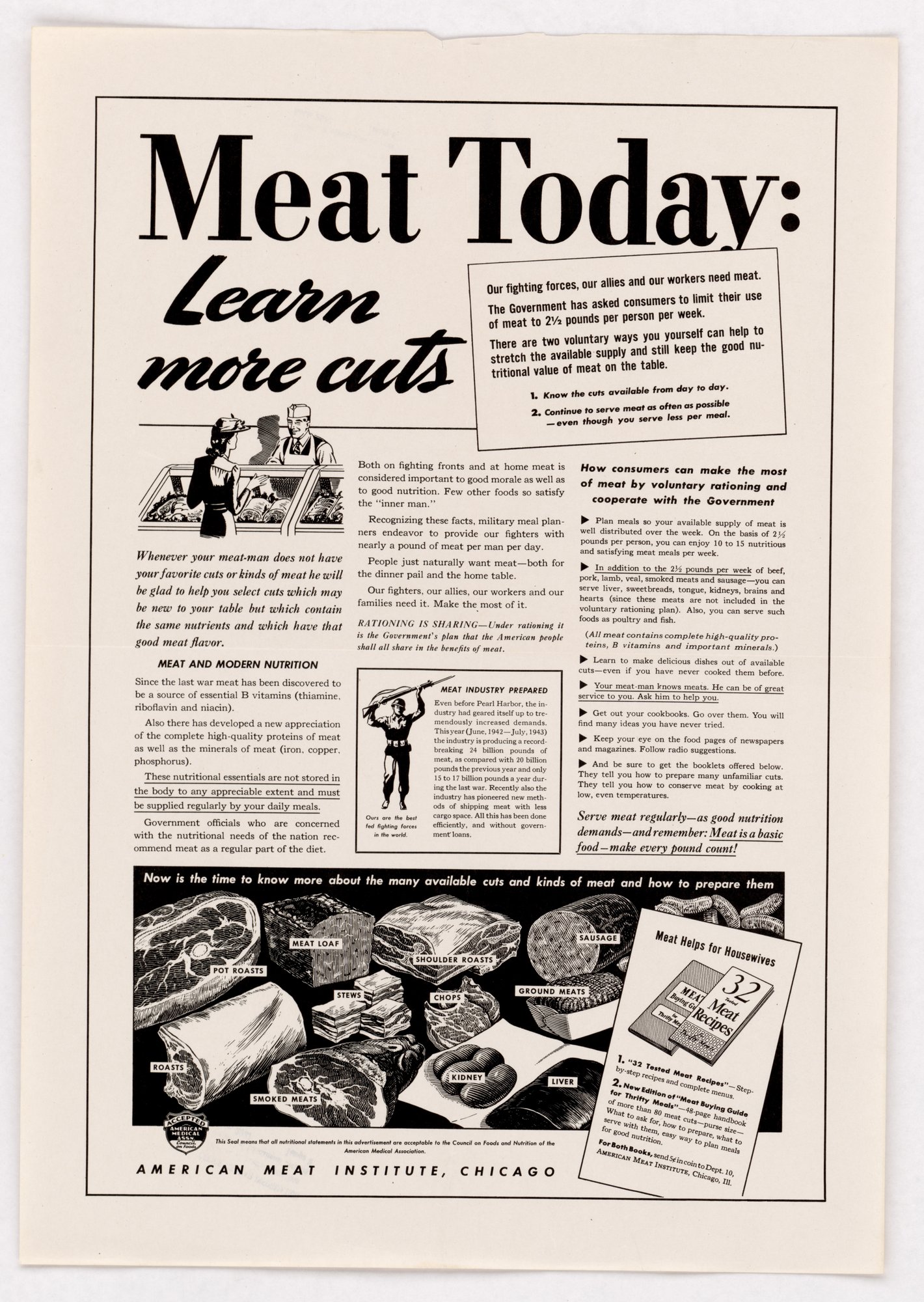
Text-heavy trade-association advertisement for wartime meat rationing: a headline, a boxed Government request to limit meat to 2½ pounds per person per week, a shopper and butcher drawing, a panel with a soldier, and labelled cuts of meat. It borrows the Government's request and an American Medical Association seal for the industry's own message (transfer), and cites production figures and no costs or shortages (card-stacking).
Propaganda techniques used in this advertisement
- Date
- 1943
- Period
- Second World War
- Made by
- American Meat Institute, Chicago
- Region
- North America
- Country
- United States
- Medium
- Advertisement
- Issuer type
- Corporation
- Regime
- Roosevelt Administration
- Leader
- Franklin D. Roosevelt
- Audience
- Domestic public
- Purpose
- Mobilize or secure compliance
- Themes
- Home front, Economy and finance, Health
- Event
- World War II
- Regime
- Roosevelt administration
- Leader
- Franklin D. Roosevelt
- Source
- Identified Openly sourced: the speaker is who they say they are
- Source
- U.S. National Archives and Records Administration, Record Group 44, World War II Posters, retrieved October 4, 2026
- Rights
- Public domain (U.S. government work)
American Meat Institute. National Archives and Records Administration, RG 44, 44-PA-1344 (NAID 514998).
Text on the object
MEAT TODAY:
Learn more cuts
Our fighting forces, our allies and our workers need meat.
The Government has asked consumers to limit their use of meat to 2½ pounds per person per week.
There are two voluntary ways you yourself can help to stretch the available supply and still keep the good nutritional value of meat on the table.
1. Know the cuts available from day to day.
2. Continue to serve meat as often as possible—even though you serve less per meal.
Whenever your meat-man does not have your favorite cuts or kinds of meat he will be glad to help you select cuts which may be new to your table but which contain the same nutrients and which have that good meat flavor.
MEAT AND MODERN NUTRITION
Since the last war meat has been discovered to be a source of essential B vitamins (thiamine, riboflavin and niacin).
Also there has developed a new appreciation of the complete high-quality proteins of meat as well as the minerals of meat (iron, copper, phosphorus).
These nutritional essentials are not stored in the body to any appreciable extent and must be supplied regularly by your daily meals.
Government officials who are concerned with the nutritional needs of the nation recommend meat as a regular part of the diet.
Both on fighting fronts and at home meat is considered important to good morale as well as to good nutrition. Few other foods so satisfy the "inner man."
Recognizing these facts, military meal planners endeavor to provide our fighters with nearly a pound of meat per man per day.
People just naturally want meat—both for the dinner pail and the home table.
Our fighters, our allies, our workers and our families need it. Make the most of it.
RATIONING IS SHARING—Under rationing it is the Government's plan that the American people shall all share in the benefits of meat.
MEAT INDUSTRY PREPARED
Even before Pearl Harbor, the industry had geared itself up to tremendously increased demands. This year (June, 1942—July, 1943) the industry is producing a record-breaking 24 billion pounds of meat, as compared with 20 billion pounds the previous year and only 15 to 17 billion pounds a year during the last war. Recently also the industry has pioneered new methods of shipping meat with less cargo space. All this has been done efficiently, and without government loans.
Ours are the best fed fighting forces in the world.
How consumers can make the most of meat by voluntary rationing and cooperate with the Government
▶ Plan meals so your available supply of meat is well distributed over the week. On the basis of 2½ pounds per person, you can enjoy 10 to 15 nutritious and satisfying meat meals per week.
▶ In addition to the 2½ pounds per week of beef, pork, lamb, veal, smoked meats and sausage—you can serve liver, sweetbreads, tongue, kidneys, brains and hearts (since these meats are not included in the voluntary rationing plan). Also, you can serve such foods as poultry and fish.
(All meat contains complete high-quality proteins, B vitamins and important minerals.)
▶ Learn to make delicious dishes out of available cuts—even if you have never cooked them before.
▶ Your meat-man knows meats. He can be of great service to you. Ask him to help you.
▶ Get out your cookbooks. Go over them. You will find many ideas you have never tried.
▶ Keep your eye on the food pages of newspapers and magazines. Follow radio suggestions.
[text continues, omitted at the 4000-character cap: the final bullet about the booklets, the closing line 'Serve meat regularly...make every pound count!', the caption 'Now is the time to know more about the many available cuts...', the labels on the meat illustrations (POT ROASTS, MEAT LOAF, SHOULDER ROASTS, SAUSAGE, STEWS, CHOPS, GROUND MEATS, ROASTS, SMOKED MEATS, KIDNEY, LIVER), the 'Meat Helps for Housewives' booklet panel, the American Medical Association seal text and the footer AMERICAN MEAT INSTITUTE, CHICAGO]