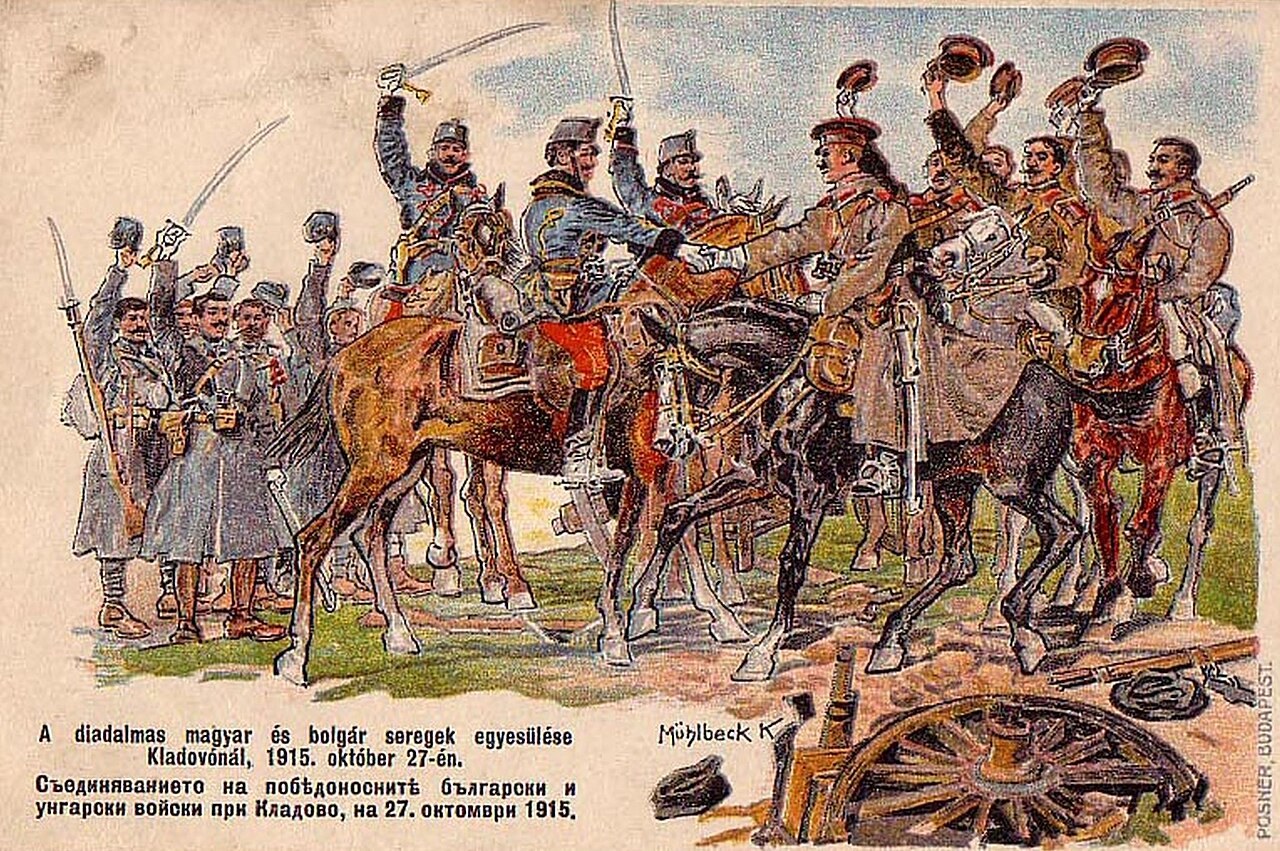
A diadalmas magyar és bolgár seregek egyesülése Kladovónál (The Union of the Victorious Hungarian and Bulgarian Armies at Kladovo), bilingual postcard
Hungarian hussars in blue and Bulgarian cavalry in grey greet each other in the field, hats and sabres raised, a wrecked gun wheel in the foreground. The caption, printed in Hungarian and in Bulgarian, calls both armies 'victorious'; the embrace lends the alliance a fraternal warmth in place of any account of the campaign.
- Date
- 1915
- Period
- First World War
- Made by
- Posner, Budapest (publisher, as printed on the card); artist Károly Mühlbeck
- Region
- Western and Central Europe
- Country
- Austria Hungary
- Medium
- Postcard
- Issuer type
- Corporation
- Regime
- Austria Hungary
- Leader
- Franz Joseph I
- Audience
- Mixed
- Purpose
- Commemorate
- Theme
- War and the military
- Event
- World War I
- Techniques
- Transfer
- Source
- Identified Openly sourced: the speaker is who they say they are
- Source
- Wikimedia Commons, retrieved September 29, 2026
- Rights
- Public domain (published 1915; artist died 1943; Commons PD-old / PDM tag)
Mühlbeck, Károly (1869-1943), artist; Posner, Budapest, publisher. 1915. Via Wikimedia Commons.
Text on the object
A diadalmas magyar és bolgár seregek egyesülése
Kladovónál, 1915. október 27-én.
Съединяванието на побѣдоноситѣ българоки и
унгароки войски при Кладово, на 27. октомври 1915.

Mühlbeck K [artist's signature]
POSNER, BUDAPEST. [vertical, right edge]
The union of the victorious Hungarian and Bulgarian armies
at Kladovo, on 27 October 1915.
The union of the victorious Bulgarian and Hungarian troops
at Kladovo, on 27 October 1915. [Bulgarian]

Mühlbeck K [artist's signature]
POSNER, BUDAPEST. [vertical, right edge]
Two-language caption, Hungarian above and Bulgarian (in Cyrillic) below. The Bulgarian adjectives are transcribed as printed ('българоки', 'унгароки'), which look like misprints of 'български' and 'унгарски'; one letter in 'побѣдоноситѣ' is uncertain. Translation is a machine translation by Claude, not verified by a fluent reader.