Pictorial Review poster, No. 9: The Space Age, industry (Amharic-English, Addis Ababa)
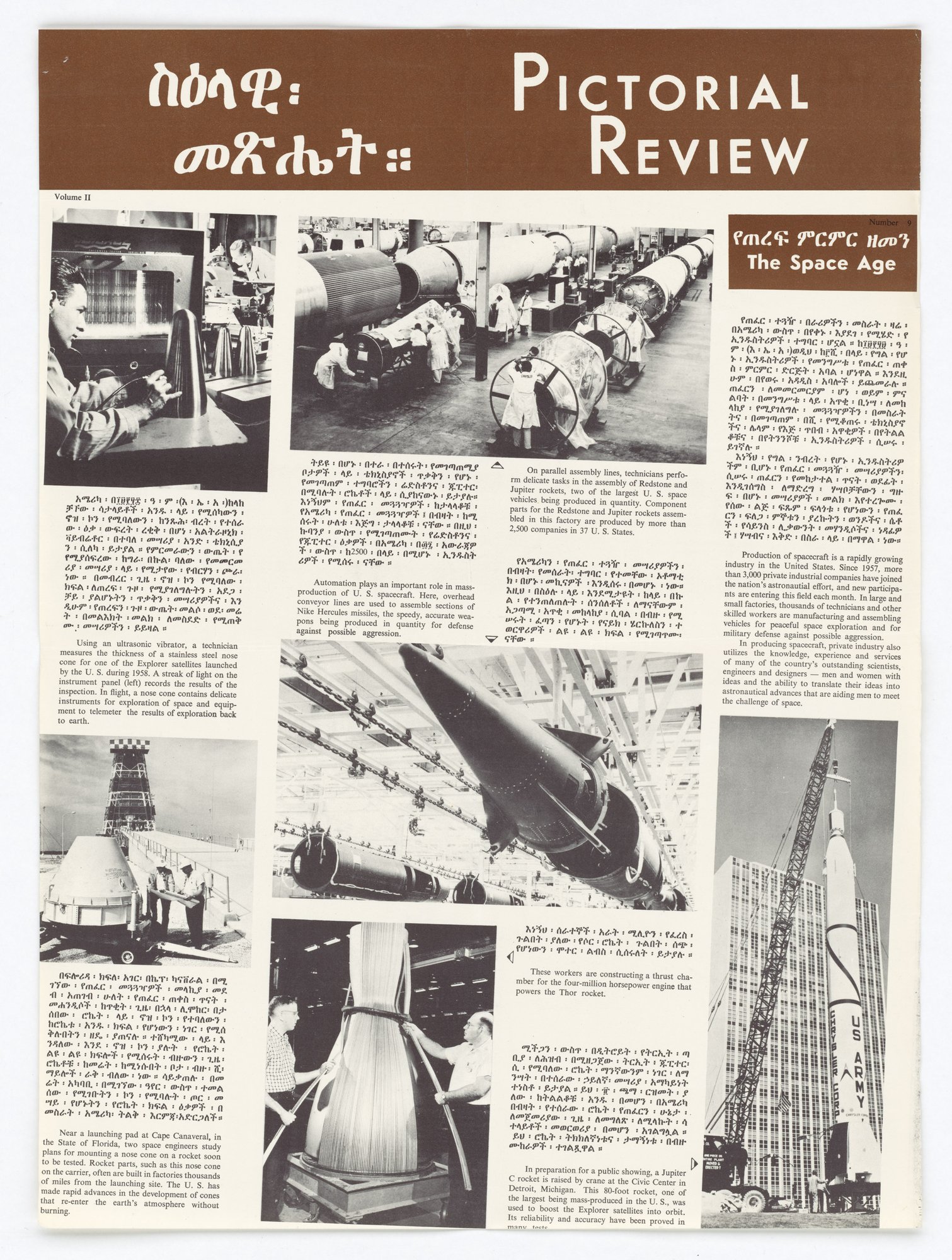
A second 'Space Age' photo sheet, on factory production of U.S. rockets: Redstone and Jupiter assembly lines, Nike Hercules missile lines, a nose-cone test, a Thor thrust chamber and a Jupiter C raised in Detroit. The text says over 3,000 private companies have joined the effort. The tell is card-stacking: output and private-industry participation are shown, with no failures or costs.
Propaganda techniques used in this poster
- Date
- June 24, 1959
- Period
- Cold War
- Made by
- U.S. Information Agency (predecessor: State Department International Information and Educational Exchange Program), Propaganda Posters Distributed in Asia, Latin America and the Middle East series
- Region
- North America
- Country
- United States
- Medium
- Poster
- Issuer type
- State
- Regime
- Eisenhower Administration
- Leader
- Dwight D. Eisenhower
- Audience
- Foreign public
- Purpose
- Persuade or win support
- Themes
- Science and technology, Economy and finance
- Event
- Cold War
- Source
- Unidentified Source blurred: contractors, cutouts, buried disclosure
- Source
- U.S. National Archives (NARA), RG 306, Propaganda Posters Distributed in Asia, Latin America and the Middle East, retrieved October 3, 2026
- Rights
- Public domain (U.S. government work; NARA RG 306)
U.S. Information Agency / Department of State, June 24, 1959. National Archives, Record Group 306 (NAID 6948758, 306-PPB-14m).
Text on the object
ስዕላዊ፡ መጽሔት። / PICTORIAL REVIEW
Volume II    Number 9

የጠረፍ ምርምር ዘመን
The Space Age

[Amharic text columns paralleling the English captions, not transcribed]

Using an ultrasonic vibrator, a technician measures the thickness of a stainless steel nose cone for one of the Explorer satellites launched by the U.S. during 1958. A streak of light on the instrument panel (left) records the results of the inspection. In flight, a nose cone contains delicate instruments for exploration of space and equipment to telemeter the results of exploration back to earth.

Near a launching pad at Cape Canaveral, in the State of Florida, two space engineers study plans for mounting a nose cone on a rocket soon to be tested. Rocket parts, such as this nose cone on the carrier, often are built in factories thousands of miles from the launching site. The U.S. has made rapid advances in the development of cones that re-enter the earth's atmosphere without burning.

On parallel assembly lines, technicians perform delicate tasks in the assembly of Redstone and Jupiter rockets, two of the largest U.S. space vehicles being produced in quantity. Component parts for the Redstone assembled in this factory are produced by more than 2,500 companies in 37 U.S. States.

Automation plays an important role in mass-production of U.S. spacecraft. Here, overhead conveyor lines are used to assemble sections of Nike Hercules missiles, the speedy, accurate weapons being produced in quantity for defense against possible aggression.

These workers are constructing a thrust chamber for the four-million horsepower engine that powers the Thor rocket.

In preparation for a public showing, a Jupiter C rocket is raised by crane at the Civic Center in Detroit, Michigan. This 80-foot rocket, one of the largest being mass-produced in the U.S., was used to boost the Explorer satellites into orbit. Its reliability and accuracy have been proved in many tests.

Production of spacecraft is a rapidly growing industry in the United States. Since 1957, more than 3,000 private industrial companies have joined the nation's astronautical effort, and new participants are entering this field each month. In large and small factories, thousands of technicians and other skilled workers are manufacturing and assembling vehicles for peaceful space exploration and for military defense against possible aggression.

In producing spacecraft, private industry also utilizes the knowledge, experience and services of many of the country's outstanding scientists, engineers and designers -- men and women with ideas and the ability to translate their ideas into astronautical advances that are aiding men to meet the challenge of space.
English portions are as printed. The Amharic masthead reads 'Pictorial Review'; the Amharic captions and columns parallel the English text and are not separately translated here.
English text transcribed in full; the Amharic (Ge'ez script) columns, which parallel the English captions, are not transcribed. No imprint or credit line is printed on the scan. The Amharic heading is given.