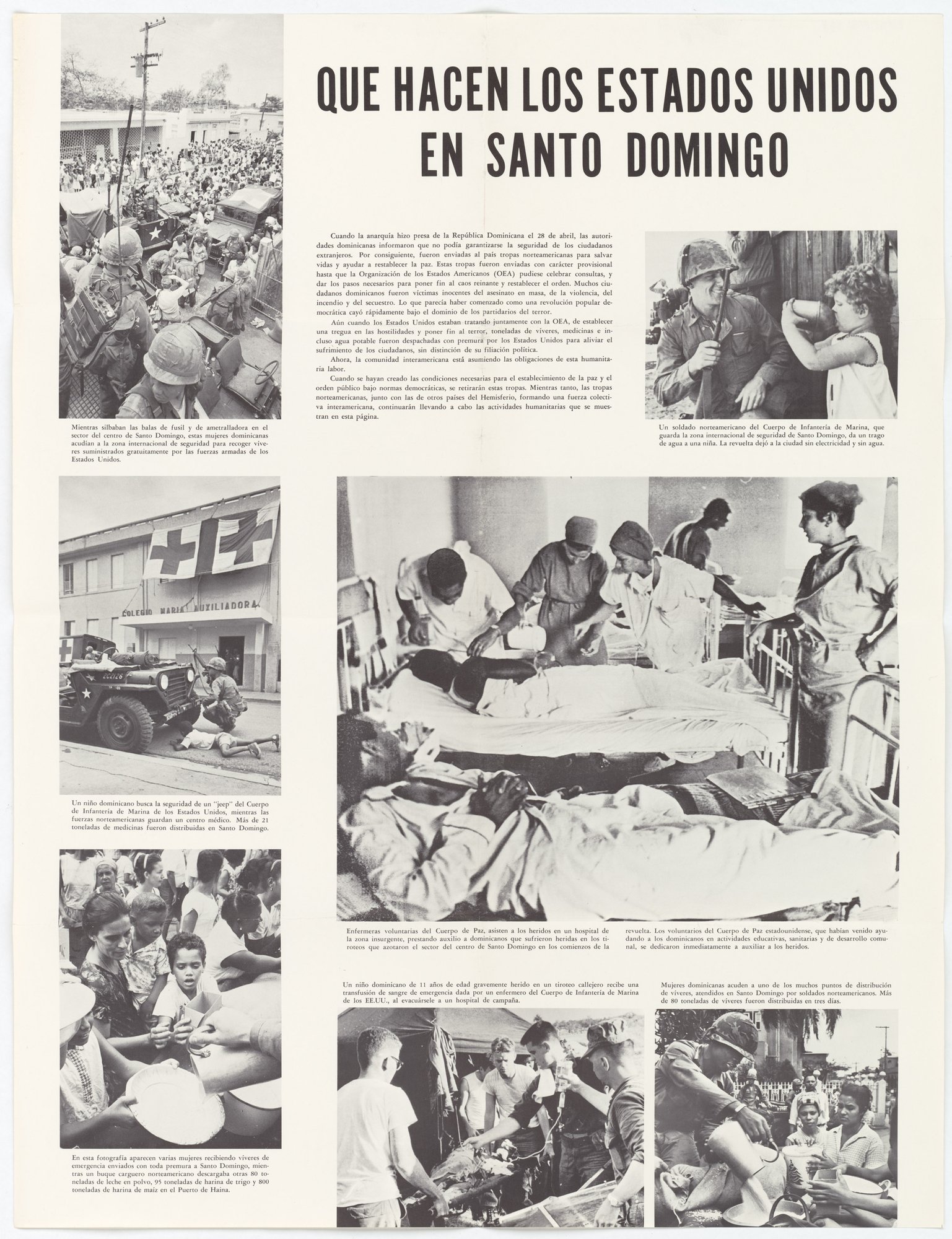
Que hacen los Estados Unidos en Santo Domingo (What the U.S. Is Doing in Santo Domingo; Spanish poster distributed in Mexico City)
A Spanish-language photo poster on the 1965 U.S. troop landing in the Dominican Republic. Under the headline, a text block says troops were sent to save lives until the OAS could act, and six captioned photographs show Marines and Peace Corps nurses giving food, water, medicine and a blood transfusion. The tell is card-stacking: only relief work is pictured, and the text labels the fighters 'partisans of terror'.
Propaganda techniques used in this poster
- Date
- May 19, 1965
- Period
- Cold War
- Made by
- U.S. Information Agency (predecessor: State Department International Information and Educational Exchange Program), Propaganda Posters Distributed in Asia, Latin America and the Middle East series
- Region
- North America
- Country
- United States
- Medium
- Poster
- Issuer type
- State
- Regime
- Johnson Administration
- Leader
- Lyndon B. Johnson
- Audience
- Foreign public
- Purpose
- Persuade or win support
- Themes
- War and the military, Health
- Event
- Dominican Intervention 1965
- Source
- Unidentified Source blurred: contractors, cutouts, buried disclosure
- Source
- U.S. National Archives (NARA), Record Group 306, Posters in Asia, Latin America, Middle East, retrieved October 4, 2026
- Rights
- Public domain (U.S. government work; NARA RG 306)
U.S. Information Agency / Department of State, May 19, 1965. National Archives, Record Group 306 (NAID 6949366, 306-PPB-424).
Text on the object
QUE HACEN LOS ESTADOS UNIDOS EN SANTO DOMINGO

Cuando la anarquía hizo presa de la República Dominicana el 28 de abril, las autoridades dominicanas informaron que no podía garantizarse la seguridad de los ciudadanos extranjeros. Por consiguiente, fueron enviadas al país tropas norteamericanas para salvar vidas y ayudar a restablecer la paz. Estas tropas fueron enviadas con carácter provisional hasta que la Organización de los Estados Americanos (OEA) pudiese celebrar consultas, y dar los pasos necesarios para poner fin al caos reinante y restablecer el orden. Muchos ciudadanos dominicanos fueron víctimas inocentes del asesinato en masa, de la violencia, del incendio y el secuestro. Lo que parecía haber comenzado como una revolución popular democrática cayó rápidamente bajo el dominio de los partidarios del terror.

Aún cuando los Estados Unidos estaban tratando juntamente con la OEA, de establecer una tregua en las hostilidades y poner fin al terror, toneladas de víveres, medicinas e incluso agua potable fueron despachadas con premura por los Estados Unidos para aliviar el sufrimiento de los ciudadanos, sin distinción de su filiación política.

Ahora, la comunidad interamericana está asumiendo las obligaciones de esta humanitaria labor.

Cuando se hayan creado las condiciones necesarias para el establecimiento de la paz y el orden público bajo normas democráticas, se retirarán estas tropas. Mientras tanto, las tropas norteamericanas, junto con las de otros países del Hemisferio, formando una fuerza colectiva interamericana, continuarán llevando a cabo las actividades humanitarias que se muestran en esta página.

Mientras silbaban las balas de fusil y de ametralladora en el sector del centro de Santo Domingo, estas mujeres dominicanas acudían a la zona internacional de seguridad para recoger víveres suministrados gratuitamente por las fuerzas armadas de los Estados Unidos.

Un soldado norteamericano del Cuerpo de Infantería de Marina, que guarda la zona internacional de seguridad de Santo Domingo, da un trago de agua a una niña. La revuelta dejó a la ciudad sin electricidad y sin agua.

Un niño dominicano busca la seguridad de un "jeep" del Cuerpo de Infantería de Marina de los Estados Unidos, mientras las fuerzas norteamericanas guardan un centro médico. Más de 21 toneladas de medicinas fueron distribuidas en Santo Domingo.

Enfermeras voluntarias del Cuerpo de Paz, asisten a los heridos en un hospital de la zona insurgente, prestando auxilio a dominicanos que sufrieron heridas en los tiroteos que azotaron el sector del centro de Santo Domingo en los comienzos de la revuelta. Los voluntarios del Cuerpo de Paz estadounidense, que habían venido ayudando a los dominicanos en actividades educativas, sanitarias y de desarrollo comunal, se dedicaron inmediatamente a auxiliar a los heridos.

Un niño dominicano de 11 años de edad gravemente herido en un tiroteo callejero recibe una transfusión de sangre de emergencia dada por un enfermero del Cuerpo de Infantería de Marina de los EE.UU., al evacuársele a un hospital de campaña.

Mujeres dominicanas acuden a uno de los muchos puntos de distribución de víveres, atendidos en Santo Domingo por soldados norteamericanos. Más de 80 toneladas de víveres fueron distribuidas en tres días.

En esta fotografía aparecen varias mujeres recibiendo víveres de emergencia enviados con toda premura a Santo Domingo, mientras un buque carguero norteamericano descargaba otras 80 toneladas de leche en polvo, 95 toneladas de harina de trigo y 800 toneladas de harina de maíz en el Puerto de Haina.
WHAT THE UNITED STATES IS DOING IN SANTO DOMINGO

When anarchy gripped the Dominican Republic on 28 April, the Dominican authorities reported that the safety of foreign citizens could not be guaranteed. Consequently, North American troops were sent to the country to save lives and help restore peace. These troops were sent on a provisional basis until the Organization of American States (OAS) could hold consultations and take the steps needed to end the prevailing chaos and restore order. Many Dominican citizens were innocent victims of mass murder, violence, arson and kidnapping. What seemed to have begun as a democratic popular revolution fell quickly under the domination of the partisans of terror.

Even while the United States was working together with the OAS to establish a truce in the hostilities and end the terror, tons of foodstuffs, medicines and even drinking water were hurriedly dispatched by the United States to relieve the suffering of the citizens, without distinction of their political affiliation.

Now the inter-American community is taking on the obligations of this humanitarian work.

When the conditions necessary for establishing peace and public order under democratic norms have been created, these troops will be withdrawn. Meanwhile, the North American troops, together with those of other countries of the Hemisphere, forming a collective inter-American force, will continue carrying out the humanitarian activities shown on this page.

[Photo captions, in order:] While rifle and machine-gun bullets whistled in the downtown sector of Santo Domingo, these Dominican women came to the international security zone to collect foodstuffs supplied free by the armed forces of the United States.

A North American Marine Corps soldier guarding the international security zone of Santo Domingo gives a girl a drink of water. The revolt left the city without electricity and without water.

A Dominican boy seeks safety at a United States Marine Corps "jeep" while North American forces guard a medical centre. More than 21 tons of medicines were distributed in Santo Domingo.

Volunteer Peace Corps nurses assist the wounded in a hospital in the insurgent zone, giving aid to Dominicans who were wounded in the shootings that struck the downtown sector of Santo Domingo at the start of the revolt. The United States Peace Corps volunteers, who had come to help Dominicans in educational, health and community development activities, immediately devoted themselves to aiding the wounded.

An 11-year-old Dominican boy gravely wounded in a street shooting receives an emergency blood transfusion given by a U.S. Marine Corps medical orderly as he is evacuated to a field hospital.

Dominican women come to one of the many food distribution points, staffed in Santo Domingo by North American soldiers. More than 80 tons of foodstuffs were distributed in three days.

This photograph shows several women receiving emergency foodstuffs sent in great haste to Santo Domingo, while a North American cargo ship unloaded another 80 tons of powdered milk, 95 tons of wheat flour and 800 tons of corn flour at the Port of Haina.
No imprint or credit line is printed on the sheet.