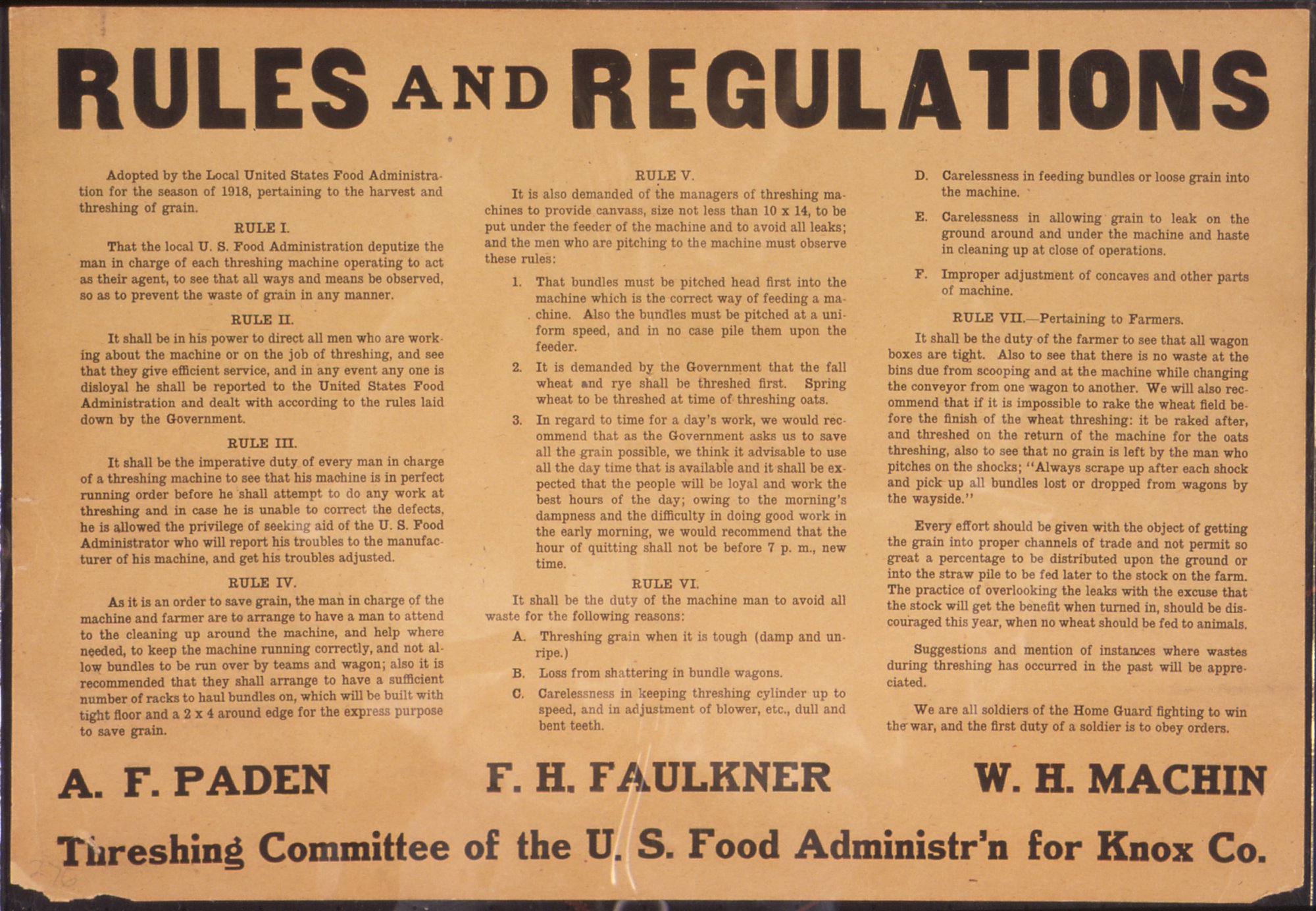
Rules and Regulations, Threshing Committee of the U.S. Food Administration for Knox Co.
A text-only notice sets out seven numbered rules for grain threshing in the 1918 season, addressed in turn to machine managers, crews and farmers, and signed by three committee members. It names reporting to the Food Administration for any man found 'disloyal' and closes by calling everyone 'soldiers of the Home Guard.' The tell is the pairing of operating rules with a loyalty test and a wartime-soldier identity for farm workers.
Propaganda techniques used in this poster
- Date
- 1918
- Period
- First World War
- Made by
- Threshing Committee of the U.S. Food Administration for Knox County
- Region
- North America
- Country
- United States
- Medium
- Poster
- Issuer type
- State
- Regime
- Wilson Administration
- Leader
- Woodrow Wilson
- Audience
- Domestic public
- Purpose
- Mobilize or secure compliance
- Themes
- Home front, Economy and finance
- Event
- World War I
- Regime
- Wilson administration
- Leader
- Woodrow Wilson
- Source
- Identified Openly sourced: the speaker is who they say they are
- Source
- U.S. National Archives (NARA), RG 4 (U.S. Food Administration), World War I Posters (NAID 512439), retrieved October 3, 2026
- Rights
- NARA Unrestricted; hosted by owner decision
Threshing Committee of the U.S. Food Administration for Knox County. National Archives and Records Administration, 4-P-276.
Text on the object
RULES AND REGULATIONS

Adopted by the Local United States Food Administration for the season of 1918, pertaining to the harvest and threshing of grain.

RULE I.
That the local U. S. Food Administration deputize the man in charge of each threshing machine operating to act as their agent, to see that all ways and means be observed, so as to prevent the waste of grain in any manner.

RULE II.
It shall be in his power to direct all men who are working about the machine or on the job of threshing, and see that they give efficient service, and in any event any one is disloyal he shall be reported to the United States Food Administration and dealt with according to the rules laid down by the Government.

RULE III.
It shall be the imperative duty of every man in charge of a threshing machine to see that his machine is in perfect running order before he shall attempt to do any work at threshing and in case he is unable to correct the defects, he is allowed the privilege of seeking aid of the U. S. Food Administrator who will report his troubles to the manufacturer of his machine, and get his troubles adjusted.

RULE IV.
As it is an order to save grain, the man in charge of the machine and farmer are to arrange to have a man to attend to the cleaning up around the machine, and help where needed, to keep the machine running correctly, and not allow bundles to be run over by teams and wagon; also it is recommended that they shall arrange to have a sufficient number of racks to haul bundles on, which will be built with tight floor and a 2 x 4 around edge for the express purpose to save grain.

RULE V.
It is also demanded of the managers of threshing machines to provide canvass, size not less than 10 x 14, to be put under the feeder of the machine and to avoid all leaks; and the men who are pitching to the machine must observe these rules:
1. That bundles must be pitched head first into the machine which is the correct way of feeding a machine. Also the bundles must be pitched at a uniform speed, and in no case pile them upon the feeder.
2. It is demanded by the Government that the fall wheat and rye shall be threshed first. Spring wheat to be threshed at time of threshing oats.
3. In regard to time for a day's work, we would recommend that as the Government asks us to save all the grain possible, we think it advisable to use all the day time that is available and it shall be expected that the people will be loyal and work the best hours of the day; owing to the morning's dampness and the difficulty in doing good work in the early morning, we would recommend that the hour of quitting shall not be before 7 p. m., new time.

RULE VI.
It shall be the duty of the machine man to avoid all waste for the following reasons:
A. Threshing grain when it is tough (damp and unripe.)
B. Loss from shattering in bundle wagons.
[...items C to F omitted for length]

RULE VII.--Pertaining to Farmers.
It shall be the duty of the farmer to see that all wagon boxes are tight. Also to see that there is no waste at the bins due from scooping and at the machine while changing the conveyor from one wagon to another. We will also recommend that if it is impossible to rake the wheat field before the finish of the wheat threshing: it be raked after, and threshed on the return of the machine for the oats threshing, also to see that no grain is left by the man who pitches on the shocks; "Always scrape up after each shock and pick up all bundles lost or dropped from wagons by the wayside."

[...three paragraphs of Rule VII omitted for length, from 'Every effort should be given' to '...will be appreciated.']

We are all soldiers of the Home Guard fighting to win the war, and the first duty of a soldier is to obey orders.

A. F. PADEN          F. H. FAULKNER          W. H. MACHIN
Threshing Committee of the U. S. Food Administr'n for Knox Co.
Column order follows the printed layout (left, middle, right). Spelling ('canvass') and 'new time' are as printed. The text is truncated at the schema limit: Rule VI items C to F and the last three paragraphs of Rule VII are summarised in square brackets; the closing line and signatures are transcribed in full. A faint handwritten '276' at lower left is an archival number, not transcribed.