Oregon tuna long-line photo sheet (Japanese-language poster distributed in the Ryukyu Islands)
A green sheet with three photographs of the crew of the U.S. trawler Oregon handling long-line gear and hoisting tuna, with Japanese text and a CI&E/USCAR badge. The text says U.S. fishery men copied a Ryukyuan long-line method to fish tuna profitably in the Gulf of Mexico. The tell is plain-folks and transfer: American fishing is shown as the same craft as the Ryukyuans' own, and a Ryukyuan practice is credited with a U.S. success.
Propaganda techniques used in this poster
- Date
- 1950
- Period
- Cold War
- Made by
- CI&E, U.S. Civil Administration of the Ryukyu Islands (USCAR), per badge; USIA Propaganda Posters Distributed in Asia series
- Region
- North America
- Country
- United States
- Medium
- Poster
- Issuer type
- State
- Regime
- Eisenhower Administration
- Leader
- Dwight D. Eisenhower
- Audience
- Foreign public
- Purpose
- Persuade or win support
- Themes
- Economy and finance, Empire and colonialism
- Event
- Cold War
- Source
- Identified Openly sourced: the speaker is who they say they are
- Source
- U.S. National Archives (NARA), Record Group 306, Propaganda Posters Distributed in Asia, retrieved October 3, 2026
- Rights
- Public domain (U.S. government work; NARA RG 306)
U.S. Information Agency / Department of State, c. 1950-55. National Archives, Record Group 306 (NAID 5730123, 306-PPA-225).
Text on the object
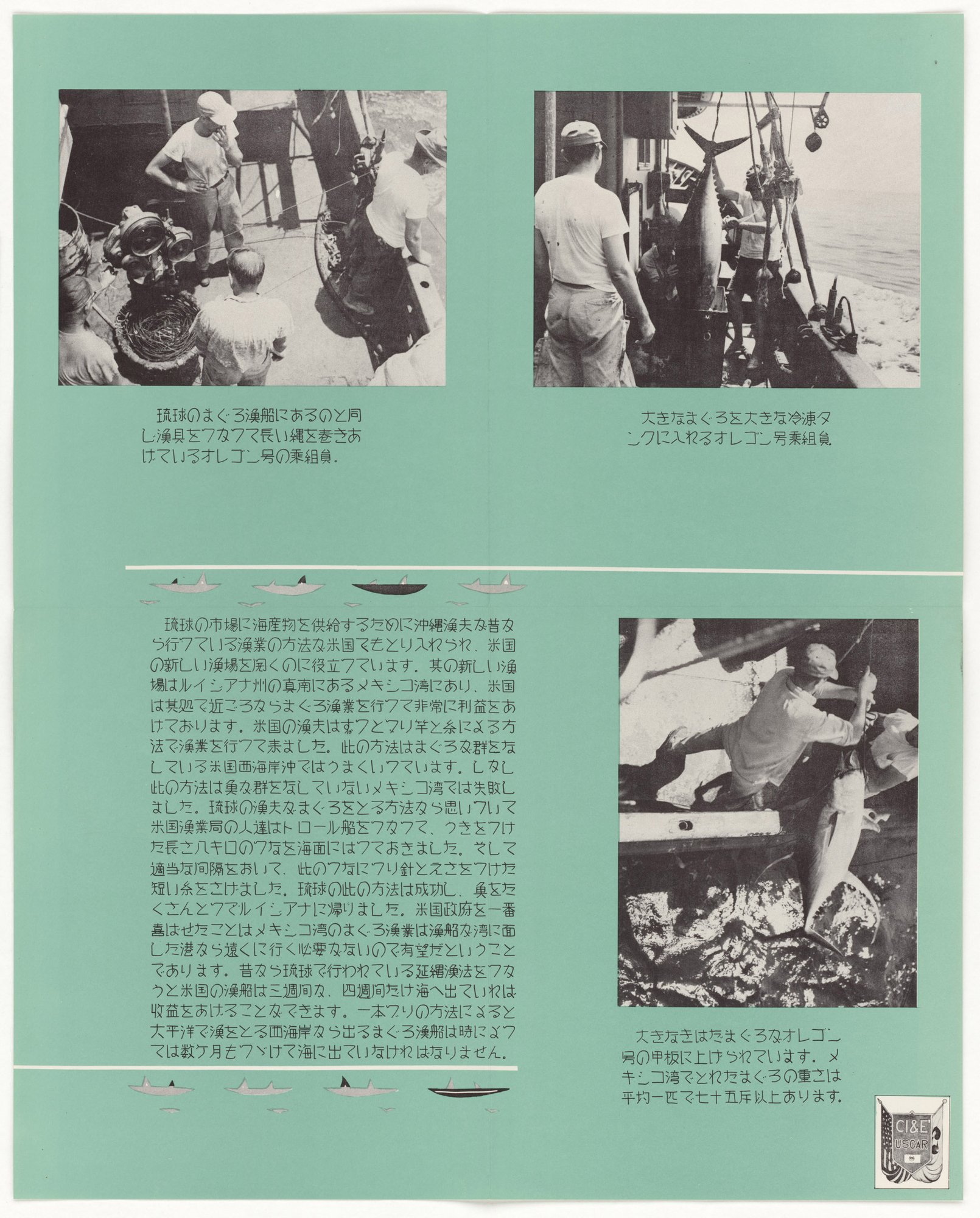
琉球のまぐろ漁船にあるのと同し漁具をつかつて長い縄を巻きあけているオレゴン号の乗組員.

大きなまぐろを大きな冷凍タンクに入れるオレゴン号乗組員.

琉球の市場に海産物を供給するために沖縄漁夫が昔から行つている漁業の方法が米国でもとり入れられ、米国の新しい漁場を開くのに役立つています。其の新しい漁場はルイジアナ州の真南にあるメキシコ湾にあり、米国は其処で近ごろまぐろ漁業を行つて非常に利益をあげております。米国の漁夫はずつとつり竿と糸による方法で漁業を行つて来ました。此の方法はまぐろが群をなしている米国西海岸沖ではうまくいつています。しかし此の方法は魚が群をなしていないメキシコ湾では失敗しました。琉球の漁夫がまぐろをとる方法から思いついて米国漁業局の人達はトロール船をつかつて、うきをつけた長さ八キロのつなを海面にはつておきました。そして適当な間隔をおいて、此のつなにつり針とえさをつけた短い糸をさげました。琉球の此の方法は成功し、魚をたくさんとつてルイジアナに帰りました。米国政府を一番喜ばせたことはメキシコ湾のまぐろ漁業は漁船が湾に面した港から遠くに行く必要がないので有望だということであります。昔から琉球で行われている延縄漁法をつかうと米国の漁船は三週間か、四週間だけ海へ出ていれば収益をあげることができます。一本づりの方法によると大平洋で漁をとる西海岸から出るまぐろ漁船は時によつては数ケ月もつづけて海に出ていなければなりません。

大きなきはだまぐろがオレゴン号の甲板に上げられています。メキシコ湾でとれたまぐろの重さは平均一匹で七十五斤以上あります。

[badge:] CI&E USCAR
Crew of the Oregon coil up a long line using the same gear as on Ryukyuan tuna boats.

Oregon crew put a big tuna into a big freezer tank.

The fishing methods that Okinawan fishermen have long practised to supply the Ryukyu market with seafood have also been adopted in the United States and are helping open up a new American fishing ground. That new ground is in the Gulf of Mexico due south of Louisiana, where the United States has recently begun tuna fishing and is making very large profits. American fishermen had always fished with rod and line. That method works well off the U.S. west coast, where tuna school, but it failed in the Gulf of Mexico, where the fish do not school. Taking the idea from the way Ryukyuan fishermen catch tuna, men of the U.S. Fish and Wildlife Service used a trawler to lay an eight-kilometre line with floats on the sea surface, and hung short lines with hooks and bait from it at suitable intervals. This Ryukyuan method succeeded, and they returned to Louisiana with many fish. What pleased the U.S. government most is that Gulf of Mexico tuna fishing is promising because boats need not go far from ports on the Gulf. Using the long-line method long practised in the Ryukyus, American boats can turn a profit with only three or four weeks at sea, whereas with single-line fishing, tuna boats from the west coast fishing the Pacific must sometimes stay out for several months.

A big yellowfin tuna is hoisted onto the deck of the Oregon. Tuna caught in the Gulf of Mexico average more than 75 kin each.

[badge:] CI&E USCAR
Printed in a stylised display typeface in which small and large kana and dakuten are hard to tell apart; reading is the best available from the image. 'Kin' is an old weight unit (about 0.6 kg).