Saving Life by Artificial Respiration: Prone Pressure Method
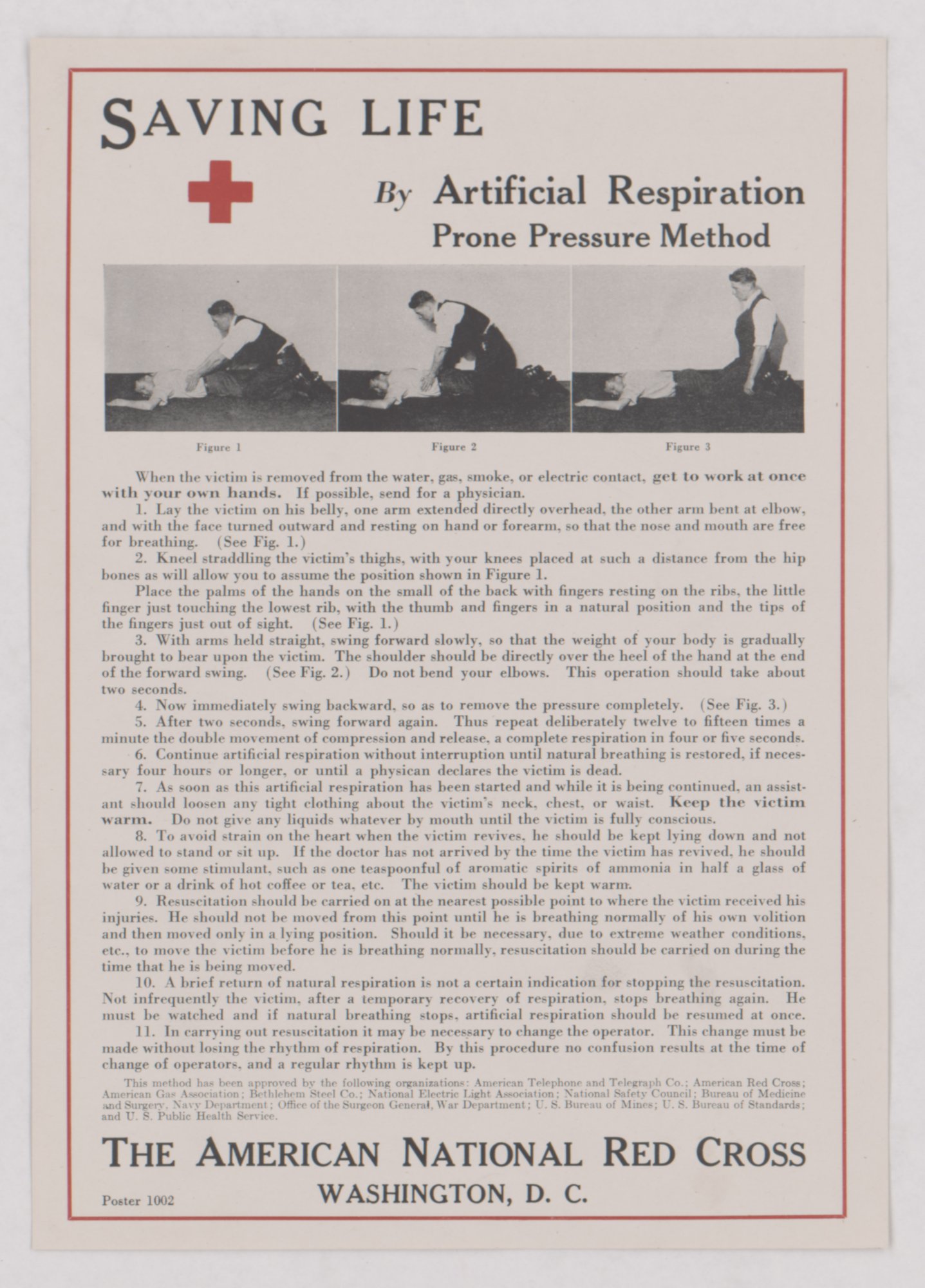
First-aid instruction sheet with a red cross emblem, three photographs of a rescuer working on a prone victim, eleven numbered steps and a list of approving bodies. It is mainly instruction; the technique is faint, limited to the Red Cross emblem and the list of endorsing organizations lending authority (transfer).
Propaganda techniques used in this poster
- Date
- 1941
- Period
- Second World War
- Made by
- American National Red Cross
- Region
- North America
- Country
- United States
- Medium
- Poster
- Issuer type
- NGO
- Regime
- Roosevelt Administration
- Leader
- Franklin D. Roosevelt
- Audience
- Domestic public
- Purpose
- Warn or inform
- Themes
- Health, Home front
- Event
- World War II
- Regime
- Roosevelt administration
- Leader
- Franklin D. Roosevelt
- Source
- Identified Openly sourced: the speaker is who they say they are
- Source
- U.S. National Archives and Records Administration, Record Group 44, World War II Posters, retrieved October 4, 2026
- Rights
- Public domain (U.S. government work)
American National Red Cross. National Archives and Records Administration, RG 44, 44-PA-1683 (NAID 515351).
Text on the object
SAVING LIFE
By Artificial Respiration
Prone Pressure Method
Figure 1
Figure 2
Figure 3
When the victim is removed from the water, gas, smoke, or electric contact, get to work at once with your own hands. If possible, send for a physician.
1. Lay the victim on his belly, one arm extended directly overhead, the other arm bent at elbow, and with the face turned outward and resting on hand or forearm, so that the nose and mouth are free for breathing. (See Fig. 1.)
2. Kneel straddling the victim's thighs, with your knees placed at such a distance from the hip bones as will allow you to assume the position shown in Figure 1.
Place the palms of the hands on the small of the back with fingers resting on the ribs, the little finger just touching the lowest rib, with the thumb and fingers in a natural position and the tips of the fingers just out of sight. (See Fig. 1.)
3. With arms held straight, swing forward slowly, so that the weight of your body is gradually brought to bear upon the victim. The shoulder should be directly over the heel of the hand at the end of the forward swing. (See Fig. 2.) Do not bend your elbows. This operation should take about two seconds.
4. Now immediately swing backward, so as to remove the pressure completely. (See Fig. 3.)
5. After two seconds, swing forward again. Thus repeat deliberately twelve to fifteen times a minute the double movement of compression and release, a complete respiration in four or five seconds.
6. Continue artificial respiration without interruption until natural breathing is restored, if necessary four hours or longer, or until a physician declares the victim is dead.
7. As soon as this artificial respiration has been started and while it is being continued, an assistant should loosen any tight clothing about the victim's neck, chest, or waist. Keep the victim warm. Do not give any liquids whatever by mouth until the victim is fully conscious.
8. To avoid strain on the heart when the victim revives, he should be kept lying down and not allowed to stand or sit up. If the doctor has not arrived by the time the victim has revived, he should be given some stimulant, such as one teaspoonful of aromatic spirits of ammonia in half a glass of water or a drink of hot coffee or tea, etc. The victim should be kept warm.
9. Resuscitation should be carried on at the nearest possible point to where the victim received his injuries. He should not be moved from this point until he is breathing normally of his own volition and then moved only in a lying position. Should it be necessary, due to extreme weather conditions, etc., to move the victim before he is breathing normally, resuscitation should be carried on during the time that he is being moved.
10. A brief return of natural respiration is not a certain indication for stopping the resuscitation. Not infrequently the victim, after a temporary recovery of respiration, stops breathing again. He must be watched and if natural breathing stops, artificial respiration should be resumed at once.
11. In carrying out resuscitation it may be necessary to change the operator. This change must be made without losing the rhythm of respiration. By this procedure no confusion results at the time of change of operators, and a regular rhythm is kept up.
This method has been approved by the following organizations: American Telephone and Telegraph Co.; American Red Cross; American Gas Association; Bethlehem Steel Co.; National Electric Light Association; National Safety Council; Bureau of Medicine and Surgery, Navy Department; Office of the Surgeon General, War Department; U. S. Bureau of Mines; U. S. Bureau of Standards; and U. S. Public Health Service.
THE AMERICAN NATIONAL RED CROSS
WASHINGTON, D. C.
Poster 1002