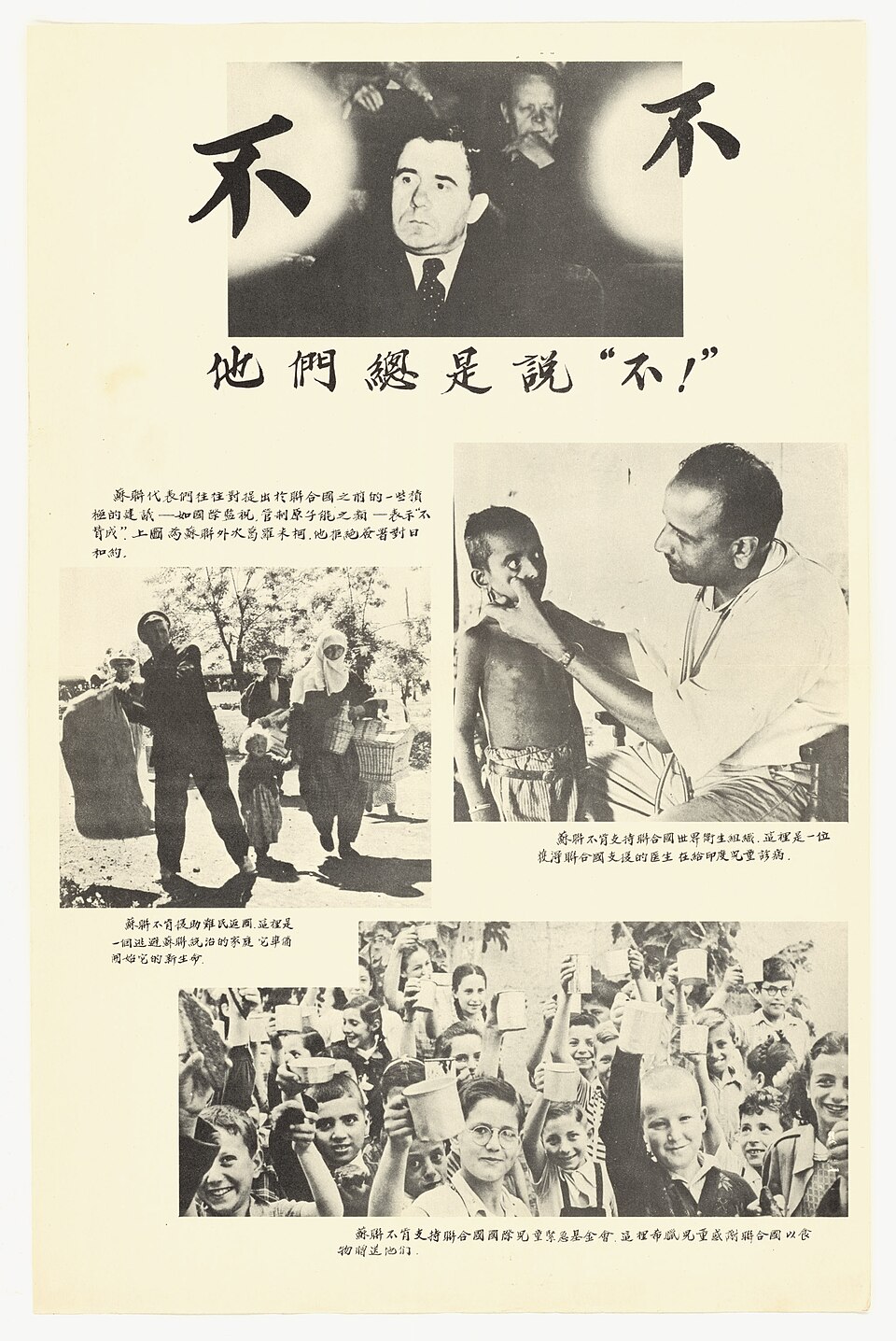
他們總是說「不!」 (They Always Say "No!")
A Chinese-language U.S. photo poster. A portrait of Soviet deputy foreign minister Gromyko sits between two huge brush-stroke characters for 'No' under the headline 'They always say No!', and three photographs below show refugees, a doctor examining a child and children holding cups, each captioned as something the Soviet Union 'would not' support. The photographs show United Nations relief and say nothing about any Soviet vote; the link is made only by the caption, which ties each picture to a refusal.
- Date
- May 15, 1952
- Period
- Cold War
- Made by
- U.S. Department of State, International Information and Educational Exchange Program (records later held by the U.S. Information Agency)
- Region
- North America
- Country
- United States
- Medium
- Poster
- Issuer type
- State
- Regime
- Truman Administration
- Leader
- Harry S. Truman
- Audience
- Foreign public
- Purpose
- Persuade or win support
- Themes
- Media and information, Health
- Event
- Cold War
- Techniques
- Card stacking
- Source
- Unidentified Source blurred: contractors, cutouts, buried disclosure
- Source
- Wikimedia Commons (from U.S. National Archives, RG 306, NAID 5730037), retrieved October 2, 2026
- Rights
- Public domain (U.S. government work; Commons PD-USGov, NARA RG 306 record)
U.S. Department of State, International Information and Educational Exchange Program / U.S. Information Agency, 1952. National Archives, Record Group 306 (NAID 5730037). The Commons file page cites PD-USGov.
Text on the object
不    不

他們總是說“不!”

蘇聯代表們往往對提出於聯合國之前的一些積極的建議——如國際監視管制原子能之類——表示“不贊成”。上圖為蘇聯外次葛羅米柯,他拒絕簽署對日和約。

蘇聯不肯援助難民返國。這裡是一個逃避蘇聯統治的家庭,它準備開始它的新生命。

蘇聯不肯支持聯合國世界衛生組織。這裡是一位獲得聯合國支援的醫生在給印度兒童診病。

蘇聯不肯支持聯合國國際兒童緊急基金會。這裡希臘兒童感謝聯合國以食物贈送他們。
No          No

They always say "No!"

Soviet representatives often indicate "disapproval" of constructive proposals put before the United Nations, such as international inspection and control of atomic energy. Above is Soviet Deputy Foreign Minister Gromyko, who refused to sign the peace treaty with Japan.

The Soviet Union is unwilling to help refugees return home. Here is a family that escaped Soviet rule; it is preparing to begin its new life.

The Soviet Union is unwilling to support the United Nations World Health Organization. Here is a doctor who has received UN support, treating an Indian child.

The Soviet Union is unwilling to support the United Nations International Children's Emergency Fund. Here Greek children thank the United Nations for giving them food.
Read from a 960 px image of brush-style lettering; the punctuation marks and a few characters (for example 希臘 'Greek' and 它準備) are the closest readings, not certain. Translation is a literal machine translation by Claude, not verified by a fluent reader.