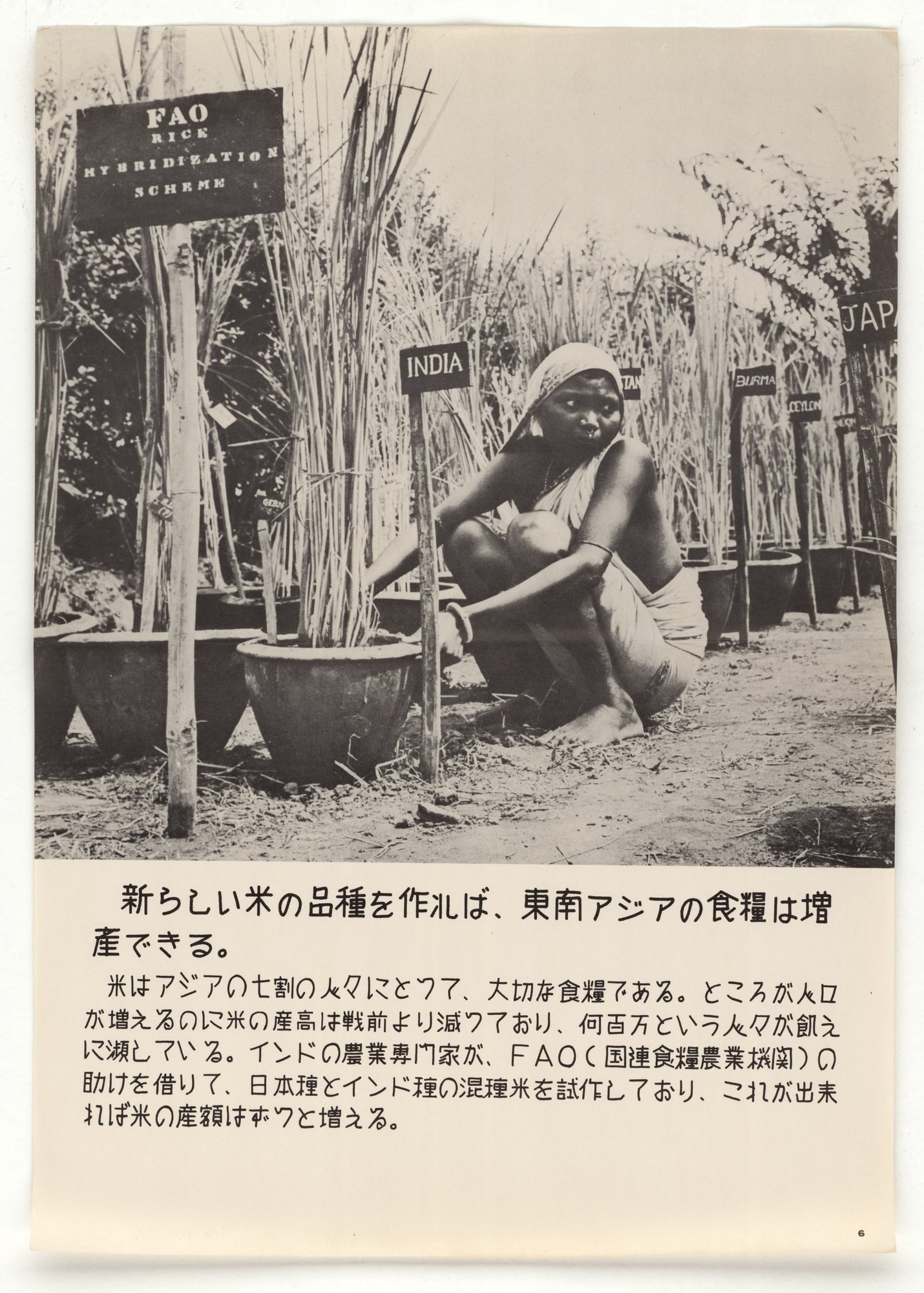
新しい米の品種を作れば、東南アジアの食糧は増産できる。 (If new rice varieties are made, Southeast Asia's food can be increased) (Japanese poster distributed in Asia, U.N. Day Poster #6)
A Japanese-language photo poster saying new rice varieties can raise Southeast Asian food output. A woman crouches among potted rice plants labelled by country (India, Burma, Ceylon, Japan) under a sign reading 'FAO Rice Hybridization Scheme'. The text says rice feeds seven in ten Asians, output is below pre-war levels, and Indian specialists with FAO help are trialling a Japanese-Indian hybrid. The tell is transfer: the FAO name and the scientific plot lend authority to the promised yield gain.
Propaganda techniques used in this poster
- Date
- September 14, 1953
- Period
- Cold War
- Made by
- U.S. Information Agency (predecessor: State Department International Information and Educational Exchange Program), Propaganda Posters Distributed in Asia series
- Region
- North America
- Country
- United States
- Medium
- Poster
- Issuer type
- State
- Regime
- Eisenhower Administration
- Leader
- Dwight D. Eisenhower
- Audience
- Foreign public
- Purpose
- Persuade or win support
- Themes
- Economy and finance, Science and technology
- Event
- Cold War
- Source
- Unidentified Source blurred: contractors, cutouts, buried disclosure
- Source
- U.S. National Archives (NARA), Record Group 306, Propaganda Posters Distributed in Asia, retrieved October 3, 2026
- Rights
- Public domain (U.S. government work; NARA RG 306)
U.S. Information Agency / Department of State, September 14, 1953. National Archives, Record Group 306 (NAID 5730108, 306-PPA-208).
Text on the object
FAO
RICE
HYBRIDIZATION
SCHEME

INDIA
[illegible]TAN
BURMA
CEYLON
JAPA[N]

新らしい米の品種を作れば、東南アジアの食糧は増
産できる。

米はアジアの七割の人々にとつて、大切な食糧である。ところが人口
が増えるのに米の産高は戦前より減つており、何百万という人々が飢え
に瀕している。インドの農業専門家が、FAO(国連食糧農業機関)の
助けを借りて、日本種とインド種の混種米を試作しており、これが出来
れば米の産額はずつと増える。

6
FAO
RICE
HYBRIDIZATION
SCHEME

INDIA
[illegible]TAN
BURMA
CEYLON
JAPA[N]

If new rice varieties are made, Southeast Asia's food can be increased.

Rice is an important food for seven in ten people in Asia. Yet while the population grows, rice output is lower than before the war, and millions of people are on the verge of starvation. Indian agricultural specialists, with the help of the FAO (U.N. Food and Agriculture Organization), are making trial crops of a hybrid rice of Japanese and Indian varieties, and if this succeeds, rice output will increase greatly.

6
Printed in Japanese with historical kana spelling and small kana set full-size; no imprint is printed.