Voyage to Mars poster, Spanish edition (Spanish-language poster distributed in San Jose)
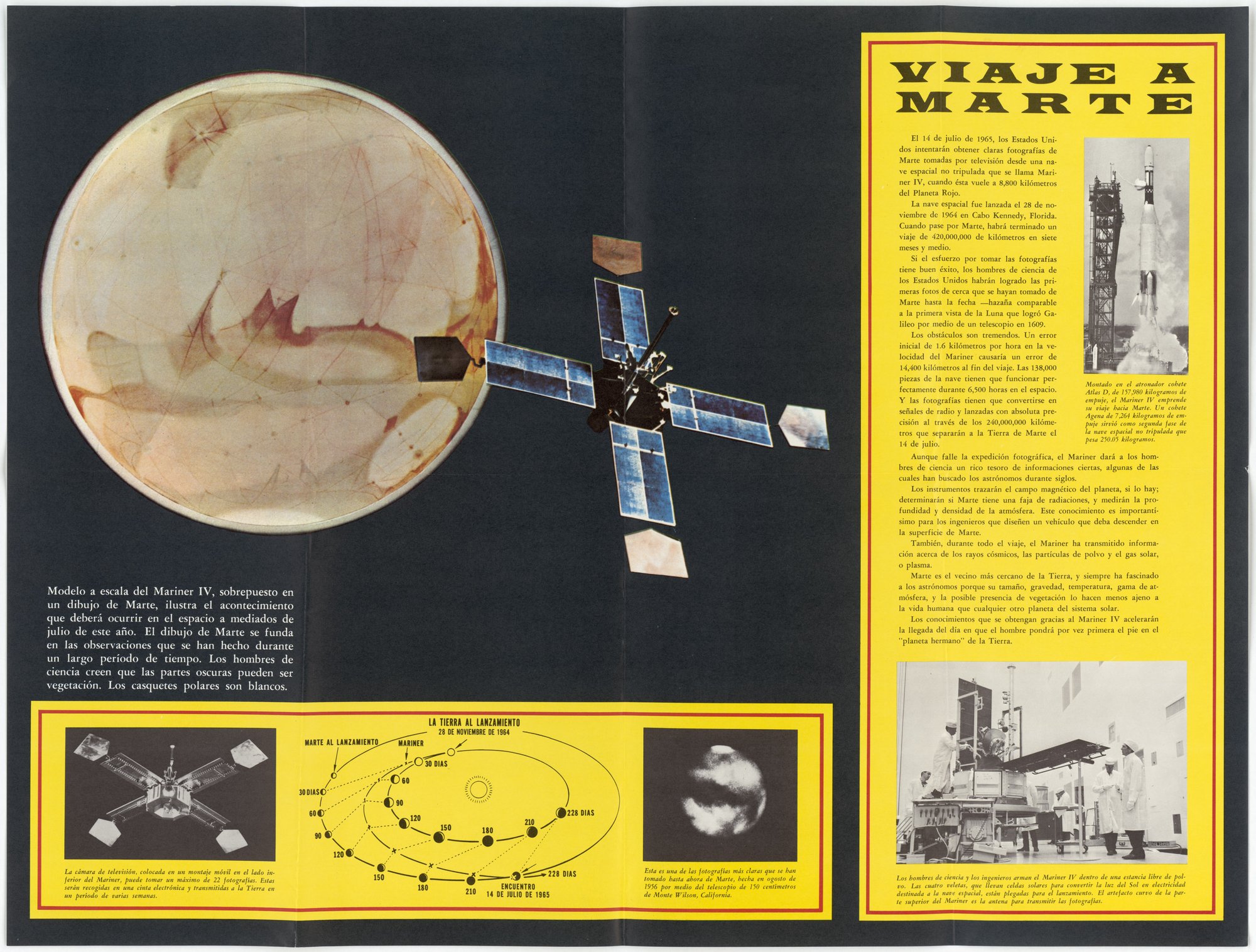
A folded Spanish photo poster, 'Viaje a Marte', announcing the planned 14 July 1965 flyby of Mars by the U.S. unmanned spacecraft Mariner IV. It carries a scale model of the craft over a drawing of Mars, launch and assembly photographs, a trajectory diagram and a text on the mission's difficulties and aims. The tell is transfer: the planned photographs are compared to Galileo's first telescope view of the Moon, and success is tied to the day man first sets foot on a 'sister planet'.
Propaganda techniques used in this poster
- Date
- June 14, 1965
- Period
- Cold War
- Made by
- U.S. Information Agency (predecessor: State Department International Information and Educational Exchange Program), Propaganda Posters Distributed in Asia, Latin America and the Middle East series
- Region
- North America
- Country
- United States
- Medium
- Poster
- Issuer type
- State
- Regime
- Johnson Administration
- Leader
- Lyndon B. Johnson
- Audience
- Foreign public
- Purpose
- Persuade or win support
- Theme
- Science and technology
- Event
- Cold War
- Source
- Unidentified Source blurred: contractors, cutouts, buried disclosure
- Source
- U.S. National Archives (NARA), Record Group 306, Posters in Asia, Latin America, Middle East, retrieved October 4, 2026
- Rights
- Public domain (U.S. government work; NARA RG 306)
U.S. Information Agency / Department of State, June 14, 1965. National Archives, Record Group 306 (NAID 6949365, 306-PPB-423).
Text on the object
VIAJE A MARTE

El 14 de julio de 1965, los Estados Unidos intentarán obtener claras fotografías de Marte tomadas por televisión desde una nave espacial no tripulada que se llama Mariner IV, cuando ésta vuele a 8,800 kilómetros del Planeta Rojo.

La nave espacial fue lanzada el 28 de noviembre de 1964 en Cabo Kennedy, Florida. Cuando pase por Marte, habrá terminado un viaje de 420,000,000 de kilómetros en siete meses y medio.

Si el esfuerzo por tomar las fotografías tiene buen éxito, los hombres de ciencia de los Estados Unidos habrán logrado las primeras fotos de cerca que se hayan tomado de Marte hasta la fecha —hazaña comparable a la primera vista de la Luna que logró Galileo por medio de un telescopio en 1609.

Los obstáculos son tremendos. Un error inicial de 1.6 kilómetros por hora en la velocidad del Mariner causaría un error de 14,400 kilómetros al fin del viaje. Las 138,000 piezas de la nave tienen que funcionar perfectamente durante 6,500 horas en el espacio. Y las fotografías tienen que convertirse en señales de radio y lanzadas con absoluta precisión a través de los 240,000,000 kilómetros que separarán a la Tierra de Marte el 14 de julio.

Aunque falle la expedición fotográfica, el Mariner dará a los hombres de ciencia un rico tesoro de informaciones ciertas, algunas de las cuales han buscado los astrónomos durante siglos.

Los instrumentos trazarán el campo magnético del planeta, si lo hay; determinarán si Marte tiene una faja de radiaciones, y medirán la profundidad y densidad de la atmósfera. Este conocimiento es importantísimo para los ingenieros que diseñen un vehículo que deba descender en la superficie de Marte.

También, durante todo el viaje, el Mariner ha transmitido información acerca de los rayos cósmicos, las partículas de polvo y el gas solar, o plasma.

Marte es el vecino más cercano de la Tierra, y siempre ha fascinado a los astrónomos porque su tamaño, gravedad, temperatura, gama de atmósfera, y la posible presencia de vegetación lo hacen menos ajeno a la vida humana que cualquier otro planeta del sistema solar.

Los conocimientos que se obtengan gracias al Mariner IV acelerarán la llegada del día en que el hombre pondrá por vez primera el pie en el "planeta hermano" de la Tierra.

Montado en el atronador cohete Atlas D, de 157,980 kilogramos de empuje, el Mariner IV emprende su viaje hacia Marte. Un cohete Agena de 7,264 kilogramos de empuje sirvió como segunda fase de la nave espacial no tripulada que pesa 250.05 kilogramos.

Los hombres de ciencia y los ingenieros arman el Mariner IV dentro de una estancia libre de polvo. Las cuatro veletas, que llevan celdas solares para convertir la luz del Sol en electricidad destinada a la nave espacial, están plegadas para el lanzamiento. El artefacto curvo de la parte superior del Mariner es la antena para transmitir las fotografías.

Modelo a escala del Mariner IV, sobrepuesto en un dibujo de Marte, ilustra el acontecimiento que deberá ocurrir en el espacio a mediados de julio de este año. El dibujo de Marte se funda en las observaciones que se han hecho durante un largo período de tiempo. Los hombres de ciencia creen que las partes oscuras pueden ser vegetación. Los casquetes polares son blancos.

La cámara de televisión, colocada en un montaje móvil en el lado inferior del Mariner, puede tomar un máximo de 22 fotografías. Estas serán recogidas en una cinta electrónica y transmitidas a la Tierra en un período de varias semanas.

LA TIERRA AL LANZAMIENTO
28 DE NOVIEMBRE DE 1964
[Diagram labels: MARTE AL LANZAMIENTO; MARINER; 30 DIAS, 60, 90, 120, 150, 180, 210, 228 DIAS; ENCUENTRO 14 DE JULIO DE 1965]

Esta es una de las fotografías más claras que se han tomado hasta ahora de Marte, hecha en agosto de 1956 por medio del telescopio de 150 centímetros de Monte Wilson, California.
VOYAGE TO MARS

On 14 July 1965 the United States will attempt to obtain clear television photographs of Mars from an unmanned spacecraft called Mariner IV, as it flies 8,800 kilometres from the Red Planet.

The spacecraft was launched on 28 November 1964 at Cape Kennedy, Florida. When it passes Mars it will have completed a journey of 420,000,000 kilometres in seven and a half months.

If the effort to take the photographs succeeds, United States scientists will have obtained the first close-up pictures of Mars ever taken, a feat comparable to the first view of the Moon obtained by Galileo with a telescope in 1609.

The obstacles are tremendous. An initial error of 1.6 kilometres per hour in Mariner's speed would cause an error of 14,400 kilometres at the end of the journey. The spacecraft's 138,000 parts must function perfectly for 6,500 hours in space. And the photographs must be converted into radio signals and sent with absolute precision across the 240,000,000 kilometres that will separate Earth from Mars on 14 July.

Even if the photographic expedition fails, Mariner will give scientists a rich treasure of sound information, some of which astronomers have sought for centuries.

The instruments will trace the planet's magnetic field, if there is one; determine whether Mars has a radiation belt, and measure the depth and density of the atmosphere. This knowledge is extremely important for engineers who design a vehicle to descend onto the surface of Mars.

Also, throughout the journey, Mariner has transmitted information about cosmic rays, dust particles and solar gas, or plasma.

Mars is Earth's nearest neighbour and has always fascinated astronomers because its size, gravity, temperature, range of atmosphere and the possible presence of vegetation make it less alien to human life than any other planet of the solar system.

The knowledge obtained thanks to Mariner IV will hasten the arrival of the day when man will set foot for the first time on Earth's "sister planet."

Mounted on the thundering Atlas D rocket, of 157,980 kilograms of thrust, Mariner IV begins its journey toward Mars. An Agena rocket of 7,264 kilograms of thrust served as the second stage of the unmanned spacecraft, which weighs 250.05 kilograms.

Scientists and engineers assemble Mariner IV inside a dust-free room. The four vanes, which carry solar cells to convert sunlight into electricity for the spacecraft, are folded for launch. The curved device at the top of Mariner is the antenna for transmitting the photographs.

A scale model of Mariner IV, superimposed on a drawing of Mars, illustrates the event that is due to occur in space in mid-July of this year. The drawing of Mars is based on observations made over a long period of time. Scientists believe the dark parts may be vegetation. The polar caps are white.

The television camera, placed on a movable mount on the lower side of Mariner, can take a maximum of 22 photographs. These will be collected on electronic tape and transmitted to Earth over a period of several weeks.

EARTH AT LAUNCH
28 NOVEMBER 1964
[Diagram labels: Mars at launch; Mariner; 30 days, 60, 90, 120, 150, 180, 210, 228 days; Encounter 14 July 1965]

This is one of the clearest photographs of Mars taken so far, made in August 1956 with the 150-centimetre telescope at Mount Wilson, California.
No imprint or credit line is printed on the sheet. Diagram labels are listed in the order they appear.