Baco na caming mga tawo! (We are not people any more!) (Bikol poster distributed in the Philippines)
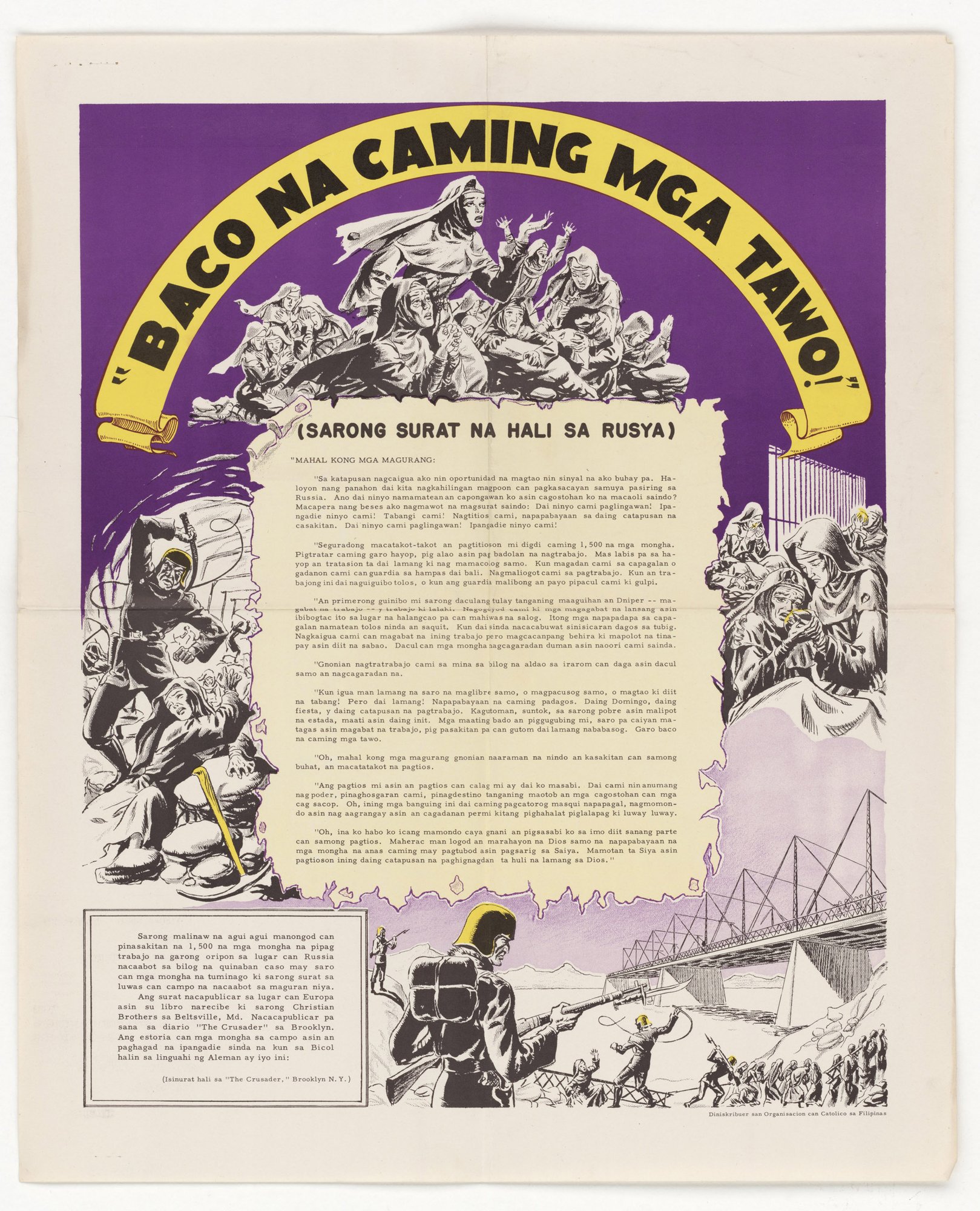
A purple-and-yellow poster reprinting a letter said to be from a German nun held with 1,500 others in a labour camp in Russia, ringed by drawings of guards whipping and beating nuns and of a bridge over the Dnieper. It asks readers to pray for the nuns. The tell is testimonial: an anonymous letter is vouched for only by the publications that carried it, with no checkable names or dates.
Propaganda techniques used in this poster
- Date
- March 26, 1951
- Period
- Cold War
- Made by
- U.S. Information Agency (predecessor: State Dept. information program), Asia posters series; imprint: Distributed by the Catholic Organization in the Philippines
- Region
- North America
- Country
- United States
- Medium
- Poster
- Issuer type
- State
- Regime
- Truman Administration
- Leader
- Harry S. Truman
- Audience
- Foreign public
- Purpose
- Persuade or win support
- Themes
- Religion, War and the military
- Event
- Cold War
- Source
- Unidentified Source blurred: contractors, cutouts, buried disclosure
- Source
- U.S. National Archives (NARA), Record Group 306, Propaganda Posters Distributed in Asia, retrieved October 3, 2026
- Rights
- Public domain (U.S. government work; NARA RG 306)
U.S. Information Agency / Department of State, March 26, 1951. National Archives, Record Group 306 (NAID 5730154, 306-PPA-253).
Text on the object
"BACO NA CAMING MGA TAWO!"

(SARONG SURAT NA HALI SA RUSYA)

"MAHAL KONG MGA MAGURANG:

"Sa katapusan nagcaigua ako nin oportunidad na magtao nin sinyal na ako buhay pa. Haloyon nang panahon dai kita nagkahilingan magpoon can pagkasacayan samuya pasiring sa Russia. Ano dai ninyo namamatean an capongawan ko asin cagostohan ko na macaoli saindo? Macapera nang beses ako nagmawot na magsurat saindo: Dai ninyo cami paglingawan! Ipangadie ninyo cami! Tabangi cami! Nagtitios cami, napapabayaan sa daing catapusan na casakitan. Dai ninyo cami paglingawan! Ipangadie ninyo cami!

[...]

Sarong malinaw na agui agui manongod can pinasakitan na 1,500 na mga mongha na pipag trabajo na garong oripon sa sarong lugar can Russia nacaabot sa bilog na quinaban caso may saro can mga mongha na tuminago ki sarong surat sa luwas can campo na nacaabot sa maguran niya.
Ang surat nacapublicar sa lugar can Europa asin su libro narecibe ki sarong Christian Brothers sa Beltsville, Md. Nacapublicar pa sana sa diario "The Crusader" sa Brooklyn. Ang estoria can mga mongha sa campo asin an paghagad na ipangadie sinda na kun sa Bicol halin sa linguahi ng Aleman ay iyo ini:

(Isinurat hali sa "The Crusader," Brooklyn N.Y.)

Diniskribuer san Organisacion can Catolico sa Filipinas
"We Are Not People Any More!" / (A letter from Russia) / "My dear parents: At last I have had the chance to give a sign that I am still alive. It has been a long time since we have seen each other, since we were sent to Russia. [...] Many times I wanted to write to you: Do not forget us! Pray for us! Help us! We are suffering, abandoned in endless pain. [...] / A clear account of the suffering of 1,500 nuns made to work like slaves in a place in Russia reached the whole world when one of the nuns hid a letter outside the camp that reached her parents. The letter was published in Europe and a copy was received by a Christian Brother in Beltsville, Md. It was also published in the newspaper "The Crusader" in Brooklyn. The story of the nuns in the camp and their plea to be prayed for, in Bicol from the German language, is this: (Written from "The Crusader," Brooklyn N.Y.) / Distributed by the Catholic Organization in the Philippines
Body text abridged at [...]; headline, subtitle, opening, explanatory box and imprint are given as printed. Translation is a literal best reading.