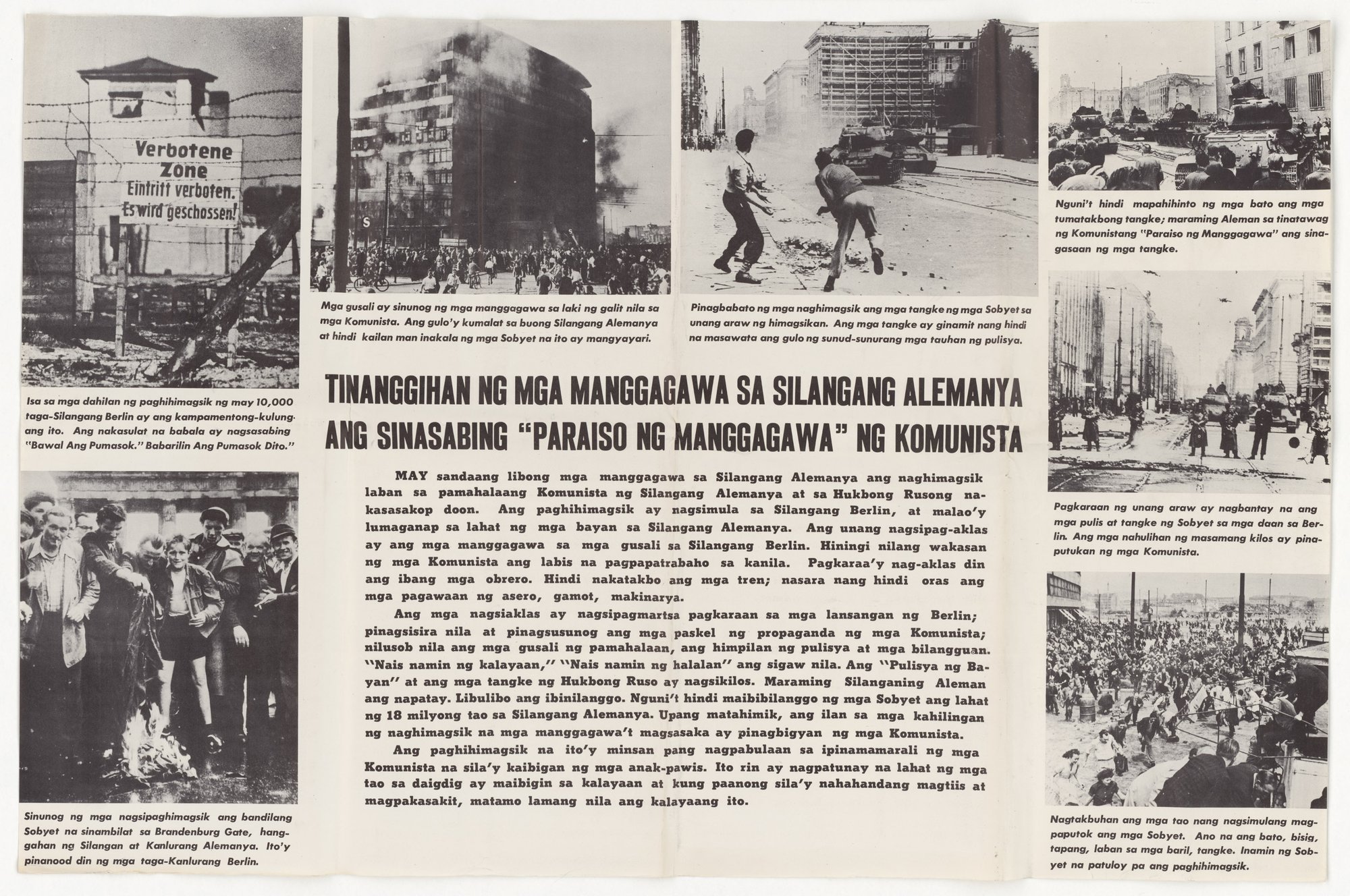
Tinanggihan ng mga Manggagawa ang "Paraiso ng Manggagawa" (East German Workers Reject the 'Workers' Paradise') (Tagalog poster, Philippines)
A Tagalog photo-and-text sheet on the East German uprising of June 1953: a barbed-wire 'Verbotene Zone' sign, a burning building, young men throwing stones at a Soviet tank, tanks in Berlin streets, a Soviet flag being burned and a crowd fleeing gunfire. The text says some 100,000 East German workers rebelled against the Communist government and Soviet army and that many were killed and thousands jailed. The tell is card-stacking: only photographs of the protesters and the tanks are used, and the headline puts the Communists' own phrase 'Workers' Paradise' in quotation marks.
Propaganda techniques used in this poster
- Date
- July 30, 1953
- Period
- Cold War
- Made by
- U.S. Information Agency (predecessor: State Department International Information and Educational Exchange Program), Propaganda Posters Distributed in Asia series
- Region
- North America
- Country
- United States
- Medium
- Poster
- Issuer type
- State
- Regime
- Eisenhower Administration
- Leader
- Dwight D. Eisenhower
- Audience
- Foreign public
- Purpose
- Demonize
- Themes
- Labor, Security and surveillance, War and the military
- Event
- Cold War
- Source
- Unidentified Source blurred: contractors, cutouts, buried disclosure
- Source
- U.S. National Archives (NARA), Record Group 306, Propaganda Posters Distributed in Asia, retrieved October 3, 2026
- Rights
- Public domain (U.S. government work; NARA RG 306)
U.S. Information Agency / Department of State, July 30, 1953. National Archives, Record Group 306 (NAID 5730164, 306-PPA-263).
Text on the object
[Photo captions, left column, top:] Isa sa mga dahilan ng paghihimagsik ng may 10,000 taga-Silangang Berlin ay ang kampamentong-kulungang ito. Ang nakasulat na babala ay nagsasabing "Bawal Ang Pumasok." Babarilin Ang Pumasok Dito."
[Sign in photo:] Verbotene Zone / Eintritt verboten. / Es wird geschossen!

[Caption, second photo:] Mga gusali ay sinunog ng mga manggagawa sa laki ng galit nila sa mga Komunista. Ang gulo'y kumalat sa buong Silangang Alemanya at hindi kailan man inakala ng mga Sobyet na ito ay mangyayari.

[Caption, third photo:] Pinagbabato ng mga naghihimagsik ang mga tangke ng mga Sobyet sa unang araw ng himagsikan. Ang mga tangke ay ginamit nang hindi na masawata ang gulo ng sunud-sunurang mga tauhan ng pulisya.

[Caption, fourth photo:] Nguni't hindi mapahihinto ng mga bato ang mga tumatakbong tangke; maraming Aleman sa tinatawag ng Komunistang "Paraiso ng Manggagawa" ang sinagasaan ng mga tangke.

[Caption, fifth photo:] Pagkaraan ng unang araw ay nagbantay na ang mga pulis at tangke ng Sobyet sa mga daan ng Berlin. Ang nahuhulihan ng masamang kilos ay pinaputukan ng mga Komunista.

[Caption, sixth photo:] Nagtakbuhan ang mga tao nang nagsimulang magpaputok ang mga Sobyet. Ano na ang bato, bisig, tapang, laban sa mga baril, tangke. Inamin ng Sobyet na patuloy pa ang paghihimagsik.

[Caption, left column bottom:] Sinunog ng mga nagsisipaghimagsik ang bandilang Sobyet na sinambit sa Brandenburg Gate, hanggahan ng Silangan at Kanlurang Alemanya. Ito'y pinanood din ng mga taga-Kanlurang Berlin.

TINANGGIHAN NG MGA MANGGAGAWA SA SILANGANG ALEMANYA
ANG SINASABING "PARAISO NG MANGGAGAWA" NG KOMUNISTA

MAY sandaang libong mga manggagawa sa Silangang Alemanya ang naghimagsik laban sa pamahalaang Komunista ng Silangang Alemanya at sa Hukbong Rusong nakasasakop doon. Ang paghihimagsik ay nagsimula sa Silangang Berlin, at malao'y lumaganap sa lahat ng mga bayan sa Silangang Alemanya. Ang unang nagsipag-aklas ay ang mga manggagawa sa mga gusali sa Silangang Berlin. Hininging nilang wakasan ng mga Komunista ang labis na pagpapatrabaho sa kanila. Pagkaraa'y nag-aklas din ang ibang mga obrero. Hindi nakatakbo ang mga tren; nasara nang hindi oras ang mga pagawaan ng asero, gamot, makinarya.
Ang mga nagsiaklas ay nagsipagmartsa pagkaraan sa mga lansangan ng Berlin; pinagsisira nila at pinagsusunog ang mga paskel ng propaganda ng mga Komunista; nilusob nila ang mga gusali ng pamahalaan, ang himpilan ng pulisya at mga bilangguan. "Nais namin ang kalayaan," "Nais namin ang halalan" ang sigaw nila. Ang "Pulisya ng Bayan" at ang mga tangke ng Hukbong Ruso ay nagsikilos. Maraming Silangang Aleman ang napatay. Libulibo ang ibinilanggo. Nguni't hindi maibibilanggo ng mga Sobyet ang lahat ng 18 milyong tao sa Silangang Alemanya. Upang matahimik, ang ilan sa mga kahilingan ng naghimagsik na mga manggagawa't magsasaka ay pinagbigyan ng mga Komunista.
Ang paghihimagsik na ito'y minsan pang nagpabulaan sa ipinamamarali ng mga Komunista na sila'y kaibigan ng mga anak-pawis. Ito rin ay nagpatunay na lahat ng mga tao sa daigdig ay maibigin sa kalayaan at kung paanong sila'y nahahandang magtiis at magpakasakit, matamo lamang nila ang kalayaang ito.
[Photo captions] One of the reasons for the uprising of some 10,000 East Berliners was this prison-camp. The written warning says 'No Entry.' Whoever enters here will be shot. [Sign:] Forbidden zone. Entry forbidden. Shots will be fired! / Buildings were burned by the workers in the size of their anger at the Communists. The disorder spread across all of East Germany and the Soviets never thought this would happen. / The rebels stoned the Soviet tanks on the first day of the uprising. The tanks were used when the disorder could no longer be stopped by successive waves of police. / But stones cannot stop the advancing tanks; many Germans in what the Communists call the 'Workers' Paradise' were run over by tanks. / After the first day, Soviet police and tanks guarded the streets of Berlin. Those caught in wrongdoing were fired upon by the Communists. / People ran when the Soviets began to shoot. What are stone, arm, courage against guns and tanks. The Soviets admitted the uprising was continuing. / The rebels burned the Soviet flag torn down at the Brandenburg Gate, the border of East and West Germany [as printed]. West Berliners also watched it.
EAST GERMAN WORKERS REJECT THE COMMUNISTS' SO-CALLED 'WORKERS' PARADISE'
A hundred thousand workers in East Germany rebelled against the East German Communist government and the Russian Army occupying it. The uprising began in East Berlin and soon spread to all the towns of East Germany. The first to strike were the building workers in East Berlin. They asked the Communists to end the excessive work imposed on them. Afterwards other workers struck too. Trains did not run; steel, medicine and machinery factories were shut at the wrong time. The strikers then marched through the streets of Berlin; they destroyed and burned Communist propaganda posters; attacked government buildings, the police station and prisons. 'We want freedom,' 'We want elections' were their cries. The 'People's Police' and the Russian Army's tanks moved. Many East Germans were killed. Thousands were jailed. But the Soviets cannot imprison all 18 million people of East Germany. To quiet things, some of the demands of the rebelling workers and farmers were granted by the Communists. This uprising once again disproved the Communists' boast that they are friends of the working people. It also proved that all people of the world love freedom and how ready they are to endure and sacrifice just to win this freedom. (Literal, lightly smoothed.)
Small caption type; minor misreadings are possible. Layout is a six-photo sheet; captions are given in the order read from top left.