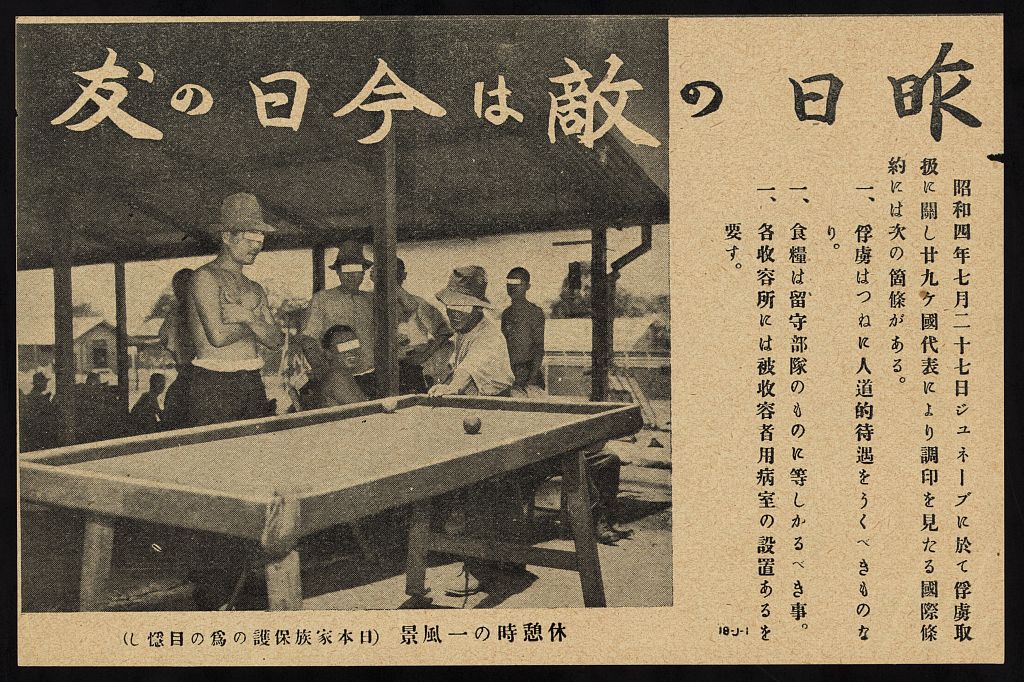
'Yesterday's enemy is today's friend' (US leaflet 18-J-1 to Japanese troops)
A Japanese-language leaflet with a large calligraphic title, 'Yesterday's enemy is today's friend', over a photograph of shirtless and hatted prisoners crowded round a pool table under a thatched roof, their eyes masked. Vertical text on the right cites three articles of the 1929 Geneva convention on prisoners of war. The tell is a single benign camp scene offered as the whole picture of captivity, with the choice to surrender left implicit.
- Date
- 1944
- Period
- Second World War
- Made by
- U.S. Army Forces, Pacific Area, Psychological Warfare Branch (APO 500)
- Region
- North America
- Country
- United States
- Medium
- Leaflet
- Issuer type
- Military
- Regime
- Roosevelt Administration
- Leader
- Franklin D. Roosevelt
- Audience
- Enemy forces
- Purpose
- Mobilize or secure compliance
- Theme
- War and the military
- Event
- World War II
- Techniques
- Card stacking
- Regime
- Roosevelt administration
- Leader
- Franklin D. Roosevelt
- Source
- Identified Openly sourced: the speaker is who they say they are
- Source
- Library of Congress, retrieved September 29, 2026
- Rights
- US wartime military leaflet; LOC: No known restrictions on publication
U.S. Army Forces, Pacific Area, Psychological Warfare Branch; Library of Congress Prints and Photographs Division, LOT 8093, LC-DIG-ppmsca-13368.
Text on the object
昨日の敵は今日の友

昭和四年七月二十七日ジュネーブに於て俘虜取扱に關し廿九ケ國代表により調印を見たる國際條約には次の箇條がある。
一、俘虜はつねに人道的待遇をうくべきものなり。
一、食糧は留守部隊のものに等しかるべき事。
一、各收容所には被收容者用病室の設置あるを要す。

休憩時の一風景(日本家族保護の爲目隱し)

18-J-1
Yesterday's enemy is today's friend

The international convention on the handling of prisoners of war, signed at Geneva on 27 July of Showa 4 (1929) by representatives of twenty-nine countries, contains the following articles.
1. Prisoners of war shall always receive humane treatment.
2. Food shall be equal to that of the depot (garrison) troops.
3. Each camp must have an infirmary for the inmates.

A scene during the rest period (eyes covered to protect families in Japan)

18-J-1