In one line: President Ulysses S. Grant, the Republican incumbent, ran against Horace Greeley, the New York Tribune editor nominated by the Liberal Republicans and also backed by the Democrats; Grant won, and Greeley died before the electors met.
Context
Grant stood for re-election with Henry Wilson as his running mate. His opponent was Horace Greeley, with Benjamin Gratz Brown as running mate. Contemporary prints name the Greeley ticket as the Liberal Republican nomination made at Cincinnati, and the National Archives lists Greeley as the Democratic candidate [1][7]. Grant took 3,598,468 votes (55.6 percent) to Greeley's 2,835,315 (43.8 percent) in the popular count [2]. Greeley died on 29 November 1872, after the election and before the electors voted. The electors cast 286 votes for Grant; the 3 votes cast for Greeley were not counted by resolution of the House, and the remaining 63 votes for president were divided among Thomas A. Hendricks (42), Gratz Brown (18), Charles J. Jenkins (2) and David Davis (1) [1].
The printed campaign material turned on Grant's war record and his administration, on Greeley's long career as an editor and his earlier positions on the South (including his part in raising bail for Jefferson Davis in 1867), on amnesty and reconciliation, and on the contest between a Republican party and a coalition of Liberal Republicans and Democrats [6][9][12].
Campaign literature
Each side below has six objects from the Library of Congress, with the same space, and the same technique definitions are applied to each. Some Republican-side prints are aimed at Greeley rather than made to praise Grant; they sit with the Republican side because that is the party they were published for. No object from a third-party ticket is hosted here yet: searches of the Library's catalogue for the Equal Rights and Straight-Out Democratic tickets found no hostable campaign material, so that side is a gap in the archive and not a judgment on its importance.
Ulysses S. Grant and Henry Wilson (Republican)
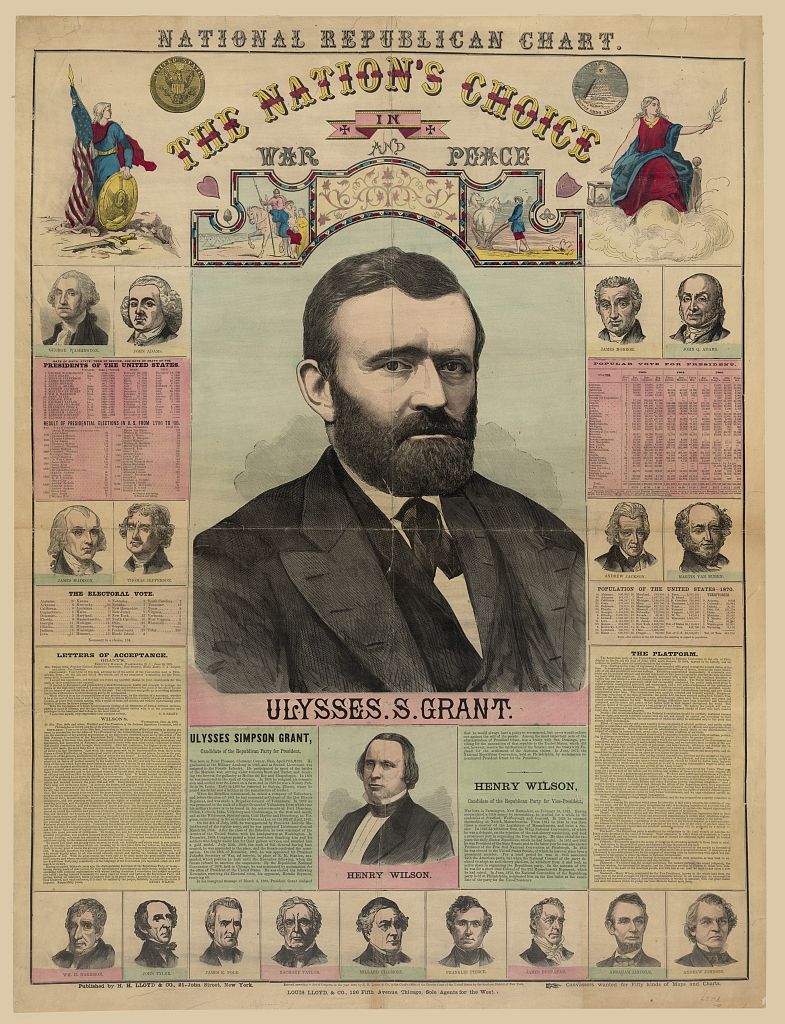
The Republican chart. The nation's choice in war and peace Ulysses S. Grant. H.H. Lloyd & Co., New York, 1872 (engraver M.T. Boyd). Public domain by age; Library of Congress.
The chart prints the platform and the two candidates' letters of acceptance, and ranks Grant in a row of presidential portraits from Washington on; this is Transfer of prestige by lineage, with Glittering generalities in the heading 'The Nation's Choice in War and Peace' [3].
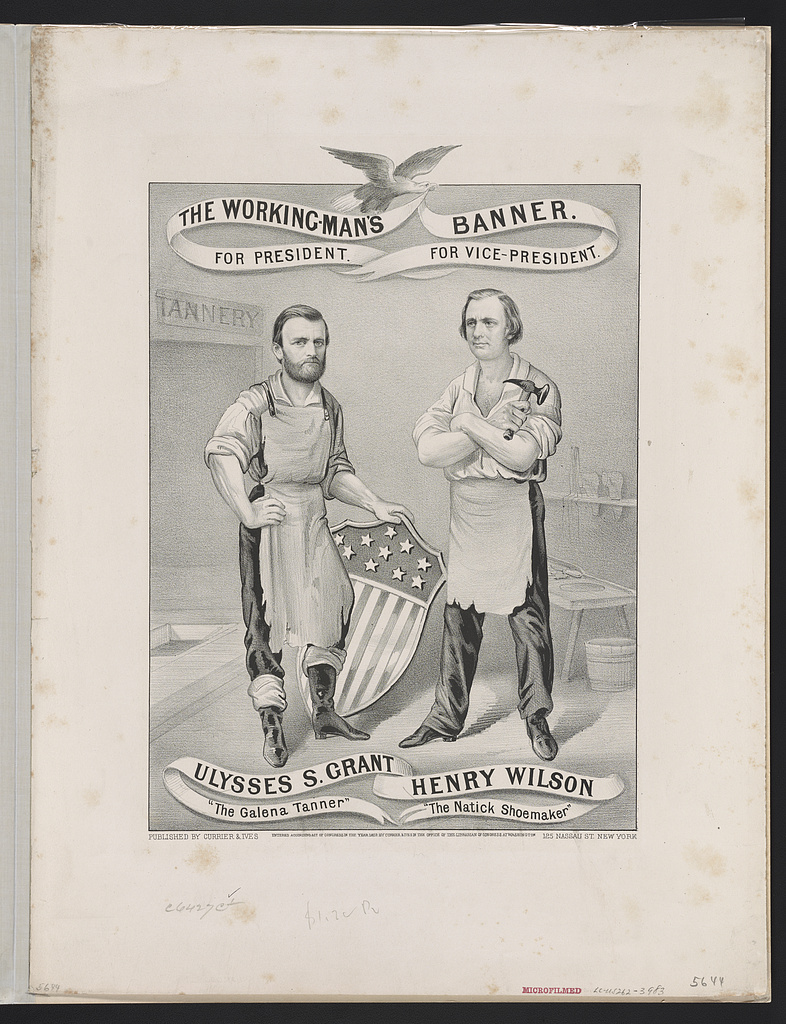
The working-man's banner. For President, Ulysses S. Grant, 'The Galena Tanner.' For Vice-President, Henry Wilson, 'The Natick Shoemaker.'. Currier & Ives, New York, 1872. Public domain by age; Library of Congress.
The ticket is dressed in a tanner's and a shoemaker's work clothes with the trade labelled, which is Plain folks presentation, here by a Republican publisher [4].
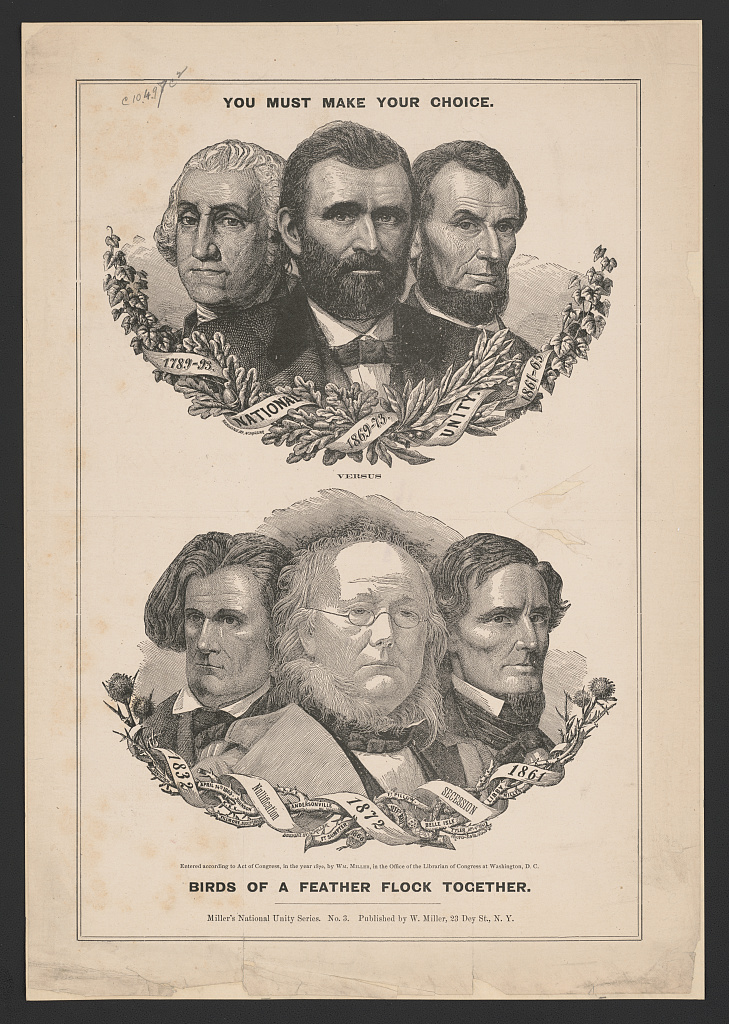
You must make your choice. Birds of a feather flock together. William Miller, New York, 1872 ('National Unity Series' no. 3). Public domain by age; Library of Congress.
Placing Greeley beside Calhoun and Davis, under ribbons reading 'Secession' and 'Andersonville', attaches the stigma of those names to him (Transfer) and assigns him the blame for Southern secession (Scapegoating) [5].
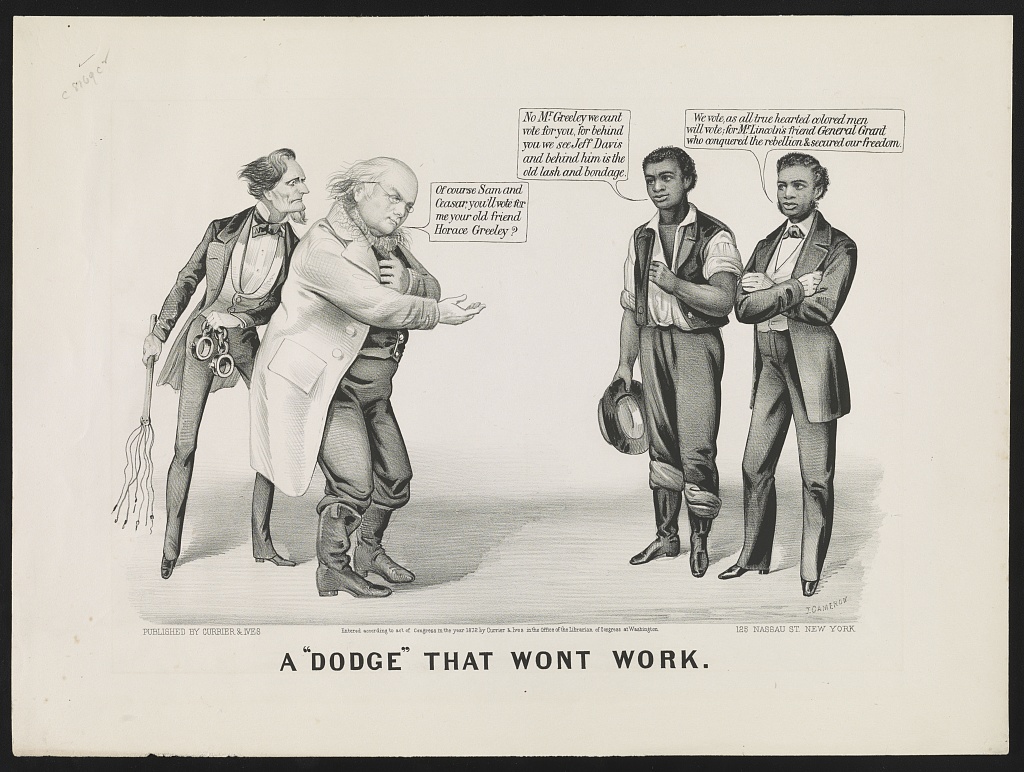
A "dodge" that wont work. Currier & Ives after J. Cameron, 1872. Public domain by age; Library of Congress.
Greeley is drawn with Jefferson Davis behind him and the speakers refuse because they see 'the old lash and bondage'; the print uses Transfer of stigma and puts the argument in the mouths of two Black men, a form of Testimonial. It rests on Greeley's real 1867 part in raising bail for Davis, which the LOC record notes [6].
Content note: period caricature of two Black men drawn as spokesmen for the publisher's case; shown as printed.
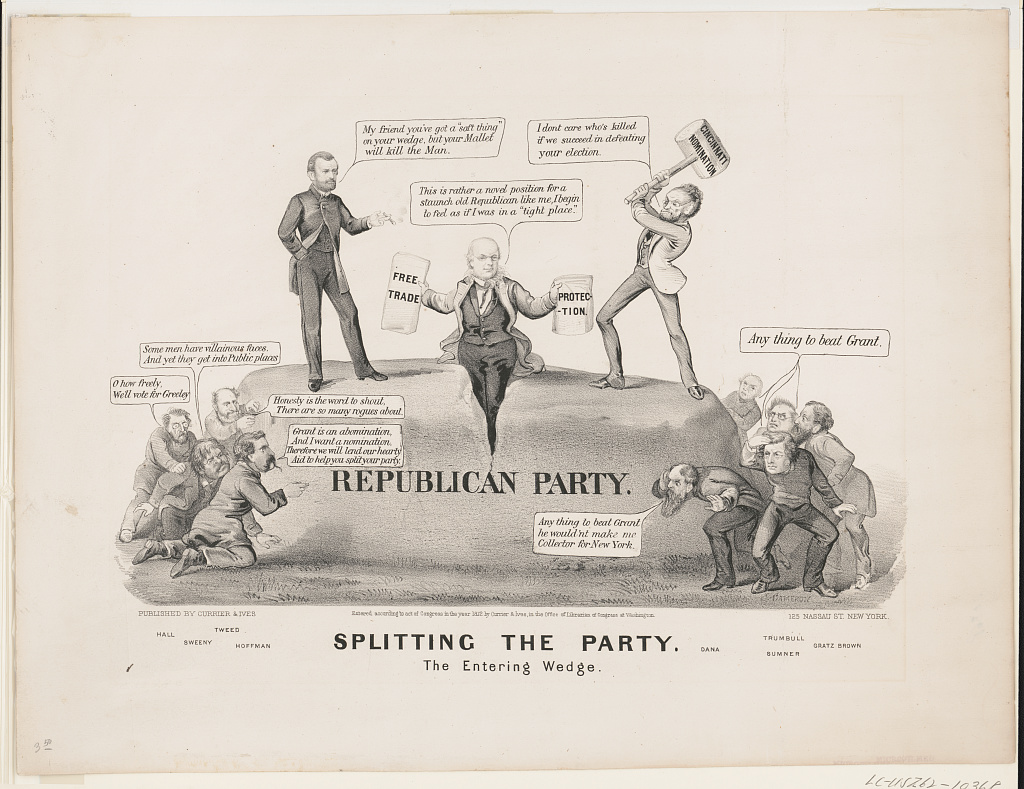
Splitting the party - the entering wedge. Currier & Ives after J. Cameron, 1872. Public domain by age; Library of Congress.
Greeley is wedged in the rock with Tammany figures and Liberal Republican leaders crowded round him, each named in print; the print links the Cincinnati ticket to men its readers were expected to distrust (Transfer) and labels them with phrases such as 'Any thing to beat Grant' (Name-calling) [7].
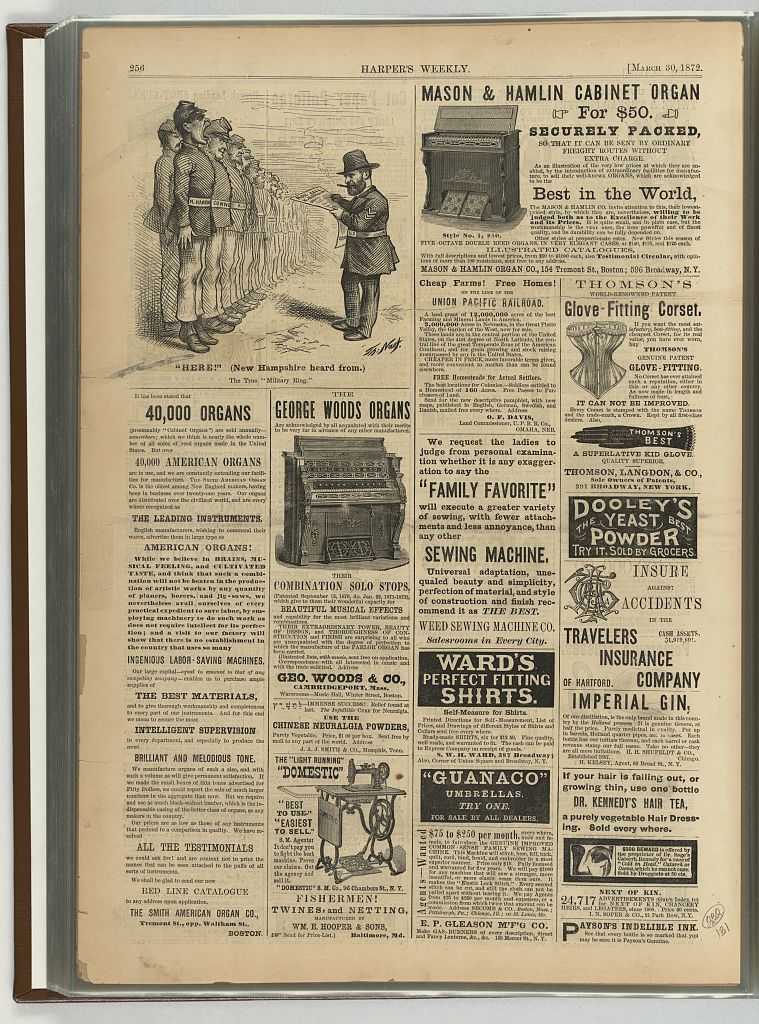
Here! (New Hampshire heard from) The true Military Ring. Thomas Nast, Harper's Weekly, 30 March 1872. Public domain by age; Library of Congress.
Grant reads a roll to which soldiers answer 'Here!', and the caption ties it to New Hampshire's state election; the picture of states answering in turn is a Bandwagon image. It appeared before either party's convention [8].
Horace Greeley and Benjamin Gratz Brown (Liberal Republican and Democratic)
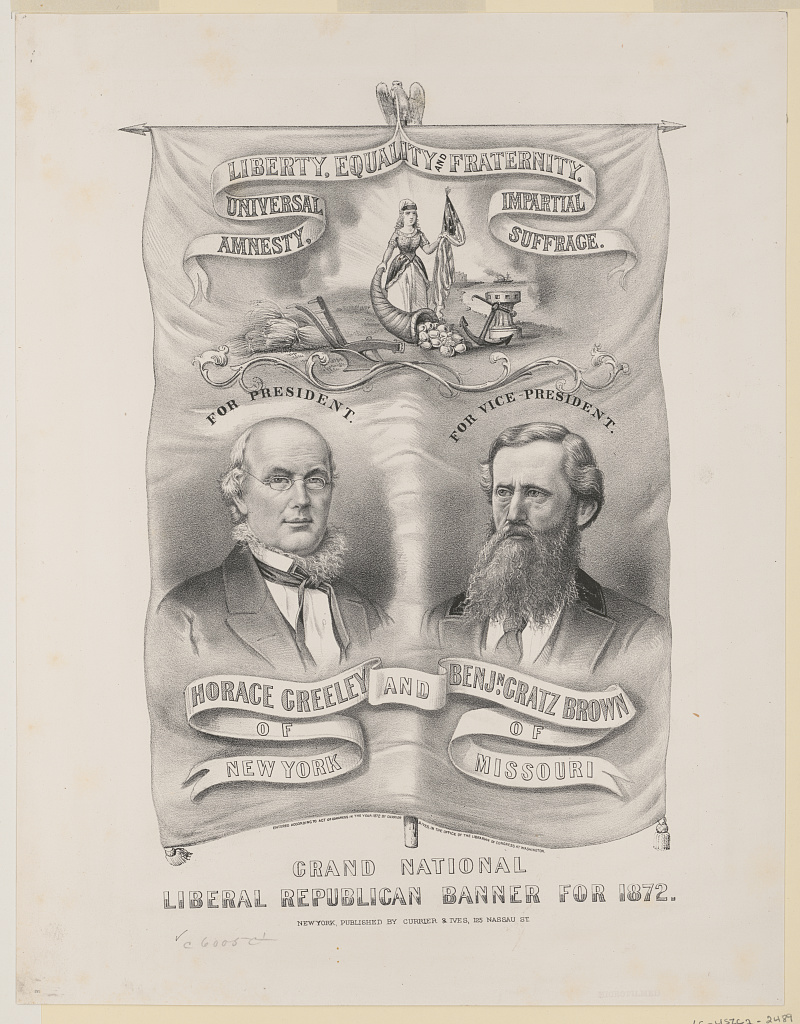
Grand National Liberal Republican banner for 1872. Currier & Ives, New York, 1872. Public domain by age; Library of Congress.
The banner carries the mottoes 'Liberty, Equality and Fraternity', 'Universal Amnesty' and 'Impartial Suffrage' under an eagle and Columbia, standard Glittering generalities and national-symbol Transfer [9].
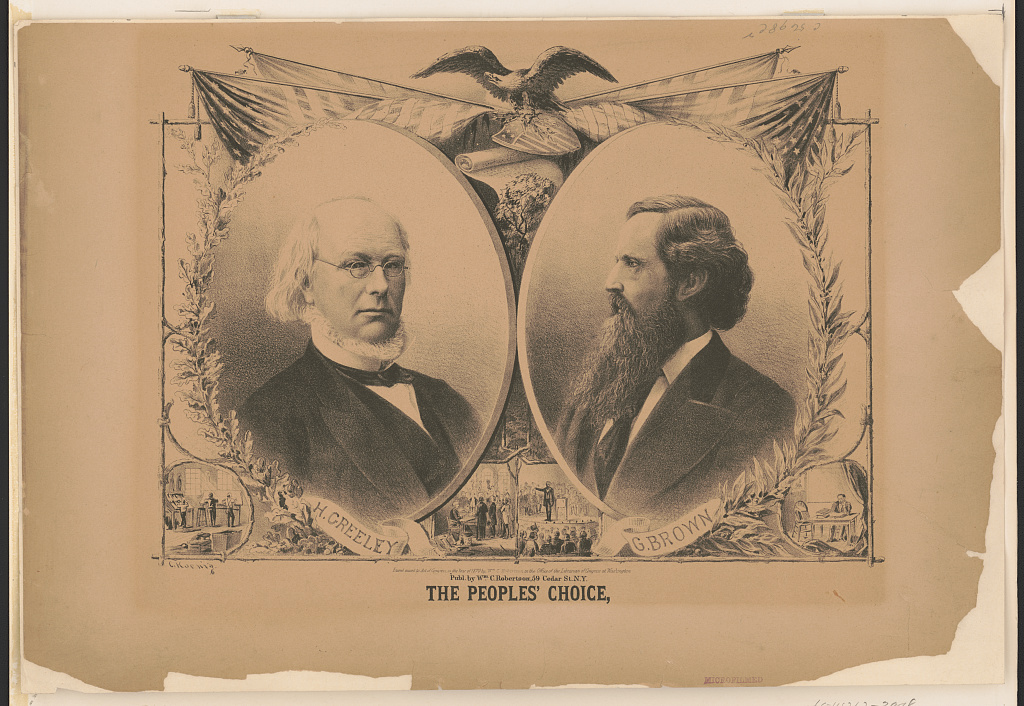
The peoples' choice, H. Greeley G. Brown. Wm. C. Robertson after C. Koenig, New York, 1872. Public domain by age; Library of Congress.
The title claims popular endorsement (Bandwagon) and the vignettes of a composing room and a newspaper office present Greeley as a working printer and editor (Plain folks) [10].
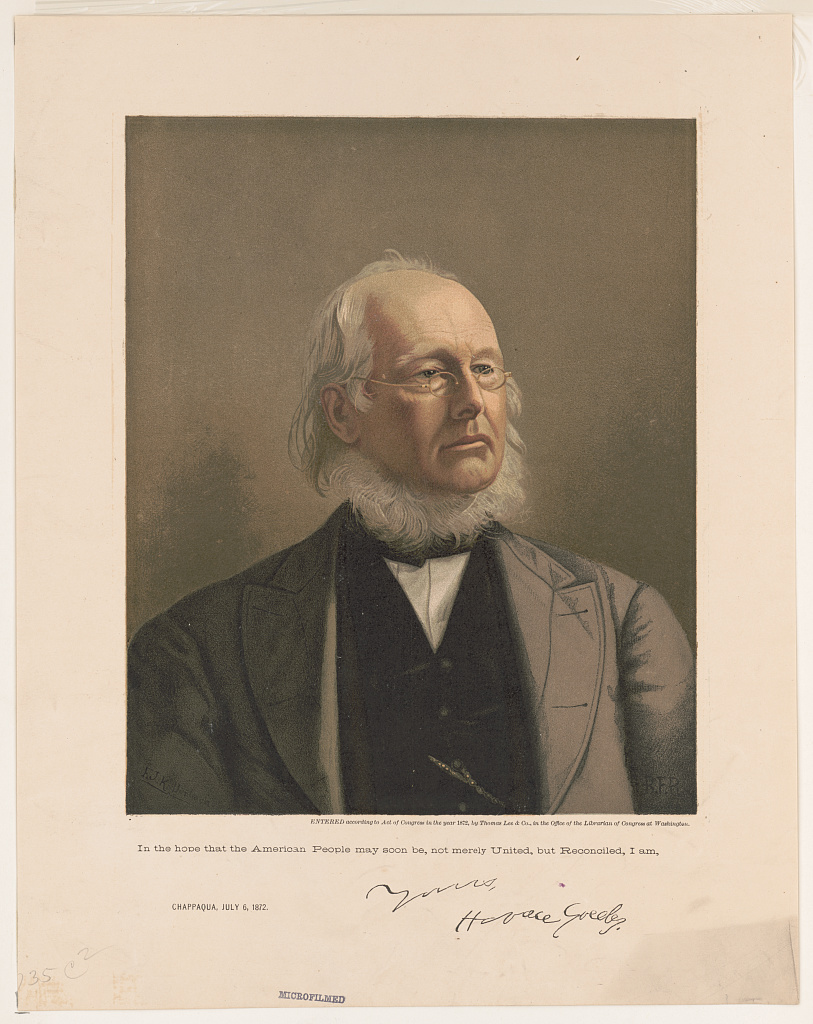
In the hope that the American people may soon be, not merely united, but reconciled, I am, yours, Horace Greeley. T. Lee & Co., 1872. Public domain by age; Library of Congress.
The print pairs the portrait with a line over Greeley's signature, 'In the hope that the American people may soon be, not merely united, but reconciled', a Glittering generalities appeal to reconciliation after the war [11].
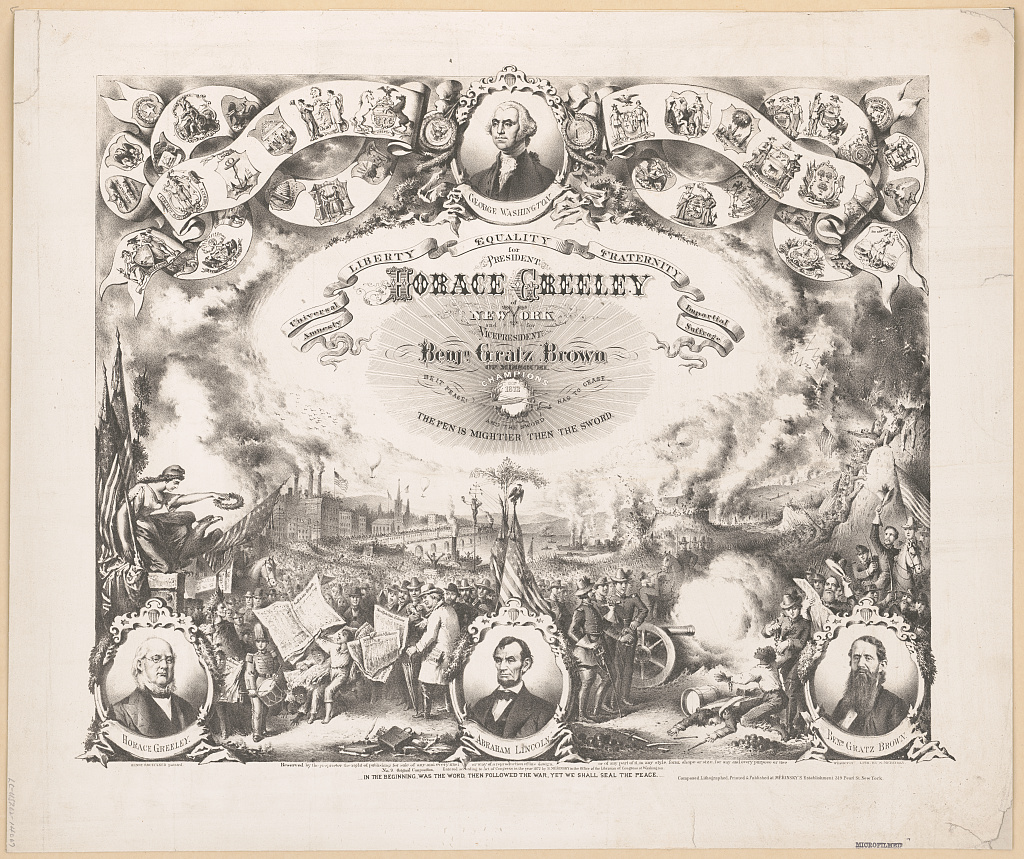
For president Horace Greeley of New York and for vice president Benjn. Gratz Brown of Missouri. Svobodin Merinsky after Henry Brueckner, New York, 1872. Public domain by age; Library of Congress.
Greeley and newsboys fill the peace side and cannon fire the war side, which the LOC reads as a contrast with Grant's Civil War record; the legend 'The pen is mightier than the sword' frames the contrast as Transfer of a familiar proverb to the candidate [12].
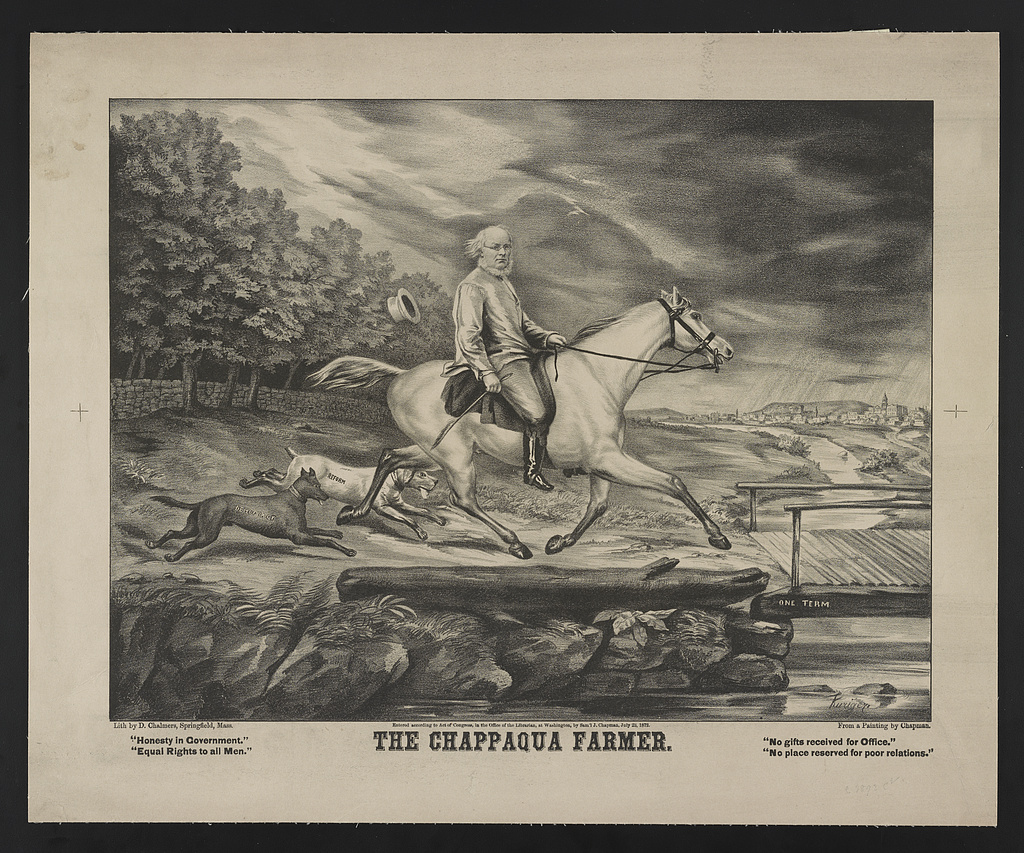
The Chappaqua farmer. D. Chalmers after Samuel J. Chapman, Springfield, Mass., July 1872. Public domain by age; Library of Congress.
Greeley appears as a farmer on horseback, in the margins 'Honesty in Government' and 'No place reserved for poor relations', which is Plain folks imagery joined with Glittering generalities [13].
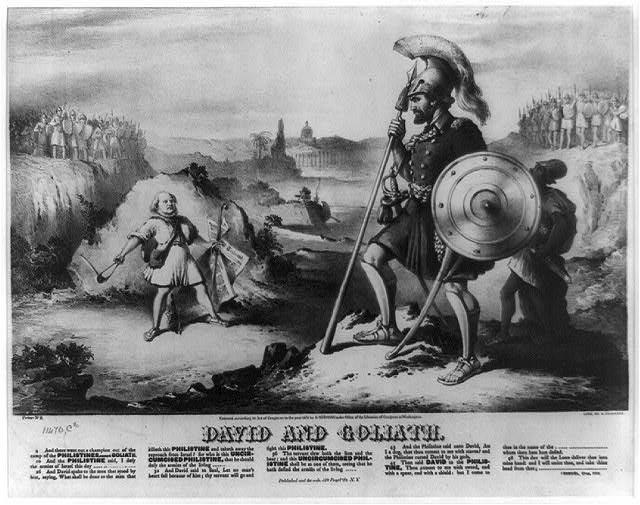
David and Goliath. Merinsky's Establishment, New York, 1872. Public domain by age; Library of Congress.
The biblical story is applied to the contest, with Greeley as David and Grant as the armed giant; the story is borrowed for its moral weight (Transfer) [14].
Techniques visible
Both sides use Transfer heavily: the Republican prints transfer the standing of Washington and Lincoln to Grant and the stigma of Davis and Calhoun to Greeley, and the Greeley prints transfer a proverb, a biblical story and national symbols to him. Both use Glittering generalities (the Republican chart's heading, the Liberal Republican mottoes and the Greeley reconciliation line) and Plain folks (the Grant tanner banner and Greeley's farmer and printer prints). Bandwagon claims appear in Nast's roll call and in 'The Peoples' Choice'. Name-calling and Scapegoating appear in the Republican-side prints aimed at Greeley, and Testimonial in the Currier & Ives dodge print. No print attacking Grant by name was found and hosted from the Greeley side, so the archive shows none; that reflects what was found, not the whole record.
Sources
- National Archives, "1872 Electoral College Results", https://www.archives.gov/electoral-college/1872
- American Presidency Project, "Presidential Elections: 1872", https://www.presidency.ucsb.edu/statistics/elections/1872
- Library of Congress, "The Republican chart. The nation's choice in war and peace Ulysses S. Grant", https://www.loc.gov/item/2012648820/
- Library of Congress, "The working-man's banner", https://www.loc.gov/item/2003656593/
- Library of Congress, "You must make your choice. Birds of a feather flock together", https://www.loc.gov/item/2003690769/
- Library of Congress, 'A "dodge" that wont work', https://www.loc.gov/item/96511771/
- Library of Congress, "Splitting the party - the entering wedge", https://www.loc.gov/item/2010646232/
- Library of Congress, Nast, "Here! (New Hampshire heard from)", https://www.loc.gov/item/2007684704/
- Library of Congress, "Grand National Liberal Republican banner for 1872", https://www.loc.gov/item/2003656592/
- Library of Congress, "The peoples' choice, H. Greeley G. Brown", https://www.loc.gov/item/2012648846/
- Library of Congress, "In the hope that the American people may soon be, not merely united, but reconciled", https://www.loc.gov/item/2003670291/
- Library of Congress, "For president Horace Greeley of New York and for vice president Benjn. Gratz Brown", https://www.loc.gov/item/2003671797/
- Library of Congress, "The Chappaqua farmer", https://www.loc.gov/item/2003690767/
- Library of Congress, "David and Goliath", https://www.loc.gov/item/2008661714/