In one line: the first presidential election after the Reconstruction Acts was fought largely over those Acts and over the war's memory, with Republican prints tying the Democratic ticket to the Confederacy and to violence, and Democratic prints tying the Republicans to taxation, the debt and Black political power; both sides' material includes racial caricature.
Context
Ulysses S. Grant, the Union general, ran as the Republican (National Union Republican) nominee with Schuyler Colfax of Indiana for vice president. The Democrats nominated Horatio Seymour, a former governor of New York, with Francis P. Blair, Jr., of Missouri, a former Union general, for vice president. Grant won 214 electoral votes to Seymour's 80 (the National Archives records Seymour's total as 71 if Georgia's contested votes are excluded; Grant was the winner in either case). In the popular vote Grant had 3,013,650 (52.7 per cent) and Seymour 2,708,744 (47.3 per cent) [1][2]. Mississippi cast no electoral votes [1].
The main issues were Congress's Reconstruction Acts and the status of the former Confederate states, Black male suffrage, the national debt and how to repay war bonds, and taxation. Grant's acceptance letter of 29 May 1868 closed with the words "Let us have peace", which became the Republican slogan. The Democratic platform called the Reconstruction Acts "usurpations, and unconstitutional, revolutionary, and void"; that sentence is quoted in the caption of a Thomas Nast cartoon below [3][4]. No third-party candidate drew a significant vote or left material in the collection, so the page covers the two main tickets.
Campaign literature
| Candidate | Objects in the archive | Note |
|---|---|---|
| Ulysses S. Grant (Republican) | 6 | One portrait lithograph, three cartoons by commercial publishers, two prints by Thomas Nast. |
| Horatio Seymour (Democratic) | 6 | One portrait lithograph, five cartoons or placards, all aimed at the Republicans. |
Six objects are shown for each side. Printed campaign cartoons were largely issued by commercial lithographers in New York, Hartford and Philadelphia, not by the party committees.
Ulysses S. Grant (Republican)
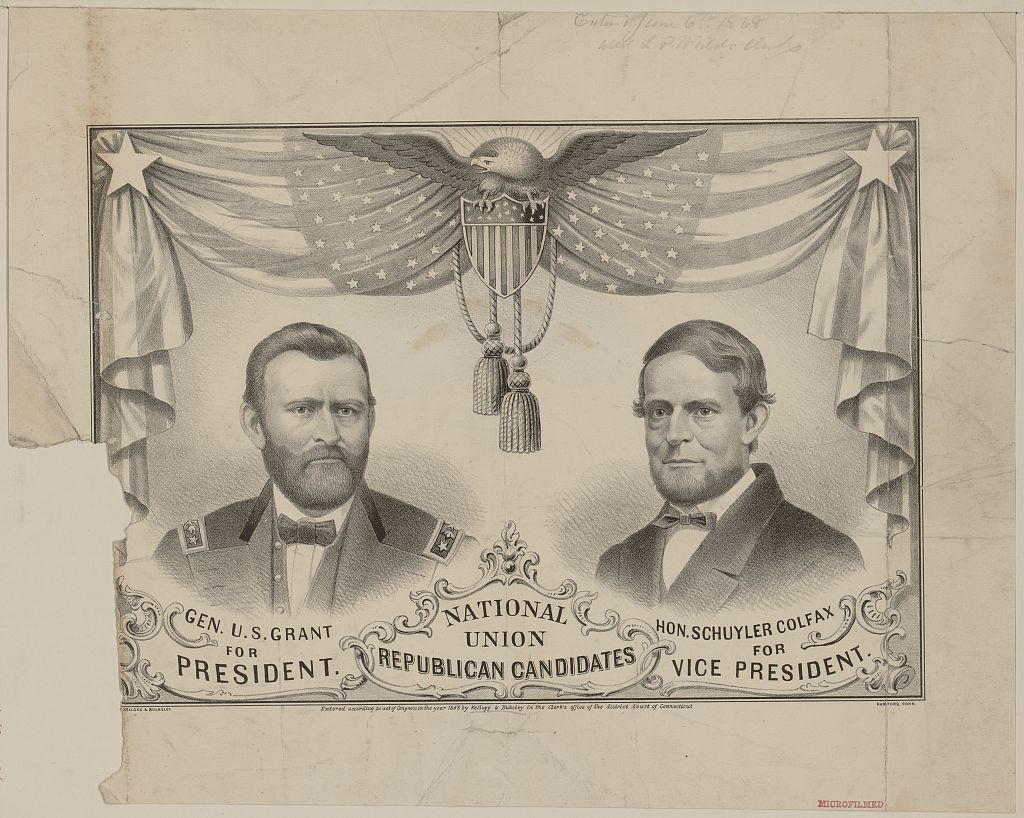
National Union Republican Candidates. Kellogg & Bulkeley, Hartford, c1868. Public domain by age; Library of Congress. Portraits of Grant and Colfax framed by a flag, eagle and shield, with no argument in the text. The national symbols placed around the candidates are Transfer: borrowed prestige attached to the ticket.
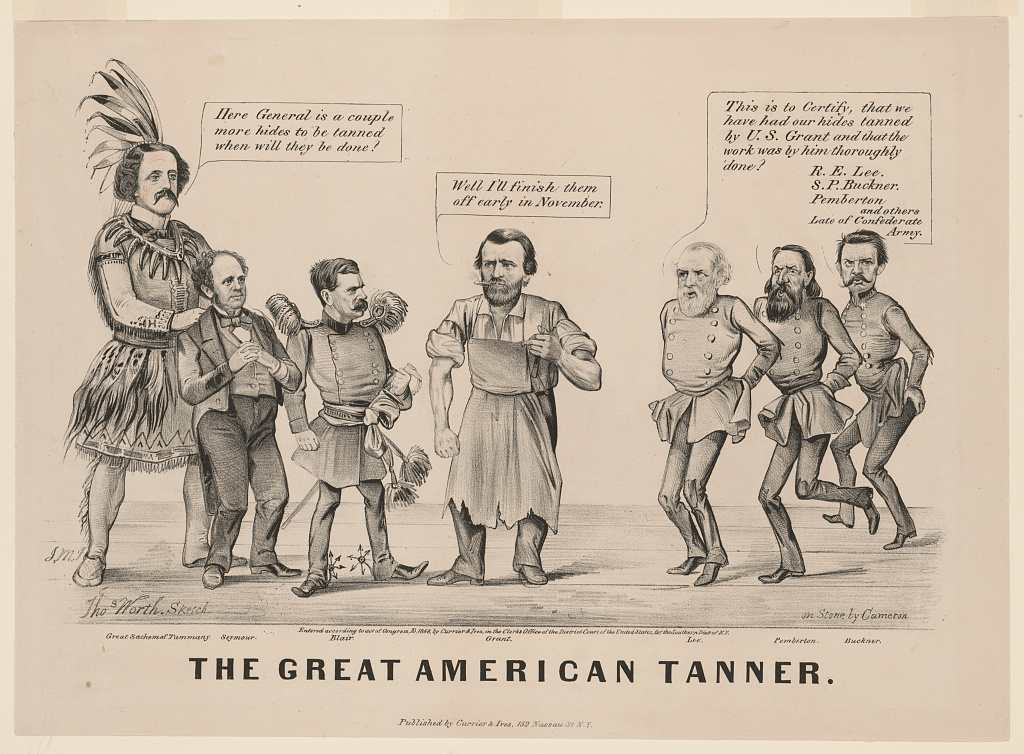
The Great American Tanner. Currier & Ives, New York, c1868. Public domain by age; Library of Congress. Grant, playing on his family's leather trade, says he will finish the Democratic ticket "early in November", while Lee, Pemberton and Buckner say he has already "tanned" their hides, and a figure in Native American dress stands for Tammany. Pairing the Democratic nominees with Confederate commanders and Tammany is Transfer of stigma; the labels are Name-calling.
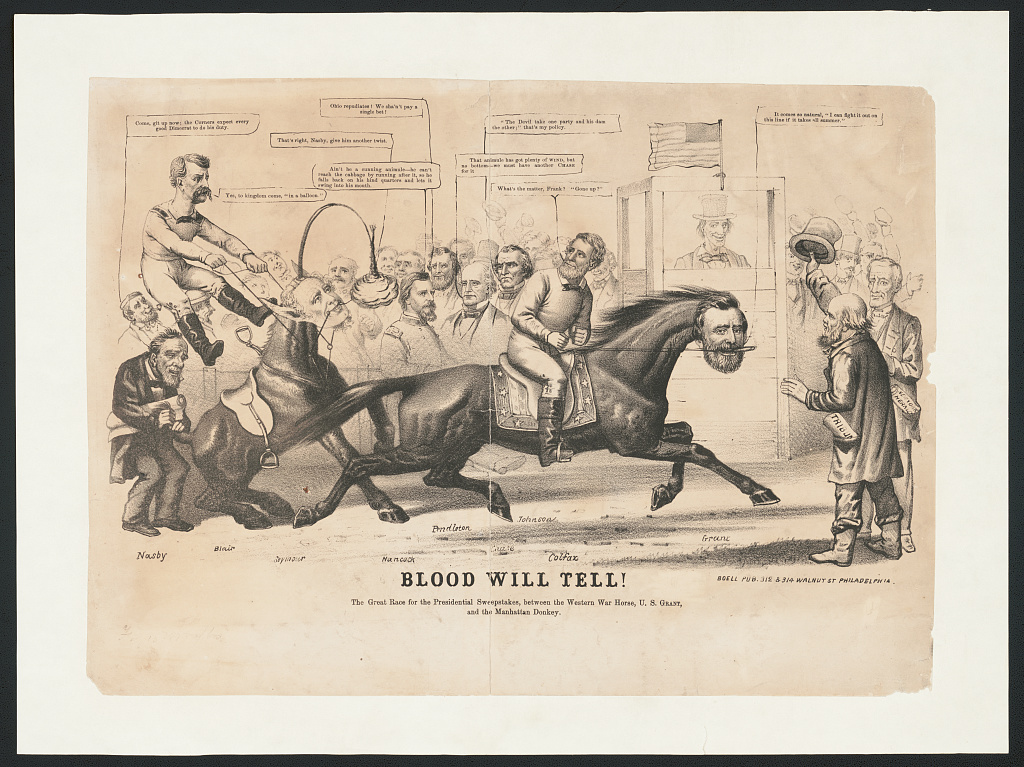
Blood Will Tell! The Great Race for the Presidential Sweepstakes. Boell, Philadelphia, 1868. Public domain by age; Library of Congress. A horse with Grant's head, ridden by Colfax, leads one with Seymour's head whose rider, Blair, is being thrown; the title calls the opposing horse the "Manhattan donkey". The lead is shown as settled in advance, a Bandwagon frame, and the donkey label is Name-calling.
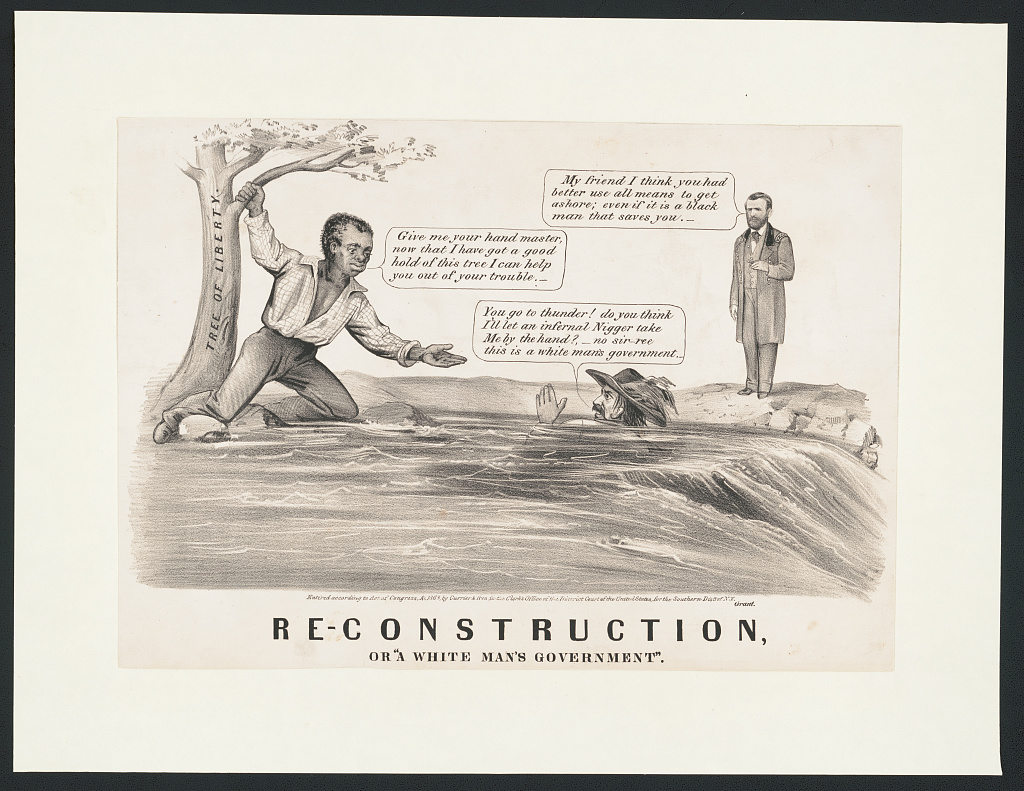
Re-construction, or 'a white man's government'. Currier & Ives, New York, 1868. Public domain by age; Library of Congress. A Black man on the "tree of Liberty" reaches out to a drowning former slaveholder, who refuses in dialect speech that includes a racial slur, while Grant urges him to accept. The print takes the Democratic slogan "a white man's government" and puts it in a Republican scene: Semantic hijacking. Content note: period dialect and a racial slur, shown as printed.
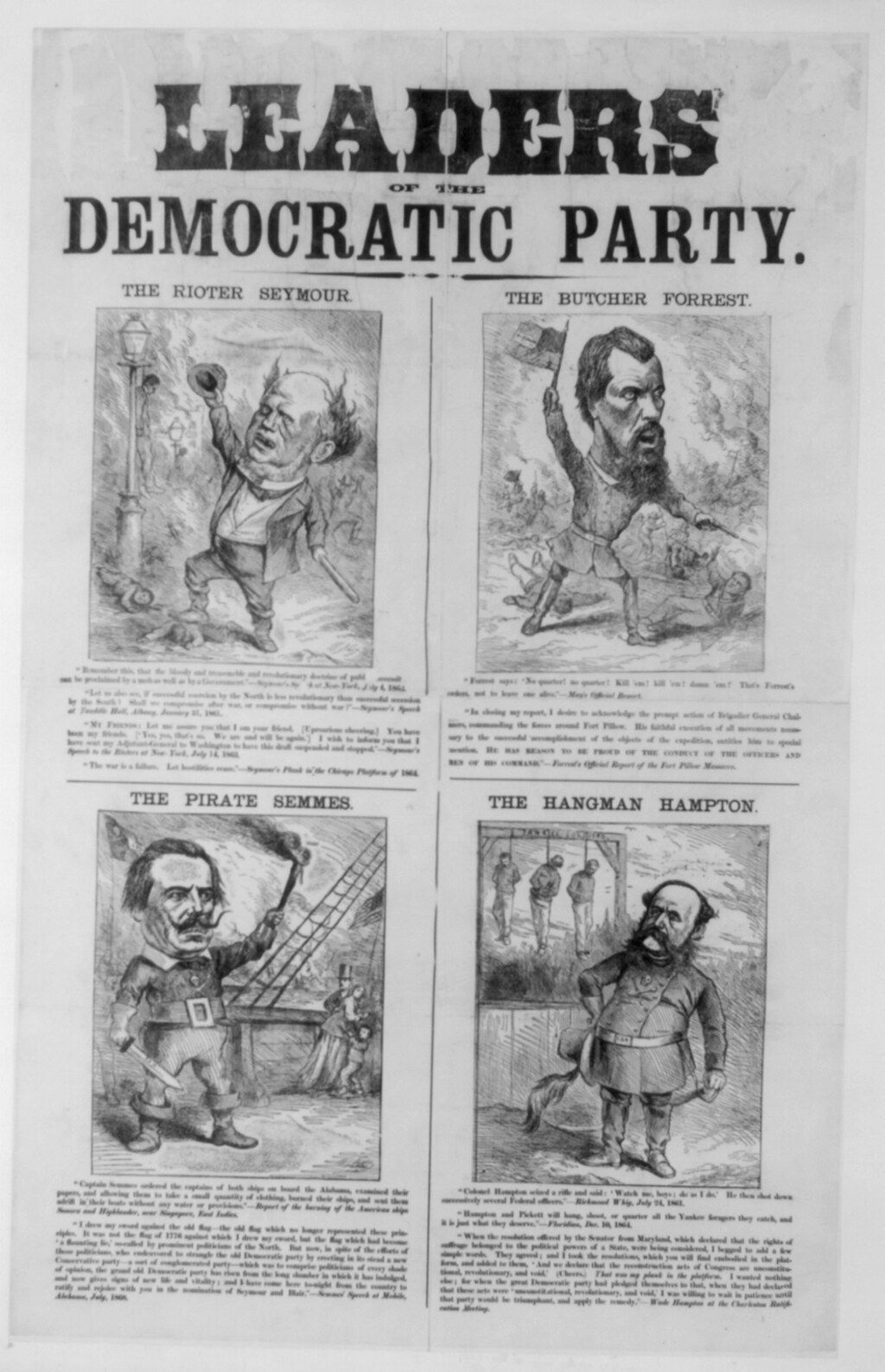
Leaders of the Democratic Party: The Rioter Seymour, the Butcher Forrest, the Pirate Semmes, the Hangman Hampton. Thomas Nast (signed), 1868. Public domain by age; Library of Congress. Four panels, "The Rioter Seymour", "The Butcher Forrest", "The Pirate Semmes" and "The Hangman Hampton", each over extracts from the man's own speech or an official report. The labels are Name-calling, and setting the nominee beside Confederate officers by selected quotation is Card stacking and Transfer.
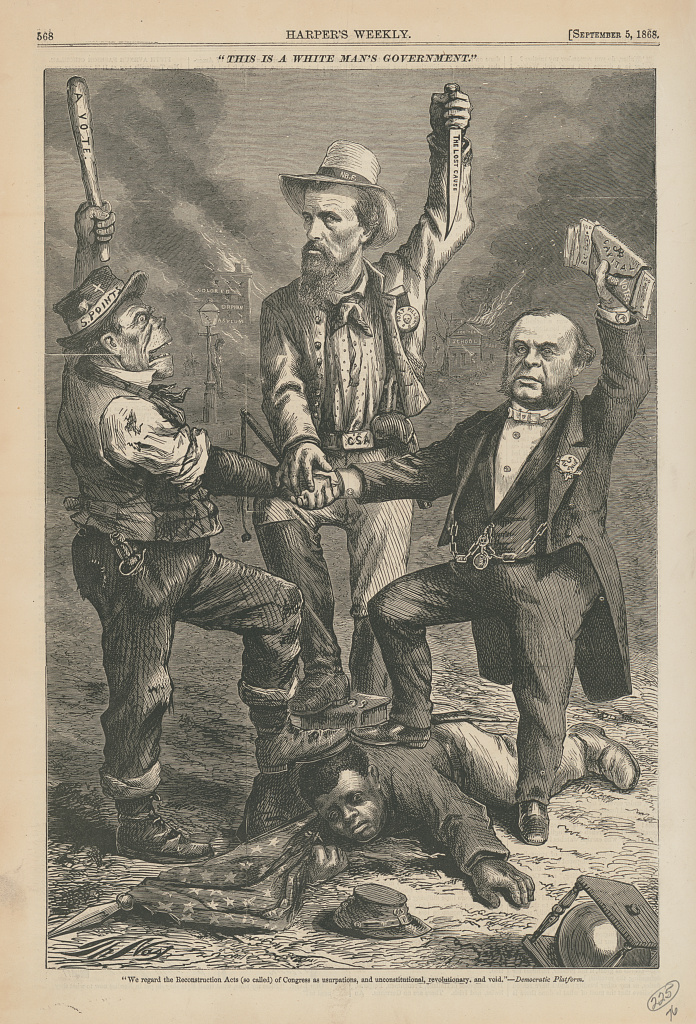
This Is a White Man's Government. Thomas Nast, Harper's Weekly, 5 September 1868. Public domain by age; Library of Congress. Three men clasp hands over a Black man: one with a club marked "A VOTE" and a "5 Points" cap, one with a knife marked "The Lost Cause" and a "CSA" buckle, and one in a frock coat holding a roll of money. A school and a building burn behind them, and the caption quotes the Democratic platform. The image stages Fear appeal about the platform's effect, attaching violence and the Confederacy to it by Transfer.
Horatio Seymour (Democratic)
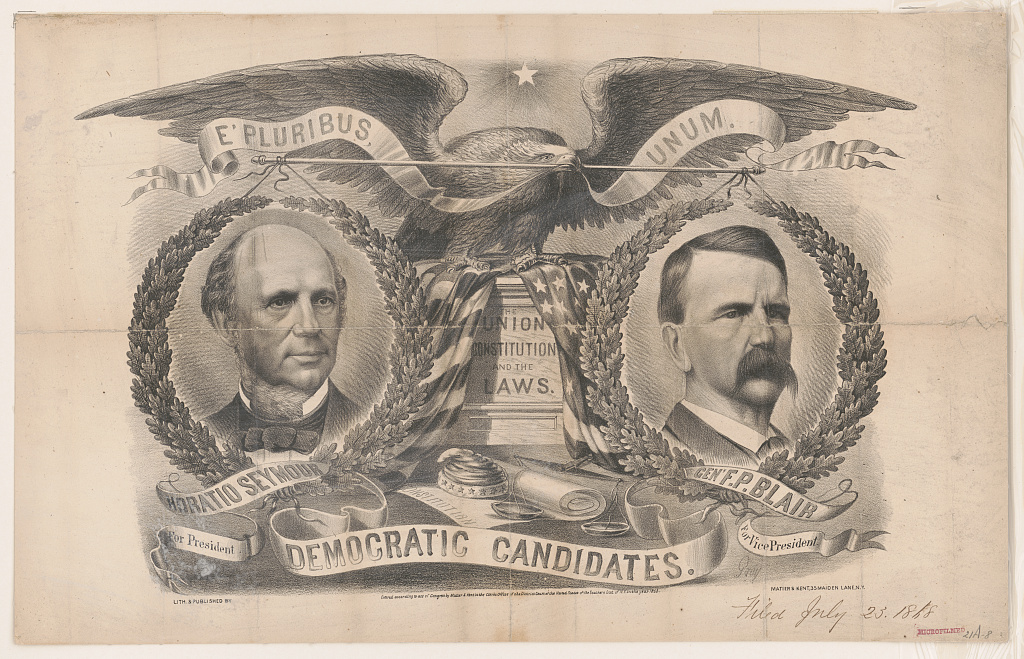
Democratic Candidate. Matier & Kent, New York, c1868. Public domain by age; Library of Congress. Portraits of Seymour and Blair in wreaths under an eagle and "E Pluribus Unum", over a column inscribed with the Constitution and the laws. As on the Republican portrait print, the national symbols are Transfer.
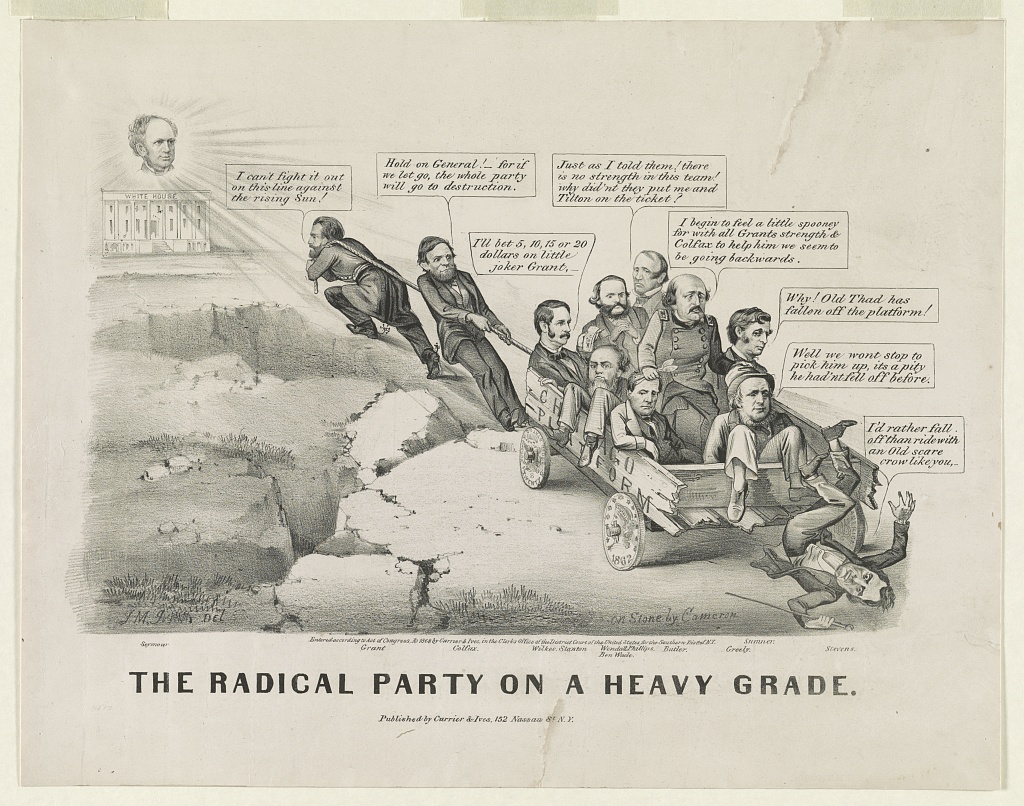
The Radical Party on a Heavy Grade. Currier & Ives, New York, c1868. Public domain by age; Library of Congress. A cart of Republican leaders, hauled by Grant and pushed back by its own weight, nears a precipice while Seymour's head glows over the White House. The speech balloons say the party is "going backwards"; the party label "Radical" is Name-calling and the rising-sun image is a Bandwagon claim.
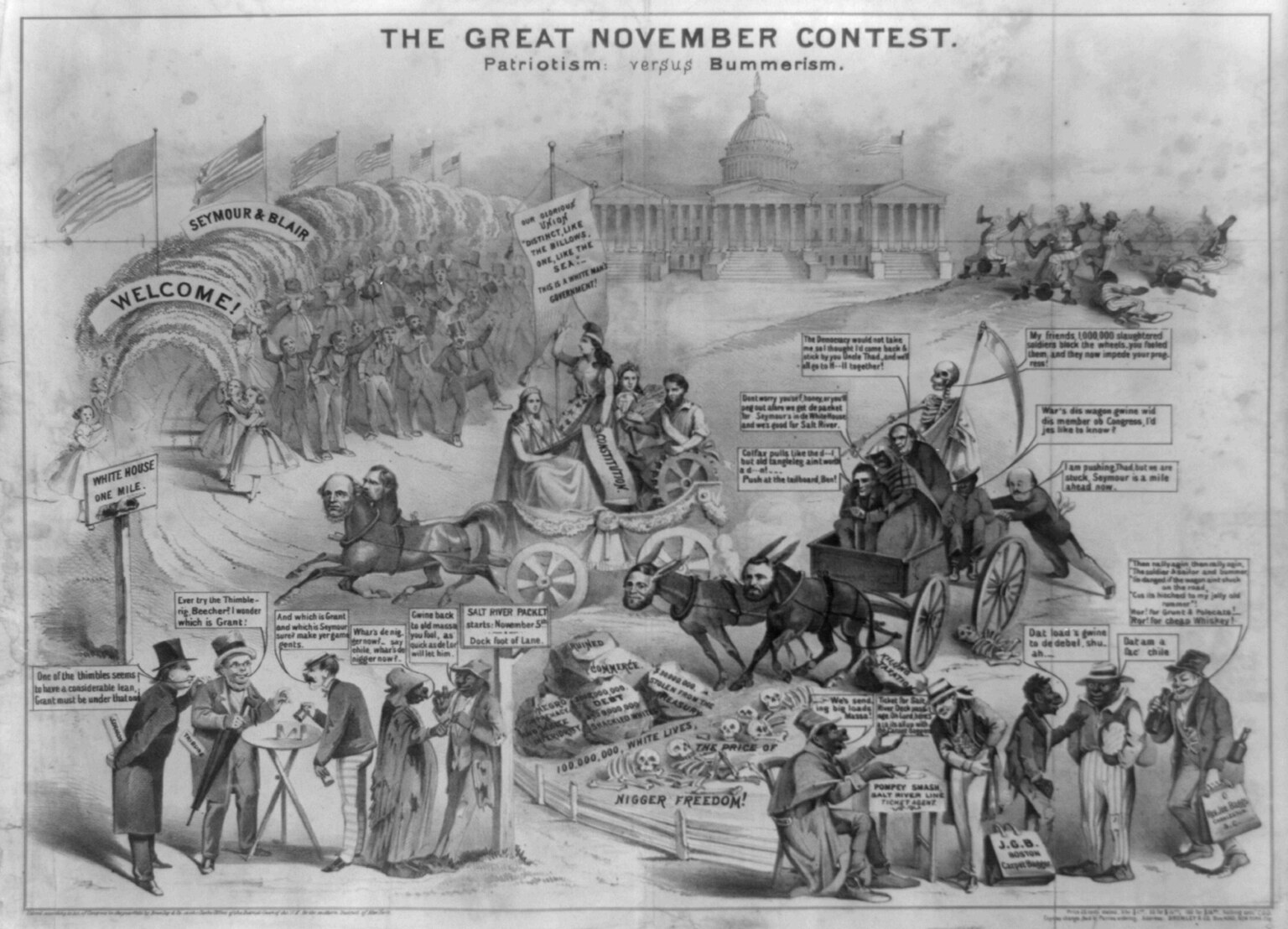
The Great November Contest. Patriotism versus Bummerism. Bromley & Co., New York, 1868. Public domain by age; Library of Congress. A carriage drawn by horses with the heads of Seymour and Blair, carrying Liberty and "This is a White Man's Government!", outruns a wagon drawn by asses with the heads of Grant and Colfax, which is stalled before a graveyard labelled "100,000,000 White Lives, the Price of Nigger Freedom!" and stones marked "Negro Supremacy". Black figures are drawn as idle and in dialect. This is Fear appeal and Scapegoating of Black Americans and Republicans, with Name-calling. Content note: racial slur, caricature and dialect, shown as printed; the Library of Congress calls the Democratic campaign of 1868 strongly racist and this print an attack on Reconstruction and Black rights.
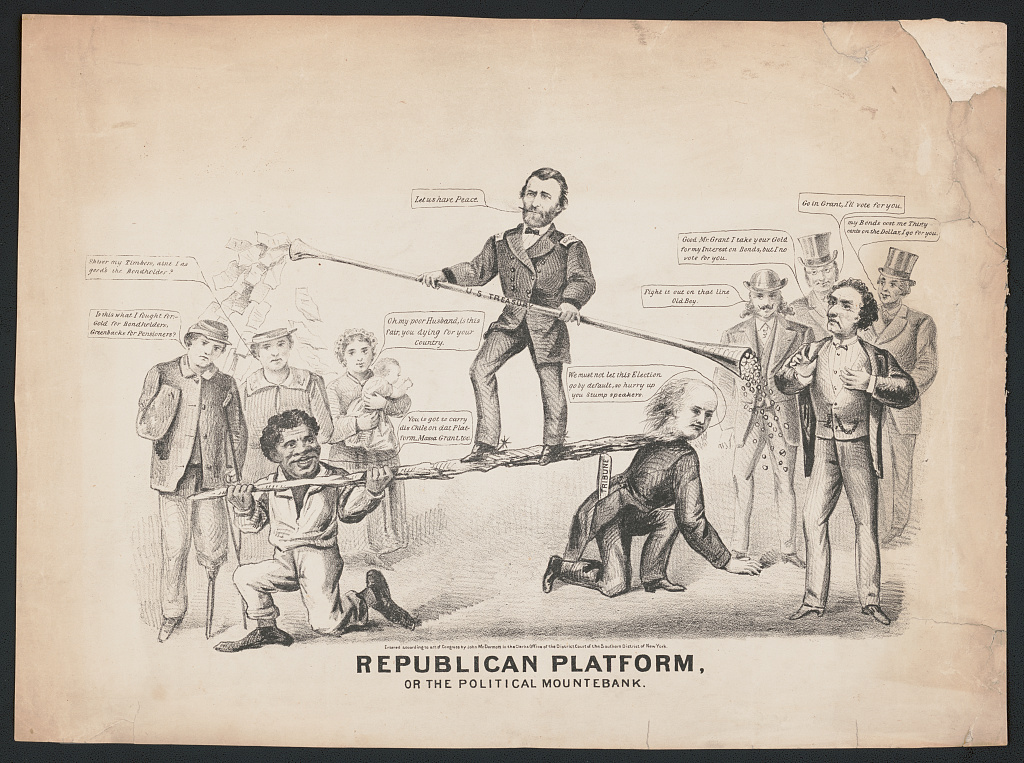
The Republican Platform, or the Political Mountebank. John McDermott, New York, 1868. Public domain by age; Library of Congress. Grant balances on a rail held by a kneeling Black man and Horace Greeley, and a pole marked "U.S. Treasury" spills paper to a soldier, sailor and widow on one side and gold to wealthy men on the other. The Library of Congress reads it as charging Grant with favouring bondholders over veterans; the choice of what the pole delivers to whom is Card stacking, and "mountebank" is Name-calling. Content note: caricature of a Black man.
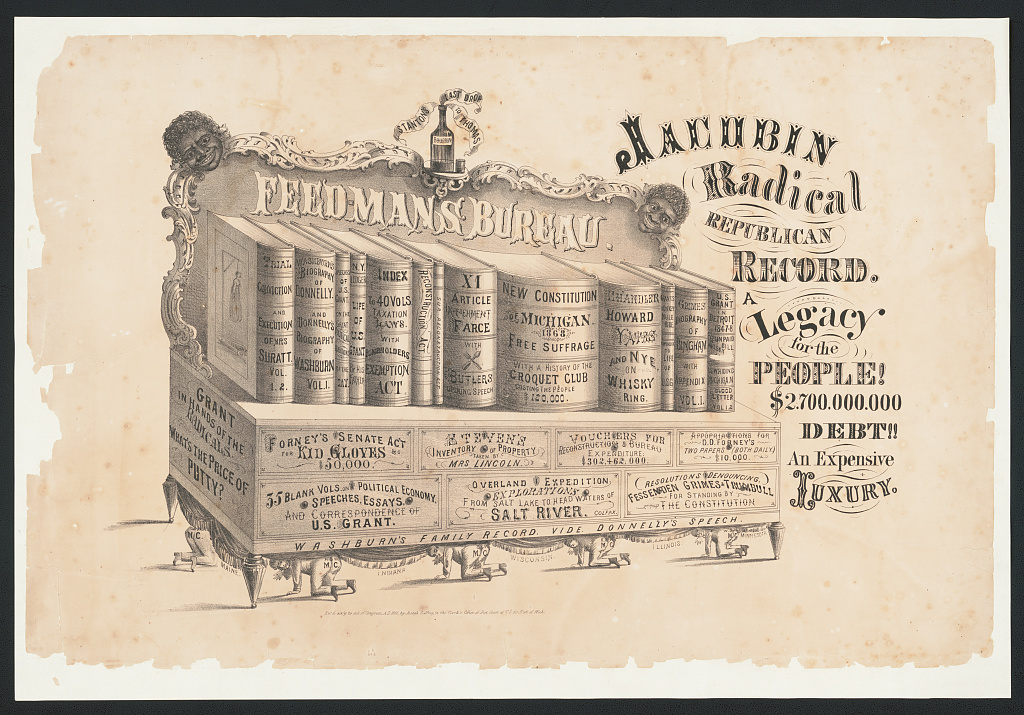
Jacobin Radical Republican Record: a legacy for the people! $2,700,000,000 debt!! an expensive luxury. Publisher not identified, 1868. Public domain by age; Library of Congress. A "Feed-Mans Bureau" sideboard lists the debt, taxation, Reconstruction, Black suffrage, the Johnson impeachment and the Whisky Ring as the Republican record, topped with caricatured Black faces. "Jacobin" and "Radical" are Name-calling and the one-sided inventory is Card stacking. Content note: racial caricature.
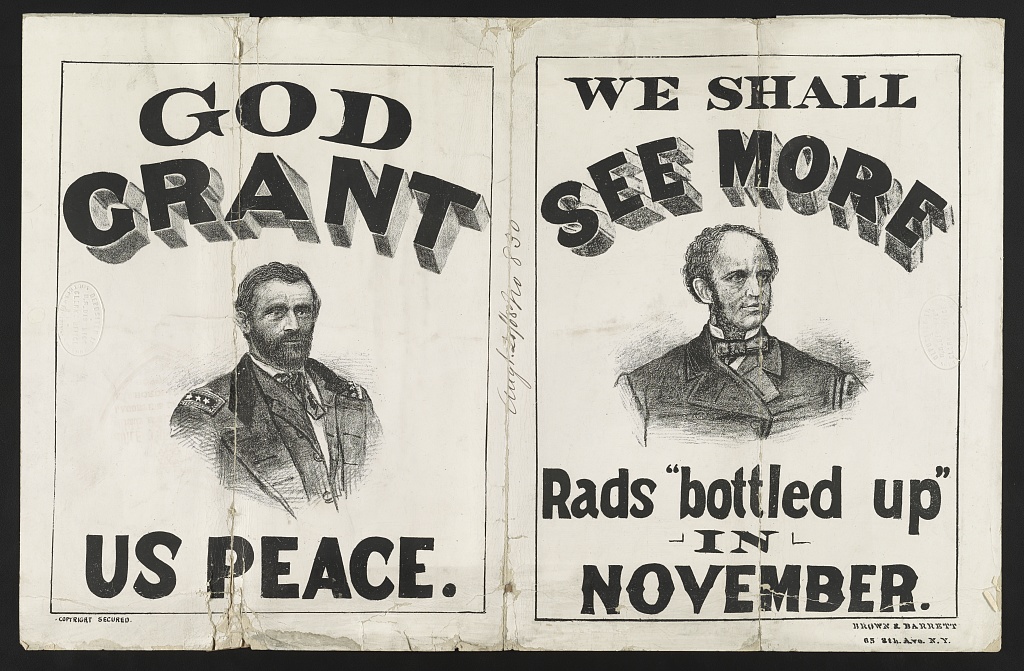
God Grant Us Peace / We Shall See More Rads 'Bottled Up' in November. Brown & Barrett, New York, 1868. Public domain by age; Library of Congress. An uncut proof for two placards: a Grant portrait over "God Grant Us Peace" beside a Seymour portrait over a pun on his name ("We Shall See More Rads 'bottled up' in November"). The Library of Congress notes the proof may have been made for both camps and that "bottled up" may allude to rumours of Grant's drinking; the pun uses Name-calling ("Rads"). It is filed here because its printed pun targets the Republicans.
Techniques visible
Both tickets were presented with the same stock devices. Portrait lithographs on each side lean on Transfer from flags and eagles. Both sides' cartoons use Name-calling labels (donkey, "Radical", "Jacobin", "mountebank", Tammany, "the Butcher"), and both use Card stacking by listing selected grievances or quotations. The Republican prints here stress the Confederate record of Democratic figures and violence (Transfer, Fear appeal); the Democratic prints stress debt, taxation and Black political power (Fear appeal, Scapegoating). Both sides use "a white man's government" as a slogan: the Democratic side as its claim, the Republican side by Semantic hijacking of it. On scale and intent, the Democratic prints here put the racial charge into the main message about Black Americans, while the Republican prints direct their charge at named Democratic leaders and the party platform; both groups include racial caricature, which is shown as printed.
Gaps
All twelve objects are prints or placards held by the Library of Congress. Badges, ribbons, songsters and broadsides from this campaign (for example the Library's 1868 Grant button and the Seymour and Blair sheet-music covers) exist but are not yet catalogued here. No third-party candidate has material.
Sources
- National Archives, "1868 Electoral College Results", https://www.archives.gov/electoral-college/1868
- American Presidency Project, "1868 Presidential Election", https://www.presidency.ucsb.edu/statistics/elections/1868
- Library of Congress, catalogue records for the objects above, https://www.loc.gov/pictures/ (item pages cited in each collection entry)
- Harper's Weekly, 5 September 1868, p. 568, via Library of Congress, https://www.loc.gov/item/98513794/