Content note: Quotes wartime anti-German language, including "Hun", and period terms for racial and national groups. This object is shown as it was published. Why
THE domestic task was simple compared with the undertaking that faced the Committee on Public Information when it turned from the United States to make the fight for world opinion. It was not only that the people of the Allied Powers had to be strengthened with a message of encouragement, but there was the moral verdict of the neutral nations to be won and the stubborn problem of reaching the deluded soldiers and civilians of the Central Powers with the truths of the war. A prime importance was to preach the determination and military might of America and the certainty of victory, but it was equally necessary to teach the motives, purposes, and ideals of America so that friend, foe, and neutral alike might come to see us as a people without selfishness and in love with justice.
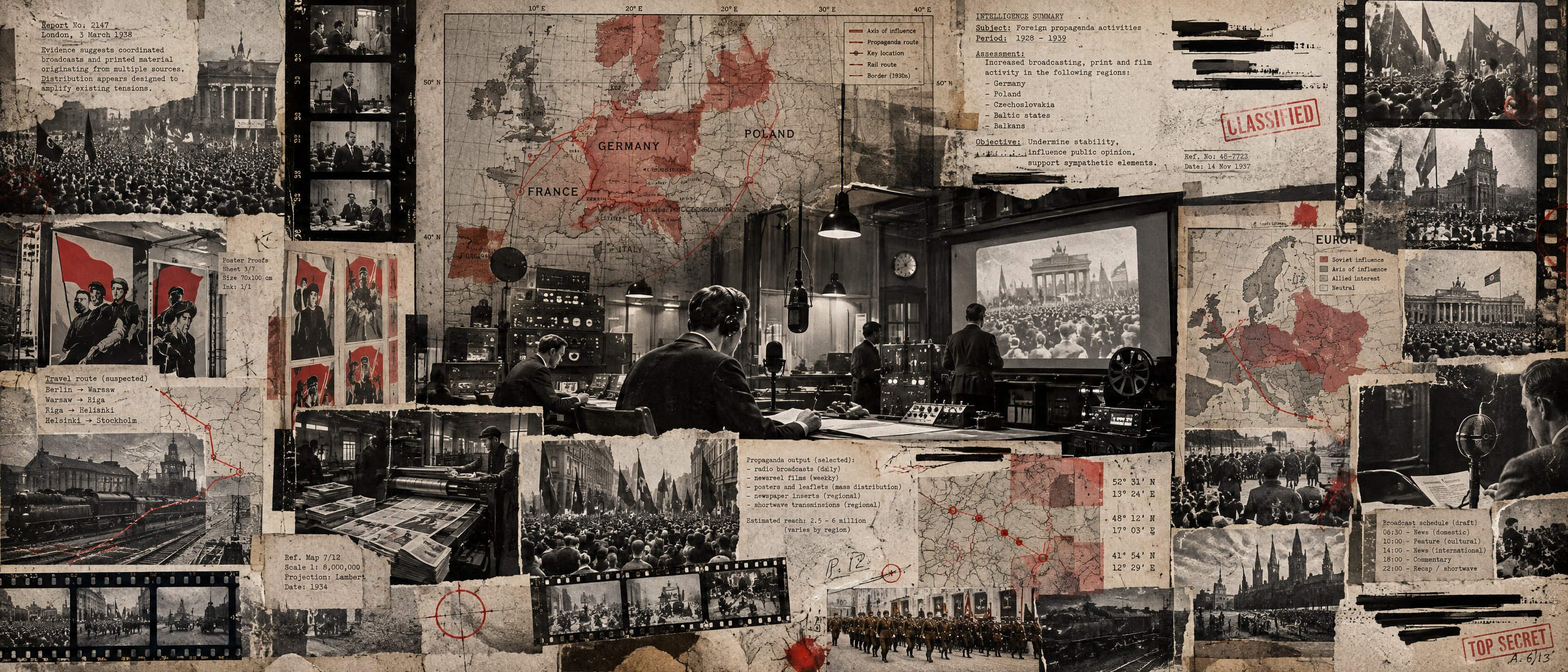
It was a task that looked almost hopeless. The United States, alone of the great nations of the world, had never conducted a propaganda movement. For years preceding the war Germany had been secretly building a vast publicity machine in every corner of the earth, designed to overwhelm all foreign peoples with pictures of Germany's vast power, her overwhelming pre-eminence in industry, commerce, and the arts. German agents, carefully selected from among her journalists and authors, neglected no opportunities for presenting Germany's case to readers of every language, and her commercial firms linked a propaganda of liberal credits with this newspaper campaign throughout the world.
Great Britain, through Reuters, likewise conducted a governmental propaganda. France had official connection with the Havas Agency. Both England and France, through ownership or liberal subsidy of certain great cable arteries, had long been able to direct currents of public opinion in channels favorable to themselves. Other nations had publicity machines of varying types.
America controlled no cables, manipulated no press associations, operated no propaganda machinery of any kind. We were, and always had been, dependent upon foreign press agencies for intercourse with the world. The volume of information that went from our shores was comparatively small, and after it had been filtered in London, or Paris, it grew smaller and smaller until it amounted to mere "flashes" when it reached a far country. Strangely enough, we were at once the best-known and the least-known people in the world. There was no corner of the globe in which America was not a familiar word, but as to our aims, our ideals, our social and industrial progress, our struggles and our achievements, there were the most absolute and disheartening misunderstandings and misconceptions. For instance, when the "gun-men" were executed in New York, papers in South America actually printed accounts that told of an admission fee being charged, with Governor Whitman taking tickets at the door. Into this situation the Germans projected themselves with vigor and decision. From the first, Berlin had an exact appreciation of the military value of public opinion, and it spent millions in its endeavor to win it or else to corrupt it. Just as the German propagandists worked in the United States during our period of neutrality, using every effort to prejudice Americans against the Allies, so did they now attempt to poison the Allied and the neutral nations of the world against America.
It is impossible even to estimate the amount of money spent on propaganda by the Germans. Russians competent to judge assured us that the agents of Berlin spent $500,000,000 in that country alone in their work of corruption and destruction, and their expenditures in Spain were estimated at $60,000,000. Close to $5,000,000 went to Bolo Pasha for the corruption of the Paris press, and the sums spent in Mexico ran high into the millions. I know that they owned or subsidized dailies in most of the important cities of Spain, South America, the Orient, Scandinavia, Switzerland, and Holland; that their publications, issued in every language, ran from costly brochures to the most expensive books and albums; that they thought nothing of paying $25,000 for a hole-in-the-wall picturehouse, and that in every large city in every country their blackmailers and bribe-givers swarmed like carrion crows.
Their propaganda, while playing upon different points of prejudice in various countries, was much the same in all countries. As an initial proposition America's military strength was derided. By no possibility could the United States raise or train an army, and if, by some miracle, this did happen, the army could not be transported. America was a fat, loblolly nation, lacking courage, equipment, and ships, etc., etc. Working away from this pleasing premise, Americans were described as a nation of dollar-grabbers, devoid of ideals, and inordinate in their ambitions. Our war with Mexico was played up as a cold-blooded, evil conquest and our struggle with Spain painted as an effort of our financial masters to enter upon dreams of world imperialism; Cuba, the Philippines, and Porto Rico were pitied as "America's slave nations"; Pershing's expedition to Mexico was declared to be the start of a war of conquest that we were later forced to relinquish because our "cowardice" shrank before the "dauntless" courage of Carranza; the Colorado coal strike, the Lawrence strike, and the Paterson strikes were all treated in the utmost detail to prove America's "system of wage-slavery"; pictures were drawn of tremendous wealth on the one hand and peonage on the other; lynchings were exaggerated until it was made to appear that almost every tree in America was used for purposes of execution, and we were charged in every conceivable form and fashion with being the secret partner of one or the other of the Allies in commercial plans to control the trade of the world.
Where there was French sentiment, America was set down as the secret partner of England. Where English sentiment prevailed, we were the secret partner of France; and where Italian sentiment obtained, America, England, and France were assumed to be in a plot to destroy Italy.
In Spain every effort was made to revive the prejudices and passions of 1898, and the pro-German press ran daily lies in proof of "Yankee Contempt for the Spaniard." One falsehood was that a favorite American recruiting slogan was: "Enlist for the War! Remember the Maine and Spain."
In Switzerland we were accused of withholding grain shipments in order to starve the Swiss into alliance with us, and in South and Central America the Germans put full emphasis on the "Panama Canal rape" and the "conquest and annexation" of Haiti and Santo Domingo.
The German drive against us was particularly strong in Italy and France among the peasants, and weekly papers, printed in close imitation of French and Italian publications, were circulated by the thousands. The French were asked to believe that the high prices were entirely due to the selfishness and extravagance of the Americans in France, also that the docks and railroads and warehouses built by the Expeditionary Forces would be permanent American properties with a view to the commercial enslavement of France and the French.
Playing upon the fact that only a small number of American troops were in Italy, the German "fakes" kept up the continual cry : "Why is Italy deserted? A new and more terrific drive is on the way, but Foch keeps help from us. Pershing and the Americans are the dupes of the selfish French."
In France the Gazette des Ardennes, published in French printing-offices in the occupied district, deceived thousands, and Italian newspapers were also printed and distributed from captured cities. In both cases, the names of well-known French and Italian writers and artists were forged to articles and cartoons. A principal propaganda weapon, however, was The Continental Times, published in Berlin, with branch office^ in Holland and Switzerland. Printed in English, edited by American and British renegades, and called "an independent cosmopolitan newspaper published in the interests of truth," the wretched sheet gave itself wholly to the dissemination of falsehood. It was peculiarly the medium used in attacking America, and in each issue there were columns devoted to the "failure" of our Liberty Loans, "armed resistance to the draft," the "utter breakdown" of our war preparations, and other like lies. In Russia particularly, but also among the labor and Socialist grorps of all the neutral and Allied countries, exaggerated attention was paid to the Mooney trial, the imprisonment of Emma Goldman, the deportations in Arizona, and other matters intended to give the lying impression that there was an industrial autocracy in the United States more to be feared than the military autocracy of Germany.
The great wireless plant at Nauen was used almost exclusively for propaganda, from two to three thousand words being "broadcasted" each day as a lure to neutrals. The navy picked it up regularly for studying by various divisions of the government, in order that we might know what lies to fight.
Strangely enough, the Germans gathered much of their most effective material from our own press. From first to last American newspapers went to neutral countries without hindrance, and everything that they contained about "inefficiency," "graft," "delay," or "Wilson Bitterly Arraigned as Dictator" was seized upon by the German propagandists and played across the board. Mr. Roosevelt's articles, however conscientiously intended as constructive criticism, were among the chief weapons used by the Germans in their propaganda attack in every country. Senator La Follette's speeches were printed between red covers and broadcasted. No wonder that the thing that fairly stunned the visiting Mexican editors was their first sight of an aviation-field! They honestly believed, as a result of reports of Congressional debates, that there was not one airplane in America that could fly.
We were called upon to combat the prejudices of years, to buck a vast propaganda machinery with millions behind it, yet not only were we without equipment or agencies, but there was also the daily harassment of a press that refused to understand and the ignorances and partizanships of a Congress that counted the day lost that did not see some new obstacle thrown in the way of the Committee on Public Information.
Our one asset was the justice of our cause, our one hope the carrying power of truth, and not the least factor of our success in every neutral country was the honesty of our initial approach. We did not send agents secretly to carry on their work by stealth, but to each government we addressed an honest statement of purpose somewhat after this fashion:
It is desired to establish in your country offices for the distribution of a wireless cable, and mail news service to the press; for the exhibition of motion pictures expressive of America's purpose and energies, for the assignment of speakers, for pamphlet distribution, and for other similar open activities. There will be no item nor pamphlet that we will not be willing to submit to the inspection of qualified officials, for our purpose is not the coercion of public opinion, but the information of public opinion to the end that there may be a better understanding between our two countries.
We desire to do these things openly, not only because it is the national policy to avoid secrecy, but because it is our desire to do nothing contrary to the wishes of your government or violative of the neutrality that we respect. It is not the idea of the United States to conduct propaganda in neutral countries in the sense of attacking the motives and methods of the 'enemy, or in the nature of argument designed to compel or to persuade certain courses of conduct. Our activities in every neutral country are open and aboveboard, confined always to a very frank exposition of America's war aims, the nation's ideals, and future hopes.
A news service was soon carrying several thousand words a day to the press of the world, a clarion as to America's war preparation and progress, America's purpose, thought, and aims. It was through this machinery that we were able to give universal circulation to the addresses of the President, putting them in every language within forty-eight hours of their delivery.
Under the direction of Ernest Poole, the author, a Foreign Mail Press Bureau was also formed that soon enlisted the services of many well-known writers and publicists in the United States. Week by week, a package went out to every one of our foreign representatives, carrying material designed to clear away all points of misunderstanding and misconception that prevailed, or might prevail, in foreign countries in regard to America, its life, work, ideals, and opinions; material in the shape of editorial comment from newspapers, and original special articles prepared by accepted authorities, covering every phase of our national activity — education, agriculture, invention, co-operative ventures, modern machinery, rural free delivery, social legislation, etc., etc.
Charles Dana Gibson, at the head of the mobilized artists of the United States, and Charles S. Hart, director of the Film Division, worked closely with Mr. Poole, and through the Foreign Press Bureau went out posters, captioned in every language, millions of picture postals, and "still" photographs for purposes of display. In every country the show-windows of American business houses were commandeered and used for the display of posters, bulletins, and photographs, all changed at short intervals just as a theatrical offering is changed.
The problem of the spoken word was an awkward one to solve. At first we tried the experiment of selecting Americans of foreign birth, men of achievement in their particular trades and professions, and sending them back to their native lands for speaking tours. Certain patriotic Socialists, despatched to France and Italy, did splendid work along this line, and various other groups functioned very well. Speakers were not sent anywhere, however, unless they could be kept under careful observation, so that the use of oratory was therefore limited.
Capt. Charles E. Merriam finally evolved the idea of finding native Italians who knew America, filling them up with our latest facts and figures, and sending them out to talk to their own people. The scheme worked so well that we adopted it in some other countries, drawing impartially from the universities, shops, and farms. It was Captain Merriam, too, who thought of suggesting to General Pershing that wounded Americans of Italian birth or descent be invalided to Italy for convalescence. These men turned out to be our best propagandists, preaching the gospel of democracy with a fervor and understanding that would have shamed many an heir of Plymouth Rock.
James F. Kerney, in charge in France until the late summer of 1918, added to our working capital of experience by virtually mobilizing the French universities in the interests of America. French professors of standing who * knew the United States were "educated" up to date, and these volunteers, proceeding from university to university, "educated" the various faculties, who in turn spread out over the communities with the truth about the United States and L* effort americain.
Reading-rooms were also established, with all the pamphlets, posters, and picture postals of the Committee for distribution, and with a full equipment of American books, newspapers, and magazines. Mr. Robert H. Murray, head of the work in Mexico, introduced a rather novel experiment in the shape of classes in English, American residents giving their time as teachers free of charge. These classes, ten a week, drew an average attendance of about eight hundred young men, and the instruction gave splendid opportunity to preach the history, aims, and ideals of America, with the result that every one of the eight hundred became an understanding champion of the United States.
The foreign-born, and those of foreign descent, played no small part in our educational effort. As I have related in previous chapters, the twenty-three principal foreign-language groups in the United States formed themselves into loyalty leagues and aided in the organization of great meetings from coast to coast that not only pledged the devotion of America's adopted sons to the President and the war, but also sent resolutions across the seas to strengthen the hearts of the firing-line and sustain the determination of the civilian population. 17 «*6 After the Caporetto disaster, when it seemed that Italy might have to be dismissed as a factor in the war, the Italians in America rallied as one man, and for weeks the cables were loaded down with messages, and the mails were filled with letters, all telling the preparations of America, pledging the aid of America, calling for courage and redoubled effort. The results were almost instantly apparent, and the Italian government has stated repeatedly that it was this cry of faith and command from the United States that stiffened the Italian defensive into a resistless offensive.
A feature of this phase of the work that had the most far-reaching effect probably was the great Fourth-of-July celebration, organized and handled by those of foreign birth or foreign descent. Each race in each city had its own story to send back to its country, its own set of motion pictures for distribution in its native land, and there was the great climax in the pilgrimage to Mount Vernon by representatives of the thirty-three foreign-language groups as the guests of the President. To this very day, in almost every country of the world, the stories of the Fourth of July are being printed, the pictures are being shown, and the speech of President Wilson has been translated into every language and has achieved wide use in the public schools.
So the work went on, each day forcing enlargements, each week witnessing progress, until at last there came the time when it was possible to say, "We have won." The things that we set out to do were done. The morale of the Allied fighting fronts had been galvanized, and faith and friendship had been substituted for dislike and distrust in the hearts of the civilian populations; the neutral nations had been brought to a conviction of American victory and a belief in American idealism, and the German censorship, breaking under our attack, let through the truth to soldiers and civilians a flood that crumbled the rotten structures of lies. Whatever may be the condition to-day after months of a Congress that brought to the surface all that was mean and despicable in American life, the fact remains that on the day of the armistice there was not a corner of earth that did not know us as we were —a people with failures behind us, but struggling indomitably to the heights ; a people materialistic in achievement, but idealistic in every aspiration — and, knowing us, they liked and trusted us.
As chairman of the Committee on Public Information, keenly aware of the importancies and intricacies of these foreign activities, I exercised personal direction of all the work until the various trails were well blazed and when the need of undivided executive attention became imperative. Mr. Arthur Woods, former police commissioner of New York City, was decided upon as director of the Foreign Section, but within a week the aviation division of the army begged his services, and, knowing the bitter need for his type of genius, I released him. In January, 1918, at the height of our new search for the right man, Will Irwin dropped from heaven, via Europe, and volunteered for six months of service. He knew Western Europe intimately, was thoroughly familiar with German propaganda in all of its forms, and in addition to this knowledge he brought vision to the work, originality, and an enthusiasm that had the carry of a bullet.
He stayed his promised six months, carrying through the great Fourth-of-July celebration that was his idea, and after his return to his European work the post of director of the Foreign Section fell to Edgar G. Sisson, just back from Russia. At his right hand Mr. Sisson placed Carl Byoir as associate and business director, and Harry N. Rickey as assistant general director, and these three swept the program through to the end. Mr. Rickey, formerly executive head of the Newspaper Enterprise Association, had served as the Committee's representative in London, and brought experience to the aid of his rare ability. As for Mr. Byoir, he had, like Mr. Sisson, "grown up" with the Committee. Sacrificing his own business interests to serve, he soon came to be known among us as the "multiple director," for I used his organizing ability in division after division, moving him from one to the other, and, whether the activity was domestic or foreign, he showed equal skill in giving it efficiency, force, and direction.
The record would not be complete without recognition of the devoted and effective services of those who served the Foreign Section in the capitals of the world. In Russia Arthur Bullard, author and publicist, fought the fight from Petrograd to Vladivostok; Charles E. Merriam, of the University of Chicago, spread the gospel over Italy; James F. Kerney, editor of The Trenton Times, handled the difficult .^clearing-house job in France; Charles Edward Russell, Harry Rickey, and Paul Perry wrestled in turn with the English problem; George Edward Riis, son of Jacob Riis, went to Denmark, the home of his fathers; Eric Palmer, a first-class newspaper man of Swedish descent, and Guy Croswell Smith, in charge of films, were our representatives in Sweden; Mrs. Norman de R. Whitehouse carried the cause to victory in Switzerland; Henry Suydam, European correspondent of The Brooklyn Eagle, gave up his position to serve his country in Holland; Frank J. Marion, president of the Kalem Company, looked after Spain and Portugal; Robert H. Murray, for years the correspondent of The New York World, was our representative in Mexico; to Buenos Aires we sent Henry B. Sevier; to Chile, A. A. Preciado; in Peru we found C. V. Griffis, an American editing a powerful newspaper; in Brazil Ambassador Edwin V. Morgan was the real head of the work; S. P. Verner handled Central America, from Panama; and in the Orient, Carl Crow, the American correspondent, achieved brilliantly, aided at all times by Paul Reinsch, our Minister to China, and Roland Morris, our Ambassador to Japan.
Each man went to his post with few assistants, usually a good news editor, a motion-picture expert, and perhaps a stenographer. Translators were expected to be engaged on the ground and from the American colony. Everywhere the consular corps gave intelligent, earnest aid. Too great credit cannot be given to the devoted drudgery of these small forces.
How We Advertised America, George Creel. Published in the United States in 1920, more than 95 years ago, so in the public domain in the United States; the Internet Archive lists the scan as not in copyright. Creel died in 1953, so the text is also in the public domain in countries that count the author's life plus 70 years. Provenance and rights.