Content note: Quotes wartime anti-German language, including "Hun", and period terms for racial and national groups. This object is shown as it was published. Why
fin HROUGHOUT these two weeks of press arrangements JL the work of dismantling the Foreign Section was proceeding steadily. Orders went out to the Committee's commissioners in every country to "close shop," settle accounts, and make the best possible disposition of furniture, fixtures, films, and all other assets. The only offices kept alive were those in Paris and New York, and these were skeleton organizations for news distribution.
It was my deep desire to make a clean sweep, but the American Peace Commission was of the opinion that some machinery should be left to assure the proper world distribution of official policies and positions in times of crisis. There was also our agreement with the American correspondents in the matter of the wireless and cable accommodations. Walter Rogers and Herman Suter, therefore, "stayed on the job" in Paris, handling the daily service for the press, and at the disposal of the Peace Commission for putting official statements into the channels of worldcommunication.
With demobilization in full swing, but one constructive task remained to be discharged. While much of our matter had penetrated Middle Europe during the war, it was still the case that enemy censorship had prevented any complete approach. What we wanted to do, the thing that we felt it necessary to do, was to drive home, once and for all, the idealism of America and the blood-guilt of Germany. Poles, Czechs, Austrians, Hungarians, and Jugoslavs were crystallizing into new political shapes, and nothing seemed more desirable than that they should have the facts in the case in order that their determinations might form along lines acceptable to the new world.
In accordance with an arrangement made previously with President Masaryk it was decided that Prague should be our headquarters, and from the Division of Military Intelligence we borrowed Capt. Emanuel Voska, a man who fitted our plans as skin fits the hand. A native of Bohemia and an ardent patriot from his boyhood, Captain Voska had been compelled to find safety in exile when still a young man, and in 1914 was the head of a prosperous business. He saw in the World War the chance for Bohemian independence, and, quitting everything, he began the task of turning the Bohemian National Alliance into a war body. Undoubtedly he will tell his own story some day. It must suffice at this time to say that it was Captain Voska, more than any other one man, who defeated German intrigue in the United States and worked the exposure of Dumba and von Bernstorff. Czechs, speaking German perfectly, were placed in Austrian consulates and in every like office, so that every move of the plotters was known to Captain Voska in its inception. At first he worked in connection with the British Secret Service, but when America entered the war he put himself and his organization at the disposal of the War Department and joined the Military Intelligence with the rank of captain.
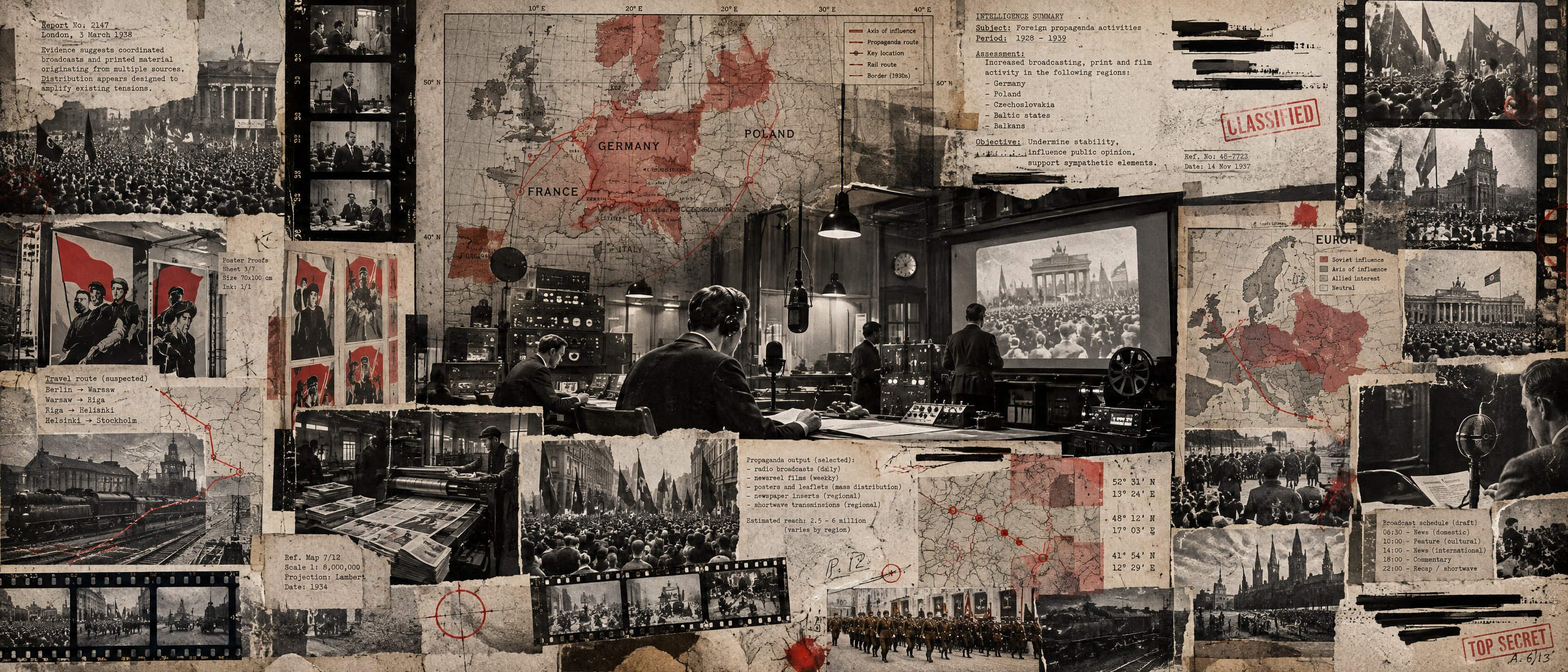
It was this man that we wanted to help us now. As his assistants Captain Voska selected five Czechs from the American army and borrowed five Czechoslovak legionaries from the French — men who spoke Czech, Polish, Magyar, German, and the various tongues of Jugoslavia. One was a radio expert. It was not only our plan to print selected publications in the various tongues, but to make arrangements to put the various wireless stations in touch with the wireless station at Lyons.
On January 1st I left Paris for Rome with the President and was joined there a few days later by Mr. Byoir. Mr. Sisson, going by way of Berne, wound up our affairs in Switzerland and reached Rome on January 8th. By that time Mr. Byoir and I had finished the Italian settlement with Mr. Hearley and the three of us set out that night for Padua, where Captain Voska and his party were waiting for us.
There was no passenger service of any kind between Italy and Bohemia, and Captain Voska had arranged that we were to travel to Prague with a troop-train of Czechoslovak legionaries. There were about one thousand of them — veterans who had seen fighting on many fronts — and with their horses and guns and baggage they filled thirty-five freight-cars. For our own accommodation we managed to secure a battered passenger-coach, stripped of all upholstery and indescribably dirty. To add to congestion our party of fourteen was asked to share this car with Colonel Phillippe, the French officer in charge of the legionaries, also his aides, and with the newly appointed British charge d'affaires who was trying to reach Prague at the earliest possible moment.
The journey to Prague from Padua took almost four days, a weary crawl through the devastated Piave plain and over the Alps, with never a chance to get the bitter cold out of one's marrow. We took off nothing but our hats when we slept on the narrow seats, and aside from hot coffee, made over charcoal braziers, we ate out of mail-sacks that we had filled with dried apricots, Italian bread, "bully beef," and canned stuff. Heaven only knows what would have happened to us but for the blankets loaned in Padua by the American Red Cross! The stations in Austria were closed as we passed, owing to fear of trouble, and all that we saw of the people were sullen faces peering at us through railings or from the hills. They looked well fed and fat, the villages were whole and the land unravaged — all in sharp contrast to the hunger and devastation of France and Italy. I knew, as every one must know, that the peace of the world depended upon just treatment of these defeated enemies, but I could not help thinking that justice took much of the joy out of life.
The one thrill of the dreary journey came to us on the night when we reached the border of what had once been the ancient kingdom of Bohemia and which was now the boundary-line of the free Republic of Czechoslovakia. For an hour the whole train had hummed to a vast excitement, for among the legionaries were many men who had gone into exile as youths, and others who had been fighting for four years, out of touch entirely with their homes and people. No sooner had we stopped at the little station across the border than every legionary was off the train, kissing the sacred soil that had been won at last from the Austrian. Officers and men embraced with tears running down their cheeks, then the entire thousand grouped reverently and, lifting their faces to the hills and the stars, sang the national hymn of Bohemia — a song in a minor key for the most part, like the songs of all oppressed peoples — but rising at the end to a tremendous challenge that rang like a trumpet. And after that a great cheering for America, "the hope of the world."
We reached Prague Monday noon, January 13th, and a second thrill came to us as its patriot citizens received the heroes who had helped to make independence possible. A wonderful old city and a still more wonderful people. As we came to see them and hear them it was easy to understand how they had held to their national aspirations through five centuries of oppression, rising at last in unity and strength. Not even Americans are more in love with freedom than these Czechoslovaks, and, what is finest, their patriotism did not disintegrate with victory. They massed behind the beloved Masaryk as a unit, putting country above party and political feuds, and in the Cabinet that worked as a team there were Socialists, Agrarians, and even a jolly old Catholic priest as director-general of railroads. Of all the countries in Europe, Czechoslovakia had courage, purpose, and high resolve.
We saw President Masaryk almost immediately, were quickly put in touch with other officials, and in twenty-four hours work was under way. One group went at the task of "tuning up" the government wireless station to a point where it could receive our service from Paris, and the rest of us grappled with the questions of paper and printing.
The five pamphlets intended for distribution were these: How the War Came to America, German War Practices in Conquered Territory, German Intrigue in the United States, America's War Aims and Peace Terms, and The German - Bolshevik Conspiracy. For each of these we had the translations in Czech, Polish, Magyar, Croatian, German, and Ukrainian. This circulation was of vital importance, in the opinion of President Masaryk and his associates, for out of the fifteen million inhabitants of Czechslovakia full three million were Germans and there were also large numbers of Hungarians. The selected pamphlets were meant to do three things: first, to drive home the meanings and purposes of America; second, to show the guilt, the cruelty, and the monstrous plans of Germany; third, to expose the German direction of the Bolshevik revolution. Mr. Haberman, head of the Department of Education, put his machinery at our disposal and assumed entire responsibility for the distribution of the pamphlets to schools, churches, the papers, and the leaders of thought in every community.
28 421 Leaving Captain Voska to follow through the printing arrangements, Mr. Sisson, Mr. Byoir, and I left on Friday for Cracow, for Poland, also had a very grave German problem in Galicia. In a stay of two days we managed to put the government wireless station in touch with Paris, but the paper and printing situation forced us to reach the decision that Prague would have to take care of our Polish publications. Telegrams from Paderewski urged me to come to Warsaw, and a special train was put at our disposal, but as such a trip was without values other than social and sightseeing, we were compelled to refuse.
Leaving Cracow, with committees still beseeching us to go to Warsaw, we returned to Prague by way of Slovakia. We had interpreters with us, but it was amazing always in Czechoslovakia to see how many spoke English. As a result of conferences usually held on the train, complete arrangements were made for the pamphlet distribution in Slovakia and Moravia.
Reaching Prague at noon on Thursday we found that Captain Voska had the wireless arrangements well under way and that the printing program was going through without a hitch. That very afternoon I left for Budapest, taking one interpreter with me. Captain Voska was to stay in Prague until he had finished the work and Mr. Sisson and Mr. Byoir were to leave on Friday for Vienna to look after the Austrian end of the machinery. It was agreed that we should meet in Trieste on Monday morning, an arrangement that meant hard traveling.
We were lucky enough to get a compartment on the night train to Vienna, and Czabulk, my interpreter, and I had visions of an uncrowded night. At the last moment, however, we picked up Lester Perrin, a young Detroit boy who had wandered into Prague after his release from the German prison-camps in Poland. The poor youngster was without money, and the certainty of his delay in getting in touch with the American military authorities in Paris made me decide to take him with me. In Vienna we left Perrin to wait for Sisson and Byoir and hurried on without halt. Where once fifteen express-trains ran daily between Vienna and Budapest there was now but one a day, a wretched collection of battered third-class cars. The very highest official influence was necessary to get us a compartment on this train and it took a guard of soldiers to force us into it through the jam of passengers. Once in, we locked the door and gave ourselves over to happy contemplation of the two long seats that would permit us to have a regular "lie-down" sleep. The corridor, however, was jammed with people and I found it utterly impossible to' shut out the consciousness that the women among them were facing a long, bitter night on their feet. For a full half an hour my selfishness fought with my shame, but at last I told Czabulk to open the door and announce that the first women to reach the four seats could have them. We drew a Turk, two Hungarians, and an Austrian, and while the ample Turkish lady took far more than her fair share of room, she contributed a genial radiation that added materially to the comfort of the night. We stopped two hours at the Austrian frontier while the entire train was searched for food-smuggling, and there were other stops of every kind, so that we did not reach Budapest until ten the next morning.
The Hungarian situation was deplorable to the last degree. Count Karolyi was in the president's chair, but it was plain to be seen that he could not last more than a couple of weeks unless the Allies decided upon some helpful action in his behalf. It was Karolyi who had agreed to the Franchet d'Esperey armistice, and it was the provisions of this armistice that were now being violated daily. On three sides the Czechs, the Jugoslavs, and the Serbs were making steady encroachments, while on the fourth side the Rumanians were sweeping forward in utter disregard of what should have been sacred agreements. The food situation was also reaching a crisis and Bela Kun, plentifully supplied with Bolshevik money, was preaching the gospel of a new revolt.
The whole thing was tragic in the extreme. There was little or nothing that could be done, however. The only Americans on the ground were two representatives of the Food Commission, while I myself had neither the power nor the desire to interfere in the political matters that were the sole province of the State Department. All that I could do was to send an instant report to Paris, outlining the situation, and it was this report that brought a declaration from the Peace Conference to the effect that the boundary-lines laid down by Franchet d'Esperey must be respected. This helped tremendously for the moment, but as nothing was done to give force to the declaration, things became worse than before and in the course of a few weeks Karolyi was deposed and Bela Kun rose to power.
I made arrangements for the government wireless to take our Paris service, but the first survey of the field made me realize that it was hopeless to attempt printing or distribution of any kind in Budapest. As a consequence, I sent instructions to Prague to have all the Magyar editions printed there.
Getting out of Budapest was even worse than getting in. At five o'clock on Sunday morning Czabulk and I climbed drearily into the usual cold, damp compartment of a third-class train, and at eight o'clock that evening reached Praegerhof, where we were supposed to change to a through train to Trieste. Instead of that we were transferred to a local and rode until one o'clock in a car that had pine boards in place of windows. At Leibach, under Jugoslav control, we had another passport battle and changed again to the worst train of the trip. Not only was it without windows, but every inch of upholstering had been taken out. One explanation was that the soldiers used the plush for clothing, but, although I looked hopefully for some such gleam of color, I failed to discover that any such use had been made of the material. At four o'clock in the morning we were thrown out at the town of Loich and found it in the hands of Italians, at that time busily engaged in pushing forward their "historical boundaries." Only some petty officers were in charge and the fact that we came from Budapest made us the object of instant suspicion. For three mortal hours Czabulk argued in every tongue at his command, but without the slightest avail as far as I could see. The train for Trieste came along at seven and I told Czabulk to convey the information that we were going on board whether they liked it or not, since death itself was far preferable to another hour in such a hole. The officers followed us to the very steps, debating furiously, but in the end let us go our way in peace. Again we found ourselves in a car without windows or upholstery and all night a blizzard blew that bit through blankets and overcoats and froze our very bones. We reached Trieste at noon, and late that night the rest of the party came in from Vienna. At eight the next morning we were on a boat to Venice, from Venice we sped to Turin, and from Turin to Paris, reaching there the morning of January 31st.
A hard, driving trip, but without a single neglect or one unspared effort to mar the achievement. In Prague we were printing the five pamphlets in Czech, Polish, Magyar, Croatian, German, and Ukrainian, with arrangements fully made for distribution to the schools, press, organizations, and leaders of thought in Czechoslovakia, Galicia, Saxony, Austria, Hungary, and certain parts of Jugoslavia. The wireless stations at Cracow, Prague, and Budapest were in touch with Paris. As far as humanly possible, we had carried the message of America to Mittel Europa!
One other thing we did! Immediately upon arrival in Paris we laid a detailed report before the high authorities of the Food Commission, and it was this special pleading that won quick and effective relief for Czechoslovakia and Poland.
With this satisfactory completion of the Middle-Europe task, and with every office closing with the exception of the cable and wireless service, the seat of settlement was now Washington.
How We Advertised America, George Creel. Published in the United States in 1920, more than 95 years ago, so in the public domain in the United States; the Internet Archive lists the scan as not in copyright. Creel died in 1953, so the text is also in the public domain in countries that count the author's life plus 70 years. Provenance and rights.