In one line: From about 550 to 330 BCE the Achaemenid kings of Persia, from Cyrus II to Darius III, ruled an empire reaching from the Aegean coast and Egypt to Central Asia and India, and the monuments and texts they left present each king as chosen by the god Ahuramazda against "the Lie", though how far those monuments were meant to persuade anyone, and how reliable the story they tell is, are disputed among historians.
The leader and the people under the leader
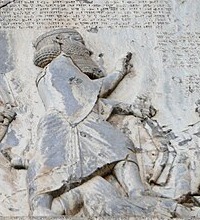
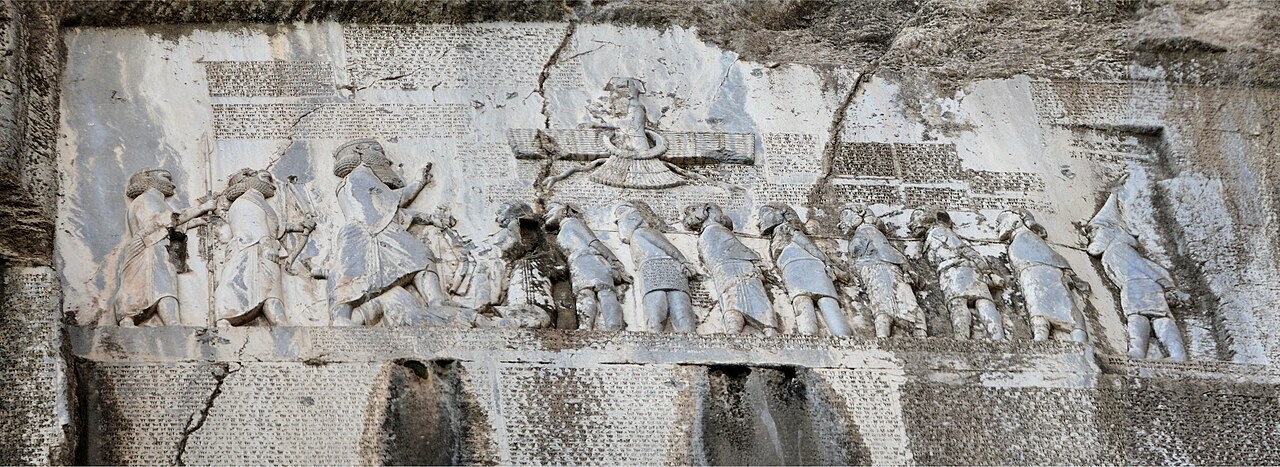
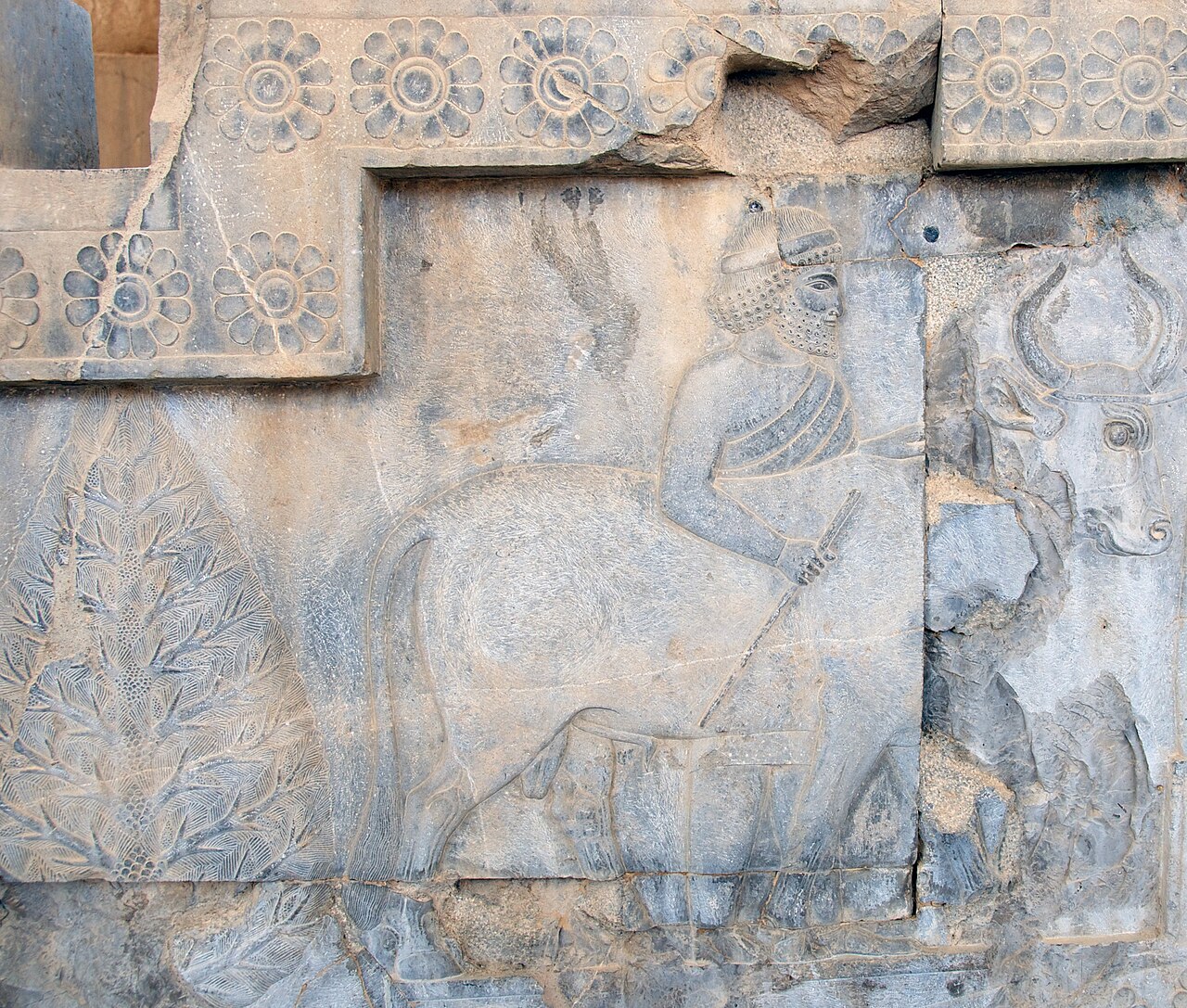
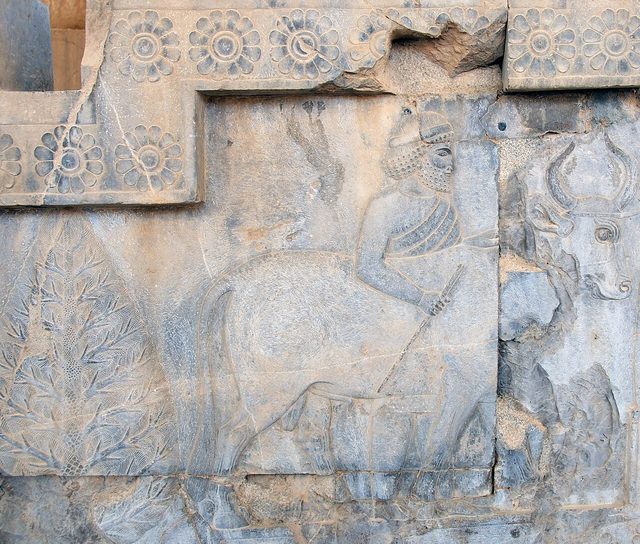
Photo: Patrick C ('dynamomosquito' on Flickr) and Pentocelo; the relief itself was carved for Darius, CC BY-SA 2.0
Darius I (Darius the Great)
Great King of Persia · 522 to 486 BCE
Darius I (Darius the Great): Read more
Took the throne in 522 BCE, put down the rebellions of 522 to 521 BCE, and left the Behistun text, the Persepolis and Susa building programmes and the tomb at Naqsh-e Rustam; the Persepolis Fortification tablets date from his thirteenth to twenty-eighth years.
In their words
“As to these provinces which revolted, lies made them revolt, so that they deceived the people. Then Ahuramazda delivered them into my hand; and I did unto them according to my will. [...] You who shall be king hereafter, protect yourself vigorously from lies; punish the liars well, if thus you shall think, 'May my country be secure!'”
“Whosoever shall read this inscription hereafter, let that which I have done be believed. You must not hold it to be lies.”
“What a man says against a man, that does not convince me, until I hear the sworn statements of both.”
Founders
CINo public-domain or openly licensed portrait exists (no securely identified contemporary portrait of Cyrus survives). Nearest: the Cyrus Cylinder photograph, source, CC0.
Cyrus II (Cyrus the Great)
King of Persia, and King of Babylon from 539 BCE · c. 550 to 530 BCE
Cyrus II (Cyrus the Great): Read more
Defeated Astyages of Media, took Lydia and Babylon; the Cyrus Cylinder, a Babylonian-language text found at Babylon in 1879, presents him as the choice of the god Marduk.
In their words
“He took the hand of Cyrus, king of the city of Anshan, and called him by his name, proclaiming him aloud for the kingship over all of everything.”
“When I went as harbinger of peace i[nt]o Babylon I founded my sovereign residence within the palace amid celebration and rejoicing.”
“I collected together all of their people and returned them to their settlements, and the gods of the land of Sumer and Akkad which Nabonidus – to the fury of the lord of the gods – had brought into Shuanna, at the command of Marduk, the great lord, I returned them unharmed to their cells, in the sanctuaries that make them happy.”
CINo public-domain or openly licensed portrait found; no securely identified contemporary portrait survives. Nearest: the Apis stele relief shown on source (licence not checked).
Cambyses II
King of Persia and, from 525 BCE, pharaoh of Egypt · 530 to 522 BCE
Cambyses II: Read more
Son of Cyrus; conquered Egypt in 525 BCE after the battle of Pelusium; in Darius's account he secretly had his brother Smerdis (Bardiya) killed before leaving for Egypt.
Contested accession
B(No portrait exists. The only image of the figure is Darius's Behistun relief (see the Behistun object in the archive), where he lies under the king's foot.
Bardiya (called Gaumata in Darius's text)
Claimant to the throne, spring to autumn 522 BCE · 522 BCE
Bardiya (called Gaumata in Darius's text): Read more
In Darius's inscription a Magian named Gaumata falsely claimed to be Cyrus's son Bardiya (Smerdis) and was killed on 29 September 522 BCE; some modern historians think the man was the real Bardiya and the impostor story Darius's justification, and others accept a pretender.
Darius and his line
XINo portrait photo cleared. Nearest: the Treasury reliefs at Persepolis, source, CC BY 2.0, which show the standing figure behind the enthroned Darius that scholars identify as Xerxes.
Xerxes I
Great King of Persia · 486 to 465 BCE
Xerxes I: Read more
Completed the Persepolis Apadana and built the Gate of All Nations; his Daiva inscription records the destruction of a sanctuary of the daivas; led the invasion of Greece of 480 to 479 BCE.
In their words
“And among these countries there was a place where previously demons (daiva) were worshipped. Afterwards, by the grace of Ahuramazda I destroyed that sanctuary of demons, and I proclaimed: 'The demons shall not be worshipped!' Where previously the demons were worshipped, there I worshipped Ahuramazda at the proper time and in the proper manner.”
“By the grace of Ahuramazda these are the countries of which I was king apart from Persia. I had lordship over them. They bore me tribute. What was said to them by me, that they did. My law, that held them”
“By the favor of Ahuramazda this Gate of All Nations I built. Much else that is beautiful was built in this Persepolis (Pârsâ), which I built and my father built.”
AINo public-domain or openly licensed portrait found.
Artaxerxes I
Great King of Persia · 465 to 424 BCE
Artaxerxes I: Read more
Succeeded Xerxes in 465 BCE and reigned until 424 BCE; the Persepolis administrative archives, Fortification and Treasury together, run to 457 BCE, within his reign.
Later kings
AINo public-domain or openly licensed portrait found.
Artaxerxes II
Great King of Persia · c. 405 to 359 or 358 BCE
Artaxerxes II: Read more
Rebuilt the Susa Apadana after a fire and invoked Ahuramazda, Anahita and Mithra together in his building inscriptions.
In their words
“My ancestor Darius [I the Great] made this audience hall [apadana], but during the reign of my grandfather Artaxerxes, it was burnt down; but, by the grace of Ahuramazda, Anahita, and Mithra, I reconstructed this audience hall.”
“May Ahuramazda, Anahita, and Mithra protect me against all evil, and may they never destroy nor damage what I have built.”
DINo Persian-made portrait survives; the best-known image (the Alexander mosaic) is a Roman copy of a Greek work and is not hosted here.
Darius III
Great King of Persia · 336 to 330 BCE
Darius III: Read more
Last Achaemenid king; defeated by Alexander of Macedon at Issus (333 BCE) and Gaugamela (331 BCE) and killed in 330 BCE by Bessus, satrap of Bactria.
Court nobility
GSNo portrait exists.
Gobryas, son of Mardonius
Persian noble named in Darius's inscription as helping to kill Gaumata · 522 BCE
Gobryas, son of Mardonius: Read more
One of six Persians (with Intaphrenes, Otanes, Hydarnes, Megabyzus and Ardumaniš) whom the Behistun text names as with Darius when he killed Gaumata; Herodotus makes the group seven with Darius.
Background and rise to power
The Achaemenid line, as Darius I traces it, descended from an ancestor named Achaemenes through Teispes, Ariaramnes and Arsames. Cyrus II, king of the Persian city of Anshan, defeated the Median king Astyages about 550 BCE, took Lydia about 547 to 546 BCE (some scholars date this to 542 or 541), and entered Babylon in October 539 BCE after the battle of Opis. He died in 530 BCE and was succeeded by his son Cambyses II, who conquered Egypt in 525 BCE (Briant 2002; Livius.org on the Cyrus Cylinder).
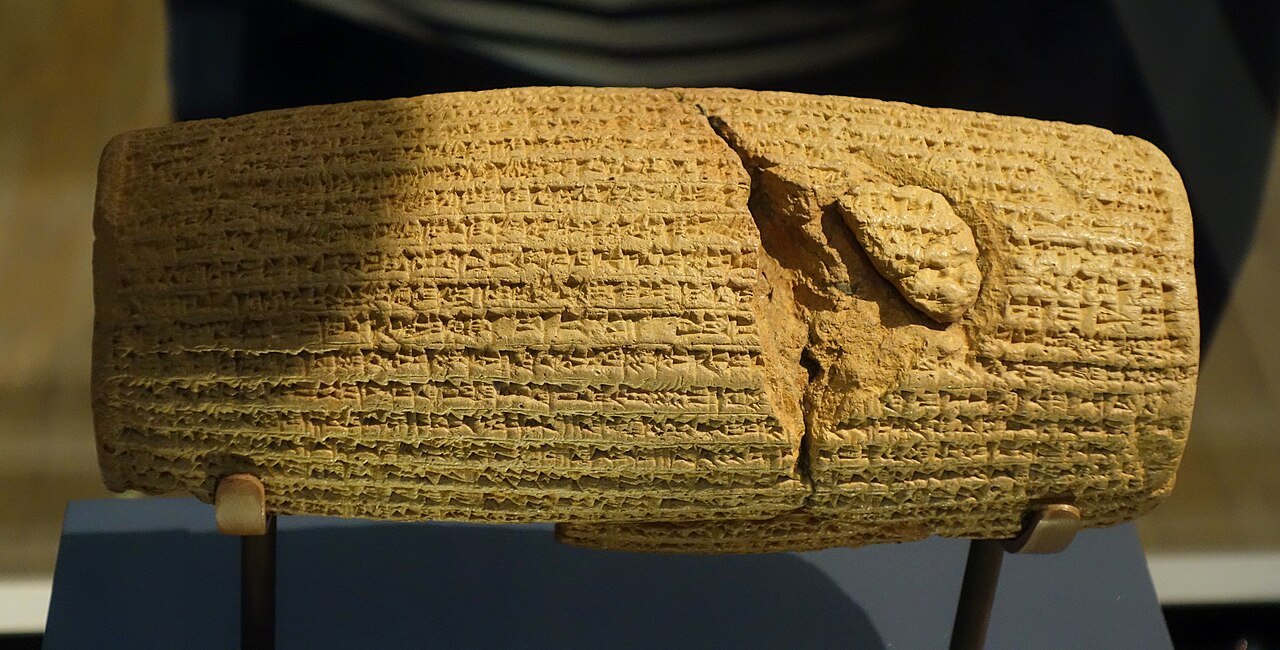
The Cyrus Cylinder, a text in Akkadian cuneiform in the Babylonian style, found at Babylon in 1879 and now in the British Museum. Its meaning, including the later claim that it is a human-rights charter, is discussed below. Source: Photo: Daderot, via Wikimedia Commons, CC0 (no attribution required), CC0 (Wikimedia Commons file page; photograph by Daderot).
Cambyses died in 522 BCE, and what happened next comes mainly from Darius I himself. His Behistun inscription says Cambyses had killed his brother Smerdis (Persian Bardiya) in secret; that a Magian named Gaumata then claimed to be that brother, rebelled on 11 March 522 BCE and took the kingdom on 1 July; and that Darius, "with a few men", killed him on 29 September 522 at a stronghold in Media (King and Thompson translation, sections 10 to 13; the calendar equivalents are the translators' notes). Darius then lists nineteen battles and nine captured "kings" in the following year (sections 52 to 54). Herodotus (3.61 to 3.88) also tells of a Magian usurper, whom he calls Smerdis and whose brother Patizeithes, also a Magian, put him on the throne, a detail absent from Darius's text (Briant, Encyclopaedia Iranica, "Gaumāta").
Modern historians divide on whether that outline is true. Many modern historians, among them Olmstead (History of the Persian Empire) and Van De Mieroop (A History of the Ancient Near East), doubt Darius's account and think the ruler killed in 522 may have been the real Bardiya. Briant (Encyclopaedia Iranica, "Gaumāta", 2000) reports that a number of historians have long answered yes, reasoning that it was vital for Darius, with no particular right to the throne, to invent a character condemned for acts against gods and men, and then sets out his own counter-arguments. Dandamaev (Encyclopaedia Iranica, "Bardiya", 1988) wrote that this reconstruction "must remain hypothetical", and Shahbazi (Oxford Handbook of Iranian History, ed. Daryaee) rejected the view that Bardiya ruled, calling it a "fantasy of revisionist historians fond of sensationalism" (as quoted in the Wikipedia article "Bardiya"; not checked against the chapter). Rollinger (1998) examined the Behistun genealogy as a question of Darius's legitimacy. This page does not settle the question; it records that the only contemporary account is Darius's own.
How power was organized
Authority rested with the Great King, who in the inscriptions is "king of kings" and "king of countries containing all kinds of men" (DNa, as rendered on Livius.org). Darius names six Persian nobles as his companions when he killed Gaumata (section 68). The empire was divided into provinces: Darius's Behistun text lists "twenty-three lands in all" (section 6), and later royal inscriptions (DNa, XPh) give longer lists. Royal texts say the lands "bore tribute" and held the king's "law" (DNa; XPh). A road from Susa to Sardis, the Royal Road, linked the western provinces to the heartland (Daryaee, in the Oxford Handbook of Iranian History), and Aramaic and Elamite served alongside Old Persian in administration. Herodotus names Ecbatana, Pasargadae or Persepolis, Susa and Babylon as the royal residences.
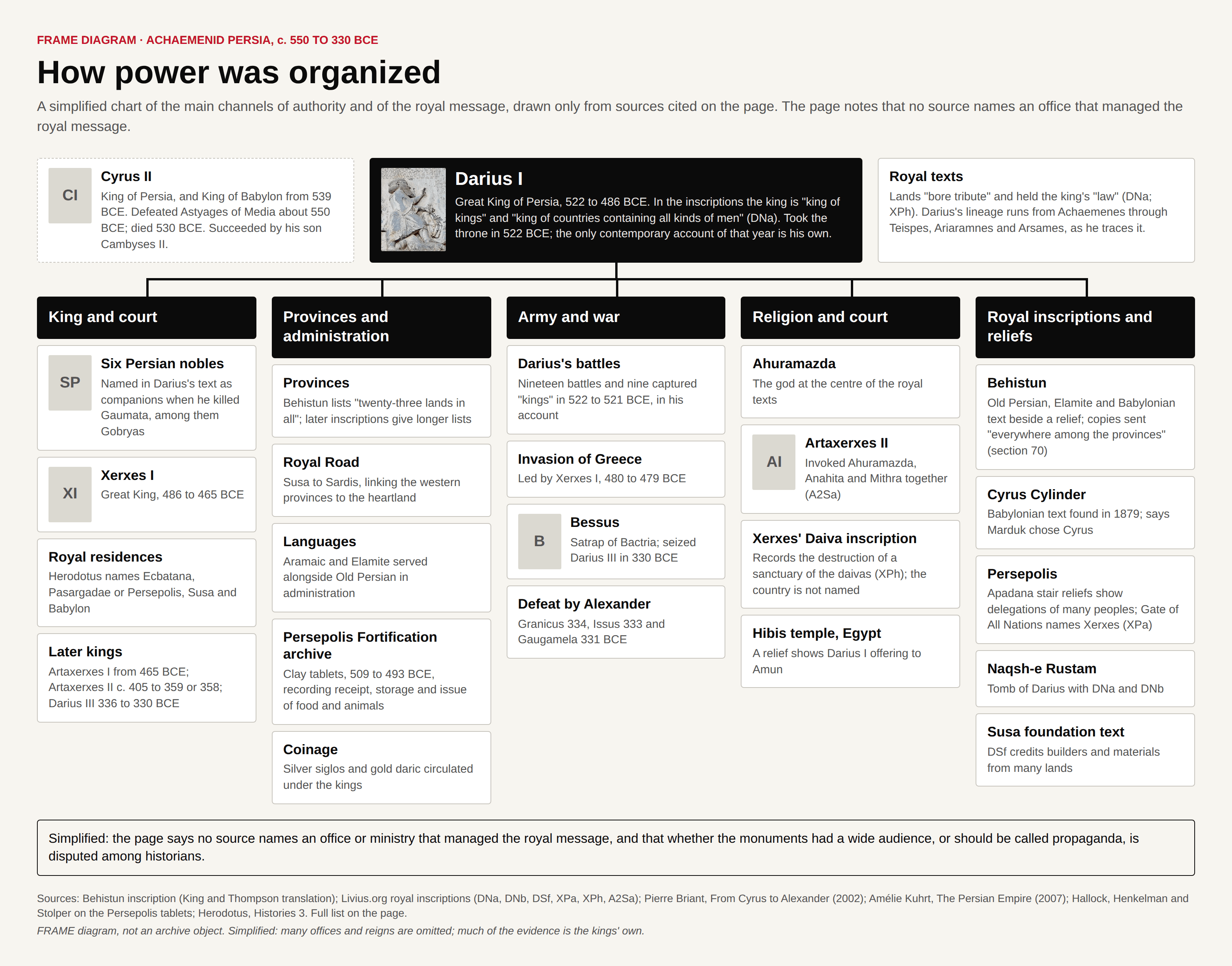
How power and the royal message were organized under the Achaemenid kings, simplified from the sources cited on this page. Source: FRAME diagram. Portraits, cropped to thumbnails: Photo: Patrick C and Pentocelo, via Wikimedia Commons, CC BY-SA 2.0, CC BY-SA 2.0 (the portraits that carry it); other portraits: none.
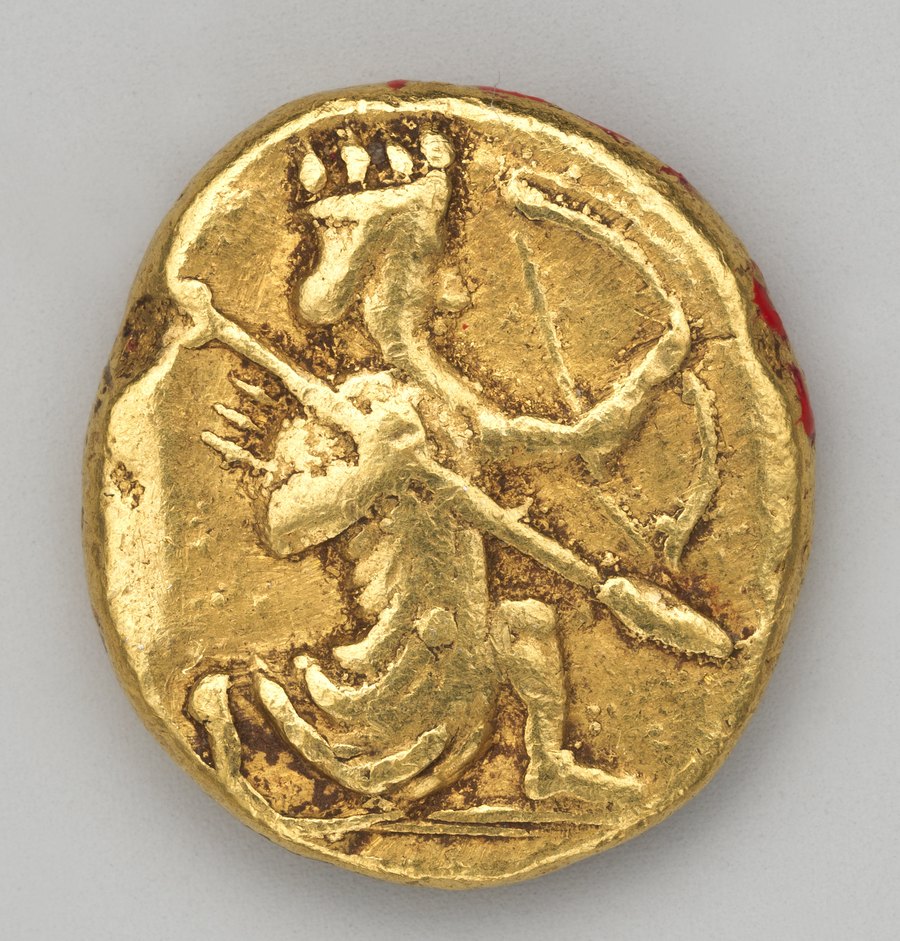
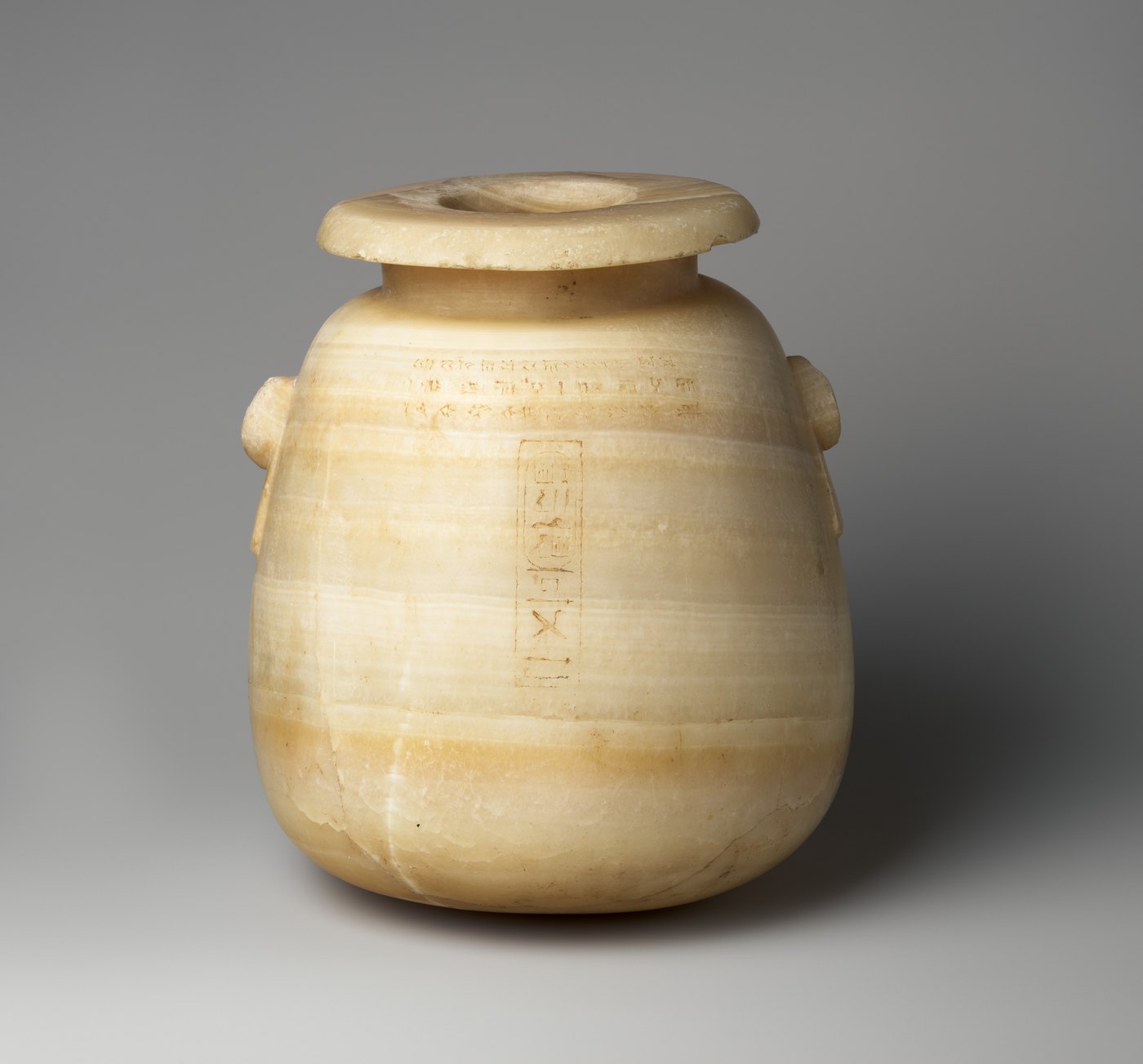
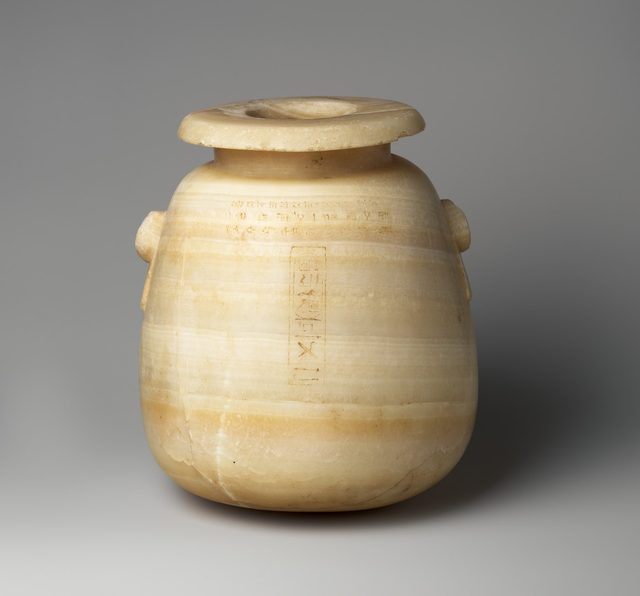
The best view of day-to-day government is not a royal text but the Persepolis Fortification archive, thousands of clay tablets found in 1933 in the fortification wall of the Persepolis terrace. They record, between April 509 and about March 493 BCE (Darius's thirteenth to twenty-eighth years), the receipt, storage and issue of food and animals across the Persepolis region, in mostly Elamite records, with fewer than a thousand in Aramaic, and name about 150 places (Hallock 1969; Henkelman 2008; Stolper 2007). Kuhrt (Persika 12, 2008) notes that historians have not yet made full use of them. Silver and gold coinage, the siglos and the daric, circulated under the kings (Alram, Encyclopaedia Iranica, "Daric"). Religious practice in the royal texts centres on Ahuramazda, with Artaxerxes II adding Anahita and Mithra (A2Sa); in Egypt a facsimile in the Metropolitan Museum records a relief in the temple of Amun at Hibis showing Darius I offering to Amun.
Illustration, not an archive object
The propaganda apparatus
No source names an office or ministry that managed the royal message. The material is the record of a court: building inscriptions cut in Old Persian, Elamite and Babylonian, relief programmes on palaces and tombs, coin types, and texts in the languages of conquered peoples. This section describes what each shows, and the disputes about it.
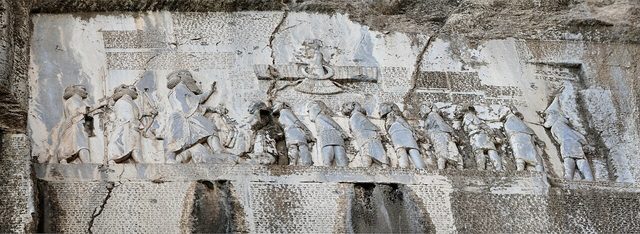
Content note: Shows bound captives before the king, and the inscription records the mutilation and public execution of rebel leaders, as the king's own account. This object is shown as it was published. Why
Where the word "propaganda" is applied. Scholars of the period use it unevenly. Morton Smith used it of the Babylonian Verse Account of Nabonidus and the Cyrus Cylinder's source material, as pre-conquest Persian propaganda, while Sherwin argues both are after-the-event compositions that need no such campaign. Jona Lendering (Livius.org) calls the Cylinder's conventions Babylonian and Assyrian "royal propaganda" and uses the word again of the 1971 Pahlavi anniversary. Much specialist work is framed instead around kingship and the court: Root's study of an "iconography of empire" (1979) and Llewellyn-Jones's King and Court (2013). Whether the monuments had a wide audience is itself in dispute. The word is used here for texts and images that present the king's claims to a reader or viewer, with the dispute stated; it does not imply a modern media machine.
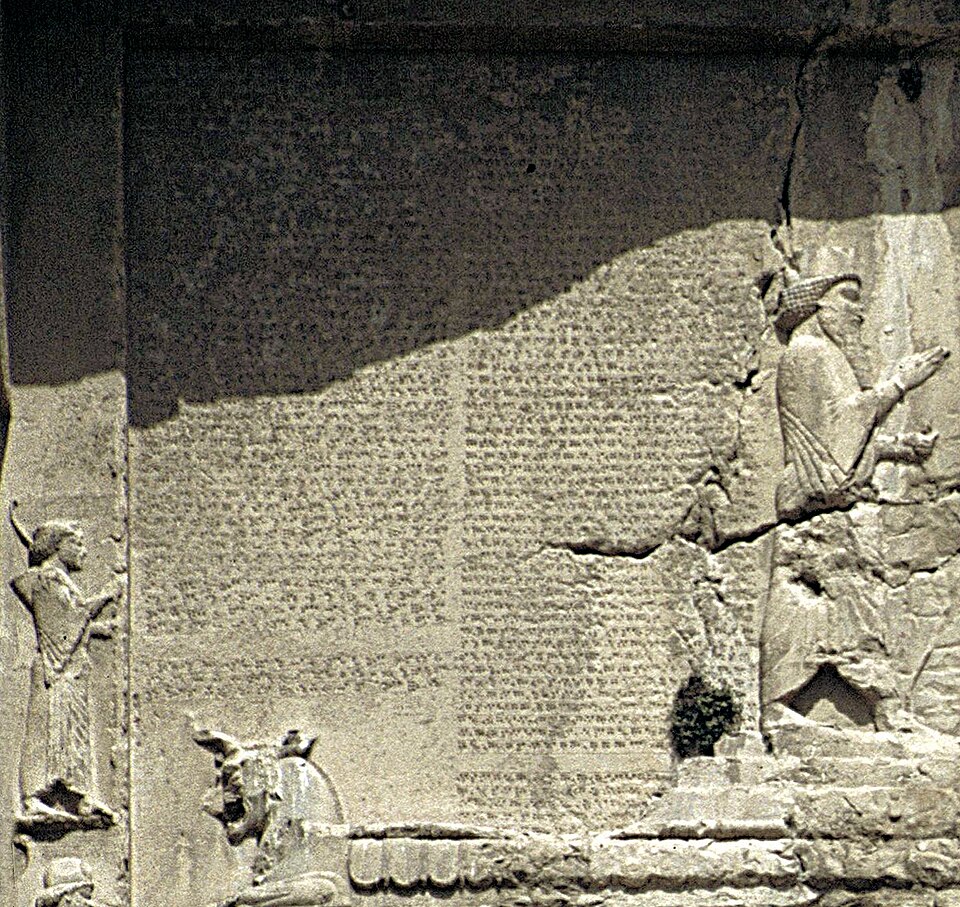
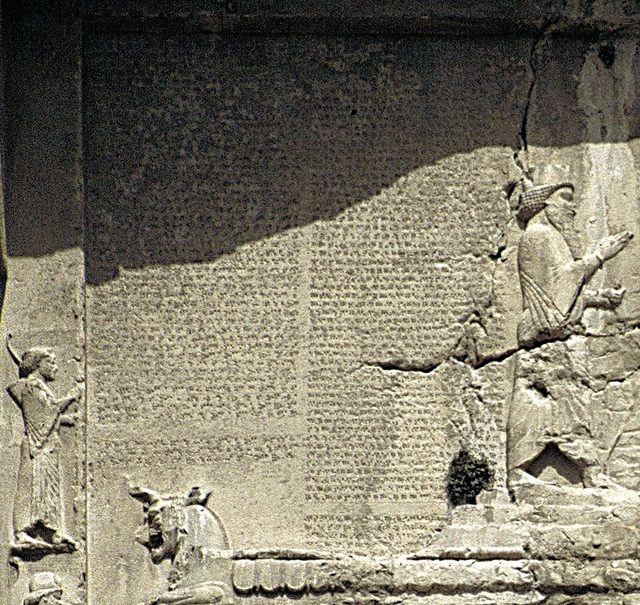
Behistun. Darius's text, at Bisotun above the road from Babylon to Ecbatana, has 414 Old Persian lines in five columns, an Elamite version and a Babylonian version, beside a relief of the king, two attendants and the bound rebel leaders beneath a winged figure. It tells events as the Lie against Truth: provinces "revolted" because "lies made them revolt" (section 54), the king should "protect yourself vigorously from lies" (55), and readers must not "hold it to be lies" (56). The text admits its own limit: Darius did "much more" that is not inscribed, lest readers find it "excessive" (58). It records the punishment of rebels in detail, including the mutilation and public killing of Phraortes of Media (section 32, translated "crucify" by King and Thompson). The text itself says Darius had it written on clay tablets and parchment "in Aryan script" and sent "everywhere among the provinces" (section 70); a fragmentary Aramaic version survives from Elephantine in Egypt (Papyrus Berlin 13447), and parts of a Babylonian copy at Babylon. Whether Old Persian cuneiform was devised for the monument is disputed: some scholars doubt Darius's claim, others accept that scribes created the script for him. The inscription is carved high on the cliff and is not legible from the road, so its audience is an open question: the copies, not the cliff, may have been the message.
The Cyrus Cylinder. A barrel of baked clay in Babylonian-language cuneiform, found by Hormuzd Rassam at Babylon in 1879, it says Marduk, angered by Nabonidus, chose Cyrus, who entered Babylon "as harbinger of peace" and returned gods and peoples to their shrines (Finkel translation). The British Museum places it in a Mesopotamian tradition of royal declarations at the start of a reign, and Kuhrt (1983) discusses it within Achaemenid imperial policy (only the article's title and a secondary summary were checked). It omits the battle of Opis (Mallowan; Briant 2002). In 1971 the Shah of Iran called it the "first charter of human rights"; C. B. F. Walker of the British Museum ("simply a building inscription, in the Babylonian and Assyrian tradition"), Bill T. Arnold and Piotr Michalowski ("it is not an edict of any kind") and the museum's then director Neil MacGregor have each placed it among Mesopotamian royal foundation texts rather than reading it as a rights charter (as quoted in the Wikipedia article "Cyrus Cylinder"; the original works were not checked), and Livius.org records that a widely circulated "translation" naming Ahuramazda and promising religious freedom is a fake.
Persepolis and Naqsh-e Rustam. The Apadana stair reliefs show delegations of many peoples approaching the king; inscriptions on the Gate of All Nations name Xerxes as builder (XPa). The tomb of Darius at Naqsh-e Rustam carries DNa, which tells the reader to "look at the sculptures [of those who] bear the throne" to know how many lands he held, and DNb, in which he calls himself "a friend of the right". Scholars disagree about the reliefs: whether they show tribute or ceremonial gifts, and whether they belong to a New Year festival (the older view, associated with Herzfeld) or, as Nylander, Calmeyer and Mousavi hold, there is no Achaemenid evidence for that festival (Encyclopaedia Iranica, "Persepolis"). Root (1985) discussed the Apadana reliefs in relation to the Parthenon frieze. Darius's Susa foundation text (DSf) credits builders and materials from Babylonia, Assyria, Lydia, Egypt, Media, the Greeks and elsewhere.
Xerxes' Daiva inscription (XPh). Xerxes says that on becoming king he put down a rebellious country and destroyed a "sanctuary of demons" (daiva), and worshipped Ahuramazda there. The text does not name the country; Lendering notes it might be in Iran or Babylonia or Egypt, and the meaning of daiva is also disputed.
The Greek sources. Much narrative history of Persia comes from Greeks writing for Greek readers. Herodotus tells of Cambyses killing the Apis bull; the Apis burial record of 524 BCE shows an Apis bull dying in September 524 BCE and receiving a normal burial at Saqqara, with a funerary monument that depicts Cambyses honouring the bull (Livius.org, "Cambyses II"). Herodotus's debate among the conspirators over forms of government (3.80 to 3.82) and the horse-neighing contest for the throne (3.84 to 3.87) have no parallel in Darius's text, and Balcer (1987) studied how his account of the accession relates to Behistun. Ctesias wrote about 400 BCE; his fragments survive in later summaries.
Timeline
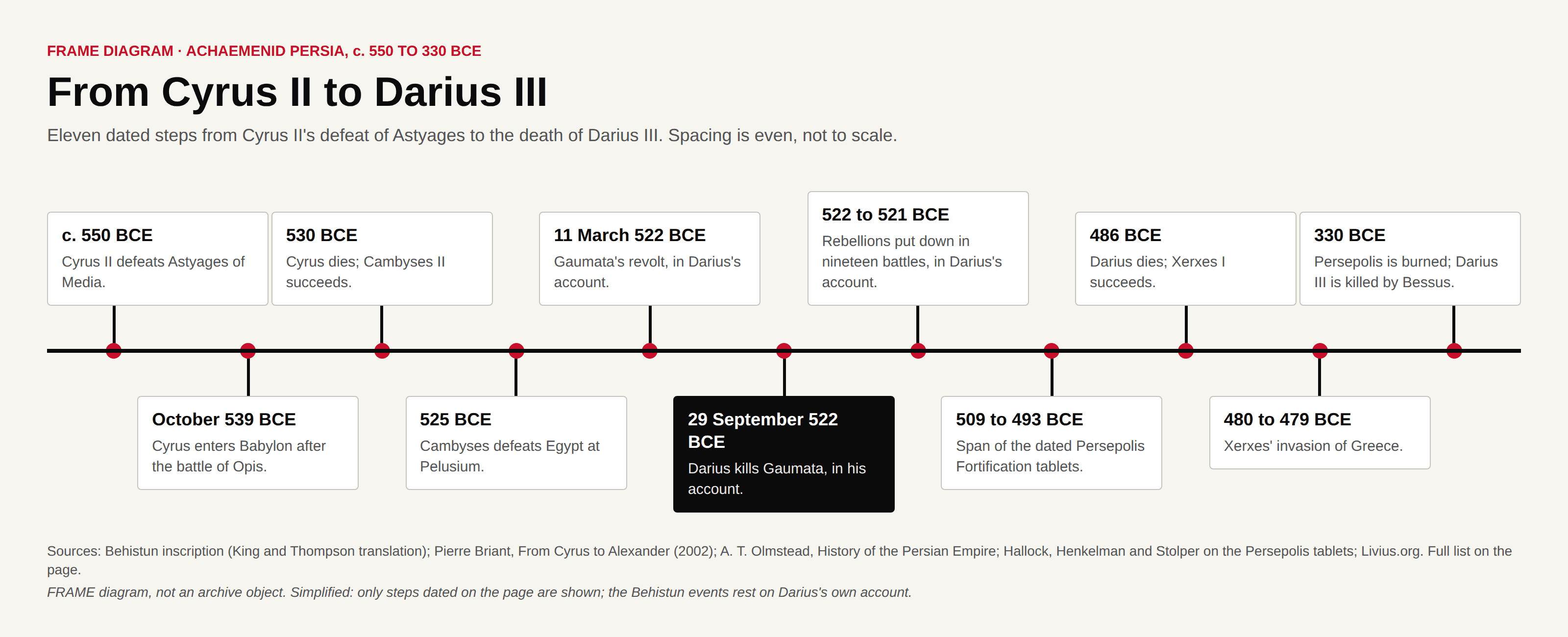
c. 550 BCE: Cyrus II defeats Astyages of Media.
c. 547 to 546 BCE: Cyrus takes Lydia (some scholars date this to 542 or 541).
October 539 BCE: Cyrus enters Babylon after the battle of Opis.
530 BCE: Cyrus dies; Cambyses II succeeds.
525 BCE: Cambyses defeats Egypt at Pelusium.
11 March 522 BCE: Gaumata's revolt, in Darius's account.
29 September 522 BCE: Darius kills Gaumata.
522 to 521 BCE: rebellions in Babylon, Elam, Media, Persia and elsewhere put down, in Darius's account, in nineteen battles.
522 to 486 BCE: the Behistun relief and inscription are carved (the date is debated).
509 to 493 BCE: span of the dated Persepolis Fortification tablets.
486 BCE: Darius dies; Xerxes I succeeds.
484 BCE: two Babylonian revolts under Xerxes, by cuneiform records cited by Livius.org.
480 to 479 BCE: Xerxes' invasion of Greece.
465 BCE: Artaxerxes I succeeds.
424 to 423 BCE: Xerxes II and Sogdianus; Darius II from 423 BCE.
c. 405 to 359 or 358 BCE: Artaxerxes II.
358 to 338 BCE: Artaxerxes III; 338 to 336 BCE: Arses; 336 to 330 BCE: Darius III.
334, 333 and 331 BCE: Alexander defeats Persian armies at Granicus, Issus and Gaugamela.
330 BCE: Persepolis is burned; Darius III is killed by Bessus.
1879 and 1933: the Cyrus Cylinder is found at Babylon; the Persepolis Fortification tablets are found at Persepolis.
1971: the Shah of Iran stages the 2,500-year celebration of the Persian monarchy at Persepolis.
Eleven dated steps from Cyrus II to Darius III, simplified from the sources cited on this page. Source: FRAME diagram, drawn from the sources listed on this page, CC BY 4.0 (FRAME archive content).
How it ended
Alexander of Macedon defeated Darius III at the Granicus (334 BCE), Issus (333 BCE) and Gaugamela (331 BCE) and took Susa and Persepolis; Persepolis was destroyed by fire in early 330 BCE (Olmstead). Darius III was seized by Bessus, his satrap in Bactria, who had him killed and took the royal title as Artaxerxes V (Olmstead; Briant 2002).
Same-standard note
This page applies the archive's one technique list to the monuments as it does to every regime: who made the claim, what it says, what it leaves out, and who could see it. It differs in scale and context from the modern regime pages. The Achaemenid kings had no mass media, most subjects could not read cuneiform, and the surviving record is overwhelmingly the king's own, with Greek, Babylonian, Egyptian and Biblical texts as the main outside voices. Whether to call the royal texts "propaganda" is itself a dispute among the cited scholars, so this page states what the sources say and where historians disagree, and draws no comparison of equivalence with any twentieth-century state.
Sources
Behistun inscription (DB), King and Thompson translation (British Museum, 1907) as adapted on Livius.org (the credit was not re-checked in this pass; the Livius Behistun section pages fetched named no translator); Livius.org, Achaemenid Royal Inscriptions: DNa, DNb, DSf, XPa, XPh, A2Sa (English renderings as given on Livius.org; the pages name no translator and list Pierre Lecoq, Les inscriptions de la Perse achéménide, 1997, as their literature; they are not Kent 1953 or Kuhrt 2007 wording).
Cyrus Cylinder, translation by Irving Finkel (British Museum), as reproduced by K. E. Eduljee, Zoroastrian Heritage; Livius.org, "Cyrus Cylinder" (translation based on Mordechai Cogan, adapted to Hanspeter Schaudig's edition); Irving Finkel (ed.), The Cyrus Cylinder (2013).
Pierre Briant, From Cyrus to Alexander: A History of the Persian Empire (Eisenbrauns, 2002); Amélie Kuhrt, The Persian Empire: A Corpus of Sources from the Achaemenid Period (Routledge, 2007), and "The Cyrus Cylinder and Achaemenid Imperial Policy", Journal for the Study of the Old Testament 25 (1983), pp. 83 to 97; Kuhrt, "The Persepolis Archives: concluding observations", Persika 12 (2008).
Margaret Cool Root, The King and Kingship in Achaemenid Art (Acta Iranica, 1979) and "The Parthenon Frieze and the Apadana Reliefs at Persepolis: Reassessing a Programmatic Relationship", American Journal of Archaeology 89 (1985), pp. 103 to 120; Lloyd Llewellyn-Jones, King and Court in Ancient Persia 559 to 331 BCE (Edinburgh University Press, 2013).
Muhammad A. Dandamaev, "Bardiya", and Pierre Briant, "Gaumāta", Encyclopaedia Iranica; Jack Martin Balcer, Herodotus and Bisitun (Historia Einzelschriften 49, 1987); Robert Rollinger, "Der Stammbaum des achaimenidischen Königshauses", Archäologische Mitteilungen aus Iran und Turan 30 (1998), pp. 155 to 209; A. T. Olmstead, History of the Persian Empire (University of Chicago Press, 1959 printing); Marc Van De Mieroop, A History of the Ancient Near East (2nd ed., Blackwell, 2006); Oxford Handbook of Iranian History, ed. Touraj Daryaee (2012), chapters by Daryaee and Shahbazi.
Richard T. Hallock, Persepolis Fortification Tablets (1969); Wouter Henkelman, The Other Gods Who Are (2008); Matthew Stolper, "What are the Persepolis Fortification Tablets?", Oriental Institute News and Notes (2007).
Herodotus, Histories 3; Ctesias, Persica (Photius epitome), in Andrew Nichols, The Complete Fragments of Ctesias of Cnidus (University of Florida doctoral thesis, 2008).
Bruce Lincoln, C. B. F. Walker, Bill T. Arnold and Piotr Michalowski, Neil MacGregor and Simon Sherwin on the Cylinder, as cited in the Wikipedia article "Cyrus Cylinder" (checked against the cited works where available); Morton Smith, Journal of the American Oriental Society 83 (1963).



_(4734172156).jpg)