In one line: From 17 April 1975 to 7 January 1979 the Communist Party of Kampuchea (CPK) under Pol Pot ruled Cambodia as Democratic Kampuchea through a secret leadership it called Angkar, emptied the cities, abolished money and markets, put the population into collective farms and work sites, arrested and killed people it named as enemies, and presided over a period in which an estimated 1.5 to 2 million people died, and the UN-backed Cambodian tribunal later convicted three of its officials of crimes against humanity, two of them also of genocide.
The leader and the people under the leader
PPNo public-domain or openly licensed portrait found. Nearest: source (Romanian National Archives, Pol Pot with Nicolae and Elena Ceaușescu and Khieu Samphan, 28 to 30 May 1978; offered free of charge with mandatory credit, no open licence stated; Wikimedia Commons tags it PD-RO-photo, which was not accepted as verification). A DC-Cam gallery page, source, shows portraits with no licence stated.
Pol Pot (Saloth Sar)
Prime Minister of Democratic Kampuchea and Secretary of the Communist Party of Kampuchea (CPK) · 1976 to 1979
Pol Pot (Saloth Sar): Read more
Secretary of the secret Party from February 1963; named Prime Minister in the government announced on 14 April 1976 and publicly identified as Party Secretary only in September 1977. The Standing Committee he led took the decisions on the evacuation of the cities, the Four-Year Plan and the purges of 1976 to 1978. He died on 15 April 1998 and was never tried by the ECCC.
In their words
“Its most important element is that we must move rapidly, in ever mightier leaps. This is basic. Why must we move so swiftly? Because enemies attack and torment us. From the east and the west they persist in pounding and worrying us; this is their strategy, to the east and to the west.”
“Thus, eating will be collectivized, and also clothing, welfare, and houses will be divided up on a collective basis. Food and dessert will be taken collectively. For this reason, food must be tasty, so that no one can criticize the notion of collectivism, saying that the food and dessert made collectively taste bad.”
“In commemorating the Seventeenth Anniversary of its founding, our Party has decided to solemnly proclaim, before our country and the whole world, the official existence of the Communist Party of Kampuchea.”
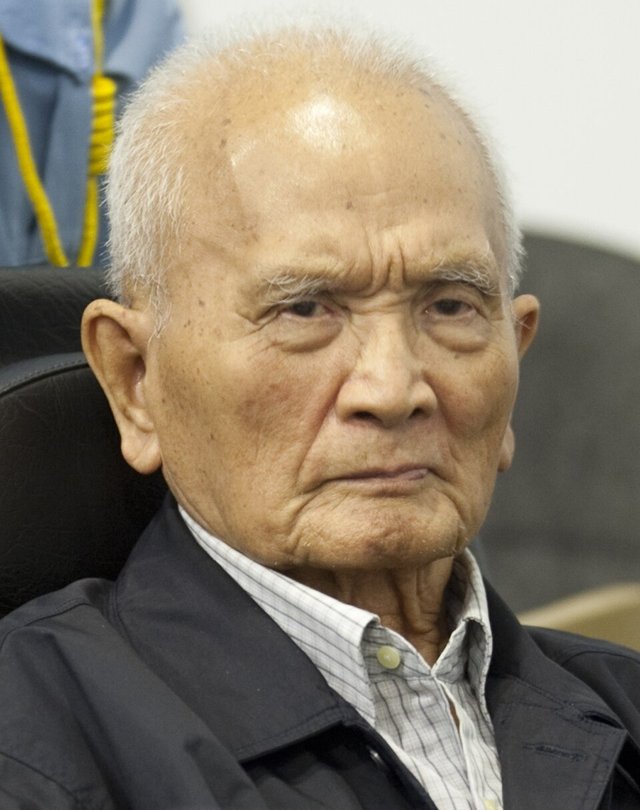
Deputy Secretary of the CPK and Chairman of the People's Representative Assembly · 1960 to 1979
Nuon Chea: Read more
Elected Deputy Secretary at the 1960 congress and second to Pol Pot in the Standing Committee; Chairman of the Assembly from April 1976 and, on paper, Acting Prime Minister from 27 September 1976. On 9 October 1975 the Standing Committee gave him party work, social affairs, culture, propaganda and education. Convicted by the ECCC in 2014 and 2018, he died on 4 August 2019.
In their words
“The other contradiction is external, Vietnam, in particular, is trying to undermine our party by military, political, economic and ideological means”
“At present, under the correct leadership of the Communist Party of Kampuchea and Comrade Secretary Pol Pot, the people and the Revolutionary Army of Kampuchea have smashed all the acts of subversion, attempts at coups d'etat and acts of aggression, expansion, annexation and swallowing of territories cruelly, barbarously and successively perpetrated by Vietnam against Democratic Kampuchea.”
TMNo public-domain or openly licensed portrait found. Nearest: source (Documentation Center of Cambodia gallery, no licence stated).
Ta Mok (Chhit Choeun)
Secretary of the Southwest Zone, member of the Standing Committee and Deputy Chairman of the Military Committee · 1968 to 1979
Ta Mok (Chhit Choeun): Read more
Southwest Zone Secretary from 1968 and, with Son Sen, head of the Party's forces from March 1974. The ECCC Trial Chambers found that he directly controlled units in the evacuation of Phnom Penh, ordered arrests including that of Vorn Vet, and sent Southwest Zone forces to purge the East Zone in 1978. He was captured in March 1999 and died on 21 July 2006 awaiting trial; he was never charged, so no court has made a finding of guilt against him.
SPNo public-domain or openly licensed portrait found, and no nearer source located.
Sao Phim
Secretary of the East Zone and member of the Standing Committee · 1975 to 1978
Sao Phim: Read more
Elected a full-rights member of the Standing Committee in 1963 and ran the East Zone, which was declared an internal enemy at a Party meeting in 1978. The Closing Order records that he killed himself in June 1978 to avoid arrest, during the purge of East Zone cadres.
KPNo public-domain or openly licensed portrait found. Nearest: source (Documentation Center of Cambodia gallery, no licence stated).
Ke Pauk
Secretary of the North Zone, later the Central Zone, and member of the Military Committee · 1975 to 1979
Ke Pauk: Read more
Replaced Koy Thuon as North Zone Secretary when Koy Thuon became Minister of Commerce, supervised the 1977 purges of Sector 106 and, as Secretary of the Central Zone, sent forces against the East Zone in 1978. He died of natural causes on 15 February 2002 at Anlong Veng.
State and foreign affairs
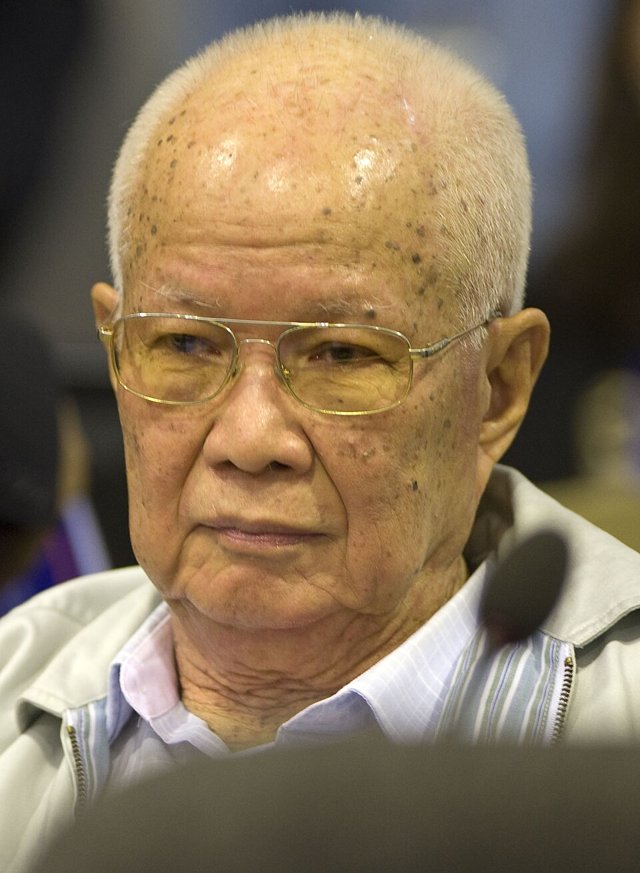
Photo: Extraordinary Chambers in the Courts of Cambodia, CC BY 2.0
Khieu Samphan
Chairman of the State Presidium (head of state) · 1976 to 1979
Khieu Samphan: Read more
Took over from Prince Norodom Sihanouk as head of state at the first session of the Assembly on 11 to 13 April 1976; earlier Deputy Prime Minister and Minister of Defence of the exile government GRUNK. The ECCC found that he was not a formal Standing Committee member but helped its work. Convicted in 2014 and, of genocide of the Vietnamese, in 2018; life sentence upheld on 22 September 2022.
In their words
“Our people are restoring the economy and building the country with soaring enthusiasm everywhere, both in the cities and the countryside.”
“we have fundamentally solved the problems of livelihood for our Cambodian people since liberation, notably with regard to food”
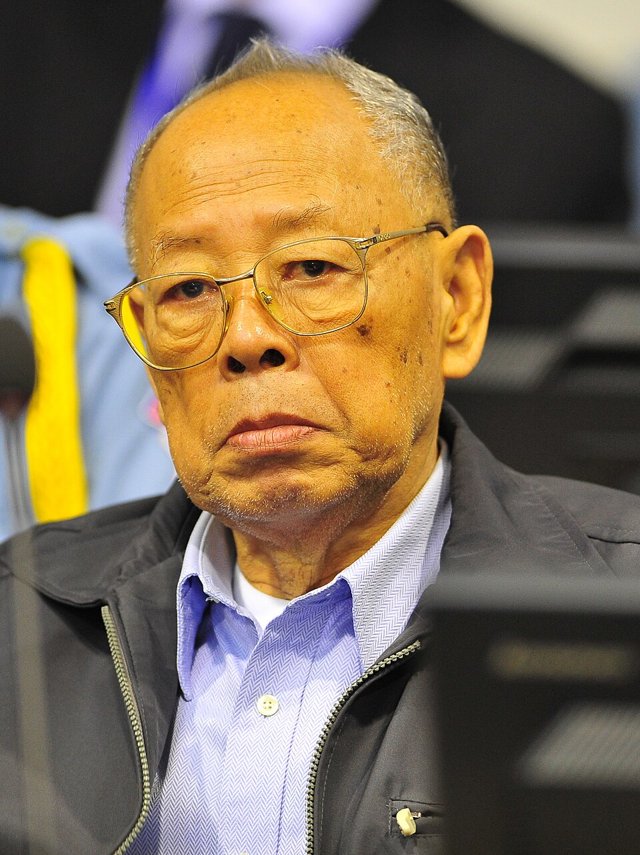
Photo: Extraordinary Chambers in the Courts of Cambodia, CC BY-SA 2.0
Ieng Sary
Deputy Prime Minister for Foreign Affairs · 1975 to 1979
Ieng Sary: Read more
Standing Committee member who ran the foreign ministry (office B-1) and spoke for Democratic Kampuchea abroad, including at the UN General Assembly on 11 October 1977. He was tried in absentia by the 1979 People's Revolutionary Tribunal, pardoned by royal decree in 1996, and was on trial at the ECCC when he died on 14 March 2013.
In their words
“During the past 8 months our Cambodian people and the Revolutionary Army have striven seethingly and arduously to increase production and successfully defend and protect our national independence, sovereignty and territorial integrity, as well as the fruits of the revolution and the people's state administration of equality and justice by smashing all manoeuvres of enemies of all stripes”
“despite many post war problems which still remain to be solved, our people and our Revolutionary Army - alerted to the true nature of the aggressive and annexationist, cruel and treacherous American imperialists and of their lackeys and reactionaries, who are the enemies of our people to be found on every hand, now constantly on the revolutionary alert - have shattered all their attempts at aggression, expansion, subversion and provocation”
Photo: Extraordinary Chambers in the Courts of Cambodia, CC BY-SA 2.0
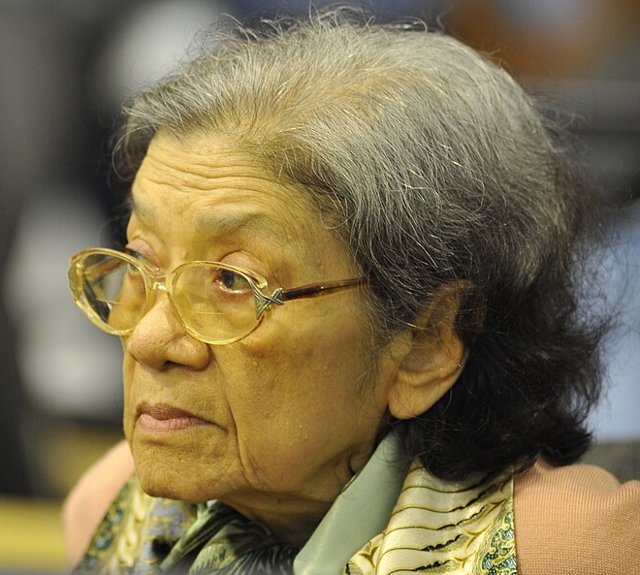
Ieng Thirith
Minister of Social Affairs · 1976 to 1979
Ieng Thirith: Read more
Ieng Sary's wife; ran the Voice of the FUNK radio from Hanoi until May 1975, was appointed Minister of Social Affairs by the Assembly in April 1976 and ran the ministry that oversaw hospitals and social action. The ECCC Trial Chamber found her unfit to stand trial in September 2012; she died on 22 August 2015.
In their words
“The wish of our Party is that we attack enemies so that they are prevented from being able to raise their heads back up”
VVNo public-domain or openly licensed portrait found. Nearest: source (a 1978 state-visit photograph that appears to come from the Romanian National Archives, offered free of charge with mandatory credit, no open licence stated).
Vorn Vet
Deputy Prime Minister for the Economy · 1976 to 1978
Vorn Vet: Read more
A delegate to the 1960 congress and Standing Committee member who ran the economy and industry; arrested in November 1978 and held at S-21, where the Closing Order records that he was later executed. The ECCC found that Ta Mok ordered his arrest.
Security and armed forces
SSNo public-domain or openly licensed portrait found. Nearest: source (Documentation Center of Cambodia gallery, no licence stated).
Son Sen
Deputy Prime Minister for National Defence and Chairman of the General Staff · 1975 to 1979
Son Sen: Read more
Standing Committee member responsible for the General Staff and, until 15 August 1977, the officer to whom S-21's chairman reported by telephone each day; moved to the East Zone in August 1977 to run the war with Vietnam. He and Yun Yat were killed on 10 June 1997 on Pol Pot's orders during the split in the Khmer Rouge remnant.
In their words
“imperative to conduct further purges of no-good elements”
“we must have an absolute stance to screen out counter-revolutionary elements”
Photo: Extraordinary Chambers in the Courts of Cambodia, CC BY-SA 2.0
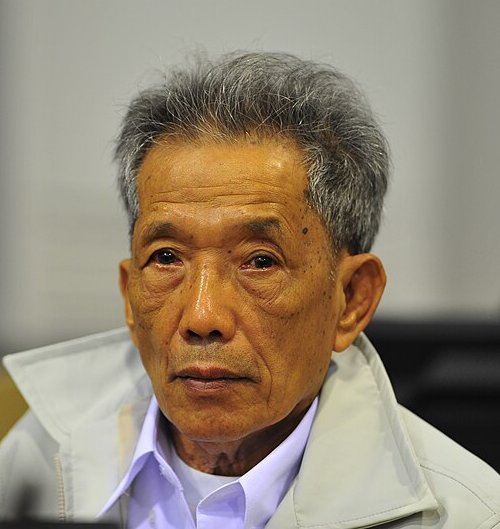
Kaing Guek Eav (Duch)
Deputy, then from March 1976 Chairman of the S-21 security office (Tuol Sleng) · 1975 to 1979
Kaing Guek Eav (Duch): Read more
Ran the Party's central prison in Phnom Penh, where the ECCC found that no fewer than 12,272 people were executed, most after torture. Convicted in Case 001 (35 years in 2010, raised to life on appeal on 3 February 2012); he died in September 2020 in custody.
In their words
“[...] to smash [...] means to arrest secretly [..., to interrogate] with torture employed, and then [to execute] secretly without the knowledge of [the detainees' family members].”
“Smash them to pieces.”
“The essence of the confessions of those Vietnamese was sent to Uncle Nuon. Therefore, whatever it is he would adjust it and then he would send it to me and I would make some changes. So the purpose of the propaganda was determined from the upper echelon”
HNNo public-domain or openly licensed portrait found, and no nearer source located.
Hu Nim
Minister of Information and Propaganda · 1975 to 1977
Hu Nim: Read more
Held the propaganda portfolio from April 1975; his ministry produced the Party's magazines and radio broadcasts. Arrested on 10 April 1977, he wrote forced confessions at S-21 and was executed on 6 July 1977. In December 1978 his hosts told a visiting American journalist he was still active in the government.
In their words
“I am not a human being. I'm an animal.”
“Because I was a CIA officer, a traitor to the party and to the people, I took that opportunity to influence comrade Sau.”
YYNo public-domain or openly licensed portrait found. Nearest: source (Documentation Center of Cambodia gallery, no licence stated).
Yun Yat
Minister of Culture, Education and Learning, who took over the Ministry of Propaganda after Hu Nim · 1976 to 1979
Yun Yat: Read more
Son Sen's wife and a minister from the April 1976 government; after Hu Nim's arrest she took charge of the propaganda ministry, and official media named her as its minister until at least January 1979, although two ministry staff told the ECCC that Nuon Chea held the post from late 1978. She was killed with Son Sen on 10 June 1997.
Background and rise to power
Cambodia was a French protectorate from 1863 and became independent in 1953 under Prince Norodom Sihanouk, a status recognised at the 1954 Geneva Conference. A communist movement grew out of the Indochinese Communist Party: the Khmer People's Revolutionary Party was set up in 1951, and its congress of September 1960, which about 20 people attended, made it the Workers' Party and later became the date the CPK gave as its birth. At the second congress in February 1963 Saloth Sar, later known as Pol Pot, became Secretary and Nuon Chea remained Deputy Secretary. After the government published a list of 34 "leftists" in 1963 the leaders went to the countryside. In 1966 the Party quietly took the name Communist Party of Kampuchea and in 1968 it began an armed uprising (ECCC Closing Order, 2010).
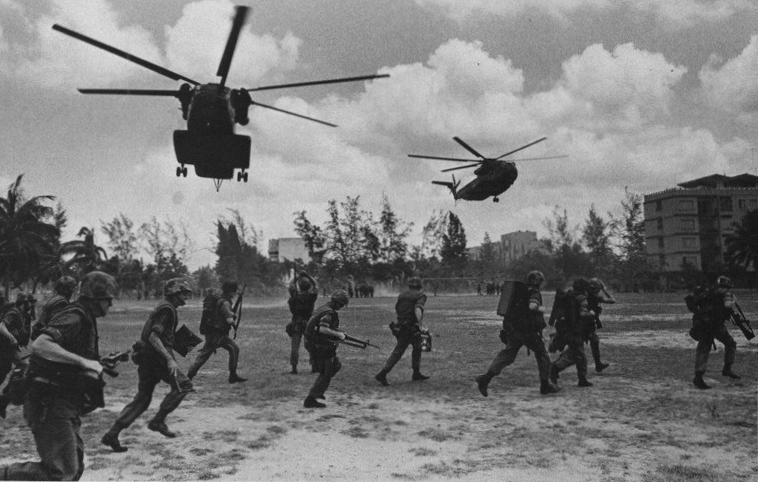
U.S. Marines at Landing Zone Hotel, Phnom Penh, on 12 April 1975, during Operation Eagle Pull, the helicopter evacuation of the U.S. embassy. Communist Party of Kampuchea forces entered the city on 17 April. Source: U.S. Department of Defense photo (USMC) A150K58, from the USS Hancock (CVA-19) 1975 cruise book, Public domain (U.S. government work; Commons PD-USGov-Military-Marines).
On 18 March 1970 General Lon Nol and Prince Sirik Matak overthrew Sihanouk, who allied with the CPK in a National United Front (FUNK) and an exile government in Beijing (GRUNK), in which Khieu Samphan was Deputy Prime Minister and Minister of Defence. A civil war followed against the Khmer Republic, with United States bombing of Cambodia that was heaviest in 1973 and ended by act of Congress on 15 August 1973; the tonnage is itself disputed, from the long-cited Air Force total of about 540,000 tons to a far higher figure in the analysis by Taylor Owen and Ben Kiernan. The CPK imposed cooperatives in the areas it held from 20 May 1973. The US embassy left Phnom Penh by helicopter on 12 April 1975 and CPK forces entered the capital on the morning of 17 April.
The Party did not announce its own existence until September 1977. Until then the public met it only as Angkar, "the Organization", a word that could mean the whole Party or its leaders at any level. Residents of Phnom Penh were told to leave at once because the Americans were about to bomb, and that they would be away for a few days. The ECCC Trial Chamber found that about two million people were moved out of the capital, and that the bombing warning and the promise of a short absence were false assurances; other towns were emptied the same way. A constitution adopted at a national congress in December 1975 and issued on 5 January 1976 named the state Democratic Kampuchea, and Sihanouk stepped down as head of state on 2 April 1976 (Chandler; Kiernan).
How power was organized
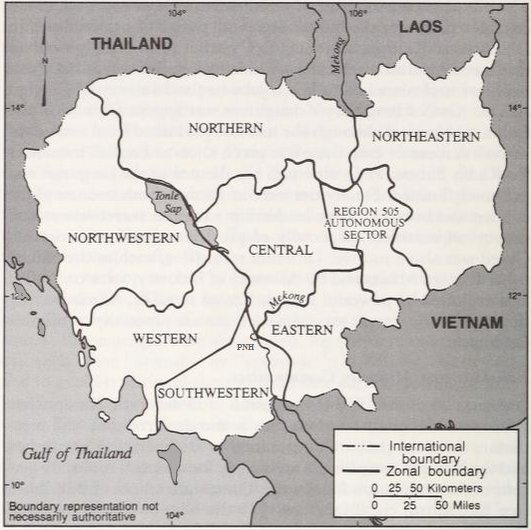
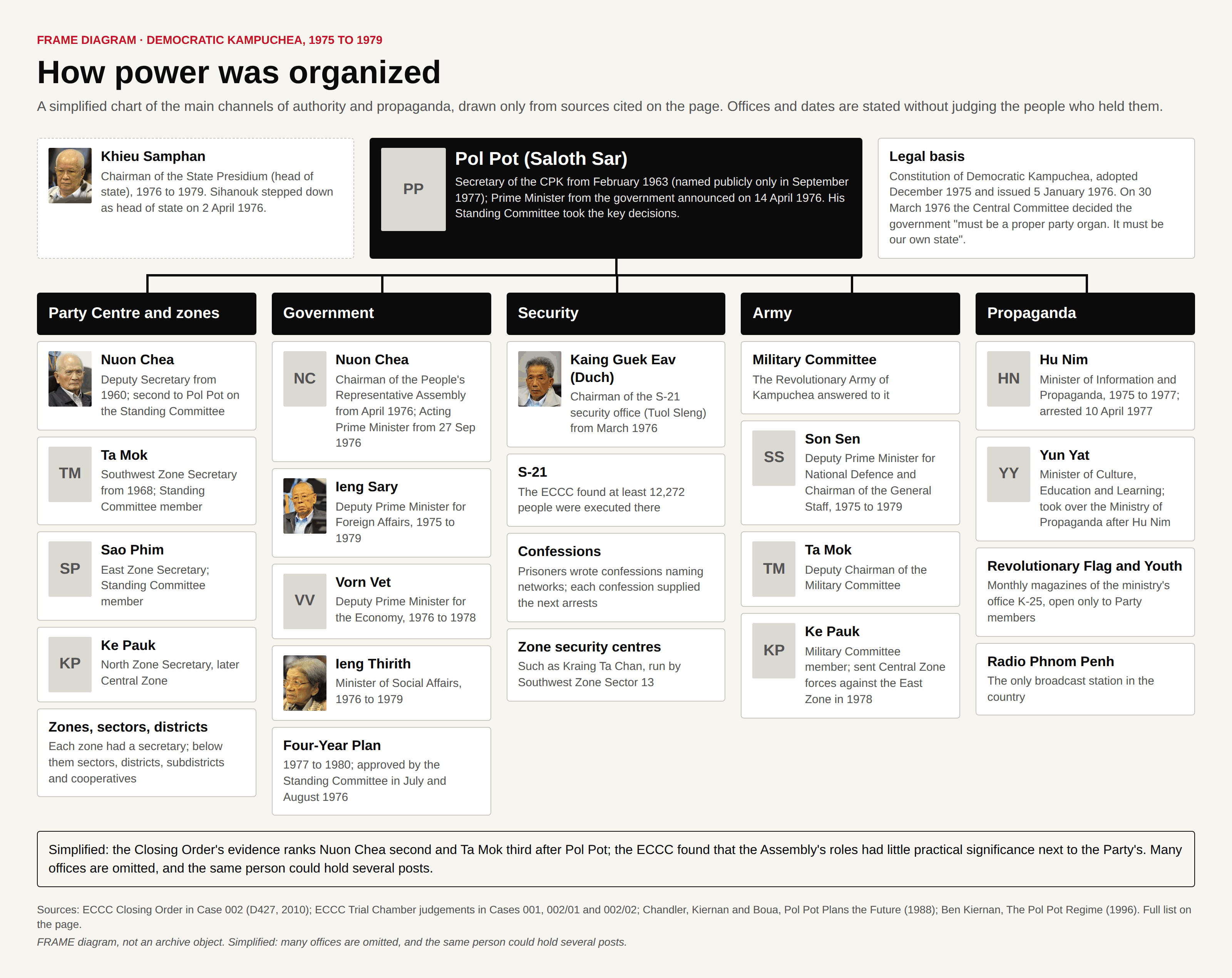
The CPK was run by a Central Committee and a Standing Committee, the "Centre" in Phnom Penh, which the ECCC describes as the body that held the key decisions. After Pol Pot, the Closing Order's evidence ranks Nuon Chea second and Ta Mok third; other Standing Committee members included Ieng Sary, Vorn Vet, Son Sen and Sao Phim. Below the Centre the country was divided into zones (Southwest, East, North and later Central, Northwest, Northeast, West and a Special Zone), each with a secretary, and then into sectors, districts, subdistricts and cooperatives. The Revolutionary Army of Kampuchea answered to a Military Committee. On 30 March 1976 the Central Committee decided the shape of a government that "must be a proper party organ. It must be our own state". The ministers were announced on 14 April 1976: Pol Pot as Prime Minister, Ieng Sary for foreign affairs, Son Sen for national defence, Vorn Vet for the economy, Nuon Chea as Chairman of the People's Representative Assembly, Khieu Samphan as Chairman of the State Presidium, Hu Nim for propaganda, Yun Yat for education and Ieng Thirith for social affairs. The ECCC found that the Assembly's roles had little practical significance next to the Party's.
The administrative zones of Democratic Kampuchea, 1975 to 1978, as mapped in the U.S. Library of Congress Federal Research Division's Cambodia: A Country Study. Zone boundaries and names changed during the period. Source: Library of Congress, Federal Research Division, Cambodia: A Country Study, via Wikimedia Commons, Public domain (Commons tag; U.S. Library of Congress Federal Research Division, Cambodia: A Country Study, a U.S. government publication).
The main channels of authority in Democratic Kampuchea, 1975 to 1979, simplified from the sources cited on this page. Source: FRAME diagram. Portraits, cropped to thumbnails: Extraordinary Chambers in the Courts of Cambodia, 30 June 2011 (Case 002 initial hearing), via Flickr (krtribunal) and Wikimedia Commons; Extraordinary Chambers in the Courts of Cambodia, 19 October 2011 (hearing on her fitness to stand trial), via Flickr and Wikimedia Commons; Extraordinary Chambers in the Courts of Cambodia, 30 March 2011 (last day of the Case 001 appeal hearing), via Flickr and Wikimedia Commons; Extraordinary Chambers in the Courts of Cambodia, 7 August 2014, via Flickr (krtribunal) and Wikimedia Commons; Extraordinary Chambers in the Courts of Cambodia (photo by Mark Peters), 31 October 2013, via Flickr (krtribunal) and Wikimedia Commons, CC BY-SA 2.0 (the portraits that carry it); other portraits: CC BY 2.0.
Money and markets were abolished and private property ended. People from the towns were classed as "new people" or "17 April people", people from the zones the CPK had held before 1975 as "base people", and in 1976 the Party reclassified them again into "full-rights" people, "candidates" and "depositees", the last mostly new people with the lowest rations (Kiernan). The Four-Year Plan of 1977 to 1980, approved by the Standing Committee in July and August 1976, set a target of three tons of rice per hectare, against yields of about one ton, and planned exports of 800,000 to one million tons of paddy in 1977 (Chandler, Kiernan and Boua). Eating was to be done in common: in his explanation of the plan on 21 August 1976 Pol Pot said "eating will be collectivized". The Trial Chambers in Cases 002/01 and 002/02 found a common purpose among the Party leaders to implement a rapid socialist revolution through a "great leap forward" and to defend the Party against internal and external enemies "by whatever means necessary".
Food was also the ground of punishment, and the record on that is uneven, so it is set out by how well it is supported. The Co-Investigating Judges' Closing Order of 2010, which summarises witness statements and documents gathered for the trials and is not a verdict, records that at the Trapeang Thma Dam "no one dared complain about the food rations for fear of being killed" (para. 341) and that at the Srae Ambel salt fields a witness said workers caught stealing food were deprived of food for two days (para. 379). Its sections on security centres list stealing food among the reasons given for arrest or for classing a prisoner as a "light offender" at Sang (para. 479), Koh Kyang (para. 524), Prey Damrei Srot (para. 542) and Wat Tlork (para. 653), and "eating food which was forbidden" at Kok Kduoch (para. 675). At a North Zone security centre, some witnesses saw prisoners who tried to steal food killed by guards, and one witness described the rape and killing of a cook who had stolen food (para. 578). These are witness statements summarised by the investigating judges, not Trial Chamber findings on each incident, but they agree that stealing food was treated as an offence and could lead to detention, beating, loss of rations or death.
Cutting open the body is documented in other settings. The Closing Order records witness statements that at Sang prisoners had their throats slit and their abdomens cut open at execution (para. 486), that at Koh Kyang prisoners were "often disembowelled to serve as a warning to others" and that guards drank gall bladders mixed with wine and cooked livers (para. 531), and that at Au Kanseng two witnesses said a woman accused of "immorality" had her back cut open and her bile bladder removed, which the centre's chairman contested (para. 623). None of these passages ties the cutting to an accusation about food. One account does: Youk Chhang, director of the Documentation Center of Cambodia (DC-Cam) and a survivor, has said that his pregnant sister was killed when, in the words of Time (5 September 2018), "a soldier split open her stomach to see if she had stolen rice. She hadn't"; a Stanford Graduate School of Business profile adds that his brother-in-law had been beaten in public for taking leftover cucumbers for her. In his own essay for DC-Cam (17 April 2005) Chhang writes that his sister was "murdered" and that he was jailed and tortured for looking for vegetables for her, without describing how she died. The soldier and the place are not named in the sources found, and no court finding on it was located. It is therefore recorded here as one survivor's account of one killing, not as a rule applied across the country. The sources checked do not attribute it, or any other cutting open over food, to Ta Mok or to any other named leader. What the ECCC says of Ta Mok is in his card above: that he was Southwest Zone Secretary, that the zone's Sector 13 ran the Kraing Ta Chan security centre, and that he took part in the flow of execution reports from it. He was never charged, and the ECCC states that its findings cannot be equated with findings of guilt against him. Popular accounts do call him "the Butcher".
The toll cannot be fixed to one number, because no census was taken and the dead include people killed by shooting and beating, people who died of hunger, disease and overwork, and people whose cause of death was never recorded. The ECCC Trial Chamber in Case 002/02 (judgement of 16 November 2018, para. 297) notes published estimates from 600,000 to three million, says that experts accept 1.5 to 2 million excess deaths as the most probable range, and stresses the uncertainty of the demographic evidence; it also cites DC-Cam's identification, by 2008, of an estimated 1.3 million human remains in 390 mass grave sites. The demographer Patrick Heuveline (Population Studies, 2015) gives a 95 per cent simulation interval of 1.2 to 2.8 million excess deaths, with a median of 1.9 million, about 21 per cent of the population at risk, of which 728,000 to 1.455 million were violent deaths. Ben Kiernan estimates about 1.7 million. Estimates of how many died by execution and how many of hunger and disease differ between studies.
Illustration, not an archive object
The propaganda apparatus
The message machinery ran through the Ministry of Propaganda, whose first minister was Hu Nim, from April 1975 until his arrest in April 1977; Yun Yat took over, and two witnesses told the ECCC that Nuon Chea held the post from late 1978. On 9 October 1975 the Standing Committee had given Nuon Chea responsibility for party work, propaganda and education, and he attended its meetings on propaganda work on 9 January, 8 March and 1 June 1976 (Closing Order). The ministry's office, K-25, produced the monthly magazines Tung Padevat ("Revolutionary Flag") and Yuvakon Padevat ("Revolutionary Youth"). The Closing Order describes them as the Party's most important propaganda magazines, open only to Party members, studied in sessions by cadres who had to pass the policies on, and the source of the content of radio broadcasts. Revolutionary Flag had been a secret magazine before 1975. Its issues carried the Party line, leaders' speeches and production targets, and it named the Party's "enemies" at each stage.
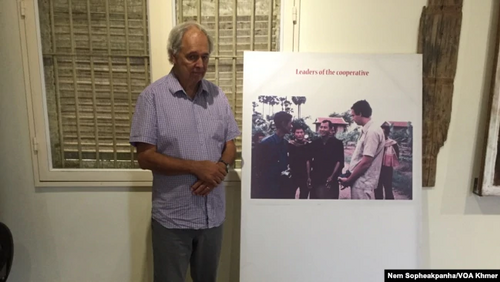
Gunnar Bergström in 2016 beside a photograph from the Swedish friendship delegation's guided visit of August 1978, which he later called a propaganda tour. Source: Nem Sopheakpanha / VOA Khmer, 12 September 2016, Public domain (U.S. government work, Voice of America; Commons PD-VOA).
Radio Phnom Penh, the successor to the Party's mobile radio unit and to the "Voice of the FUNK" that Ieng Thirith ran from Hanoi until May 1975, became the only broadcast station in the country. The leadership saw radio as the main way to spread the revolutionary idea. Its news praised the cooperatives and the achievements of the regime, and it carried no news critical of Democratic Kampuchea; it also broadcast in English and Vietnamese. Film crews were told to shoot the success of the farming communities, and photography was limited to ceremonies and foreign guests. Outside radio and print, the Party spoke through mass meetings (on 15 April 1977, the second anniversary of the victory, Khieu Samphan praised child workers who were "helping to build dams and embankments"), through study sessions and, in the army, through criticism and self-criticism sessions in which troops were expected to criticise their mistakes and implicate comrades. The Party's existence was announced in a speech by Pol Pot on the 17th anniversary, in late September 1977, which was the first time the public heard that the Party had a name and a Secretary.
The language of the regime did much of the work. "Angkar" spoke as a collective with no face. Cadres used set sayings that survivors later collected, among them "To keep you is no gain, to lose you is no loss" (Locard). Being "taken to study" or "rebuilt" was understood to mean arrest or death, and at S-21 the working word for killing was kamtech, "smash". Duch told the ECCC that to smash "means to arrest secretly" and to interrogate under torture and then execute in secret, and that the word covered more than killing. Internal reports spoke of "microbes": the Party Center's report of 20 December 1976 said "we search for the microbes within the Party without success. They are buried" and, later in the same text, "Many microbes emerged. Many networks came into view". A failure or a shortage was read as the work of traitors inside the ranks. The Standing Committee's own 1976 explanation for hurry was that "enemies attack and torment us".
The evacuation of the cities was the first and largest act of communication by order: a spoken warning of an American bombing that was not coming, delivered to hundreds of thousands at once. S-21 gave the Party a second channel, a paper one. Prisoners were photographed and made to write confessions naming networks of the CIA, the Soviet KGB and Vietnamese agents, and each confession supplied the next arrests. The ECCC found that at least 12,272 people were executed there. Confessions of captured Vietnamese were recorded and broadcast on the radio in early 1978; Duch told the ECCC that this was decided by Nuon Chea and that "the purpose of the propaganda was determined from the upper echelon". Hu Nim's confession shows the genre: the interrogator's note to Duch says "We whipped him four or five times to break his stand", Kiernan judges that the confession gives no convincing evidence for the CIA charge, and the regime never announced his arrest. When the American journalist Richard Dudman visited in December 1978 he was told Hu Nim was "still active in the government".
From 1977 the Party turned its message on Vietnam. The Closing Order says the CPK "escalated its use of propaganda against the Vietnamese", casting them as expansionist, "territory-swallowing annexationists", and that the Revolutionary Flag of December 1977 to January 1978 congratulated the country on purging "Vietnamese agents" from its ranks. Radio Phnom Penh told listeners in May 1978 that if each Cambodian killed 30 Vietnamese, two million soldiers would be enough to eliminate Vietnam's 50 million people (Kiernan, from the BBC Summary of World Broadcasts). The Foreign Ministry's Black Paper of September 1978 described Vietnam as an "aggressor, annexationist and swallower of territories". The ECCC Trial Chamber in Case 002/02 convicted Nuon Chea and Khieu Samphan of genocide of the Vietnamese.
Foreign audiences got a managed view. Romanian president Nicolae Ceaușescu made a state visit on 28 to 30 May 1978, a Swedish friendship delegation led by Gunnar Bergström toured for about two weeks in August 1978 and later called the trip a "propaganda tour", and in December 1978 the journalists Elizabeth Becker and Richard Dudman and the scholar Malcolm Caldwell were given a structured tour; Caldwell was shot dead in their guesthouse on 22 to 23 December. The archive's own write-up of the language and the confession pipeline is Angkar: language control in Democratic Kampuchea, 1975-1979.
The archive's definitions fit most clearly: euphemism ("evacuation" for three days, "study", "smash"), name-calling ("new people", "microbes", "Yuon"), scapegoating (hunger and failure read as the work of hidden traitors and of Vietnam), fear-appeal (the false bombing warning), identity-fusion (Angkar as a faceless "we", and "Khmer bodies with Vietnamese minds" in 1978) and card-stacking (S-21 files that could only confirm the conspiracy already named). Rwanda's radio in 1994 is a later case of a station naming a group as an enemy within (RTLM and Kangura), and the Soviet trials of 1936 to 1938 produced confessions in open court (Moscow show trials); the mechanisms are alike, and the settings differ.
Timeline
1951: the Khmer People's Revolutionary Party is formed; 9 November 1953, Cambodia becomes independent.
30 September 1960: the Workers' Party congress, later counted as the CPK's founding; February 1963, Saloth Sar becomes Secretary.
18 March 1970: Lon Nol overthrows Sihanouk, who joins the CPK in the FUNK and GRUNK; 5 May 1970, GRUNK is announced.
20 May 1973: cooperatives are imposed in CPK-held areas; 15 August 1973, US bombing ends by act of Congress.
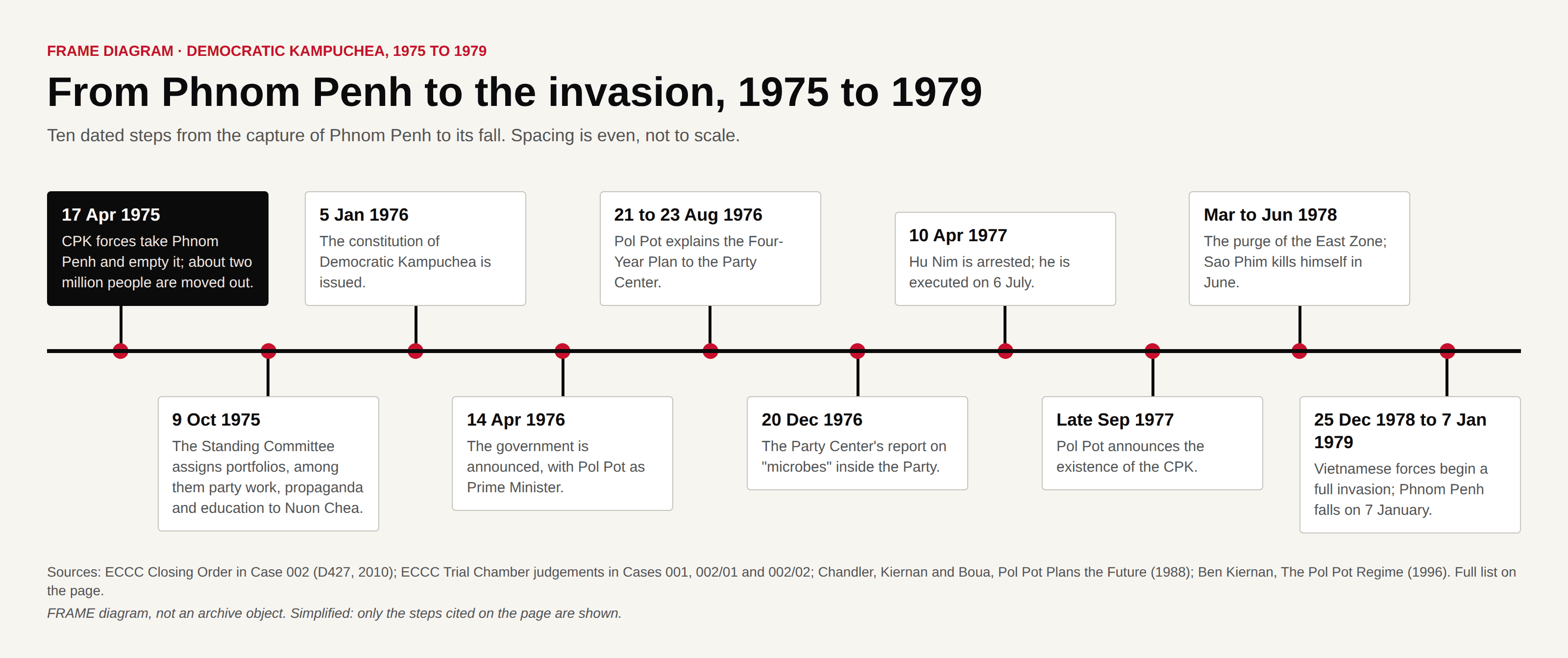
12 April 1975: the US embassy is evacuated; 17 April, CPK forces take Phnom Penh and empty it.
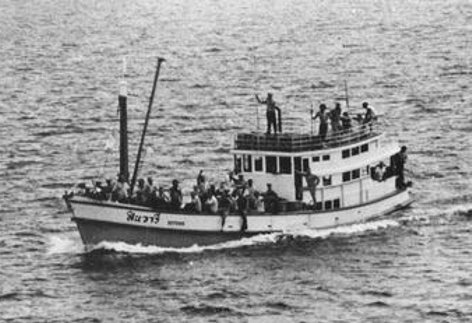
12 to 15 May 1975: Cambodian forces seize the US ship Mayaguez; the US responds at Koh Tang island and the crew is released on 15 May.
9 October 1975: the Standing Committee assigns portfolios, among them party work, propaganda and education to Nuon Chea and the General Staff to Son Sen.
5 January 1976: the constitution of Democratic Kampuchea is issued; 20 March, the Assembly election; 2 April, Sihanouk steps down; 14 April, the government is announced with Pol Pot as Prime Minister.
21 to 23 August 1976: Pol Pot explains the Four-Year Plan to the Party Center; 27 September, Nuon Chea is named Acting Prime Minister while Pol Pot is said to be on leave.
20 December 1976: the Party Center's report on "microbes" inside the Party.
10 April 1977: Hu Nim is arrested; he is executed on 6 July.
Late September 1977: Pol Pot announces the existence of the CPK (sources give 27 to 29 September for the speech).
31 December 1977: Democratic Kampuchea breaks relations with Vietnam amid border fighting.
March to June 1978: the purge of the East Zone; Sao Phim kills himself in June.
28 to 30 May 1978: Ceaușescu visits; August, the Swedish delegation; September, the Black Paper; November, Vorn Vet is arrested; December, the Becker, Dudman and Caldwell visit.
25 December 1978: Vietnamese forces begin a full invasion; 7 January 1979, Phnom Penh falls and the People's Republic of Kampuchea is set up.
15 to 19 August 1979: the People's Revolutionary Tribunal tries Pol Pot and Ieng Sary in absentia; September 1979, the UN Credentials Committee seats Democratic Kampuchea's delegation.
A Thai fishing boat carrying the crew of the seized SS Mayaguez approaches the destroyer USS Henry B. Wilson off Koh Tang island on 15 May 1975. U.S. Navy photograph. Source: U.S. Navy photo from the USS Henry B. Wilson (DDG-7) 1975 cruise book, via Wikimedia Commons, Public domain (U.S. Navy photograph, U.S. government work).
Ten dated steps from 1975 to 1979 in Democratic Kampuchea, simplified from the sources cited on this page. Source: FRAME diagram, drawn from the sources listed on this page, CC BY 4.0 (FRAME archive content).
How it ended
Illustration, not an archive object
Vietnamese forces and the Kampuchean United Front for National Salvation took Phnom Penh on 7 January 1979 and set up the People's Republic of Kampuchea (PRK). The Khmer Rouge leadership withdrew to the Thai border and fought on for nearly two decades. China, the United States, ASEAN and most Western governments declined to recognise a government installed by a foreign army and backed the Democratic Kampuchea delegation, and from 1982 the Coalition Government of Democratic Kampuchea, at the UN; Vietnam, the Soviet Union and their allies backed the PRK. The PRK held its own tribunal in August 1979 and opened the Tuol Sleng museum in 1980; several PRK leaders, among them Heng Samrin and Hun Sen, had served as Khmer Rouge cadres before defecting in 1977 and 1978. Pol Pot died on 15 April 1998; see How Pol Pot died. Son Sen and Yun Yat had been killed on his orders in June 1997, and Ta Mok was captured in March 1999 and died in 2006 without a trial.
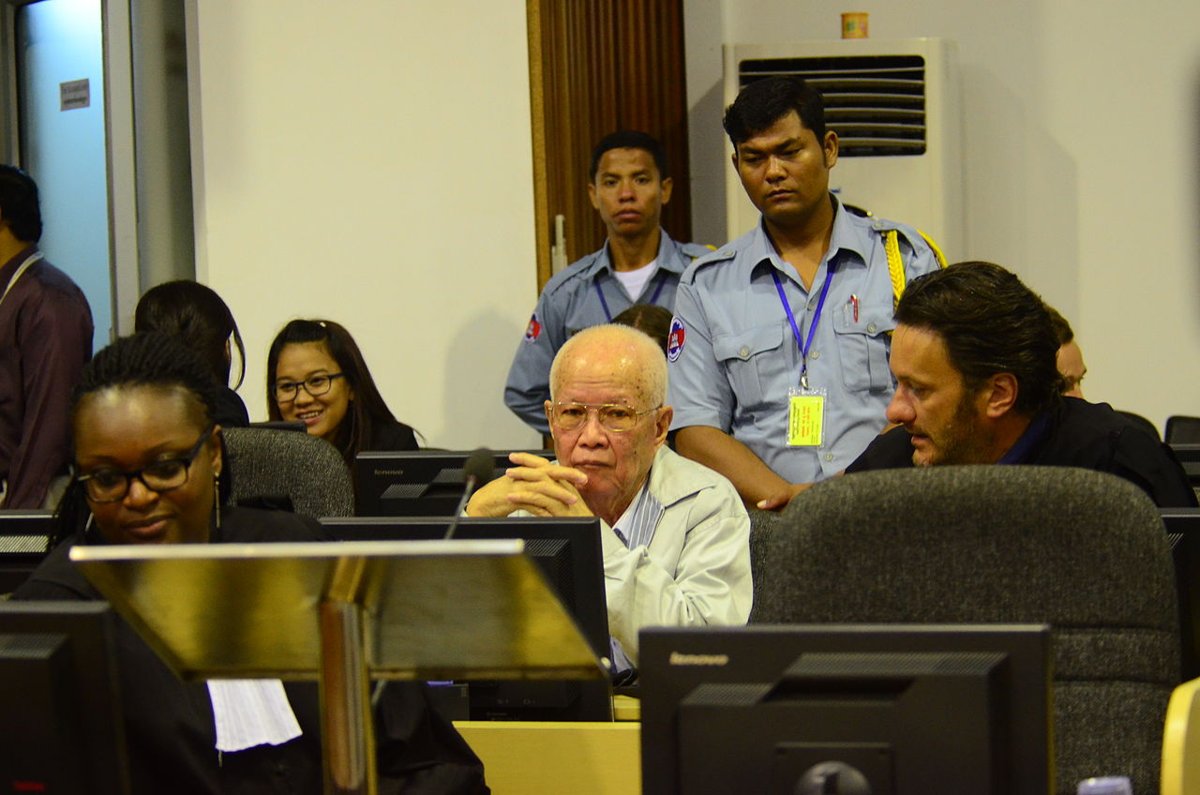
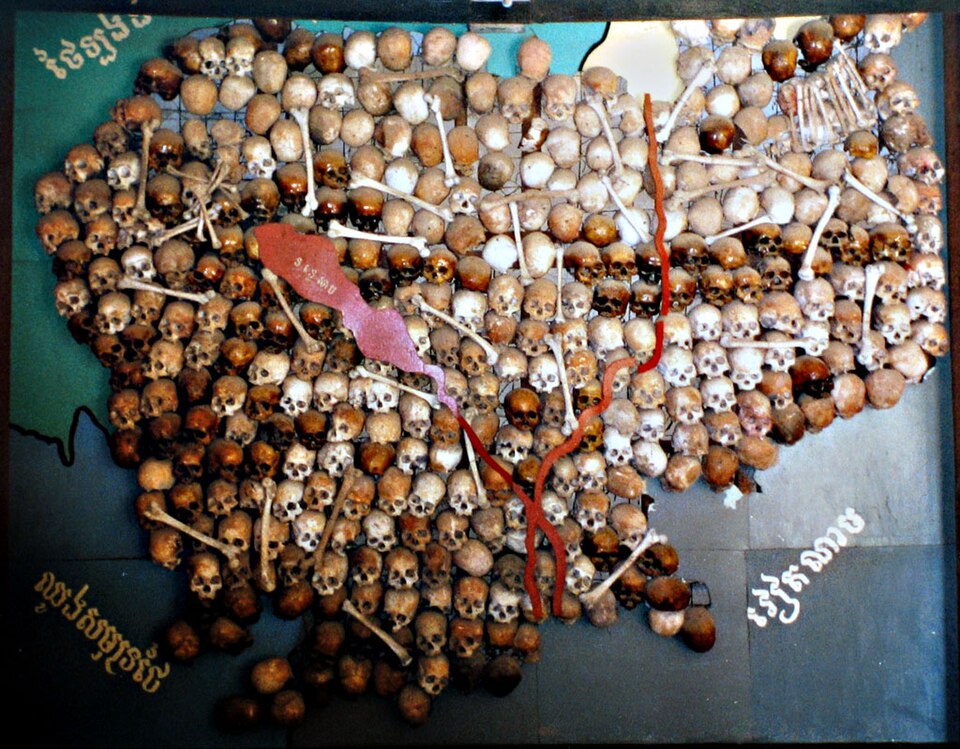
The courtroom of the Extraordinary Chambers in the Courts of Cambodia at the pronouncement of the Case 002/01 judgement, 7 August 2014. The court's Flickr record names no individuals. Source: Extraordinary Chambers in the Courts of Cambodia, 7 August 2014, via Flickr (krtribunal, https://www.flickr.com/photos/krtribunal/14825899426/, licence read on the Flickr page) and Wikimedia Commons, CC BY 2.0.The skull map at the Tuol Sleng museum, photographed in 1997. It was assembled in the period after 1979, when the Vietnamese-backed government ran the site, and was dismantled in 2002. Source: Donovan Govan, via Wikimedia Commons (January 1997), CC BY-SA 3.0.
Content note: Map of Cambodia made from victims' skulls. This object is shown as it was published. Why
The UN-backed Extraordinary Chambers in the Courts of Cambodia (ECCC) tried five people. Case 001: Duch was convicted of crimes against humanity and grave breaches of the Geneva Conventions for S-21, given 35 years on 26 July 2010 and life on appeal on 3 February 2012, and died in 2020. Case 002/01 (7 August 2014): Nuon Chea and Khieu Samphan were convicted of crimes against humanity, including the forced transfer of the population of Phnom Penh, and given life sentences, upheld on 23 November 2016. Case 002/02 (16 November 2018): both were convicted of further crimes against humanity and of genocide of the Vietnamese, and Nuon Chea also of genocide of the Cham; Nuon Chea died on 4 August 2019, and on 22 September 2022 the Supreme Court Chamber upheld Khieu Samphan's convictions and life sentence. The Chambers did not classify the killing of the Khmer majority as genocide in law. Ieng Sary died on 14 March 2013 before judgement, and Ieng Thirith was found unfit to stand trial in 2012 and died in 2015. Cases 003 and 004, against lower-ranking suspects, ended without a trial: the national and international co-investigating judges issued opposing closing orders, and the proceedings were terminated "in the absence of a definite and enforceable indictment".
Same-standard note
This page uses the same structure and definitions as every other regime page: a technique is listed only where the archive's working definition and a documented example fit, offices and dates are stated without judging the people who held them, and the findings of a court are reported as findings and kept apart from witness statements and from popular accounts. Where the record is uneven, as with punishments for food offences and with the toll, the page says which parts are supported and which are not. This was a one-party state that ruled for three years, eight months and three weeks and in which, on the ECCC experts' range, about one in five people died; its leaders spoke of enemies, hidden agents and "microbes" in the same register that appears on other regime pages, but the scale, the speed and the source of the documentation (the Party's own magazines, telegrams and prison files, tested in a court) are specific to this case, and a shared method is not an equivalence. Other regime pages record other systems, each with its own scale, intent and context.
Sources
ECCC, Co-Investigating Judges, Closing Order (Indictment) in Case 002, D427, 15 September 2010, especially paras 18 to 63, 99 to 111, 143 to 145, 194 to 201, 253, 296, 341, 379, 479, 486, 523 to 531, 542, 578, 591, 623, 653, 675, 819 to 821, 881 to 890, 950, 985, 989, 1053 to 1054, 1157 to 1167 and 1267: eccc.gov.kh.
ECCC Trial Chamber, Judgement in Case 001 (Kaing Guek Eav alias Duch), E188, 26 July 2010, paras 99 to 100, 182, 340 and 597: eccc.gov.kh; Supreme Court Chamber, Case 001 appeal judgement, 3 February 2012.
ECCC Trial Chamber, Case 002/01 Judgement E313, 7 August 2014; Case 002/02 Judgement E465, 16 November 2018 (para. 297 on the toll, as quoted in the Supreme Court Chamber's Case 002/02 appeal judgement F76, eccc.gov.kh); Supreme Court Chamber, 22 September 2022 (ABC News).
David P. Chandler, Ben Kiernan and Chanthou Boua (eds), Pol Pot Plans the Future: Confidential Leadership Documents from Democratic Kampuchea, 1976-1977 (Yale Southeast Asia Studies, 1988), including Document 4 (Pol Pot, 21 August 1976), Document 6 (20 December 1976) and Document 8 (Hu Nim's confessions): archive.org.
Pol Pot, speech on the 17th anniversary of the CPK, September 1977: archive.org.
Ben Kiernan, The Pol Pot Regime: Race, Power, and Genocide in Cambodia under the Khmer Rouge, 1975-79 (Yale University Press, 1996); David Chandler, Voices from S-21 (University of California Press, 1999) and A History of Cambodia; Henri Locard, Pol Pot's Little Red Book: The Sayings of Angkar (Silkworm Books, 2004).
Fototeca online a comunismului românesc (National Archives of Romania), record 45014X1X4, Ceaușescu's visit to Democratic Kampuchea, 28 to 30 May 1978: fototeca.iiccmer.ro; Gerald R. Ford Library, National Security Council meeting minutes, 13 to 15 May 1975 (Mayaguez).
The archive's case study: Angkar: language control in Democratic Kampuchea, 1975-1979, which carries the full source list on the BBC broadcasts, the Swedish and American visits, the 1979 tribunal and the UN seat.


.jpg)
