- Techniques
- Card stacking
In one line: two North American dailies, one Canadian and one American, printed wire copy from Rome within a day of each other when Benito Mussolini became Italian prime minister on 30 October 1922. Both headlines lead with the Fascisti's triumph. They differ in what sits beside it: the Canadian page reports raids and "twelve deaths" in the same story, and the American page-1 text, as read, reports the burning of labour-organisation records and gives no casualty figure.
What this page is, and is not. It compares how two papers framed one event, using the archive's standing technique definitions for both. It does not compare Italian newspapers: none from these days could be licence-verified (see "Image gaps"). Both papers relayed wire copy and neither was under state censorship, so this compares two foreign-wire framings, not the Italian press.
| Victoria Daily Times | The Duluth Herald | |
|---|---|---|
| Place and issuer | Victoria, British Columbia; a daily newspaper | Duluth, Minnesota; a daily newspaper |
| Date | Tuesday 31 October 1922 | Wednesday 1 November 1922 (Last Edition) |
| Source of the story | Wire copy datelined Rome, 31 October | "By the Associated Press", Rome, 1 November |
| Government at home | Mackenzie King (Liberal) | Harding (Republican) |
| Lead headline | "FASCISTI CELEBRATE IN ROME WINNING OF CONTROL IN ITALY" | "FASCISTI LEADER WILL RULE ITALY WITH IRON HAND" |
| Casualties on the page | "a total of twelve deaths being reported" | None in the page-1 text as read |
What happened
In late October 1922 the National Fascist Party mobilised tens of thousands of members around Rome while its leaders negotiated with politicians. On 28 October Prime Minister Luigi Facta asked King Victor Emmanuel III to sign a martial-law decree; the king refused. On 29 October he asked Mussolini, in Milan, to form a government; Mussolini reached Rome on 30 October and presented his ministry. On 31 October the Fascist columns paraded and the ministers took the oath. Historians describe a threat of force that worked through the king's decision, not a military conquest of the capital.
Victoria Daily Times, 31 October 1922
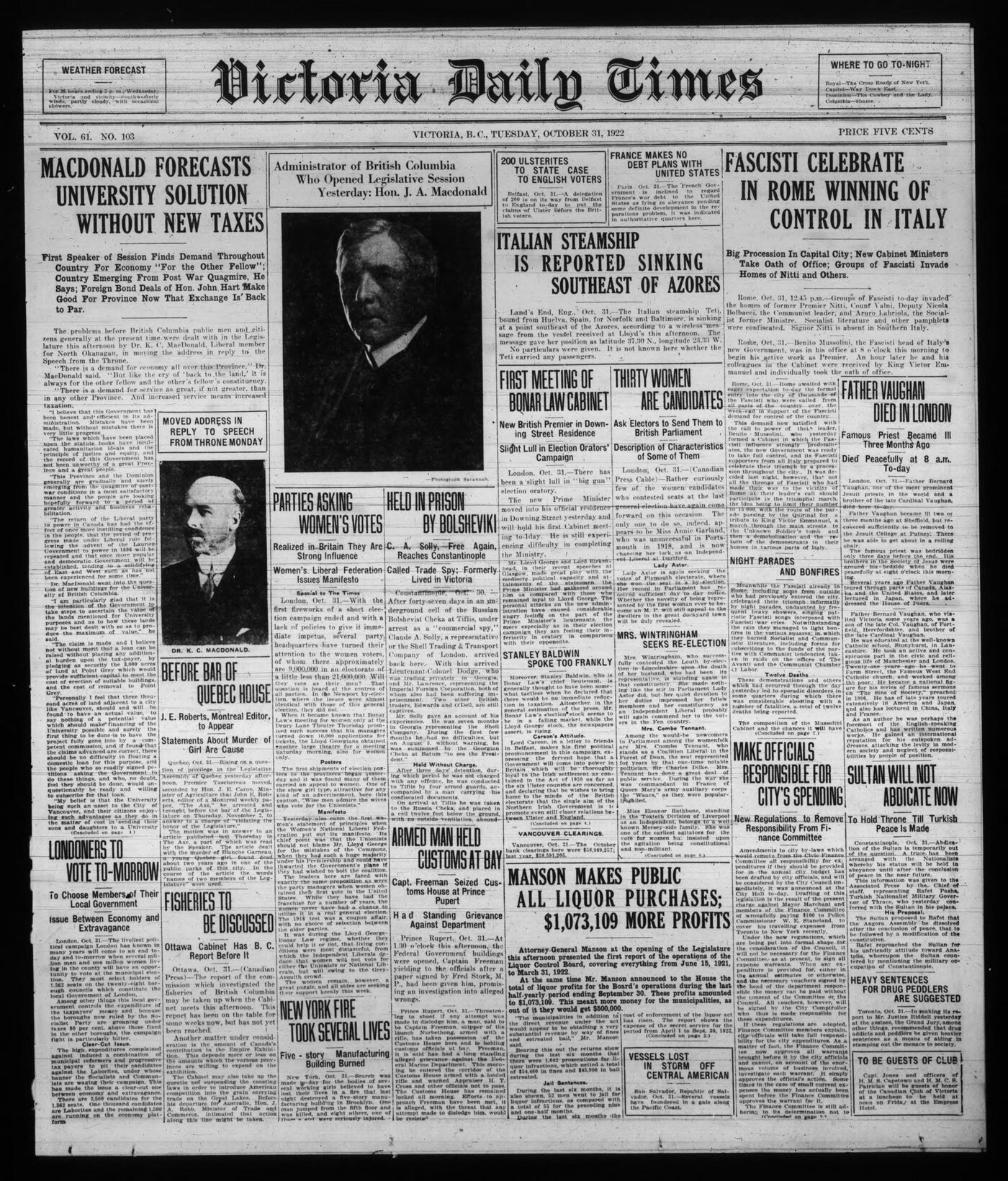
Victoria Daily Times (British Columbia), front page, 31 October 1922: 'Fascisti Celebrate in Rome Winning of Control in Italy'. Public domain (Commons: PD-Canada; published before 1931). University of Victoria digitisation via the Internet Archive and Wikimedia Commons.
Headline and deck, verbatim: "FASCISTI CELEBRATE IN ROME WINNING OF CONTROL IN ITALY. Big Procession In Capital City; New Cabinet Ministers Take Oath of Office; Groups of Fascisti Invade Homes of Nitti and Others."
The story opens with Fascisti groups invading the homes of the former premier Francesco Nitti and of a Communist and a Socialist politician, and confiscating "Socialist literature and other pamphlets". It reports the oath before the king and a procession limited to about 15,000 Fascisti. Under a boxed subhead, "Twelve Deaths", it says the day's demonstrations "led to sporadic disorders in some quarters during which there was considerable shooting with a number of fatalities, a total of twelve deaths being reported."
The Duluth Herald, 1 November 1922
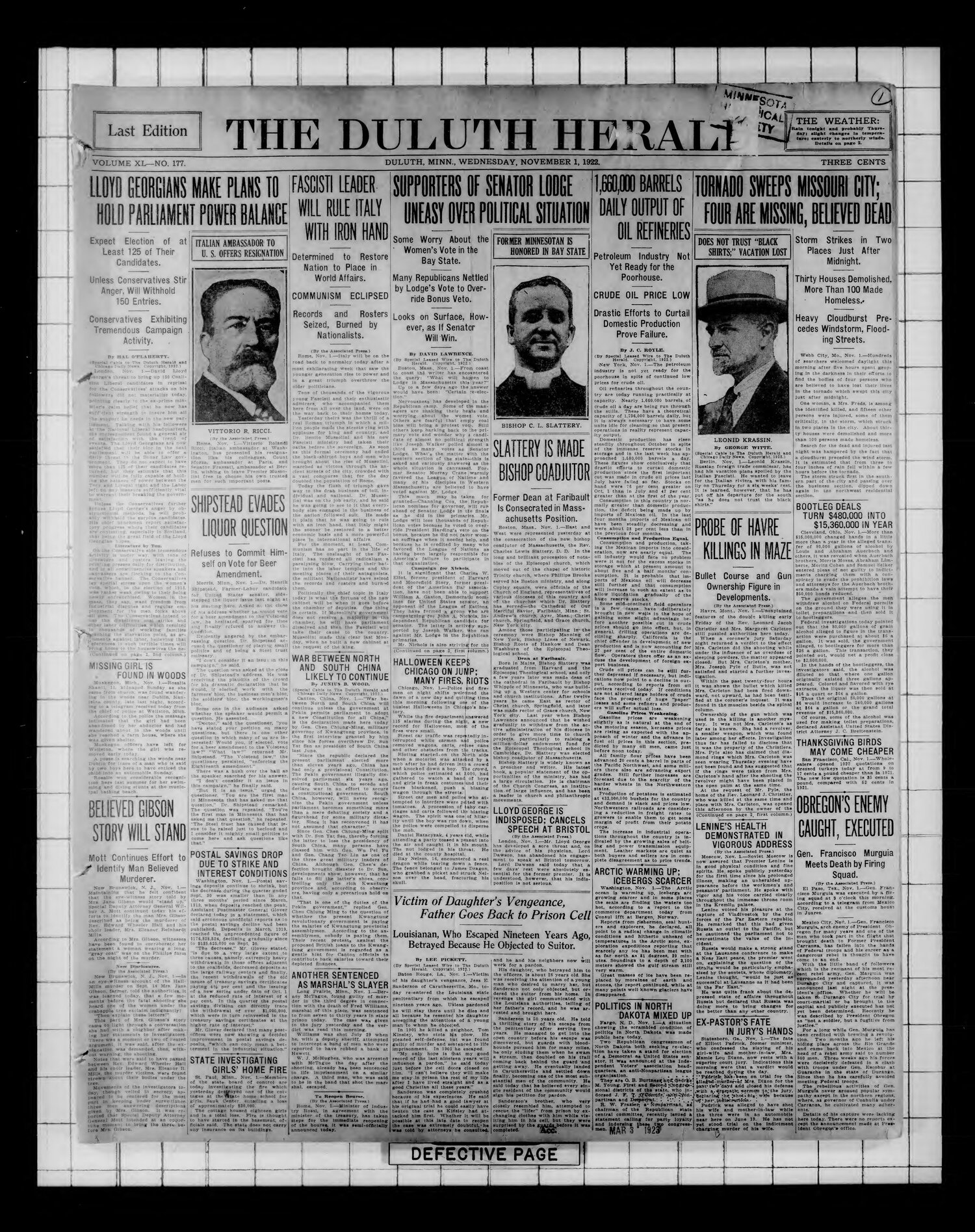
The Duluth Herald (Minnesota), front page, 1 November 1922: 'Fascisti Leader Will Rule Italy with Iron Hand'. Public domain (published before 1931). Internet Archive digitisation via Wikimedia Commons.
Headline and decks, verbatim: "FASCISTI LEADER WILL RULE ITALY WITH IRON HAND. Determined to Restore Nation to Place in World Affairs. COMMUNISM ECLIPSED. Records and Rosters Seized, Burned by Nationalists." Credited "By the Associated Press."
The story's first paragraph says "Italy will be on the road back to normalcy today after a most exhilarating week that saw the younger generation rise to power". It calls the previous day "a real Roman triumph", describes "vigorous young Fascisti" and says Mussolini "made it plain that he was going to rule with an iron hand". It reports that "the militant Nationalists have seized the records and rosters and burned them" in "the labor temples and the meeting places of their antagonists." The page-1 text as read gives no figure for deaths; the continuation on page 2 was not examined.
Mapping to the archive's definitions
The archive's definition of Card stacking: "Select, omit, or order facts so the remaining pile can only be read one way." Its tell: "Missing denominator, missing counterexample, missing dates." What it is not: "A short item that flags its own limits."
- Victoria. The headline and deck foreground celebration, procession and oath. The raids and the deaths are in the same story but below the headline, with the death toll in a short boxed paragraph near the end of the front-page text. The page does carry the deaths, so "missing counterexample" applies to the headline's ordering, not the whole story.
- Duluth. The headline and decks foreground the leader's authority and the "eclipse" of Communism. The page-1 text as read calls the week "exhilarating", speaks of "normalcy", and reports the burning of opponents' records without a casualty count. Page 2 was not checked, so the tag rests on page-1 evidence only.
The same definition is applied to both pages. Neither headline contains a statement the archive can show to be false: the oath, the king's role and the seizures of records are all in the historical record. The tag is about ordering and omission, as the definition says.
Differences stated plainly
- Time. Victoria is dated the day of the oath; Duluth is a day later and treats the parade as over ("a million people" in the streets).
- Sourcing. Both pages are wire copy from Rome, so neither paper's own view is separable from its wire service. Duluth prints its credit, "By the Associated Press".
- Scale. The 12 deaths are the Victoria page's figure for one day's disorders; this page does not adjudicate the total or compare it with later historians' counts.
- Constraints. Neither paper was under state censorship or party control of the kind the archive documents for the later Fascist regime (see Fascist Italy's propaganda machine: from the Duce's Press Office to the Ministry of Popular Culture); both were commercial dailies.
- Language. "Triumph", "vigorous young" and "exhilarating" are the wire writers' words in Duluth; the Victoria headline uses "celebrate". Both print "Fascisti", the movement's own label, for its members.
Image gaps
- Italian newspapers (for example Il Popolo d'Italia, Avanti!, Corriere della Sera, La Stampa) for 28 October to 1 November 1922: not hosted. No front page from these days was found on Wikimedia Commons or in a library collection with a stated public-domain basis, and Chronicling America was unreachable from the research environment.
- Victoria, 1 November: checked; its digitised page 1 is an inside page, so it was not used.
Sources
- Victoria Daily Times, 31 October 1922: Wikimedia Commons file page, from the Internet Archive item.
- The Duluth Herald, vol. 40, no. 177, 1 November 1922: Wikimedia Commons file page.