In one line: From the constitution that took effect on 11 April 1933 until 25 April 1974, Portugal was governed as a single-party corporative state, led by António de Oliveira Salazar until September 1968 and by Marcelo Caetano after that, with prior censorship of the press, a political police that held opponents without trial, and, from 1961, wars against independence movements in Angola, Guinea and Mozambique; it ended when army officers overthrew the government on 25 April 1974 and Caetano surrendered.
The leader and the people under the leader
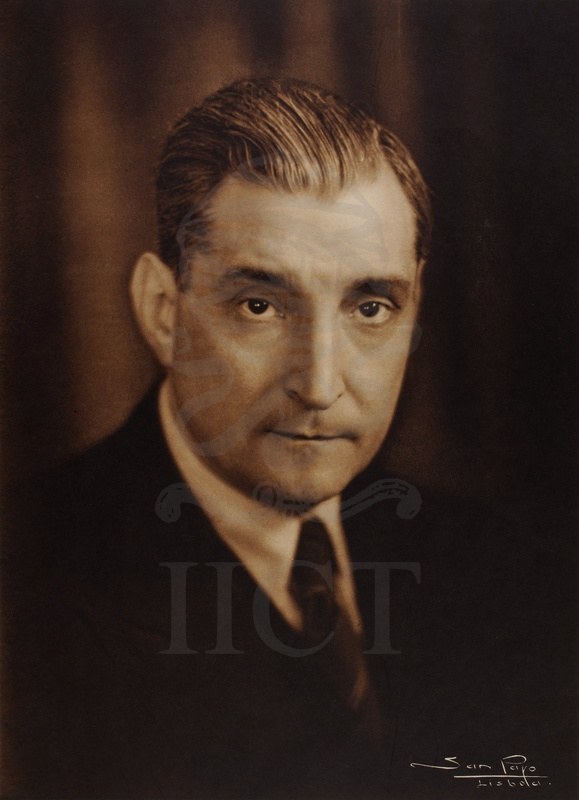
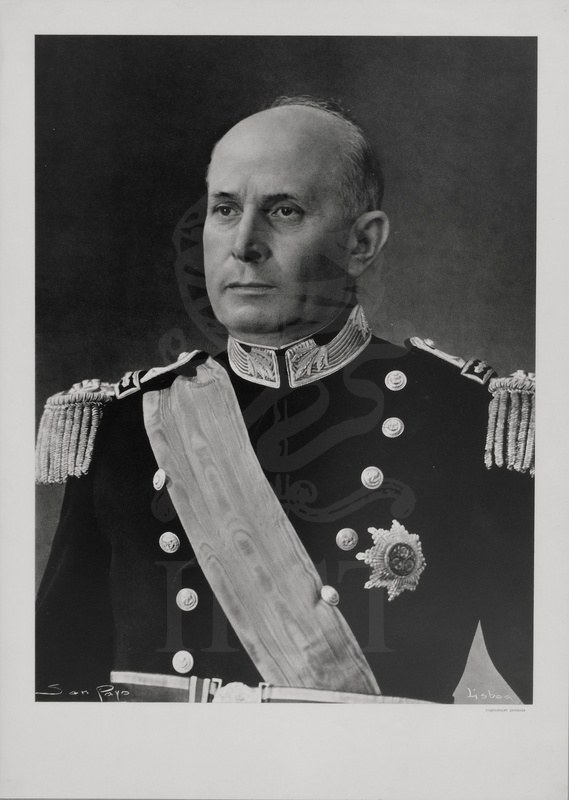
Photo: Manuel Alves de San Payo (signature on the print), Public Domain Mark 1.0 (as stated by the holding institution and Europeana)
António de Oliveira Salazar
President of the Council of Ministers (head of government) · 1932 to 1968
António de Oliveira Salazar: Read more
Coimbra economics professor and Finance Minister from 1928 to 1940; head of government from 5 July 1932 until he was replaced on 27 September 1968, after a fall at home in August; also held the foreign ministry (1936 to 1947), led the single political organisation, the União Nacional, and died on 27 July 1970.
In their words
“Politically only what the public knows exists, exists: ignorance of the realities, the services and the improvements that exist is a cause of discontent, of coldness in souls, of lack of patriotic pride, of absence of confidence and joy of living.”
“We do not discuss God and virtue; we do not discuss the Fatherland and its History; we do not discuss authority and its prestige; we do not discuss the family and its morals; we do not discuss the glory of work and its duty.”
“On various occasions I must have uttered two phrases that complete each other: 'Politically only what is known to exist, exists'; 'politically what seems, is'.”
Leader
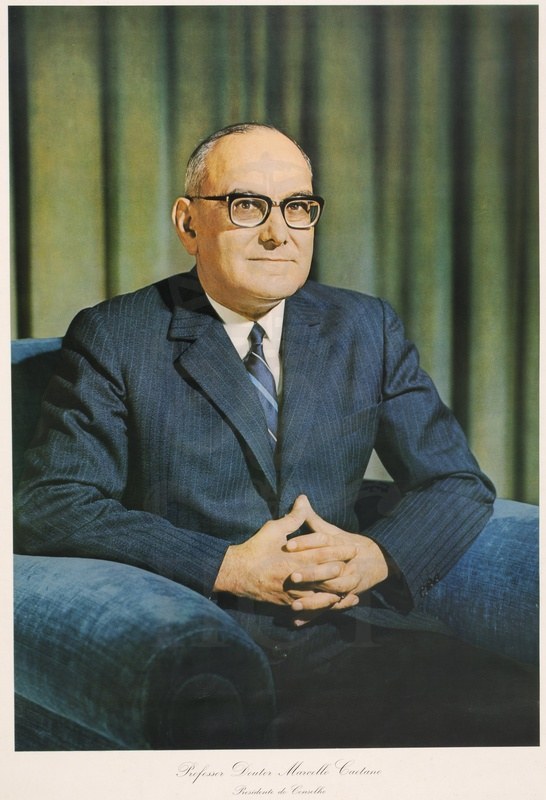
Photo: Unidentified, Public Domain Mark 1.0 (as stated by the holding institution and Europeana)
Marcelo Caetano
President of the Council of Ministers (head of government) · 1968 to 1974
Marcelo Caetano: Read more
Law professor and former Minister of the Colonies (1944 to 1947) and national commissioner of the Mocidade Portuguesa (1940 to 1944); head of government from 27 September 1968 to 25 April 1974, when he surrendered to General Spínola at the Carmo barracks; he died in Rio de Janeiro on 26 October 1980.
In their words
“I found in operation in 1968 the system of censorship of periodicals established in 1926 and regulated by law in 1933. Should I have abolished it? I could never have thought of doing so without publishing a press law.”
“However many instructions were issued, a certain arbitrariness on the part of the censors was never avoided.”
“General, I have to recognise that I am defeated. [...] If the Government has to capitulate, let it be to someone who can answer for public order, and reassure the country.”
Head of state
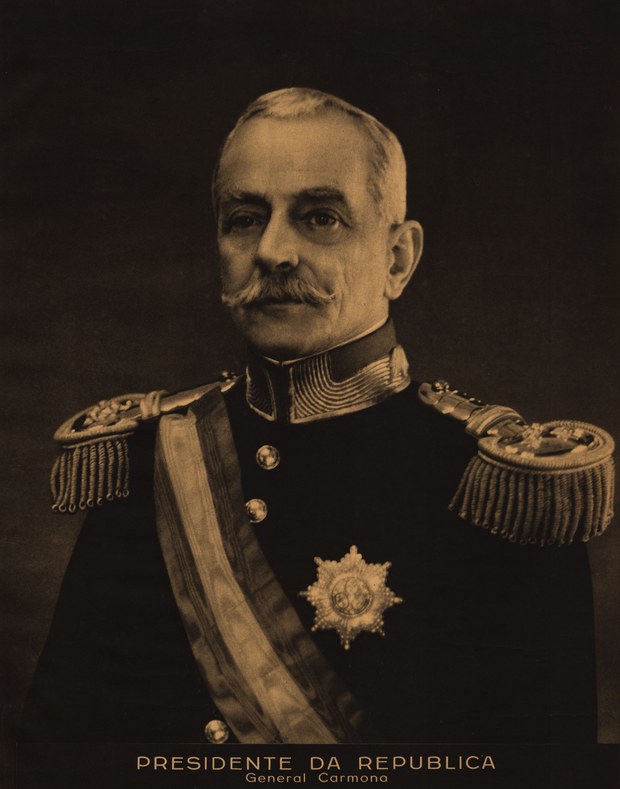
Photo: Unidentified, Public Domain Mark 1.0 (as stated by the Biblioteca Nacional de Portugal and Europeana)
Óscar Carmona
President of the Republic · 1926 to 1951
Óscar Carmona: Read more
Army marshal who became President after the coup of 28 May 1926 and was elected and re-elected until he died in office on 18 April 1951; he appointed Salazar head of government in July 1932.
Photo: Unidentified, Public Domain Mark 1.0 (as stated by the holding institution and Europeana)
Américo Tomás
President of the Republic · 1958 to 1974
Américo Tomás: Read more
Naval officer and Minister of the Navy before taking office as President on 9 August 1958 after the contested election in which Humberto Delgado stood; re-elected by an electoral college in 1965 and 1972, he appointed Caetano in September 1968 and was removed on 25 April 1974.
Propaganda and education
AFNo public-domain or openly licensed portrait cleared. Nearest: source, tagged Public domain on Commons and credited to the Fundação António Quadros, but the file page states no basis for that tag and the photograph is undated.
António Ferro
Director of the Secretariado da Propaganda Nacional, later the Secretariado Nacional da Informação · 1933 to 1949
António Ferro: Read more
Modernist writer and journalist whose 1933 interviews with Salazar were published as a book; ran the state propaganda office from its creation on 25 September 1933 until 1949, through its renaming in 1944, and was then posted to the Portuguese legation in Bern.
ACNo public-domain or openly licensed portrait of him in office found. Nearest: source, a parliamentary-archive portrait that Commons dates to before 1910, so not a likeness from his ministry.
António Carneiro Pacheco
Minister of National Education · 1936 to 1940
António Carneiro Pacheco: Read more
Held the education ministry from 1936 to 1940, the period in which the state youth organisation, the Mocidade Portuguesa, was created by decree-law of 19 May 1936 and made part of schooling.
Security and empire
FDNo public-domain or openly licensed portrait found in a Commons or Europeana search for the name.
Fernando da Silva Pais
Director of the PIDE and, from 1969, of the Direcção-Geral de Segurança (DGS) · 1962 to 1974
Fernando da Silva Pais: Read more
Appointed director of the political police on 6 April 1962 and kept the post when it was renamed DGS in 1969; he stayed in the police headquarters during the coup and surrendered in the early hours of 26 April 1974.
AMNo public-domain or openly licensed portrait cleared. Nearest: source, a 1962 press-conference still from RTP Arquivos tagged Public domain on Commons with no basis stated on the file page.
Adriano Moreira
Minister of the Overseas · 1961 to 1962
Adriano Moreira: Read more
Law and colonial-studies professor who, as minister from 13 April 1961 to 4 December 1962, issued the decree of 6 September 1961 that repealed the Native Statute (Estatuto dos Indígenas) in Angola, Mozambique and Guinea while the war in Angola was under way.
Armed forces
FDNo public-domain or openly licensed portrait cleared. Nearest: source, tagged Public domain on Commons and credited to the Presidency Museum, with no basis stated on the file page and a 1940s date.
Francisco da Costa Gomes
Chief of the General Staff of the Armed Forces · 1972 to 1974
Francisco da Costa Gomes: Read more
Army general who had commanded the forces in Angola and headed the armed forces' general staff from 1972 until Caetano dismissed him on 14 March 1974 after he and his deputy, Spínola, declined to join a show of loyalty; Junta member from 25 April and President of the Republic from 30 September 1974 to 1976.
ADNo public-domain or openly licensed portrait cleared. Nearest: source, credited to Keystone Press under CC BY-SA 3.0 nl on Commons, but the photograph is a press agency's, so the rights holder's licence could not be verified at source.
António de Spínola
Deputy Chief of the General Staff of the Armed Forces · 1973 to 1974
António de Spínola: Read more
General who was governor and commander-in-chief in Guinea from 1968 to 1973, published Portugal e o Futuro on 22 February 1974, was dismissed on 14 March 1974, received Caetano's surrender on 25 April, led the National Salvation Junta and was President of the Republic from 15 May to 30 September 1974.
Background and rise to power
The monarchy fell on 5 October 1910 and the First Republic that replaced it saw frequent changes of government, strikes and coups. A military coup on 28 May 1926 ended it and set up the Ditadura Nacional (National Dictatorship); General Óscar Carmona became President of the Republic on 29 November 1926 and held the office until his death in 1951. António de Oliveira Salazar, a Coimbra professor of economics, joined the first military cabinet as Finance Minister in 1926 and left within days; he returned to the ministry on 27 April 1928 with a veto over other ministries' spending. The Colonial Act of 1930 set out the framework for the overseas territories, and on 30 July 1930 the single political organisation, the União Nacional (National Union), was launched. Carmona made Salazar President of the Council of Ministers on 5 July 1932.
A draft constitution was published in February 1933 and put to a plebiscite on 19 March 1933, in which voters who did not vote were counted as voting yes; the result reported was about 99.5 per cent in favour. The text took effect on 11 April 1933. It described Portugal as a "unitary and corporative republic", gave a President elected by direct vote, a National Assembly and a Corporative Chamber, and made the head of government answerable to the President, not to the Assembly. Salazar's own speeches name the new order the Estado Novo (New State).
How power was organized
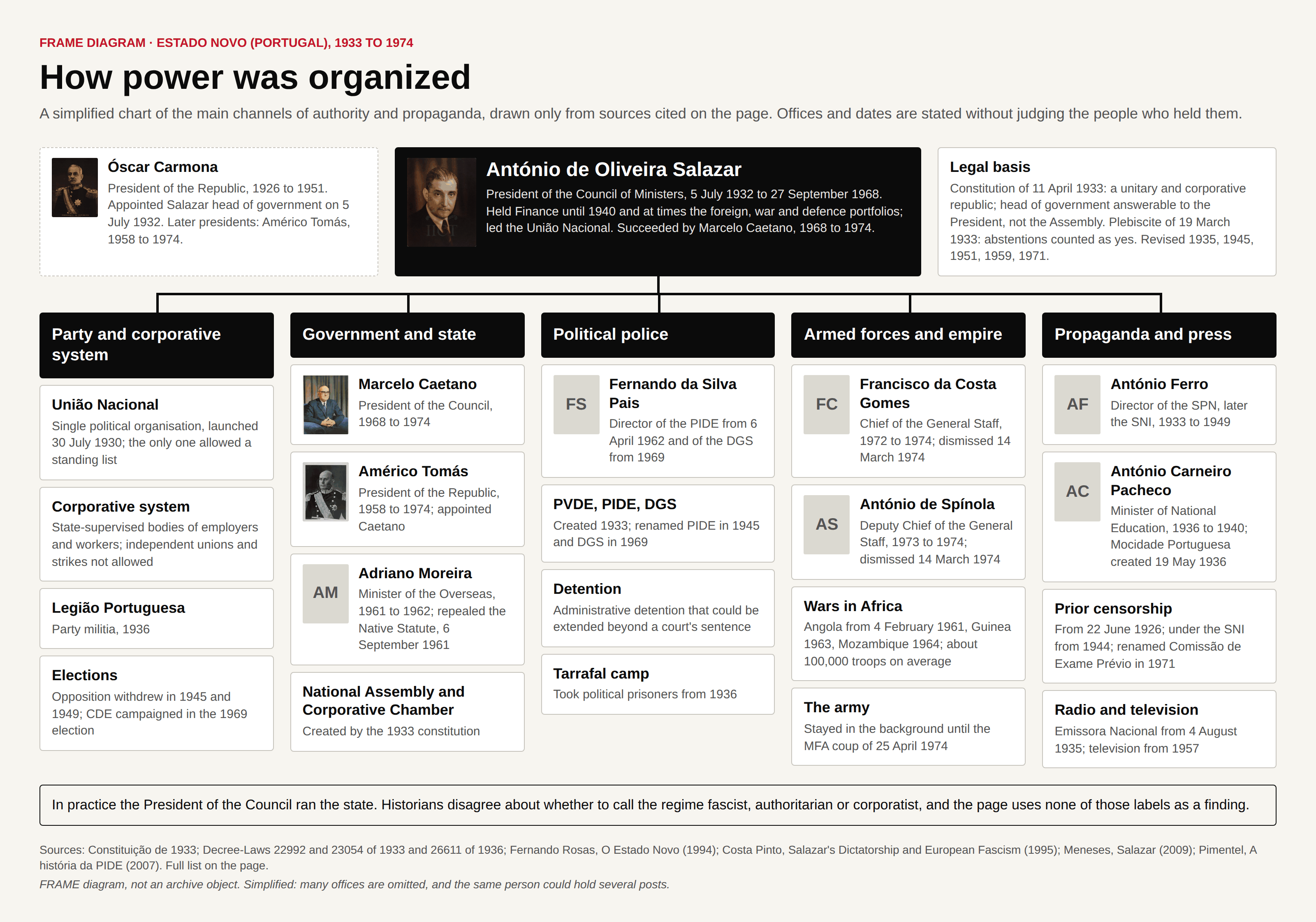
In practice the President of the Council ran the state: Salazar held the Finance Ministry until 1940 and at different times also the foreign, war and defence portfolios. The União Nacional was the only organisation allowed to field a standing list; opposition groups could appear only for the weeks of an election campaign, and in 1945 and 1949 opposition candidates withdrew before polling, citing the conditions of the campaign and the electoral rolls. In the 1958 presidential election the official result was about 76 per cent for Américo Tomás and 24 per cent for General Humberto Delgado; Delgado said the count was falsified. A constitutional revision in 1959 replaced the direct election of the President with an electoral college.
The main offices and channels of authority of the Estado Novo, 1933 to 1974, simplified from the sources cited on this page. Source: FRAME diagram. Portraits, cropped to thumbnails: Instituto de Investigação Científica Tropical (IICT), Arquivo Científico Tropical Digital, Agência Geral do Ultramar collection, AHUD23659, via Europeana; Instituto de Investigação Científica Tropical (IICT), Arquivo Científico Tropical Digital, Agência Geral do Ultramar collection, AHUD23661, via Europeana; Instituto de Investigação Científica Tropical (IICT), Arquivo Científico Tropical Digital, Agência Geral do Ultramar collection, AHUD23663, via Europeana; Biblioteca Nacional de Portugal, Biblioteca Nacional Digital, PURL 6968 (Europeana 10501/bib_rnod_33168), CC BY 4.0 (FRAME archive content); portraits are public domain or CC0: Public Domain Mark 1.0 (as stated by the Biblioteca Nacional de Portugal and Europeana); Public Domain Mark 1.0 (as stated by the holding institution and Europeana).
Employers and workers were organised in state-supervised bodies of a corporative system, and independent trade unions and strikes were not allowed. The political police, created in 1933 as the Polícia de Vigilância e Defesa do Estado (PVDE), was renamed the Polícia Internacional e de Defesa do Estado (PIDE) in 1945 and the Direcção-Geral de Segurança (DGS) in 1969. It used informers, searches, interrogation that included beatings and prolonged sleep deprivation, and administrative detention that could be extended beyond a court's sentence; the camp at Tarrafal in Cape Verde took political prisoners from 1936. PIDE agents killed Delgado near Badajoz in Spain on 13 February 1965. The Legião Portuguesa (1936), a party militia, and the army stayed in the background, while the Church kept a close relationship with the state under the 1940 Concordat.
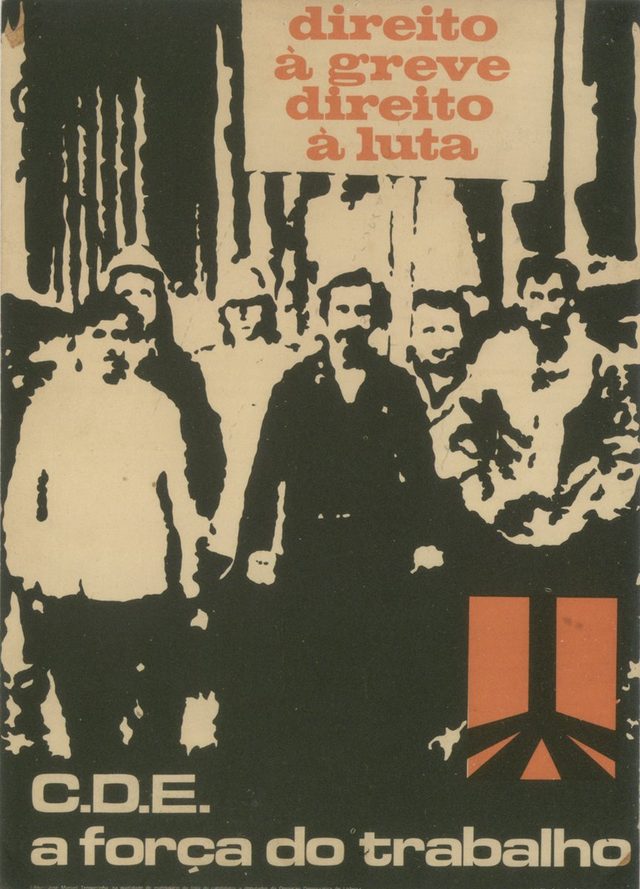
Portugal stayed neutral in the Second World War, joined NATO as a founding member in 1949 and the United Nations in 1955. In 1951 the Colonial Act was written into the constitution and the colonies were renamed "overseas provinces". After insurgencies began in Angola on 4 February 1961, in Guinea in 1963 and in Mozambique in 1964, the state kept an average of about 100,000 troops in Africa for thirteen years; estimates of the Portuguese military dead are around 8,800, and no agreed figure exists for African combatants and civilians killed. In September 1968 Salazar fell at home and, after weeks of incapacity, President Tomás replaced him with Marcelo Caetano, who took office on 27 September 1968. Caetano's first years, called the "Marcellist spring" by contemporaries and later writers, saw some easing of censorship and permission for the opposition electoral coalition, the CDE, to campaign in the National Assembly election of 26 October 1969; the political police became the DGS, the constitution was revised in 1971 to give the overseas provinces more autonomy, and the war continued.
Illustration, not an archive object
The propaganda apparatus
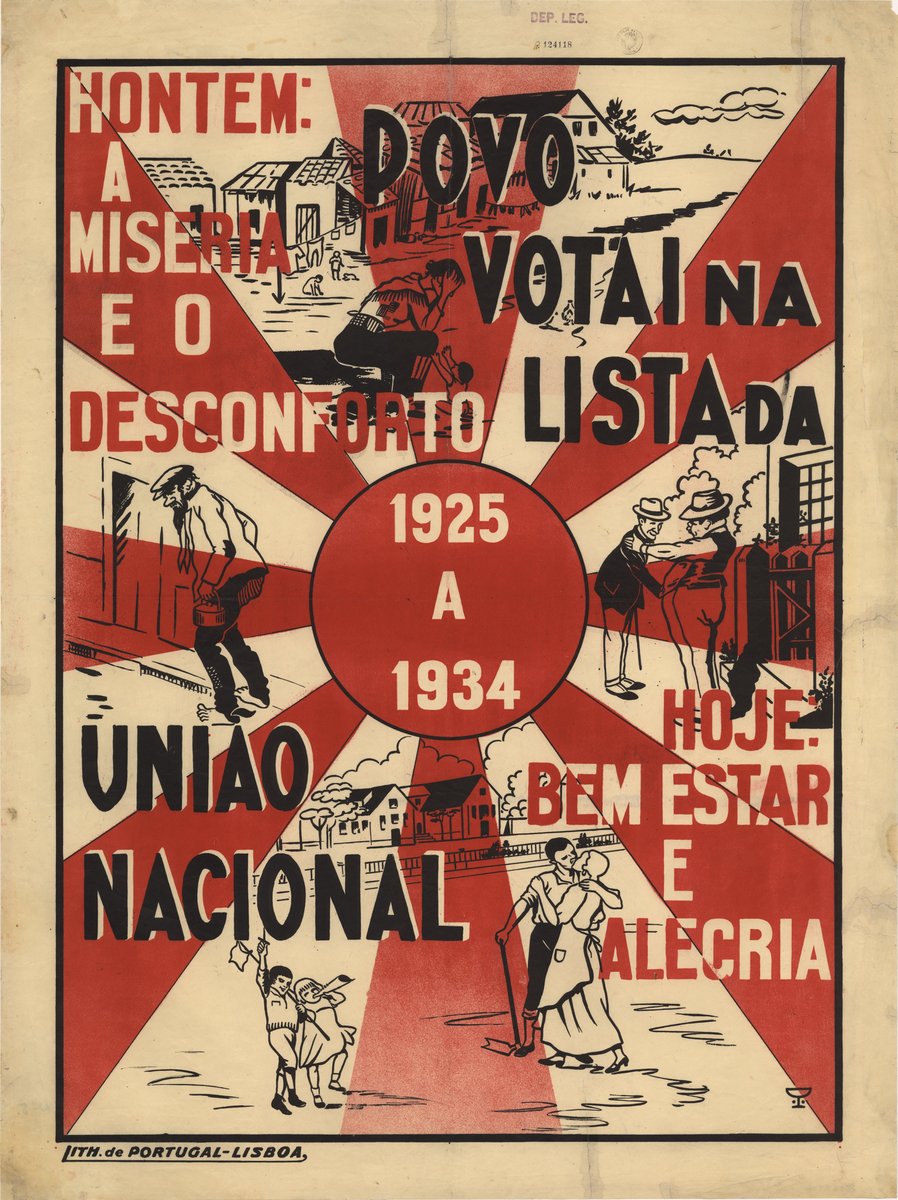
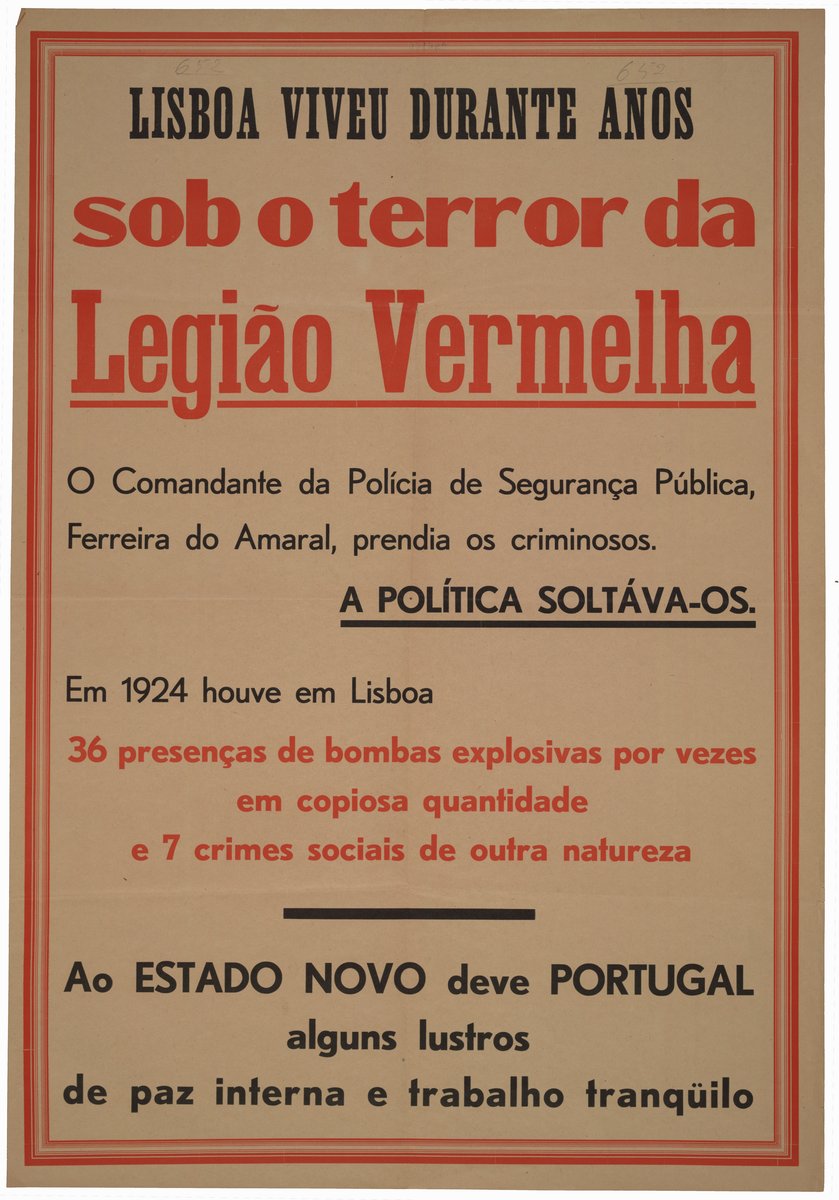
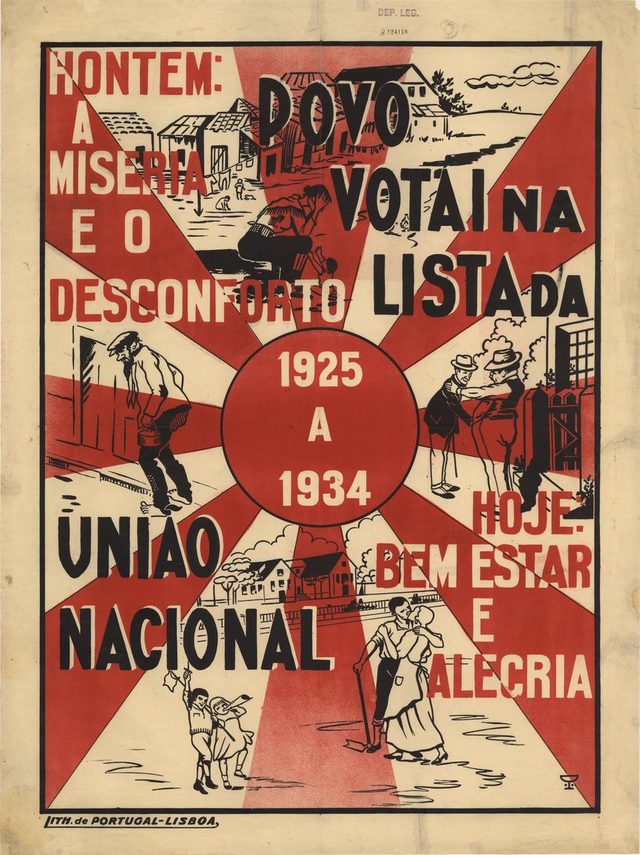
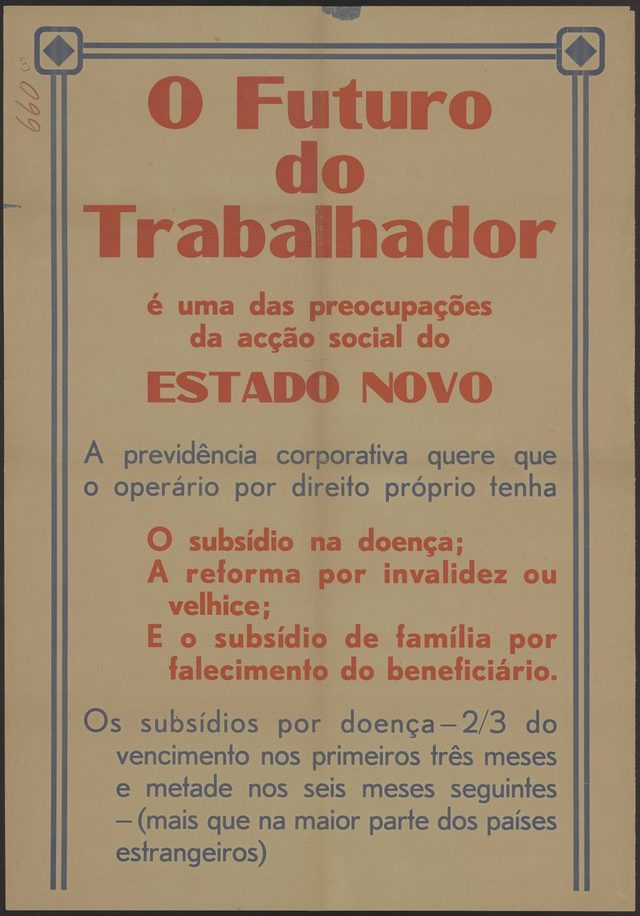
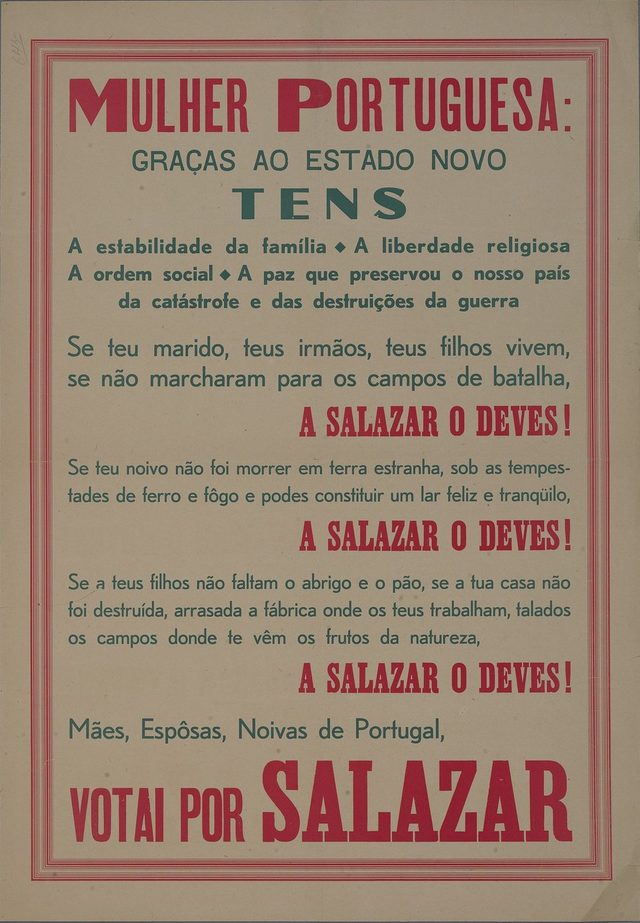
The central office was the Secretariado da Propaganda Nacional (SPN), created on 25 September 1933 under António Ferro, a modernist writer who had published interviews with Salazar earlier that year. At its opening on 26 October 1933 Salazar said that "politically only what the public knows exists, exists", and Ferro called his programme the política do espírito (policy of the spirit). In 1944 the SPN became the Secretariado Nacional da Informação (SNI), and the censorship services were brought under it that year; Ferro remained at the head until 1949. The SPN and SNI made posters, film, exhibitions (including the Exposição do Mundo Português of 1940), travelling cinema, a theatre company and folk-culture programmes. The posters in the archive from the 1930s and 1940s show the office's usual methods: a before-and-after contrast (the 1934 União Nacional election poster is one), a threat from the pre-1926 past, and a list of social benefits compared with "most foreign countries" without a named country.
Prior censorship dated from 22 June 1926 and was confirmed by the 1933 constitution and a decree-law of the same year; every newspaper page was submitted to censors before printing. In 1971 a press law renamed the censorship commission the Comissão de Exame Prévio ("prior examination") and in 1972 a decree-law removed the old "passed by the censor" stamp from published pages. Caetano wrote in 1974 that he had found the system in operation in 1968 and judged that he could not repeal it without a press law while the war lasted; he also wrote that some arbitrariness by the censors was never avoided. The state radio, the Emissora Nacional, began regular broadcasts on 4 August 1935; television began in 1957. Caetano used both for a weekly talk, Conversas em Família, from 8 January 1969.
Schools carried the message to children. The poster series A lição de Salazar (1938), designed by Jaime Martins Barata for the SPN and sent to primary schools, set out the regime's motto Deus, Pátria, Família ("God, Fatherland, Family") in pictures; the National Library of Portugal holds copies and gives no rights statement, so the archive links to it and does not host it. The youth organisation, the Mocidade Portuguesa, was created by decree-law of 19 May 1936 under Education Minister Carneiro Pacheco, and later led by Caetano, with uniforms and a salute. The Fundação Nacional para a Alegria no Trabalho (FNAT), founded in 1935, ran holidays, sports and entertainment for workers. Scholars compare FNAT and the youth organisation with the Italian Dopolavoro and Opera Nazionale Balilla and also note differences, among them that the União Nacional was not a mass party in the Italian sense.
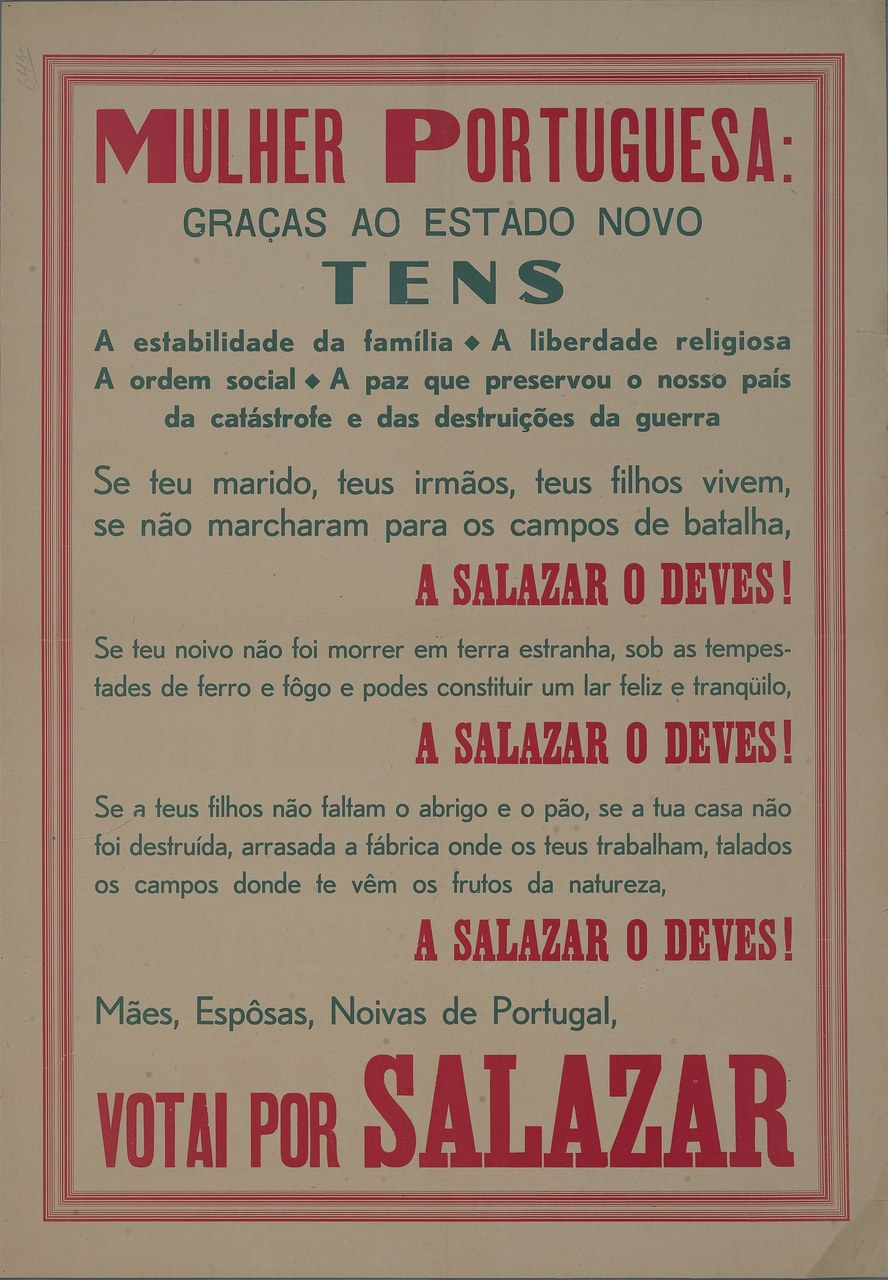
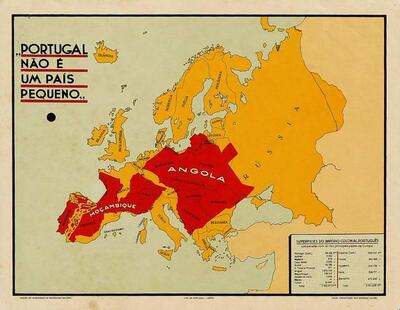
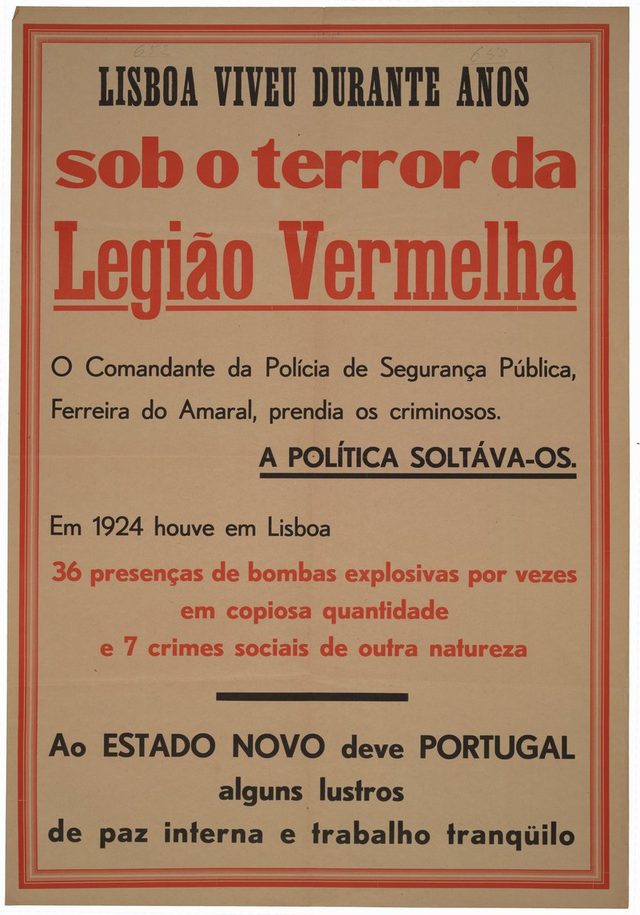
For the empire, the 1934 map Portugal não é um país pequeno ("Portugal is not a small country"), organised by Henrique Galvão, laid the colonies over a map of Europe; the SPN published it. After 1961 the state spoke of "overseas provinces" and of "one nation from Minho to Timor", and Caetano's speeches Razões da presença de Portugal no Ultramar ("Reasons for Portugal's presence overseas") were catalogued in Portuguese, French, Spanish, German and English editions between 1970 and 1973. The archive's definitions fit most clearly: manufactured consensus (the plebiscite of 1933 and single-list elections), card stacking (the before-and-after posters and the area comparison of the map), identity fusion ("A Salazar o deves!"), glittering generalities ("peace, order, family"), euphemism ("overseas provinces", "prior examination", "General Directorate of Security") and fear appeal (the 1936 poster on the Red Legion).
Timeline
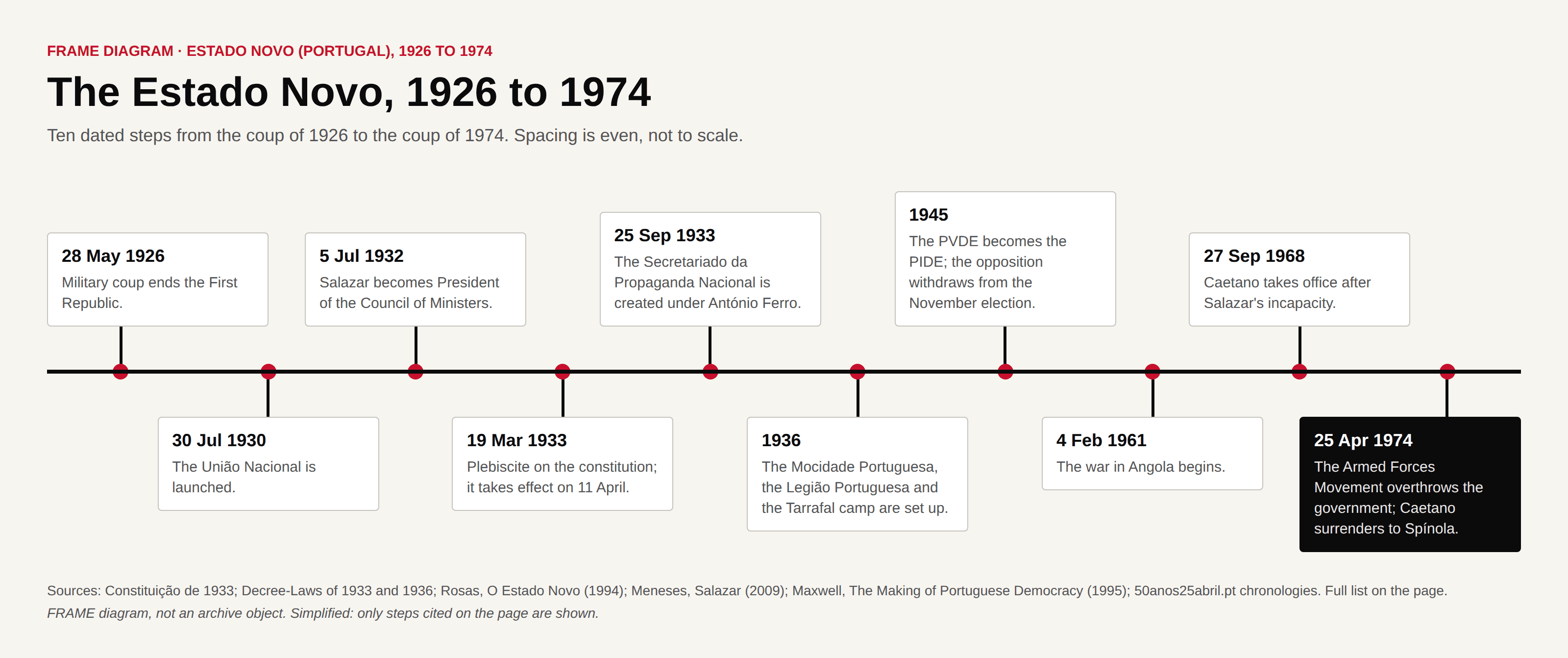
28 May 1926: military coup ends the First Republic.
27 April 1928: Salazar returns to the Finance Ministry.
30 July 1930: the União Nacional is launched.
5 July 1932: Salazar becomes President of the Council of Ministers.
19 March 1933: plebiscite on the constitution; it takes effect on 11 April.
25 September 1933: the Secretariado da Propaganda Nacional is created under António Ferro.
1935: the Emissora Nacional starts regular broadcasts; the FNAT is founded.
1936: the Mocidade Portuguesa, the Legião Portuguesa and the Tarrafal camp are set up.
1938: the Lição de Salazar poster series goes to schools.
1939 to 1945: Portugal stays neutral in the Second World War.
1944: the SPN becomes the SNI.
1945: the PVDE becomes the PIDE; the opposition withdraws from the November election.
1949: Portugal is a founding member of NATO; Ferro leaves the SNI.
1958: Tomás is elected President over Humberto Delgado.
4 February 1961: the war in Angola begins.
13 February 1965: Delgado is killed near the Spanish border.
27 September 1968: Caetano takes office after Salazar's incapacity.
1969: the PIDE becomes the DGS; the CDE campaigns in the October election.
27 July 1970: Salazar dies.
22 February to 14 March 1974: Spínola's book appears; he and Costa Gomes are dismissed; a rising at Caldas da Rainha fails.
25 April 1974: the Armed Forces Movement overthrows the government.
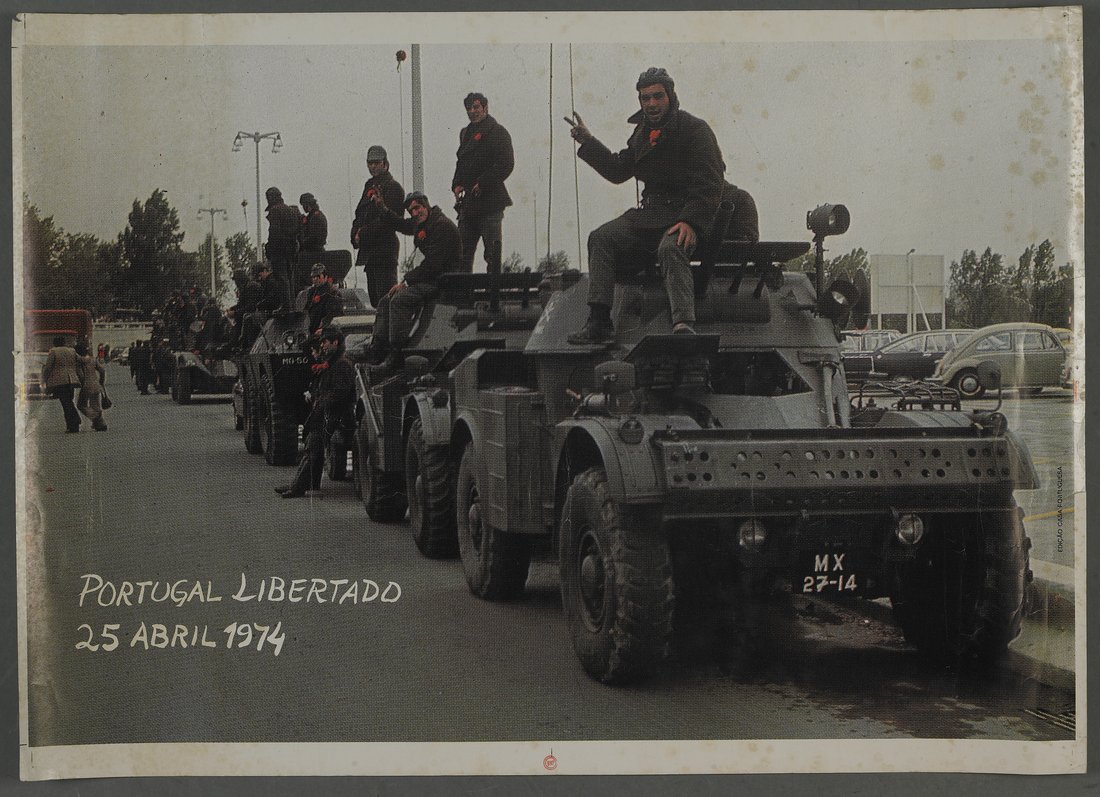
A poster printed in 1974 from a photograph of armoured cars and soldiers with red carnations, on the day Caetano surrendered. Source: Biblioteca Nacional de Portugal, Biblioteca Nacional Digital, PURL 37344 (Europeana 10501/bib_rnod_292336), Public Domain Mark 1.0, as stated by the Biblioteca Nacional de Portugal and Europeana.
Ten dated steps of the Estado Novo, 1926 to 1974, simplified from the sources cited on this page. Source: FRAME diagram, drawn from the sources listed on this page, CC BY 4.0 (FRAME archive content).
How it ended
Officers of the Movimento das Forças Armadas (MFA), a group of mid-ranking officers who had organised from September 1973 over pay, promotion and the war, planned the coup of 25 April 1974. At 22:55 on 24 April a radio station played the song E depois do adeus as the first signal and at 00:20 on 25 April another played Grândola, Vila Morena as the second. Units took the radio stations, the airport and the main ministries in Lisbon. Captain Salgueiro Maia's column surrounded the Carmo barracks of the National Republican Guard, where Caetano had taken refuge. In the afternoon Caetano surrendered, telling the officers he would yield only to General Spínola, who could answer for public order. Outside the political police headquarters in Lisbon, agents fired on the crowd, and four people were killed (some accounts count five). Silva Pais surrendered the next morning. Caetano, Tomás and other ministers were flown to Madeira under guard and then left for Brazil; Caetano lived in Rio de Janeiro until his death on 26 October 1980.
The MFA programme called for democratisation, decolonisation and development. The National Salvation Junta, under Spínola, ended prior censorship at once and the political police was dissolved. Spínola became President on 15 May 1974 and resigned on 30 September 1974; General Costa Gomes succeeded him. Guinea-Bissau was recognised as independent in September 1974, Mozambique became independent on 25 June 1975, and Angola on 11 November 1975. A new constitution replaced the 1933 text on 2 April 1976. The photograph of armoured cars with red carnations on the soldiers' uniforms, printed as a poster in 1974, is a widely reproduced image of the day.
Same-standard note
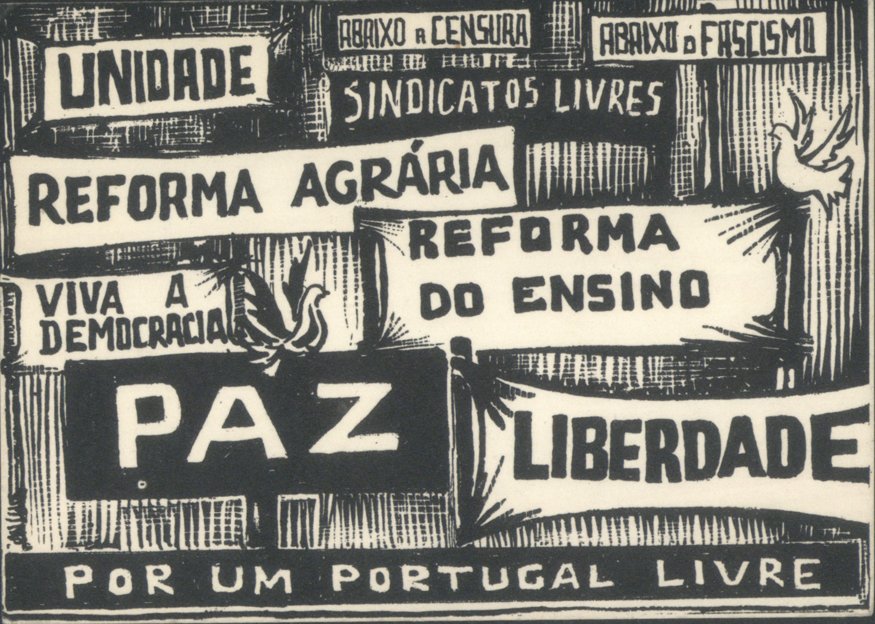
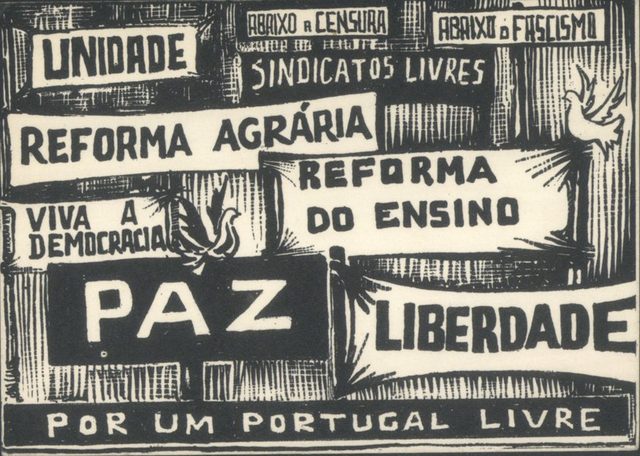
This page uses the same structure and definitions as every other regime page: a technique is listed only where the working definition and a documented example fit, the same ids are applied to every regime, and offices and dates are stated without judging the people who held them. The scale and purpose of what this state did are set out as history, not ranked: a regime that lasted forty-one years under one constitution, with a political police, prisons and a colonial war, with the figures and their sources given in the sections above. Historians disagree about whether to call it fascist, authoritarian or corporatist; this page uses none of those labels as a finding. The opposition posters in the archive (1969 election) are entered under the same rule as official ones, and their wording, including "fascism", is the issuers' own.
Sources
Constituição Política da República Portuguesa, 1933 (as in force 1933, revised 1935, 1945, 1951, 1959, 1971); Decree-Law no. 22992 of 29 August 1933 (PVDE); Decree-Law no. 23054 of 25 September 1933 (SPN); Decree-Law no. 26611 of 19 May 1936 (Mocidade Portuguesa); Law no. 5/71 (press law, 1971); Decree-Law no. 150/72 (censorship, 1972).
António de Oliveira Salazar, Discursos e Notas Políticas, vols. 1 to 3 (Coimbra Editora): speech at the inauguration of the SPN, 26 October 1933 (vol. 1); speech at Braga, 26 May 1936 (vol. 2); speech to the União Nacional commissions of Lisbon, 26 February 1940 (vol. 3). Digitised at the Internet Archive and at the Fundação Oliveira Salazar site.
Marcello Caetano, Depoimento (Record, Rio de Janeiro, 1974), on censorship and on the surrender of 25 April 1974.
Museu da Imprensa, "Galeria virtual da censura", chronology of censorship, 1926 to 1974.
Biblioteca Nacional de Portugal, Biblioteca Nacional Digital, records of the posters and map cited (PURLs 22317, 22326, 22330, 22601, 23497, 41145, 38397, 37674, 37344 and Europeana record 10501/bib_rnod_272266); Arquivo Científico Tropical Digital (IICT) portrait records.
Fernando Rosas, O Estado Novo (1926 to 1974), vol. 7 of História de Portugal (Círculo de Leitores, 1994); Fernando Rosas and J. M. Brandão de Brito (eds.), Dicionário de História do Estado Novo (Bertrand, 1996).
António Costa Pinto, Salazar's Dictatorship and European Fascism (Social Science Monographs, 1995); Filipe Ribeiro de Meneses, Salazar: A Political Biography (Enigma Books, 2009); Kenneth Maxwell, The Making of Portuguese Democracy (Cambridge University Press, 1995).
Irene Flunser Pimentel, A história da PIDE (Círculo de Leitores, 2007); Luís Reis Torgal, Estados Novos, Estado Novo (Imprensa da Universidade de Coimbra, 2009).
John P. Cann, Counterinsurgency in Africa: The Portuguese Way of War, 1961 to 1974 (Greenwood, 1997); Norrie MacQueen, The Decolonization of Portuguese Africa (Longman, 1997).
Comissão Comemorativa dos 50 Anos do 25 de Abril, "Prisões da ditadura" and "25 de Abril" chronologies (50anos25abril.pt).

.png)
.png)

.png)