- Actor
- No single organisation. The record shows several distinct clusters: a network Facebook linked to Nic Gabunada, social media manager of Rodrigo Duterte's 2016 campaign; Pages and accounts Facebook linked to the Philippine military and police; a network Facebook linked to individuals in Fujian, China, that praised the Duterte family; accounts Twitter suspended in January 2022 that Rappler tied to supporters of Ferdinand Marcos Jr.; and the advertising and PR strategists, influencer-page owners and fake-account operators that Ong and Cabañes interviewed, who they say served clients "across the political spectrum"
- Target
- Filipino users of Facebook, Instagram and Twitter, and voters in the 2016, 2019 and 2022 elections; critics of the Duterte administration, including journalists, lawmakers and activists
- Source
- Unidentified gray to black (contractor chains and undisclosed paid influencer pages are gray; pages posing as independent citizens and fake-account networks that platforms attributed to a campaign operator, security forces and a foreign source are black; open state channels are white)
- Techniques
- AstroturfingManufactured consensusNarrative launderingName-callingFear appeal
- First seen
- January 2014 (first ad in the network Facebook later linked to Gabunada); wider reporting from October 2016; platform actions 2019 to 2022
- Status
- last platform action reviewed January 21, 2022 (Twitter suspensions of a pro-Marcos Jr. network, which the campaign disputed); earlier Facebook removals March 28, 2019 and September 22, 2020; the industry described by researchers has no end date
- Related briefs
- none
Mechanism
This is a sector, not one operation. In fieldwork from December 2016 to December 2017, Jonathan Corpus Ong and Jason Vincent Cabañes interviewed 20 people who worked in Philippine digital campaigns and described a three-tier structure (Table 1, p. 21). Six were senior advertising and PR strategists at "boutique" agencies who ran the budget, wrote the communication plan and hired the rest. Five ran anonymous influencer accounts with 50,000 to 2,000,000 followers, with no disclosure of paid content to followers. Nine were community-level fake-account operators who reposted the influencers' messages to create "illusions of engagement." That is Astroturfing: rented crowds presented as spontaneous ones. The strategists' vocabulary ("influencer collaboration," "message scheduling") reframed "click armies" as ordinary marketing (p. 40), which is Narrative laundering in the researchers' account of how the work was made respectable.
Two findings cut against a simple story. The authors set out to test the idea of outsourced "digital sweatshop" political work and report they "failed to deliver evidence" for it (p. 15). They also found operators "working with clients across the political spectrum" (p. 29). They name no clients. A 2019 follow-up for the NATO Strategic Communications Centre of Excellence adds that "both administration and opposition candidates mobilised their click armies" in the May 2019 midterms, and sorts the work into four models: in-house staff, advertising and PR, clickbait and state-sponsored. The clickbait firm it profiles, Twinmark, was "primarily driven by advertising profit rather than by political ideology," though its pro-Duterte content sold well in 2016.
The platform record adds clusters with attributions. Manufactured consensus is the documented effect: many accounts, one source. Name-calling appears in the military-linked pages, which the DFRLab said engaged in red-tagging, branding lawmakers and activists as communist sympathizers or terrorists, "usually sans evidence." Fear appeal appears in the same pages' sample posts, for example "Stairway to death" captions on joining the CPP-NPA-NDF (Meta).
Differences in scale and kind matter. The Gabunada network was run by a campaign operator and drew about $59,000 in ad spending. The 2020 Philippine network is the only cluster here that Facebook tied to state security forces. The China-origin network had about $60 in ad spending and focused on the Philippines and Southeast Asia, with praise for Imee Marcos and Sara Duterte among its content. The Twitter accounts were suspended for manipulation and spam, and Twitter's reported statement named no source. The record is thicker for pro-Duterte and pro-government clusters because that is where takedowns and reporting have concentrated. No platform attribution reviewed here names an opposition network. That is a gap in the record, not proof that none existed.
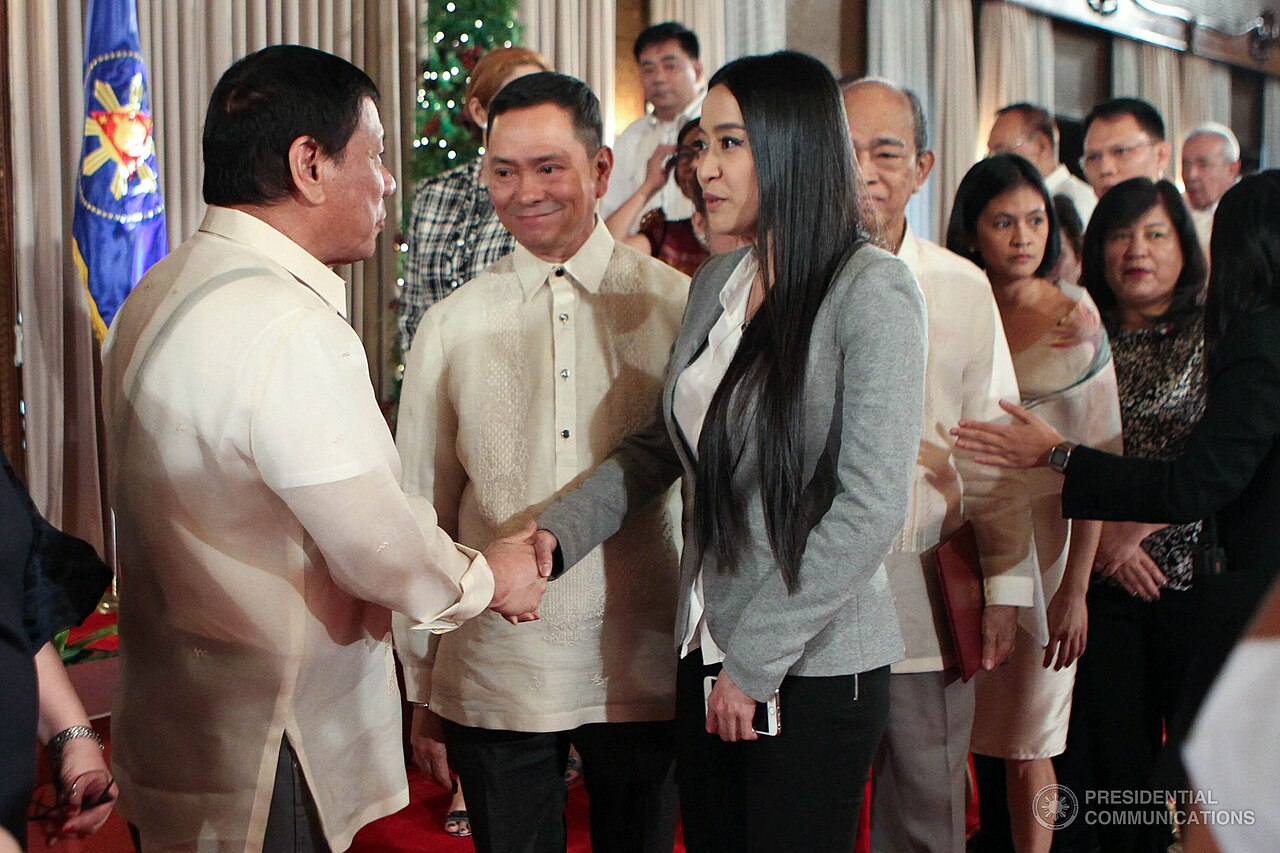
9 January 2017. Duterte greets Mocha Uson, a pro-Duterte blogger newly appointed to the film and television review board; later in 2017 she was a Presidential Communications assistant secretary. Photo by Robinson Niñal, Presidential Communications Operations Office. Public domain (PD-PhilippinesGov), via Wikimedia Commons.
Evidence
- 2014-01. First ad in the network that Facebook removed on March 28, 2019: 67 Pages, 68 accounts, 40 Groups and 25 Instagram accounts "linked to a network organized by Nic Gabunada"; about 3.6 million accounts followed a Page and about $59,000 was spent. Facebook says the operators used "a combination of authentic and fake accounts." Meta. BuzzFeed reports that Gabunada had described the engagement as organic and volunteer-driven and said the campaign bought no Facebook ads. BuzzFeed News
- 2016-10. Rappler publishes Maria Ressa's series "Propaganda war: Weaponizing the internet" on social-media propaganda. Ressa later writes that "26 fake accounts on Facebook could reach up to 3 million others," that she then received about 90 hate messages an hour, and that an #UnfollowRappler campaign followed. The series page returned an access error in this review, so the figures come from her 2019 account. TIME, 17 January 2019
- 2016-11. Ong and Cabañes observe the #IlibingNa campaign for the Marcos burial, with healing and unity messages, and a caption calling Vice President Leni Robredo "crazy and insane" that drew 28,624 shares and abusive comments. The same report shows anti-Duterte memes and misogynous attacks on Uson, so abusive content ran against both camps. Ong and Cabañes, 2018
- January 4, 2017. The New Republic reports a $200,000 budget for Duterte's social media operation, Gabunada's role, a mix of paid and unpaid supporters, and a spokesman thanking 14 million social media volunteers after the win. New Republic
- 2017. Oxford's Project on Computational Propaganda lists the Philippines with cyber troops from 2016, a budget of 200,000 (USD) and 400 to 500 staff, citing press reports rather than primary records. Bradshaw and Howard, working paper 2017.12. A 2019 edition exists; it could not be opened here.
- 2017-08. Global Voices reports that Duterte, at a press conference, acknowledged paying online "defenders" during the election, said he no longer needs them and dismissed the Oxford study. A spokesman for his party says it never hired or used online trolls. Global Voices
- 2018-04. The National Privacy Commission probes Facebook over Cambridge Analytica data on "more than a million users in the Philippines." Duterte denies that his campaign worked with the firm. No document reviewed shows Cambridge Analytica or SCL work in the Philippines, so it is not counted here. VOA
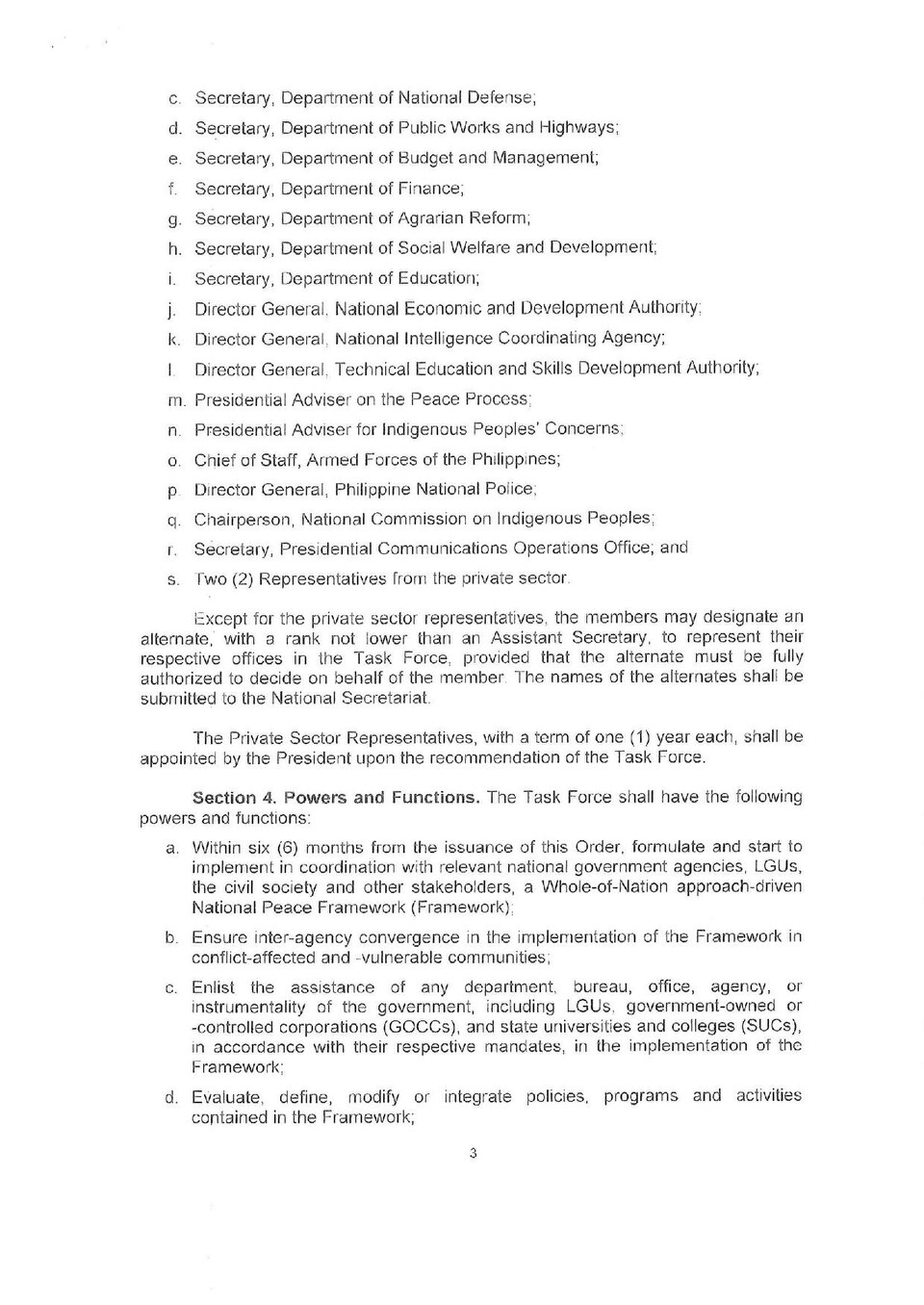
- December 4, 2018. Executive Order 70 creates the National Task Force to End Local Communist Armed Conflict, chaired by the President, with the AFP chief of staff, the PNP director general and the Presidential Communications secretary among its members. It is an open, attributed state body on the same subject as the covert pages, and it is not shown to be linked to them. Official text via Commons
4 December 2018. Page 3 of Executive Order No. 70, s. 2018, listing the task force's members. Government of the Philippines, Official Gazette. Public domain (PD-PhilippinesGov), via Wikimedia Commons.
- 2019-11. The NATO StratCom COE report, drawing on three years of fieldwork, quotes a Facebook executive calling the Philippines "patient zero" and reports that Facebook removed Twinmark's 220 Pages, 73 accounts and 29 Instagram accounts before the 2019 campaign. Ong and Cabañes, 2019
- September 22, 2020. Facebook removes two networks. The China-origin one: 155 accounts, 11 Pages, 9 Groups, 6 Instagram accounts, "links to individuals in the Fujian province of China." The Philippine one: announced as 57 accounts, 31 Pages and 20 Instagram accounts, updated on October 12, 2020 to 64, 32 and 33, with "links to Philippine military and Philippine police." Nathaniel Gleicher's post says enforcement is on "behavior rather than content, no matter who's behind them." Meta; original counts in The Diplomat
- September 22, 2020. DFRLab: the Philippine pages were created from August 2015 to August 2020, posted 5,548 times, and included "Hands Off Our Children," whose About page called it "a group of mother (sic) fighting against terrorist recruitment." Alexandre Cabales, Chief of the Army Social Media Center, administered a private group linked to that page and was the registered owner of Kalinaw News, the Army's openly affiliated outlet, which the pages amplified and which was not removed. DFRLab says the movement "may be more closely linked" to the Army's Civil-Military Operations Regiment "than it publicly lets on." DFRLab
- 2020-09. Graphika finds the China-origin network began posting on the Philippines in early 2018, made about 30 accounts on Imee Marcos in March and April 2019, and drew about 1.6 million interactions across 2016 to 2020. Graphika, Operation Naval Gazing
- September 28, 2020. Duterte tells Facebook it cannot "bar or prevent me from espousing the objectives of government." Spokesman Harry Roque calls the takedown "a form of censorship" and says the government is "not conceding these are fake accounts." The Diplomat
- January 21, 2022. Twitter suspends over 300 accounts after reviewing accounts in a Rappler story on pro-Marcos Jr. activity. Campaign spokesman Vic Rodriguez says "there is no certainty that all of them belong to the supporters of Bongbong Marcos." Philstar
- April 7, 2022. Meta's Q1 report describes spam networks exploiting election interest and a website-defacement network, with no political attribution. Meta
Sides on the record
- Duterte and allies: volunteers, or the government's right to explain its policy; the Palace called the 2020 removal censorship.
- Marcos Jr. campaign: the suspended accounts were not shown to be its supporters. The 2022 record is also in Marcos's martial law: the 'New Society' and the online contest over its memory.
- Independent media and opposition: Ressa and Rappler reported and were themselves targeted. Ong and Cabañes footnote a critique that mainstream watchdog campaigns were selective about partisan pages, and note that many vocal Duterte supporters are real citizens with real grievances.
- Operators: none of the informants called themselves trolls; each pushed responsibility elsewhere.
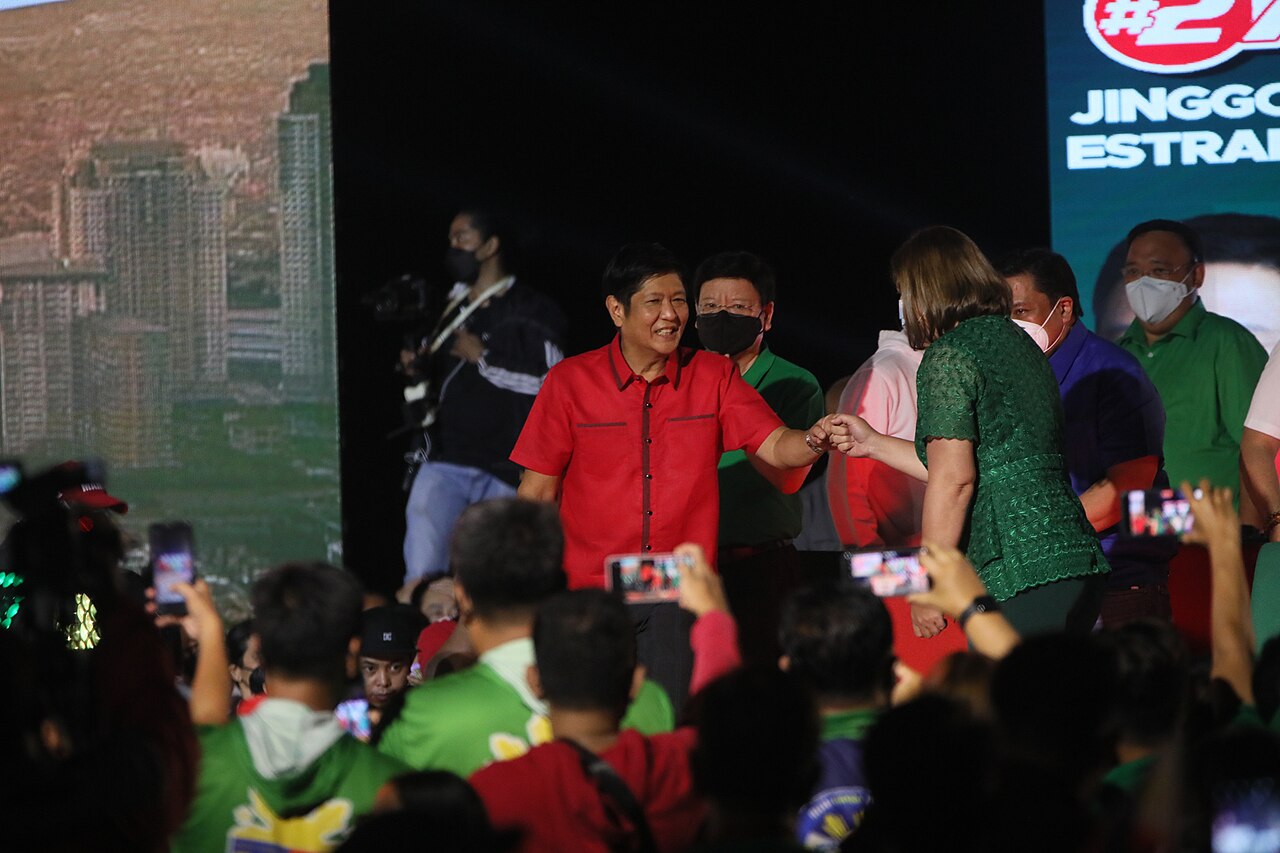
8 February 2022. Ferdinand Marcos Jr. and Sara Duterte at the UniTeam proclamation rally, Philippine Arena, Bulacan. Philippine News Agency photo by Avito Dalan. Public domain (PD-PhilippinesGov), via Wikimedia Commons.
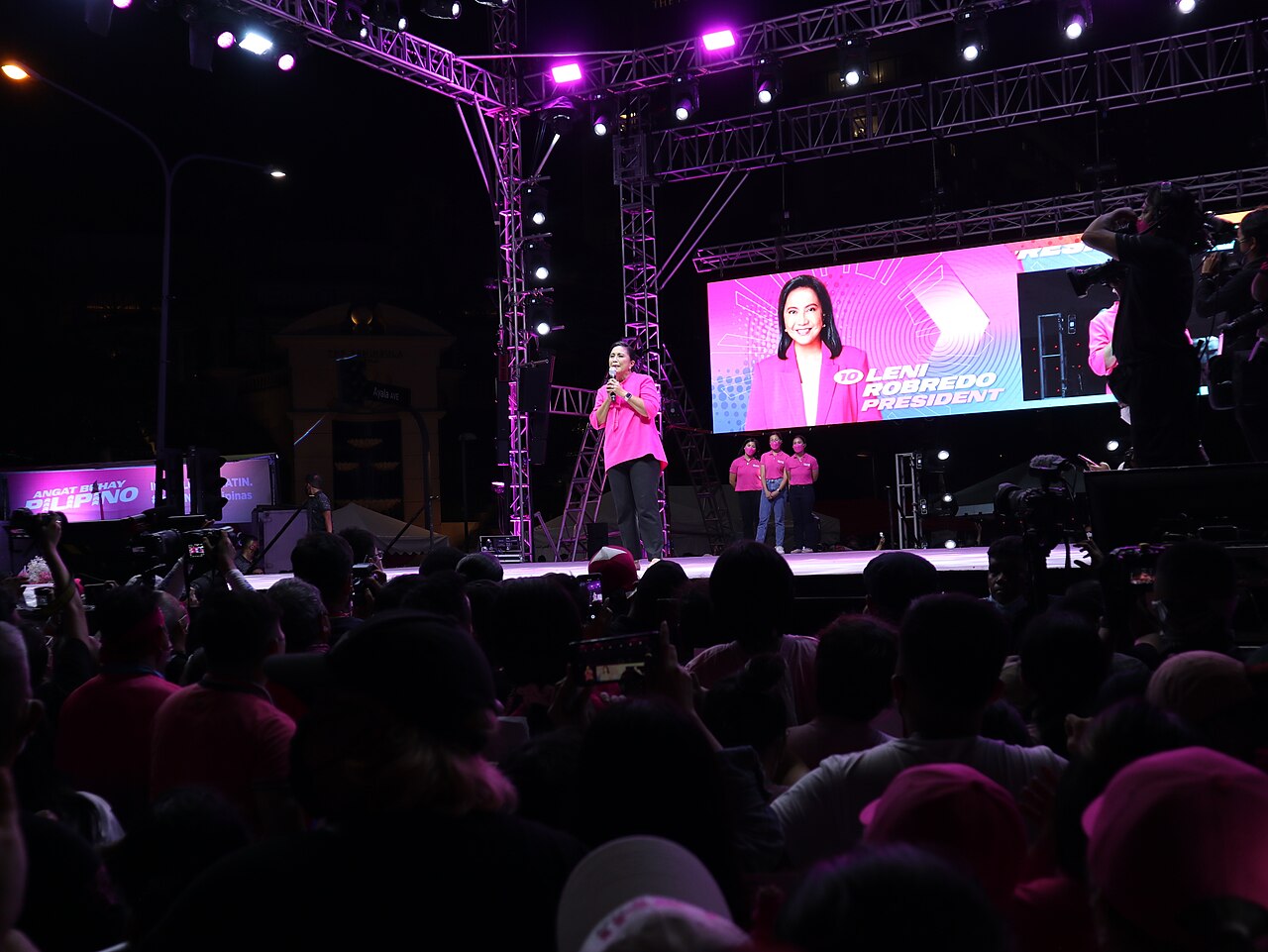
7 May 2022. Leni Robredo at the closing rally of the Robredo-Pangilinan campaign, Makati. Photo by Patrickroque01, CC BY-SA 4.0, via Wikimedia Commons. Both rally photos show open, attributed campaign events and are context only, not evidence of any network.
What would falsify this read
Platform or court records showing the Gabunada, military-police, China-origin or 2022 Twitter clusters were mislabelled, for instance that the accounts were real volunteers. Documents showing the Oxford budget and staff figures came from nothing more than one unverified press claim. Evidence that the "across the spectrum" finding meant hiring on one side only, or that opposition campaigns ran no paid networks in 2016 to 2022. Or a platform attribution of a network linked to an opposition campaign, which would add a cluster and would not change the method score.
Literacy counter
Score the method, not the camp. Check who runs a Page, when it was created and whether its posts move in the same minute. An "independent" parents' group or fan account with no disclosed backers earns a check whichever side it favours. Distinguish open channels (Kalinaw News, a ministry, a campaign page) from concealed ones. Treat a headline number as an estimate: the Philippine takedown was first reported at 57 accounts and later revised to 64. Read platform attributions for what they claim: "links to" is not "directed by." Compare fact-checkers' tallies for all candidates, and see Platform interventions: labels, nudges, notes, friction and takedowns, Fact-checking and corrections and Social proof. For the same mechanism elsewhere, see Facebook's April 2019 takedowns in India: a Congress IT cell, a BJP-linked IT firm and a Pakistani military network and Internet Research Agency (Russian operation aimed at US audiences, 2014 to 2018); the IRA differs in being foreign to its audience, while most of these clusters were domestic.