- Actor
- South African Department of Information (Minister Connie Mulder, Secretary Eschel Rhoodie), paid through the Bureau for State Security (General Hendrik van den Bergh) and the Defence Special Account, with the knowledge of Prime Minister B.J. Vorster and a small cabinet committee
- Target
- Foreign opinion-formers, legislators and newspaper readers (Britain, the United States, Western Europe); the English-language South African press and its readers; black South African readers
- Source
- Unidentified gray to black (gray where the Department spoke as itself; black where the state's ownership of *The Citizen* and the membership of its advertising fronts were denied, in one case to Parliament)
- Techniques
- Narrative launderingAstroturfingCard stackingDisclosure theater
- First seen
- 1971 (To the Point magazine); programme 1972-1978; secret fund from April 1974; The Citizen launched 7 September 1976; exposed October-November 1978
- Status
- closed June 4, 1979 (Vorster resigned as State President after the second Erasmus report; the Department had been dissolved in 1978); The Citizen still publishes, under other owners
- Related briefs
- none
Case-study narrative and the ANC's Radio Freedom material: South Africa's information war: the apartheid state's secret projects and the ANC's Radio Freedom. The censorship that ran alongside it: Apartheid South Africa's banned organisations, persons and publications.
Mechanism
From 1972 the Department of Information ran about 180 projects, at a cost given as R65 to R85 million (Haasbroek, 2016). SAHO gives R64 million moved from defence. The money came from the Defence Special Account, which is shielded from parliamentary scrutiny, and was passed to the Department through the Bureau for State Security from 1 April 1974; the Auditor-General's office was told not to audit it (Haasbroek). An informal cabinet committee of Vorster, Mulder and the finance minister approved it. Defence Minister P.W. Botha objected in writing to the arrangement in June 1976 but accepted it on the Prime Minister's instruction.
The government's stated purpose was defensive. Rhoodie argued in The Paper Curtain (1969) that foreign media denied South Africa a hearing and applied double standards. The Department's 1977 annual report called the UN's "International Anti-Apartheid Year" for 1978 "the worst period of anti-South African publicity and hostility in the country's history". Rhoodie cited the sports boycotts, campaigns against oil and arms trade, UN broadcasts into South Africa and a communist "Kremlin's blueprint" for the region. Rhoodie wrote that secret operations were "a moral imperative" (as quoted in Haasbroek). On 5 May 1978 he said the Department had for years been "asked by the government to undertake sensitive and even highly secret operations as counteraction to the propaganda war being waged against South Africa".
The method was to hide the source. Narrative laundering: The Citizen, an English daily launched under the businessman Louis Luyt, was paid for from the secret fund and presented as independent. Its first editors were not told. To the Point, a news magazine set up with a Dutch publisher, was subsidised in secret. The American publisher John McGoff received more than $11.3 million to try to buy the Washington Star and an interest in the UPITN television news agency. Astroturfing: the Club of Ten placed full-page advertisements in British, American and other papers as if from a group of businessmen; its texts were written in South Africa and passed through one man, Gerald Sparrow. The Committee for Fairness in Sport, the Foreign Affairs Association and the South African Freedom Foundation worked the same way. Card stacking: Rhoodie's plan called for large volumes of favourable material to reach opinion-formers. John Laurence, who advised the UN in 1972, listed half-truths and omissions as the commonest techniques of South African official propaganda (as summarised by Haasbroek; his analysis predates the secret fund). Disclosure theater: when the British Foreign Office pressed the Club of Ten in 1974, Sparrow named wealthy South African sponsors and one handed over a R50,000 cheque in public. The money came from the Department's secret funds, with some of his own added, according to Haasbroek.
Testimonial is not tagged. The programme planned to bring foreign visitors to South Africa as an "informed corps", but the sources opened here do not show paid endorsements passed off as spontaneous.
Actor-agnostic note: the The Congress for Cultural Freedom: a CIA-funded intellectuals' network, 1950-1967 (CIA money, magazines shown as independent) used the same method under a different flag.
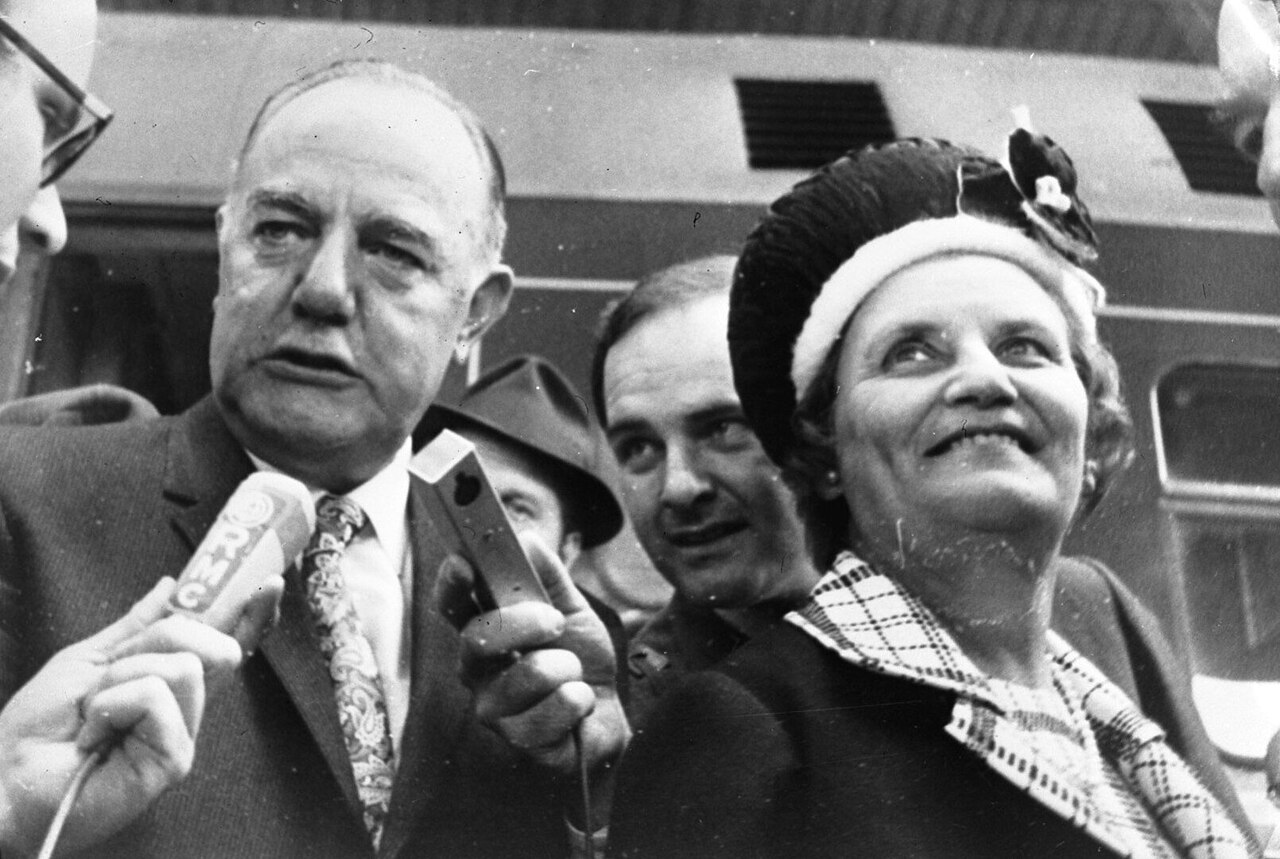
Prime Minister B.J. Vorster and his wife speaking to reporters, 5 March 1974 (Anefo caption; photographer unknown). Nationaal Archief, CC0.
Evidence
- 1971-72. To the Point founded with the Dutch publisher Hubert Jussen and state money. In 1972 Jeune Afrique called it a "Pretoria propaganda publication" (Haasbroek; SAHO, Rhoodie).
- July 1973 to 1974. Club of Ten advertisements appear at about $100,000 a year. In June 1974 the British reporters Adam Raphael and David Martin link Sparrow to Pretoria; Sparrow denies it. On 22 August 1974 the R50,000 cheque is presented (Haasbroek; Nixon excerpt, Vice).
- 1974-1979. McGoff. A U.S. court later recorded that a South African judicial commission stated he had received more than $11.3 million (SEC v. McGoff, 647 F.2d 185, quoted in United States v. McGoff, 831 F.2d 1071). In 1986 he was charged with failing to register as South Africa's agent; the charge was dismissed as time-barred and the dismissal affirmed on 13 October 1987, with a dissent. The court did not reach the merits.
- 4 December 1975 to 7 September 1976. A meeting at Les de Villiers' home approves a newspaper; Luyt is chosen as the public face; The Citizen launches. A reported editorial charter barred anything endangering the white population's position (Rees and Day, p. 99, via Haasbroek). Rhoodie's 1983 book gives a different charter stressing balance. State money spent: about R32 million.
- 27 November 1976 to August 1977. On the account in Haasbroek, Rhoodie destroys sensitive papers on the advice of Vorster and van den Bergh; Auditor-General Gerald Barrie reports irregularities to Vorster in July and August 1977.
- 5 and 10 May 1978. Rhoodie's press release admits secret operations. In the House of Assembly Mulder answers Japie Basson: "The government does not give funds to The Citizen" (Hansard, as rendered in Haasbroek).
- 29 October to 3 November 1978. The Sunday Express runs "The Citizen Secret Revealed"; the Rand Daily Mail (Mervyn Rees, Chris Day, editor Allister Sparks) follows. On 2 November Judge Anton Mostert releases evidence; on 3 November the Mail headlines "It's all true".
- November 1978 to June 1979. P.W. Botha ends Mostert's inquiry and appoints the Erasmus Commission. Its first report (6 December 1978) found Mulder negligent and Rhoodie to have deceived the Defence Department, recommended legal action against the Rhoodie brothers, and described Vorster's involvement as in good faith. Vorster resigned as State President on 4 June 1979, the month its supplementary report (RP 63/1979, per the O'Malley Archive chronology) was presented. SAHO reports it found Vorster "knew everything about the misuse of funds".
- 21 March 1979. Rhoodie, on the run, gives the BBC his account, with tape recordings and a document (Haasbroek).
- 19 July 1979 to 29 September 1980. Rhoodie is arrested in France, tried in Pretoria, convicted on five of seven fraud counts and sentenced to six years (SAHO gives 12). The Appeal Court acquits him, noting the "exceptional circumstances" of his task (Haasbroek, citing The Star, 30 September 1980).
Content note: Protest banner calling a head of government a murderer of schoolchildren. This object is shown as it was published. Why 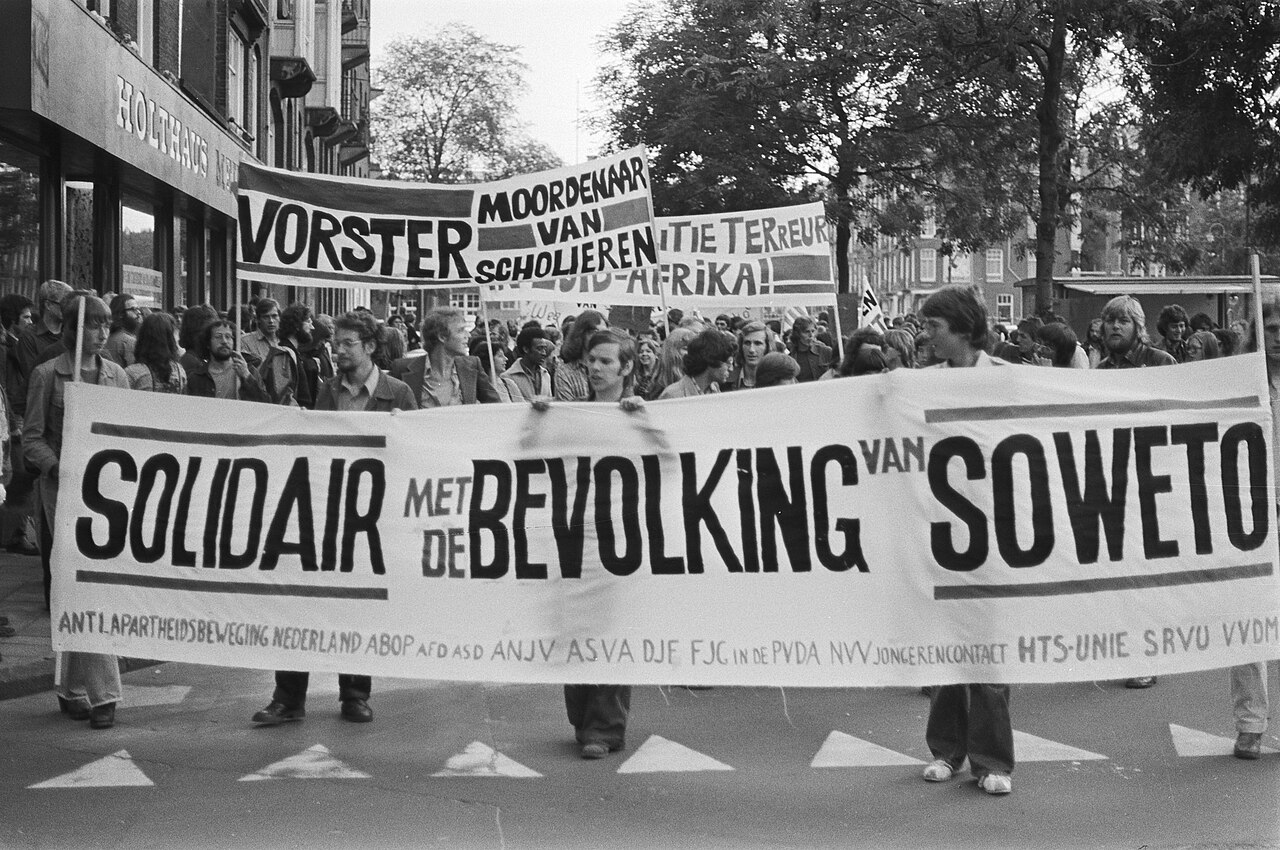
Demonstration in Amsterdam, 18 June 1976, two days after the Soweto uprising began. The lower banner reads "Solidair met de bevolking van Soweto" with the organisers' names printed beneath, including Anti-Apartheidsbeweging Nederland; the upper banner reads "Vorster moordenaar van scholieren". Photo Hans Peters / Anefo, Nationaal Archief, CC0.
Sides on the record
- Pretoria at the time. Rhoodie and Mulder said the projects answered a hostile campaign; Mulder is quoted in Hansard as saying "when the survival of South Africa is at stake, rules don't apply" (as rendered in Haasbroek). Rhoodie later said he "would not have done it if I knew this was going to happen" but believed in the necessity, because "all governments of the world are involved in this sort of thing" (Haasbroek). McGoff's brief in his 1987 case described his advocacy of ties with South Africa as resting on a "deep and long-held belief" (United States v. McGoff). The editor of The Citizen, Johnny Johnson, wrote that it was "not, and is not, a government propaganda medium of the National Party" (Daily Maverick, which dates the editorial 6 November 1978).
- The inquiries. Erasmus said his commission was not a court and ran closed hearings without cross-examination. Haasbroek notes it "never questioned the objectives or doctrines of the Department". SAHO calls it a ploy by Botha against rivals; Rhoodie's side argued at his French extradition hearing that he was being made a scapegoat. Botha was cleared, although his Defence Department had carried the money.
- The ANC, the AAM and the UN. These bodies ran information work under their own names: Sechaba ("official organ of the African National Congress", from January 1967) and Radio Freedom, broadcast from Lusaka and carried by other African state radios (see the case study) (SAHA; SAHO, Radio Freedom). On Pretoria's Soviet claim, Stephen Ellis argues, from ANC and East German archives, that the exile movement depended on the Soviet bloc for arms and training and that the Communist Party held decisive influence (review); he accepts he erred on some points in an earlier book. Under the same definitions these outlets were labelled, so the concealment tests above do not apply to them. Inside South Africa possession and listening were criminal (see Apartheid South Africa's banned organisations, persons and publications). Some later ANC broadcasts, praising the burning of "sell-outs" in 1985, are scored under Name-calling in South Africa's information war: the apartheid state's secret projects and the ANC's Radio Freedom, outside this period.
- Scale and concealment. No budget figures for the ANC's outlets were found, so scale is not compared in numbers. The documented differences are disclosure and state power: a government paid for concealed outlets while banning its opponents' outlets, and the opponents' outlets carried their own names. The UN's 1977 announcement of R250,000 for broadcasts to South Africa was likewise made openly under its name (Haasbroek).
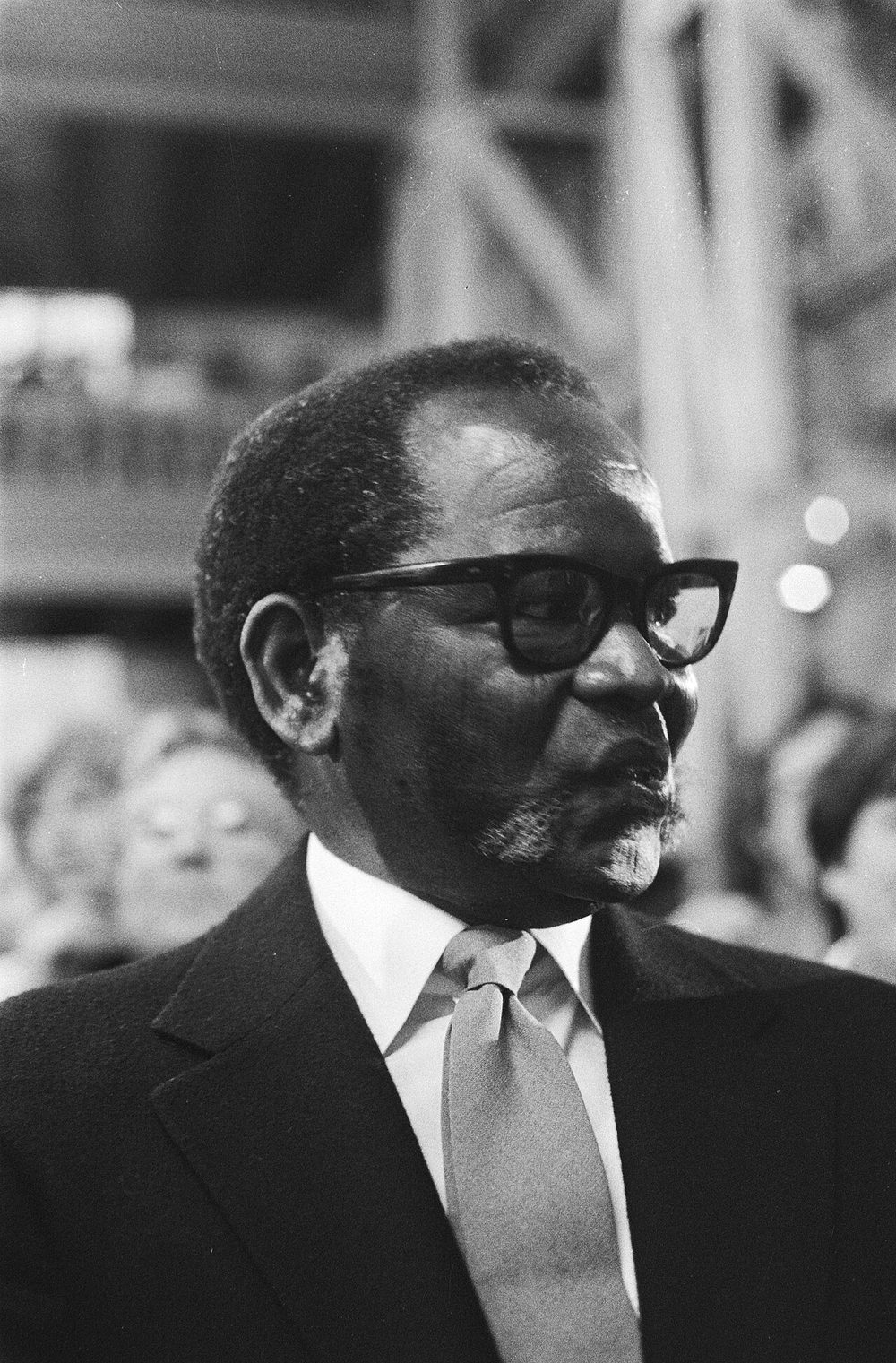
ANC President Oliver Tambo as guest speaker at the opening of the academic year, University of Amsterdam, 5 September 1983. Photo Rob Croes / Anefo, Nationaal Archief, CC0.
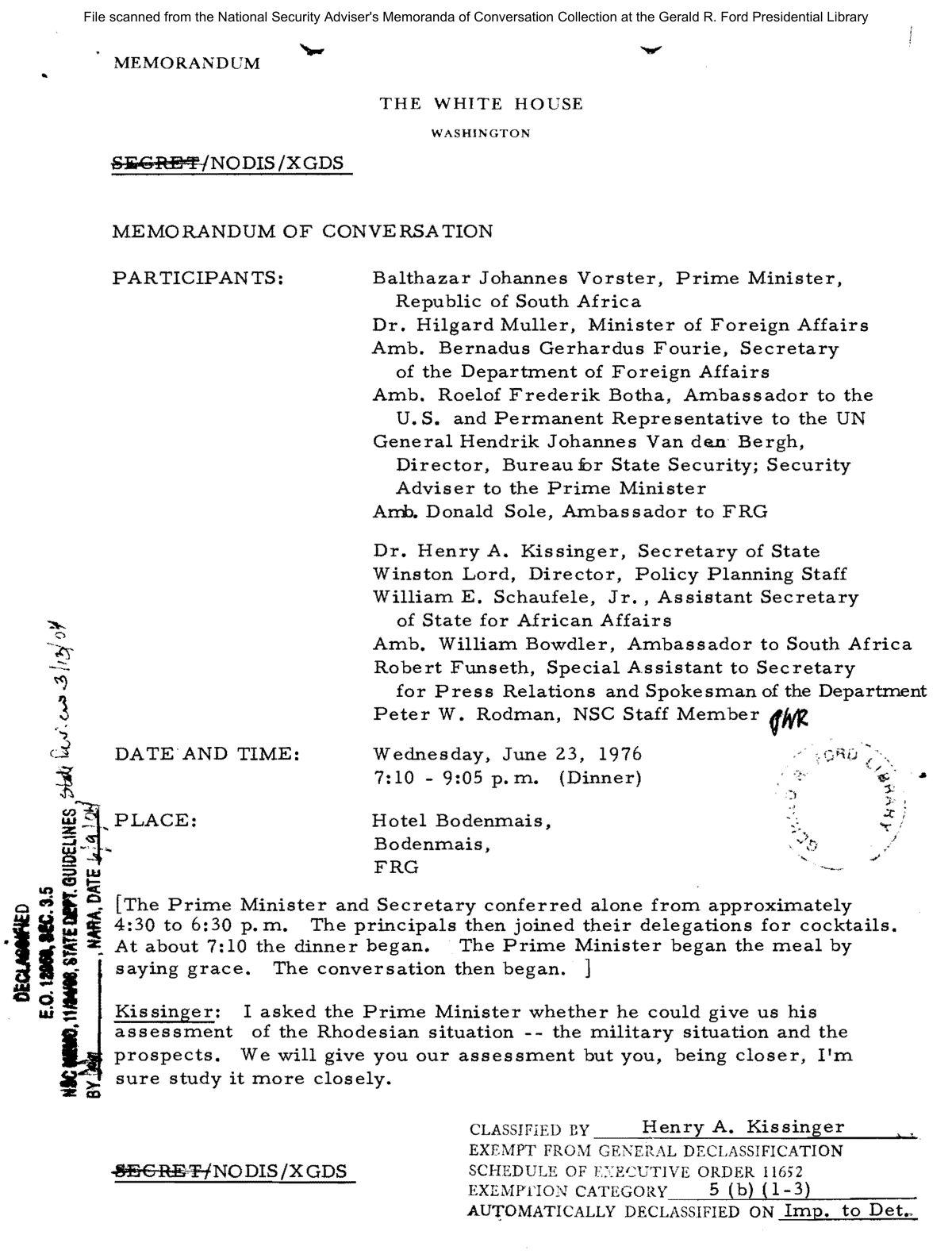
Memorandum of conversation, Secretary of State Henry Kissinger and Prime Minister Vorster, Bodenmais, 23 June 1976. The participants listed for South Africa include General van den Bergh, Director of the Bureau for State Security. Gerald R. Ford Presidential Library (NARA); U.S. federal work, public domain.
What would falsify this read
Evidence that The Citizen's state funding, or the Club of Ten's paymaster, was disclosed to readers at the time (the record shows denials instead). Evidence that the Club of Ten had the independent membership it claimed. Rhoodie's 1980 acquittal does not touch this read: it concerned fraud and personal gain, and Rhoodie himself acknowledged the secret projects. Evidence that the ANC's exile outlets concealed their source in this period, in the way Pretoria's did, would require scoring them the same way.
Literacy counter
Ask who owns a new paper and who funded its first year, and treat a sudden pro-government daily with no named backer as provisional. Check whether an "independent" advertising group has named members, an address and more than one person behind it. When an official denies funding, note whether the denial was made under oath and whether a later inquiry tested it. Read the scope of an inquiry: this one tested spending and candour, not whether a state should run concealed information programmes at all. Give an opponent's openly labelled output the same test, and read an acquittal for what it was asked to decide.