- Actor
- The major US cigarette manufacturers acting jointly (American Tobacco, Brown & Williamson, Lorillard, Philip Morris, R.J. Reynolds and, for part of the period, Liggett) through Hill & Knowlton, the Tobacco Industry Research Committee (later the Council for Tobacco Research), the Tobacco Institute (from 1958), the Center for Indoor Air Research, and outside law firms
- Target
- US smokers and the general public; physicians, journalists, legislators and regulators as secondary audiences
- Source
- Unidentified gray to black (the sponsors were named on the 1954 advertisement, but the independence of the research body was performed; later channels the court described hid the industry's funding and control)
- Techniques
- BothsidesismCard stackingNarrative launderingManufactured consensusTestimonial
- First seen
- 14 Dec 1953 (Plaza Hotel meeting) to 17 Aug 2006 (federal liability judgment)
- Status
- closed as an organised programme by November 23, 1998 (the Council for Tobacco Research was dissolved on November 6, 1998 under the Minnesota settlement; the Master Settlement Agreement of November 23, 1998 required the Tobacco Institute and the Center for Indoor Air Research to close); liability judgment August 17, 2006, largely affirmed May 22, 2009; record last verified September 29, 2026
- Related briefs
- none
This is the structured file. The narrative, the mechanism diagram and the 2017 corrective statements are in The tobacco industry's smoking-and-health doubt campaign, 1953 to 1998. This dossier adds the court record, the funding channels and the dispute over how to read them.
Mechanism
The programme began at a meeting. In December 1953 the presidents of most major cigarette firms met at the Plaza Hotel in New York and agreed to hire a public relations firm jointly and to remove health themes from their advertising. Judge Gladys Kessler found that they met to formulate an industry-wide response to falling public confidence and to what they understood as a threat to their economic future, and not, as they later suggested, in response to requests from scientists that the industry fund research. The meeting minutes said that involving the National Institutes of Health would give the research programme "an aspect of independence".
Three moves recur for fifty years.
- A research body that carried the name of science. Hill & Knowlton advised putting "research" in the committee's name because a purely "unproven" message would look self-interested. The court called the Tobacco Industry Research Committee "a sophisticated public relations vehicle" built "based on the premise of conducting independent scientific research". This is Narrative laundering: the surface was a research committee, the sponsor was the industry, and the sponsors were named. The gray comes from the performed independence, not from a hidden sponsor.
- An "open question" held against a growing body of evidence. The Frank Statement, the 1954 booklet of quotations, the Tobacco Institute's press releases and its 1982 advertisements asking readers to "weigh both sides" treated a question as a tie (Bothsidesism) and selected the doubters (Card stacking, Testimonial: the 1954 advertisement cites unnamed "eminent doctors" and "distinguished authorities"). An internal 1972 memo by Tobacco Institute staffer Fred Panzer describes the aim as "creating doubt about the health charge without actually denying it".
- Funding routed so the sponsor did not show. The court found that CTR "Special Projects" were directed by company general counsel and outside law firms, were not reviewed by CTR's Scientific Advisory Board, and were commissioned for possible use in litigation. It found that the Center for Indoor Air Research (CIAR) was billed as an independent entity while industry lawyers attended every board meeting at which projects were approved, and that a paper could say only "supported by CIAR" when Philip Morris alone had paid. It found a consultant programme for secondhand smoke, called "Whitecoat" in company documents, that aimed to "keep the controversy alive" through scientists presented as independent witnesses. This is where the record moves toward black, and it is the basis of Manufactured consensus.
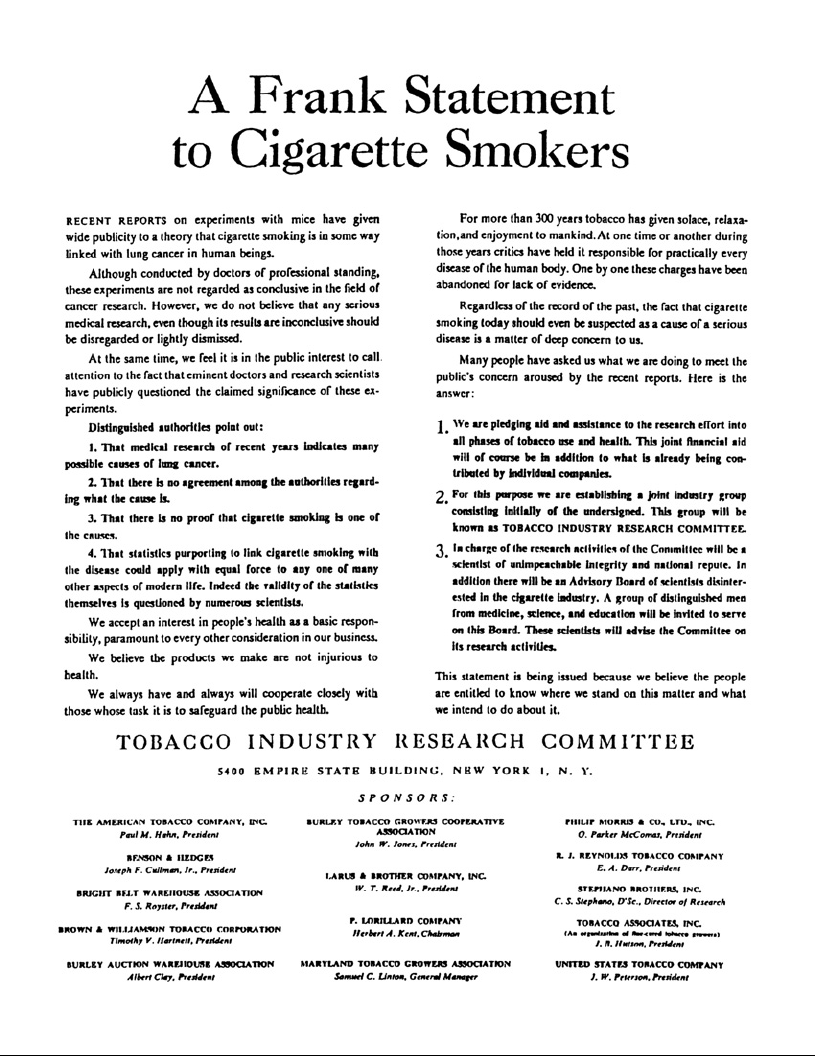
"A Frank Statement to Cigarette Smokers," 4 Jan 1954, signed by fourteen manufacturers and growers' and warehouse associations. Scan hosted in the FRAME gallery as A Frank Statement to Cigarette Smokers from Wikimedia Commons (Commons tag PD-US-no-notice). Holder: Tobacco Industry Research Committee, original; no holding-institution rights statement was located.
Sides on the record
- The companies, in the 1954 statement: "there is no proof that cigarette smoking is one of the causes" and "We believe the products we make are not injurious to health." They pledged "aid and assistance to the research effort" and a board of "scientists disinterested in the cigarette industry".
- The companies, in the 1972 Panzer memo: the strategy was also "advocating the public's right to smoke without actually urging them to take up the practice" and "encouraging objective scientific research as the only way to resolve the question." This supports the industry's stated position that it was entitled to advocate.
- The companies, at trial: their public statements were opinions held in good faith; the First Amendment and the Noerr-Pennington doctrine protected them; fraud had to be proved by clear and convincing evidence.
- What the court found on those points: only statements made directly to legislative bodies were immune, and the court held six racketeering acts (the April 1994 chief-executive testimony and one Philip Morris letter to Representative Waxman) not actionable for that reason. On the rest it wrote that where objective data disproved a statement when it was made, "a public statement of opinion by a company spokesperson can constitute actionable fraud", and that the evidence "easily meets the clear and convincing standard", so that "whichever standard of proof is required" the Government had met it.
- What the court did not find: it did not find that the Government proved a scheme to keep less hazardous cigarettes off the market. It found that Philip Morris and R.J. Reynolds in particular "spent many years, enormous amounts of money" on such products. It did not order disgorgement, which the D.C. Circuit had held unavailable under RICO in 2005. It entered no remedy against CTR, which had ceased operating. The D.C. Circuit in 2009 affirmed liability "in large part", remanded for dismissal of the two dissolved trade organizations, and vacated four discrete parts of the injunction.
- Timing: the court wrote that the denial continued "years after questions of causation were resolved in the public health community". Its findings do not rest on the 1954 statement alone. The Government charged that statement as Racketeering Act 1.
- Secondary works. Robert Proctor, Golden Holocaust (University of California Press, 2011), draws on the industry's document archives. Reviewer Howard Markel called it "forcefully written" and objected to the title, adding that "moral outrage" colors every word (The New Republic, 2012). Naomi Oreskes and Erik Conway, Merchants of Doubt (Bloomsbury, 2010), places the tobacco case beside later disputes. Historian Ronald Doel, in an H-Environment roundtable (2011), agreed with their concern and argued that the book leaves out the "full range of motivations, convictions, and world-views" of the scientists involved and risks "David-and-Goliath accounts". Those critiques concern framing and motive. They do not address the court's findings.
Evidence
Kessler findings are cited by paragraph and by page of 449 F. Supp. 2d 1 (D.D.C. 2006), text at the Caselaw Access Project.
- December 14, 1953 to December 28, 1953. Plaza Hotel meetings; Hill & Knowlton proposes a joint research committee with an advisory board "whose integrity is beyond question." Findings ¶¶ 6-14, pp. 36-38.
- January 4, 1954. Frank Statement in 448 newspapers; the court treats it as setting out the "open question" position the industry kept "for more than forty years." Findings ¶¶ 16-18. Its text is in the Wikisource transcription.
- April 14, 1954. "A Scientific Perspective on the Cigarette Controversy": 205,000 copies, quotations from about three dozen scientists, sent to 176,800 doctors. Findings ¶¶ 82-83, p. 54.
-
- Tobacco Institute created; Hill & Knowlton handles its account. Findings ¶ 126, p. 65.
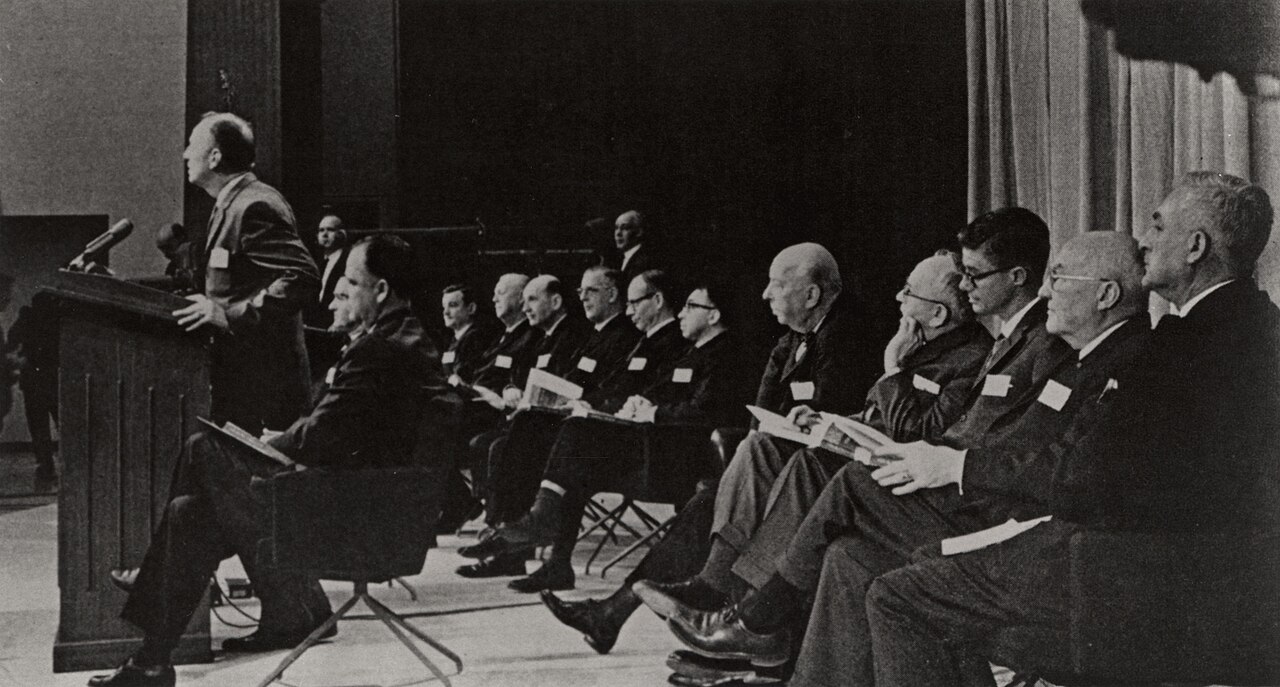
- January 11, 1964. Surgeon General's report Smoking and Health. Photograph below; the govinfo timeline carries the image.
11 Jan 1964, National Institutes of Health photograph identified in its caption as Surgeon General Luther L. Terry at the press conference releasing the report on smoking and health. Public domain (U.S. federal work). Holder: NIH, via govinfo.gov and Wikimedia Commons.
- 1966 to 1990. Five companies pay more than $18 million into CTR Special Projects (Liggett about $144,000 from 1966 to 1975). Findings ¶¶ 238-240, pp. 91-92.
- 1968 to 1972. Tobacco Institute memo advises stories that cast doubt with the headline "Controversy! Contradiction! Other factors! Unknowns!"; the 1972 Panzer memo; a 1972 press release calls the Surgeon General's report "press conference science". Opinion pp. 855-856; Findings ¶ 155.
- Undated. Brown & Williamson "Smoking and Health Proposal": "Doubt is our product since it is the best means of competing with the 'body of fact' that exists in the mind of the general public." Bates 690010951-0959, quoted at p. 856.
- May 7, 1982. RJR memo: the key point is that "it is a legitimate scientific controversy which continued unresolved." Findings ¶ 771, p. 200.
- Mid-1980s to 1999. The consultant programme and CIAR "Applied Projects." Findings ¶¶ 3539-3543, 3602-3611, pp. 742-754.
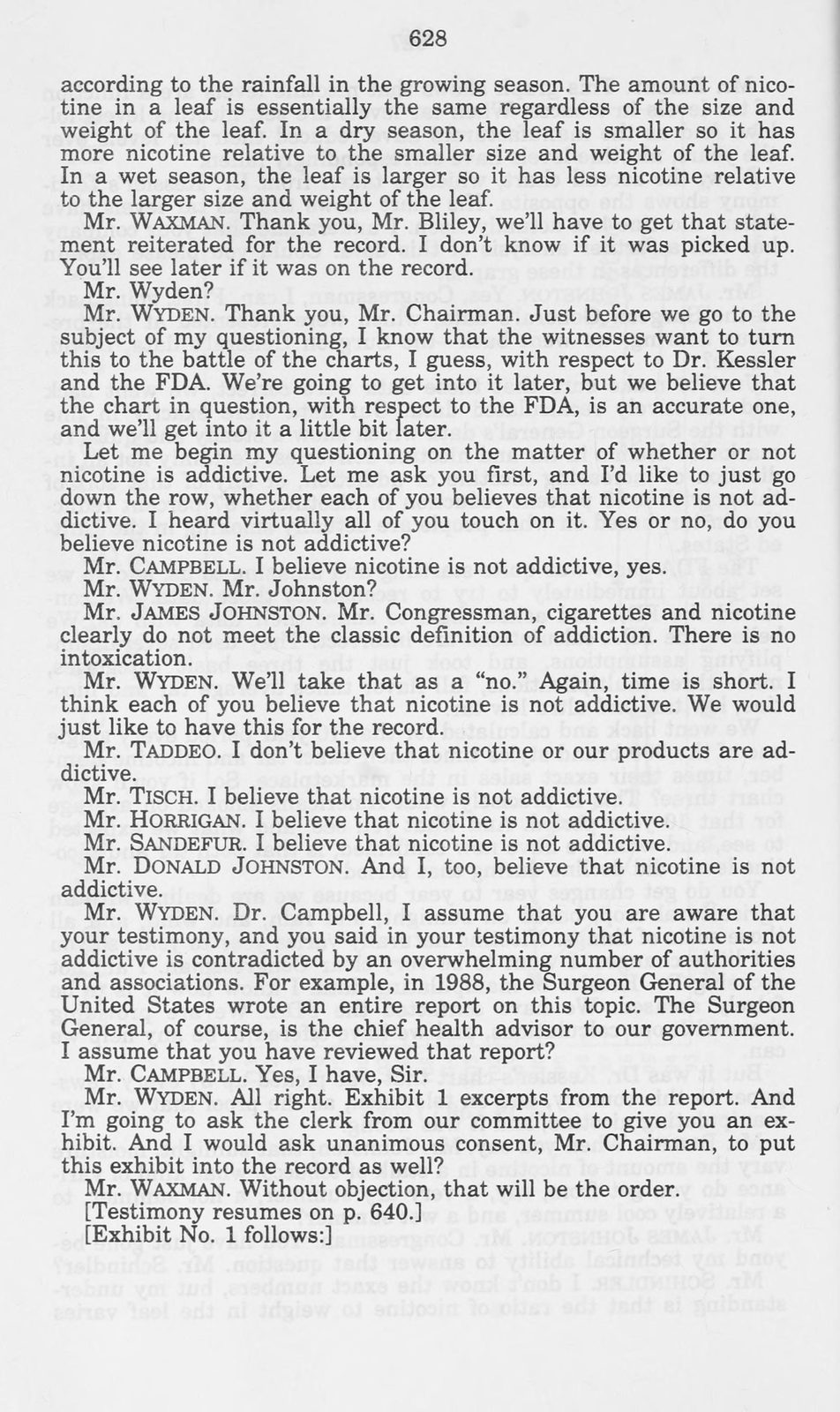
- April 14, 1994. Seven company heads tell the House subcommittee they believe nicotine is not addictive. The court held this testimony immune (p. 887).
14 Apr 1994, page 628 of "Regulation of Tobacco Products (Part 1)," hearings of the House Subcommittee on Health and the Environment, U.S. Government Printing Office, 1995. Public domain (U.S. government work). Holder: Internet Archive (Boston Public Library copy). The hearing volume has the full record.
- November 6, 1998 and November 23, 1998. CTR is dissolved under the Minnesota settlement (opinion p. 915-916). The Master Settlement Agreement, signed by four original manufacturers, Liggett and 52 jurisdictions, requires the Tobacco Institute and CIAR to close (¶¶ 3848, 4044; pp. 916-917). CIAR dissolved December 6, 1999; Philip Morris set up a replacement research programme (¶¶ 3847-3849).
- August 17, 2006. Final Opinion: liability under 18 U.S.C. § 1962(c) and (d); the court orders corrective statements, bans descriptors such as "light," and orders industry document websites and depositories kept up to allow public access. Pp. 26-28, 929-931.
- May 22, 2009. D.C. Circuit, 566 F.3d 1095, affirms liability. The govinfo docket lists the case.
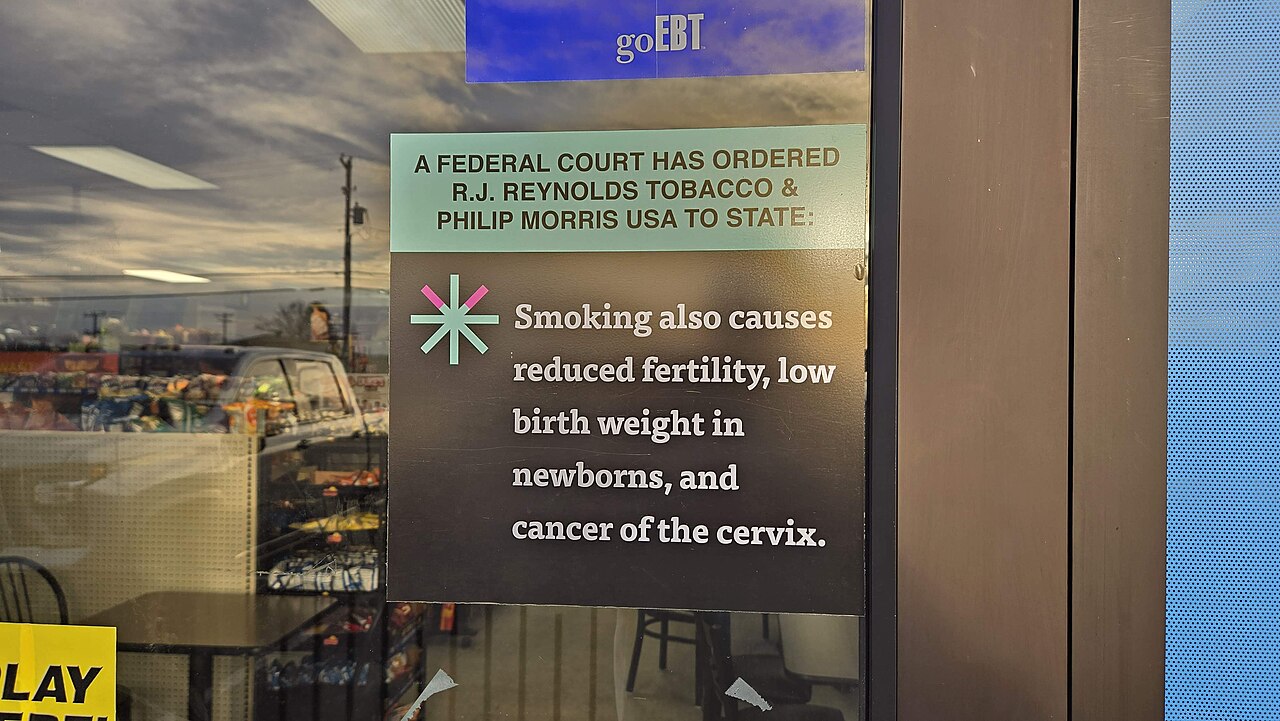
- 2017 onward. Corrective statements run in newspapers and on television; point-of-sale signs followed after a negotiated order, per the public-health intervenors' announcement.
26 Mar 2024, corrective-statement sign at a convenience store in Whitehall, Pennsylvania. Photograph by Baron Maddock, CC BY 4.0, via Wikimedia Commons.
- Secondary: Markel review of Golden Holocaust, The New Republic, 2012; H-Environment roundtable on Merchants of Doubt, 2011.
Same method, different record
Sponsored research or advocacy given a scientific surface, and a public "unsettled" position set against a fuller internal record, also appear in Fossil-fuel industry climate doubt campaigns, 1977 to the 2000s and The Sugar Research Foundation and the 1967 heart disease review. The similarity is of method. Those pages record internal documents and academic analyses; the sugar page records that its authors call the evidence on influence circumstantial and that other historians dispute it. Neither records a federal fact-finding of the kind above, and this dossier does not treat that finding as evidence about any other case. The court weighed the tobacco record under civil RICO, which is a different question from whether an argument was persuasive or scientifically right.
What would falsify this read
That the public statements were sincere opinions not contradicted by what the companies knew (the court rejected this on its record, and a different record would be needed); that CTR Special Projects and CIAR Applied Projects were disclosed to their audiences as industry-directed; or that a reasonable reader of the 1954 statement could have known the committee's research was steered by counsel. The read of the 1954 advertisement alone is narrower: it named its sponsors, and the question was still argued in the literature then. The stronger claims rest on documents from later decades. Evidence that front groups (for example the National Smokers Alliance, described in secondary sources as created for Philip Morris by Burson-Marsteller) hid their sponsor is not in the Kessler findings and is left untagged here as Astroturfing until a primary record is examined.
Literacy counter
Ask who sets up and pays a body called a "council" or "institute" that studies its sponsors' product, and whether its independence is a fact or a label. Compare a public claim with the same actor's internal papers, court filings and later admissions when a depository exists. Distinguish a real scientific uncertainty (size, timing, mechanism) from a claim that the whole question is open. Count evidence, not voices. Check whether a study says who paid; "supported by" an intermediary is not the same. Use the depositories the settlement created: the Industry Documents Library at UCSF holds the searchable archive.