Content note: this page describes antisemitic and anti-Roma measures, quotes press language about Black athletes, and mentions a suicide. It reproduces 1935-1936 U.S. newspaper pages as printed.
In one line: Berlin won the 1936 Games in 1931, before the Nazis ruled; once in power the regime kept them, used them to show visitors a calm, orderly Germany, took down anti-Jewish signs and held back its press for the duration, cleared Roma into a camp, and had the whole event filmed, while a boycott campaign in the United States and Britain argued that attending would lend the regime legitimacy and the American Olympic Committee argued that sport and politics should be kept apart; the best-known story of the Games, Hitler's "snub" of Jesse Owens, is less clean than it is usually told.
What happened
- May 1931. The IOC awards the 1936 Summer Games to Berlin over Barcelona, 43 votes to 16 (Wikipedia). Germany is still a republic.
- 1933. Hitler becomes chancellor. Accounts say he was at first uninterested in the Games and that Joseph Goebbels, the propaganda minister, saw their value (Arolsen Archives); no single dated decision was found in the sources used here. Theodor Lewald, who headed the organising committee and had Jewish ancestry on his father's side, and Carl Diem, its secretary-general, carry on the planning; Lewald is sidelined, though sources differ on how formally.
- April-June 1933. An "Aryans only" rule is imposed on German athletic organisations (USHMM). In June, under IOC pressure, German sports officials give a written promise that Jewish athletes will not be excluded from the team. In practice Jewish athletes had been expelled from the clubs they would qualify through.
Show all 11Show fewer
- 1934. Avery Brundage, president of the American Olympic Committee, makes a short, supervised inspection and says Jewish athletes are being treated fairly (USHMM).
- October-December 1935. The U.S. boycott fight peaks (see Positions). On 8 December the Amateur Athletic Union votes narrowly to send a team; Brundage returns to the AAU presidency in place of boycott leader Jeremiah Mahoney.
- 6-16 February 1936, Garmisch-Partenkirchen. At the Winter Games the correspondent William L. Shirer reports that the town "had pulled down all the signs saying that Jews are unwanted" (Wikipedia, citing Shirer's Berlin Diary). Under pressure over a possible American boycott, the regime lets Rudi Ball, a Jewish player, join the ice hockey team.
- June-July 1936. Gretel Bergmann, a Jewish high jumper who had equalled the German record, is dropped from the team. Helene Mayer, with one Jewish parent, fences for Germany and wins silver. The Barcelona "People's Olympiad", planned as a counter-event, is cancelled when the Spanish Civil War begins in July (USHMM). The press is told to "tone down racist and anti-Semitic rhetoric" for the duration (Arolsen).
- 16 July 1936. About 600 Roma are arrested in Berlin and interned in a camp at Marzahn on the city's edge (USHMM).
- 20 July-1 August 1936. The first Olympic torch relay runs from Olympia to Berlin. Counts differ by source, from about 3,000 to 3,331 runners over 3,187 km; Krupp made 3,840 torches (Wikipedia). The idea came from Alfred Schiff, a Jewish archaeologist and sports official, and Diem adopted it.
- 1-16 August 1936. Hitler opens the Games on 1 August. 49 nations send 3,963 athletes; the United States sends 312, including 18 African Americans. Television is broadcast live to public viewing rooms in Berlin and Potsdam, and radio carries the Games in 28 languages (Wikipedia). Germany tops the medal table; the United States is second. The Olympic village commandant, Captain Wolfgang Fürstner, kills himself on 3 August after being dismissed for his Jewish ancestry (USHMM). Arolsen records an SA saying that circulated: "Once the Olympics are over, we'll beat the Jews to a pulp."
- 20 April 1938. Olympia premieres on Hitler's 49th birthday, in two parts, Fest der Völker and Fest der Schönheit (Wikipedia). Riefenstahl said the IOC had commissioned it; the film was financed by the government through Olympia-Film GmbH, its budget rising from 1.5 to 2.35 million Reichsmarks, and the Propaganda Ministry oversaw production.
Explain moreShow less
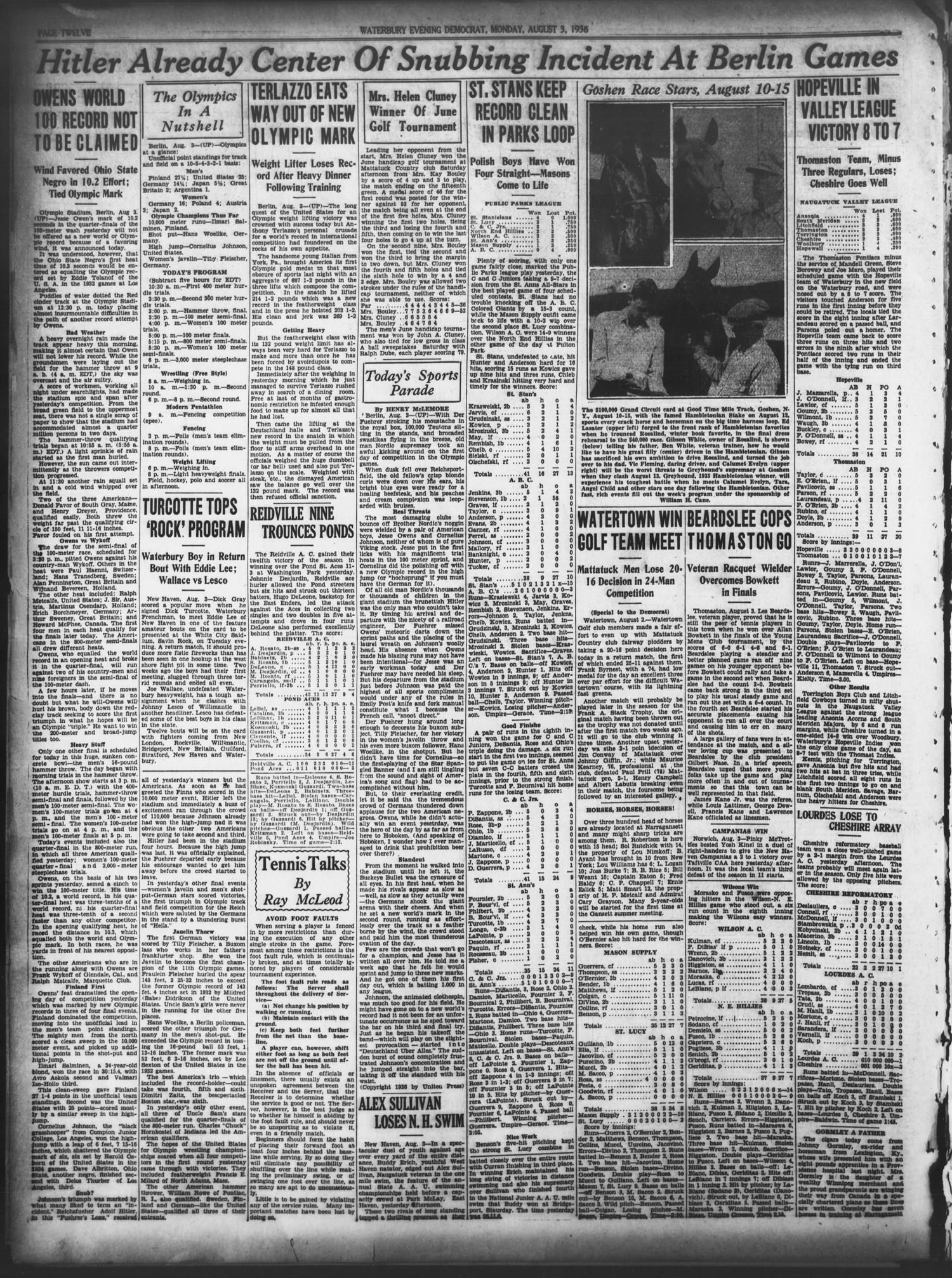
Waterbury Evening Democrat (Connecticut), 3 August 1936, p. 12. The Berlin dispatch is headed "Hitler Already Center of Snubbing Incident at Berlin Games" and reports that Hitler left the stadium after greeting the Finnish winners, before the high jump medals, "officially explained" as a wish to get the Führer away before the crowd left. Library of Congress, Chronicling America. No known restrictions.
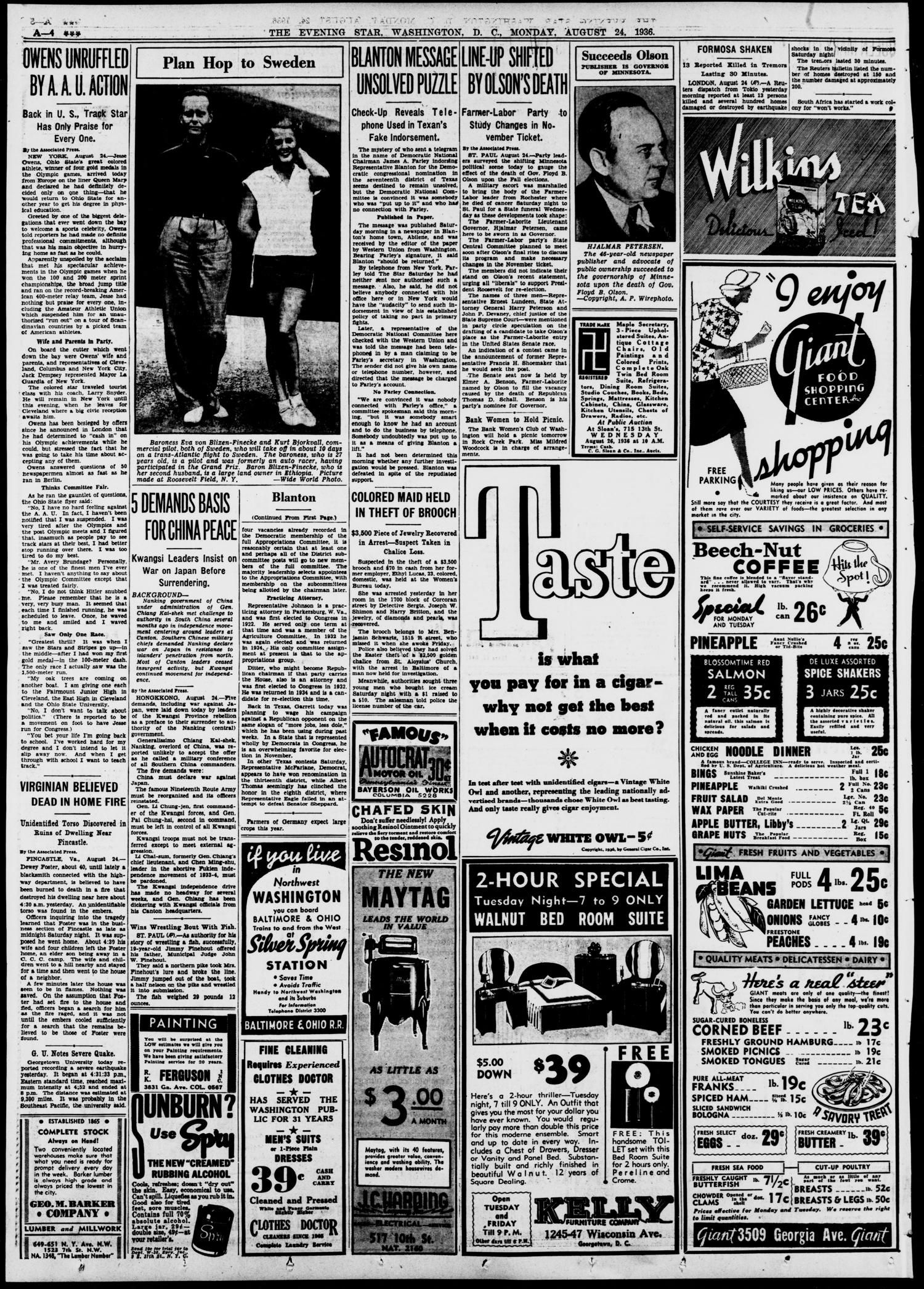
Evening Star (Washington, D.C.), 24 August 1936, p. A-4. Owens, back on the Queen Mary, is quoted: "No, I do not think Hitler snubbed me. Please remember that he is a very, very busy man... Once, he waved to me and smiled and I waved right back." Library of Congress, Chronicling America. No known restrictions.
How it works
- Transfer: the Games carried the prestige of the Olympic movement and ancient Greece onto the regime. The torch relay, with its Greek start and German finish, is the clearest case; it was invented, as noted, from an idea by a Jewish scholar. Both sides of the dispute named the same mechanism: the boycotters said attendance would "set the seal of approval on radically anti-Christian Nazi doctrines" (The Commonweal, 8 November 1935, quoted by USHMM), and the regime wanted that approval.
- Card stacking: the visitor's Berlin was selected. Signs and agitation were withdrawn for the fortnight, the Roma were moved out of sight, and a half-Jewish fencer and a half-Jewish hockey player were on the teams, while Jewish athletes were excluded from qualifying. Wikipedia's summary of the scholarship calls Mayer's inclusion a token meant to deflect foreign criticism. USHMM concludes that the Games were a propaganda success that projected an image of a peaceful, tolerant Germany.
- Manufactured consensus: the press line for the duration was uniform restraint, and the film and radio presented a unanimous festival. The crowd in the stadium was real; the restraint was ordered.
Show all 4Show fewer
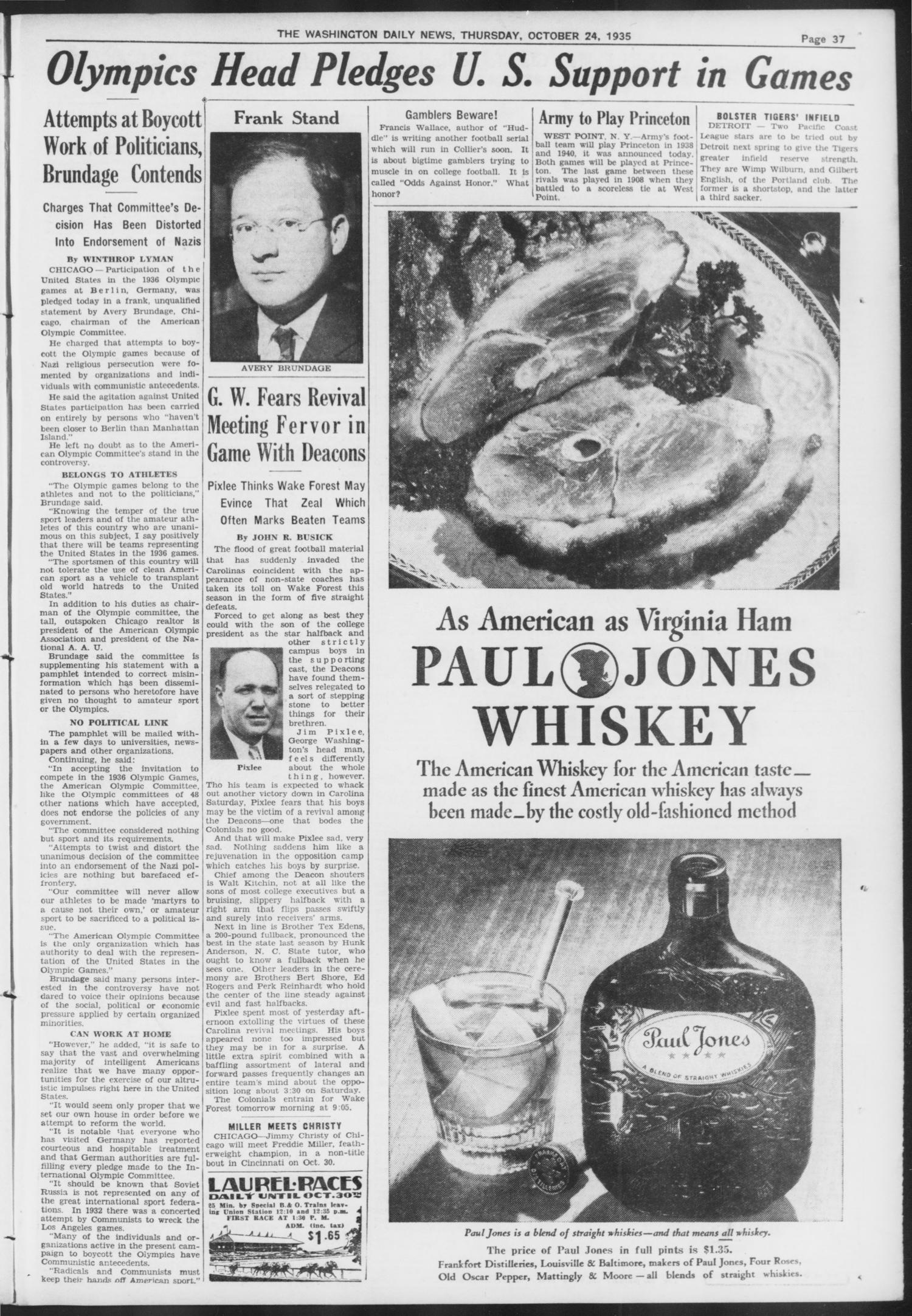
- Name-calling and Scapegoating, on the other side of the Atlantic: Brundage's 24 October 1935 statement said boycott efforts were fomented by people with "communistic antecedents" and that "radicals and Communists must keep their hands off American sport"; USHMM reports he also alleged a "Jewish-Communist conspiracy". The same page of the Washington Daily News gives his stated reasons (sport belongs to athletes, the committee does not endorse any government, Germany was fulfilling its pledges). The label tagged an opponent's motive instead of answering the argument, which is scored the same way as the German press's labels for foreign critics.
Explain moreShow less
Washington Daily News, 24 October 1935, p. 37. "Olympics Head Pledges U. S. Support in Games: Attempts at Boycott Work of Politicians, Brundage Contends." Library of Congress, Chronicling America. No known restrictions.
Jesse Owens and the Hitler "snub", checked
- Four golds, four dates. 100 m (3 August), long jump (4 August), 200 m (5 August) and the 4 x 100 m relay (9 August), per Wikipedia.
- Hitler's handshakes. On the first day Hitler received German winners and some others, then left before the high jump medals. IOC president Henri de Baillet-Latour then insisted that Hitler greet every medallist or none; he chose none. The 3 August page above shows the explanation reported at the time.
- What Owens said then. 24 August 1936 (page above): he did not think Hitler snubbed him. On 15 October 1936 in Kansas City, per Wikipedia, he said: "Hitler didn't snub me - it was our president who snubbed me." Franklin Roosevelt never invited him to the White House.
Show all 7Show fewer
- The Daily Worker called it a "deliberate snub" after the high jump; the editor Robert L. Vann wrote on 4 August that he saw Hitler "salute" Owens (both as reported by Wikipedia).
- Luz Long. Owens credited the German long jumper with technical advice; he later admitted that was untrue, and the two met only after the competition.
- The relay. Jewish sprinters Marty Glickman and Sam Stoller were replaced by Owens and Ralph Metcalfe on the morning of the race. The reason is disputed; many have attributed it to not embarrassing the hosts.
- Not shown: that Hitler shunned Owens by name, or that Hitler warmly congratulated him. Reports differ, and Owens's own accounts changed.
Then and now
Mit dem Stürmer gegen Juda (Der Stürmer display case, Worms) , Worms, August 1935.
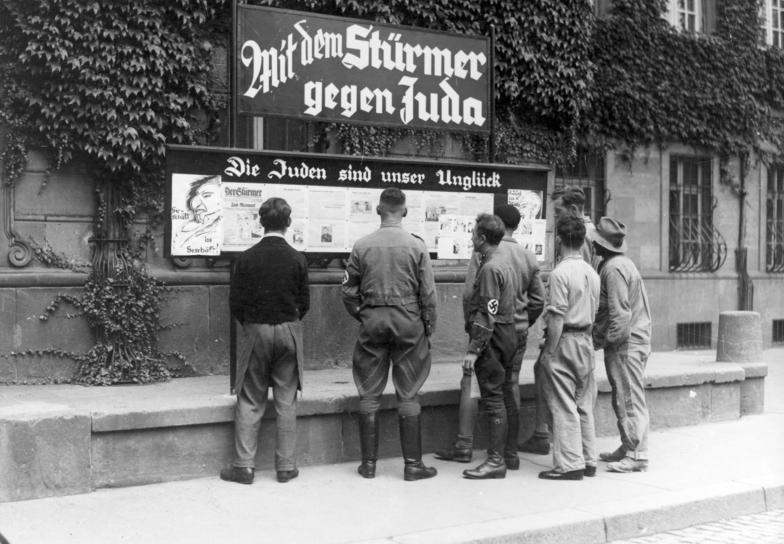
Mit dem Stürmer gegen Juda (Der Stürmer display case, Worms), Worms, August 1935. Bundesarchiv, Bild 133-075, CC BY-SA 3.0 DE.
The sources used here say anti-Jewish signs were taken down for the Games; they do not say whether Der Stürmer display cases were. This case, from a German town a year earlier, shows the kind of public agitation the temporary restraint covered.
Content note: Antisemitic boycott sign ('Kauft nicht bei Juden') posted by uniformed SA and SS men on a Jewish-owned shop window, 1933 This object is shown as it was published. Why 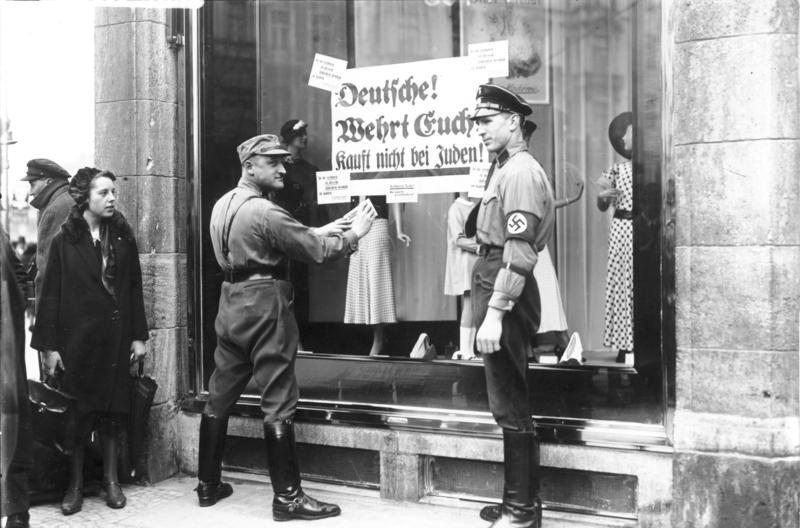
'Deutsche! Wehrt Euch! Kauft nicht bei Juden!' (Germans! Defend yourselves! Don't buy from Jews!): SA and SS men post a boycott sign, Berlin, Berlin, 1 April 1933. Bundesarchiv, Bild 102-14468, CC BY-SA 3.0 DE.
The regime that denounced the foreign boycott threat had staged its own boycott of Jewish shops three years earlier. For a later Games-related influence operation of a different kind, see 'For whites only': the forged Klan letters sent to Olympic committees in 1984; for the Reich's film system, see Film under Goebbels: Triumph des Willens (1935) and Der ewige Jude (1940) and The Reich Ministry of Public Enlightenment and Propaganda, 1933-1945.
Positions on the record
6 items · The German government: it presented the Games as a peaceful sporting festival and gave…
- The German government: it presented the Games as a peaceful sporting festival and gave pledges that German Jews would be included. Its record: the Aryans-only rule, the exclusion of Bergmann, and the press restraint ordered for the duration.
- Brundage and the American Olympic Committee: the committee held that it did not endorse any government, that it considered "nothing but sport", and that Germany was keeping its pledges (24 October 1935). Critics held that his 1934 inspection was too short and too managed to support that.
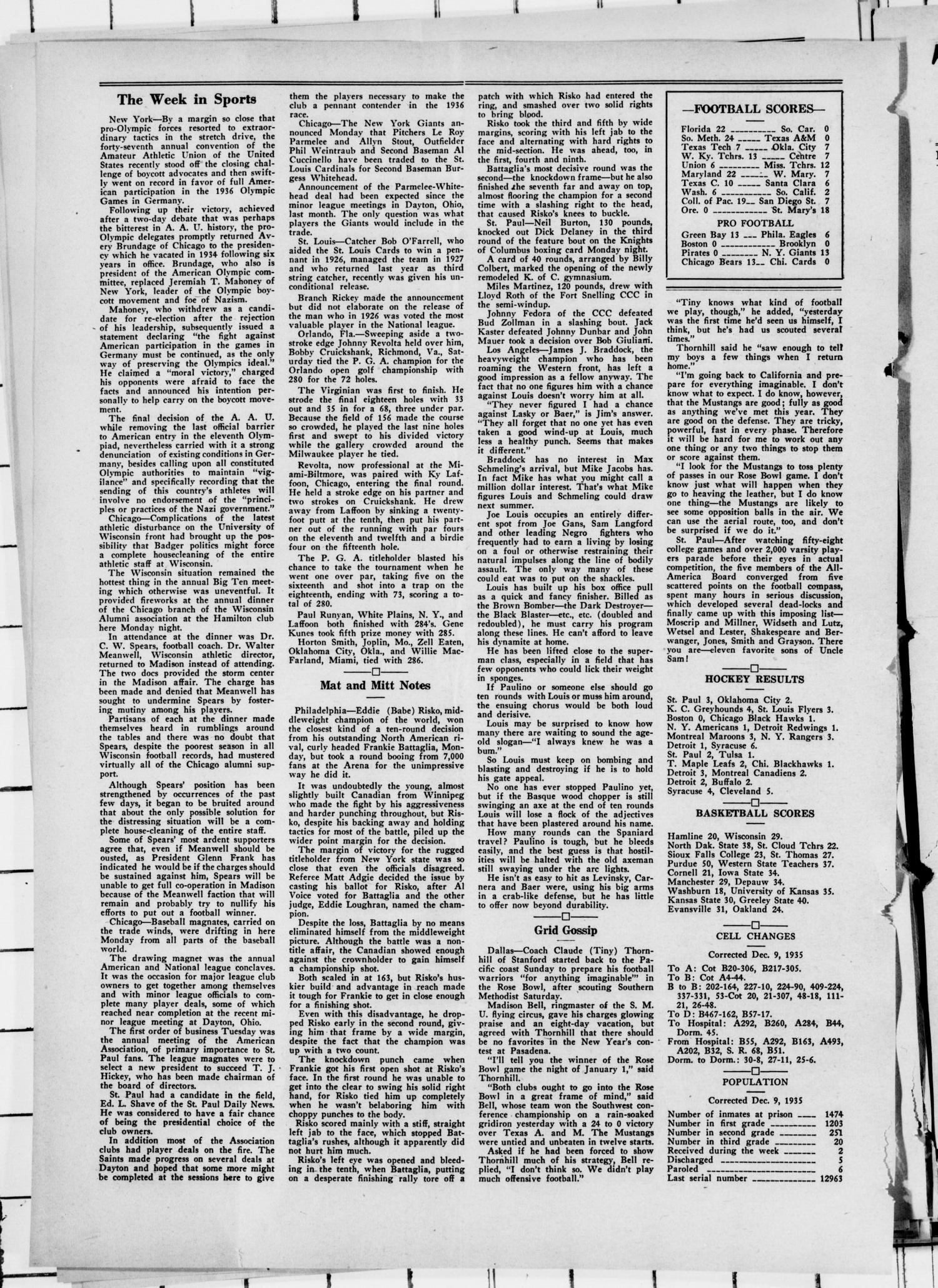
- Mahoney and the boycott movement: the AAU's president said Germany had broken the Olympic rules against discrimination; the Jewish Labor Committee and American Jewish Congress, Catholic papers such as The Commonweal, Jahncke, and mayor Fiorello La Guardia opposed sending a team. After the December 1935 vote Mahoney said "the fight against American participation in the games in Germany must be continued, as the only way of preserving the Olympics ideal" and claimed a "moral victory" (The Prison Mirror, 12 December 1935, p. 4). The AAU's resolution that passed denounced conditions in Germany and recorded that sending athletes was no endorsement of "the principles or practices of the Nazi government".
- After the vote: boycott efforts in Britain, France, Sweden, Czechoslovakia and the Netherlands also failed. In July 1936 the IOC expelled Jahncke, the only member it has ever expelled, and elected Brundage to his seat (USHMM).
- The boycott movement's own methods: its central claim, that Jewish athletes were in practice shut out, is borne out by the record above. Its distinctive argument was about legitimacy (the Commonweal line). As propaganda it used the same Transfer logic as the regime, in reverse: it said attendance would carry the Olympic name over to Nazi rule. Some Jewish athletes backed the boycott, and some faced pressure not to take part (Wikipedia).
- This archive's reading: documented are the AAU vote, the exclusions, the removal of signs, the Marzahn arrests, the press instruction, the financing of Olympia and the newspapers above. Not shown: that Brundage acted for the regime, that the boycotters were organised by Communists, or that the Games alone changed German policy afterwards.
Same-method test
A Moscow or London committee that took down "no Jews" signs for the duration of an event, moved a minority out of sight, and made…
A Moscow or London committee that took down "no Jews" signs for the duration of an event, moved a minority out of sight, and made a film its own ministry paid for would be scored the same: Card stacking, Manufactured consensus and Transfer. The U.S. committee's labelling of its critics as Communist-linked earns Name-calling exactly as the Reich press's labels for foreign critics do. A boycott campaign that says attendance equals endorsement is making a claim about Transfer too; the archive scores the mechanism, not the cause.
How to spot it
- Ask what was removed before the guests arrived, and what happened to it afterwards.
- Compare a pledge with what the same authority did the year before it was given.
- Treat a label for opponents ("politicians", "Communists") as a claim about them, and look for the argument it replaced.
Show all 5Show fewer
- Check famous scenes against the contemporary page: the 3 August 1936 headline and the 24 August interview say different things from the later legend.
- Remember that a film that says it is a record can be paid for by the state it records.
Explain moreShow less
The Prison Mirror (Stillwater, Minnesota), 12 December 1935, p. 4, "The Week in Sports". Library of Congress, Chronicling America. No known restrictions.
Sources and further reading
Images
5 items · Photographs of the Games. Library of Congress holds many 1936 photographs (opening…
| Image | Source | Licence |
|---|---|---|
| Waterbury Evening Democrat, 3 August 1936, p. 12 | Library of Congress | No known restrictions (Chronicling America) |
| Evening Star, 24 August 1936, p. A-4 | Library of Congress | No known restrictions (Chronicling America) |
| Washington Daily News, 24 October 1935, p. 37 | Library of Congress | No known restrictions (Chronicling America) |
| The Prison Mirror, 12 December 1935, p. 4 | Library of Congress | No known restrictions (Chronicling America) |
| Stürmerkasten, Worms 1935; Berlin boycott sign 1933 | FRAME gallery | CC BY-SA 3.0 DE (Bundesarchiv; already hosted) |
Image gaps
- Photographs of the Games. Library of Congress holds many 1936 photographs (opening ceremony, the Olympic bell, the torch ceremony), but most are marked "rights status not evaluated" and are German-published press or album prints; the ones marked "no known restrictions" were under 700 px wide. Held; fillable with a larger scan.
- Owens on the track. An FSA copy-negative of a press photograph of the relay exists, but the original photographer is unknown, so it is held.
- Bundesarchiv photographs (Olympic stadium, torch runners, Goebbels and Riefenstahl): CC BY-SA, not in the approved set. Held; cite-linked at Wikimedia Commons.
- Boycott posters and leaflets (American Jewish Congress, Jewish Labor Committee, Anti-Nazi League) and Nazi press pages (Völkischer Beobachter, Der Angriff): no verified open scan was found. Fillable from the Internet Archive or a library.
- Roma at Marzahn: no image with a clear licence found. Held.
Sources
7 items · U.S. Holocaust Memorial Museum, The Nazi Olympics, Berlin 1936 and The Movement to…
- U.S. Holocaust Memorial Museum, The Nazi Olympics, Berlin 1936 and The Movement to Boycott the Berlin Olympics of 1936.
- Arolsen Archives, The 1936 Olympics: A Victory for Propaganda.
- Wikipedia, 1936 Summer Olympics, 1936 Winter Olympics, 1936 torch relay, Jesse Owens, Olympia (secondary summaries; the claims taken from them are attributed above).
- Waterbury Evening Democrat, 3 August 1936; Evening Star, 24 August 1936; Washington Daily News, 24 October 1935; The Prison Mirror, 12 December 1935 (Chronicling America).
- William L. Shirer, Berlin Diary (New York: Knopf, 1941).
- Arnd Krüger and William Murray (eds.), The Nazi Olympics: Sport, Politics, and Appeasement in the 1930s (Urbana: University of Illinois Press, 2003).
- Jeremy Schaap, Triumph: The Untold Story of Jesse Owens and Hitler's Olympics (Boston: Houghton Mifflin, 2007).