Content note: this page quotes antisemitic headlines and describes the ministry's use of atrocity material (Katyn, Nemmersdorf). The genocide itself is covered in FRAME's genocide case studies.
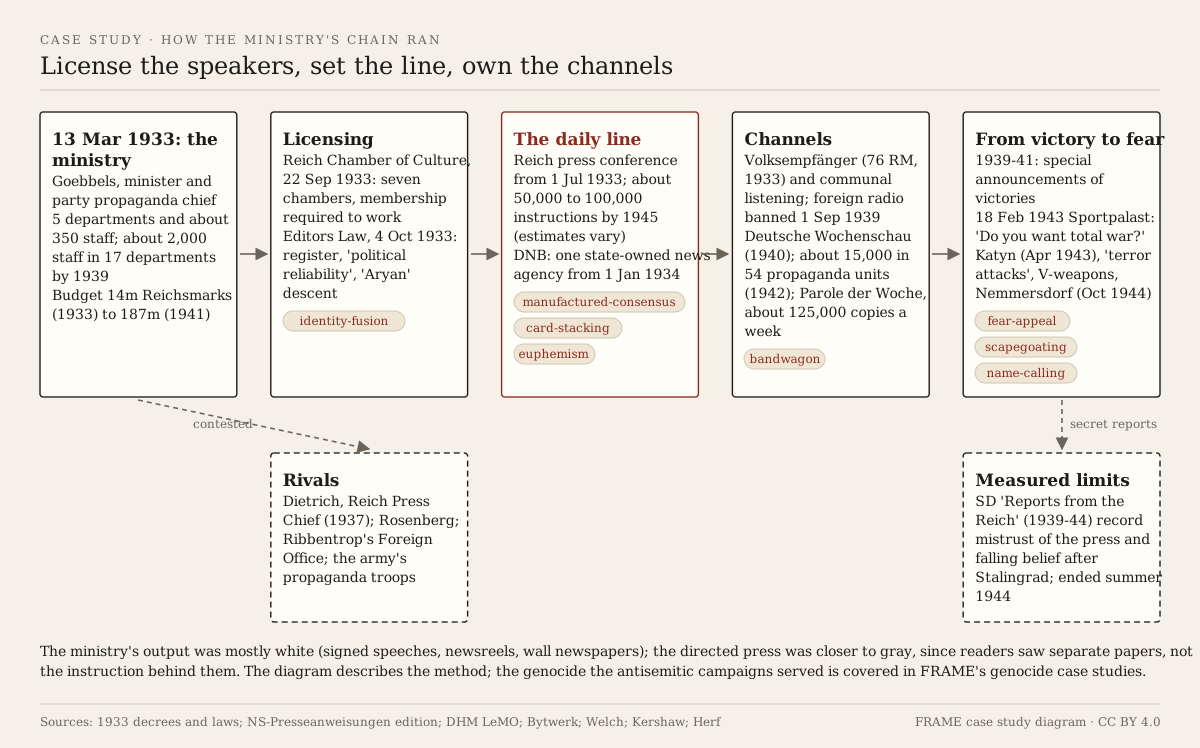
In one line: founded on 13 March 1933 with Joseph Goebbels as minister, the Reich Ministry of Public Enlightenment and Propaganda licensed everyone who wrote, broadcast, filmed, painted or performed in Germany, gave the press its line at a daily conference, put cheap radio sets in most homes, took the army's front reporting into its channels, and turned its messaging from victory to fear after Stalingrad, while the German state's own secret morale reports recorded the limits of what it could make people believe.
What happened
Founding and structure
- 13 March 1933. A decree of President Hindenburg creates the Reich Ministry of Public Enlightenment and Propaganda (RMVP) to inform and propagandise the population about the Reich government's policy. Goebbels, the NSDAP's propaganda chief since 1930, is appointed minister the next day. He keeps the party post too: the NSDAP's Reich Propaganda Directorate (Reichspropagandaleitung) runs in parallel under him, so state and party propaganda share one head.
- 30 June 1933. A Hitler decree on the ministry's tasks transfers to it responsibility for the press, radio, film, theatre, the arts, exhibitions and "enlightenment" abroad, taken from the Interior Ministry, the Foreign Office and others. The ministry moves into the former Ordenspalais on Wilhelmplatz in Berlin, opposite the Reich Chancellery, and later adds a large new wing.
- Staff and budget. The ministry started with five departments and about 350 employees. By 1939 it had about 2,000 staff in 17 departments under three state secretaries, and its budget grew from 14 million Reichsmarks in 1933 to 187 million in 1941 (figures as given by the German Federal Archives' finding aids and standard reference works; see Sources). State secretaries were Walther Funk (1933-37), Karl Hanke (1938-41), Leopold Gutterer (1941-44) and Werner Naumann (1944-45); Otto Dietrich joined as a third state secretary in November 1937 in his role as Reich Press Chief.
- Departments covered the domestic press, foreign press, periodicals, radio, film, theatre, music, fine arts, literature, "active propaganda" (rallies, exhibitions, campaigns), and foreign countries. Hans Fritzsche ran the German press department from 1938 and the radio department from late 1942.
- Regional offices. State offices in each party region (from 1937 called Reich Propaganda Offices, Reichspropagandaämter) carried the ministry's line to the provinces, usually led by the party's regional propaganda chief, so that the state and party apparatus met again at local level.
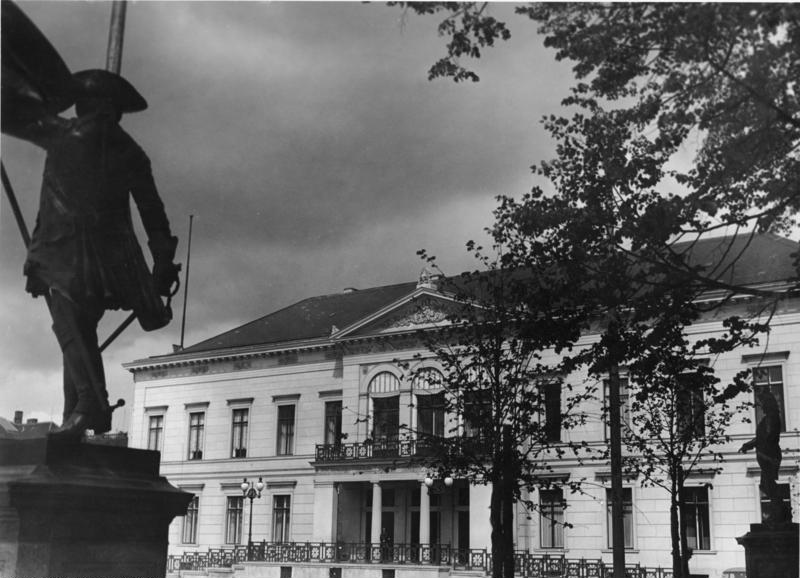
The ministry seen from Wilhelmplatz, Berlin, July 1936 (Bundesarchiv caption: "Blick vom Wilhelmplatz auf das Ministerium für Volksaufklärung und Propaganda"). Bundesarchiv, Bild 146-1993-020-32A, Bittner Bilderdienst, CC BY-SA 3.0 DE.
Licensing the producers
- 22 September 1933: the Reich Chamber of Culture (Reichskulturkammer). A law places all cultural work under a chamber presided over by Goebbels, with seven sub-chambers: literature, press, radio, theatre, music, fine arts and film. Membership is a condition of working in the field. Exclusion from a chamber, which was applied to Jews and to people judged politically unreliable, meant a ban on practising the profession. (The radio chamber was dissolved in 1939.)
- 4 October 1933: the Editors Law (Schriftleitergesetz). Journalism becomes a public office. Every editor must be entered on a register kept by the press association under the ministry's supervision, and must show "political reliability" and "Aryan" descent (for himself and his spouse). Editors are made legally responsible to the state for what they publish, not to their publishers. The law takes effect on 1 January 1934, and many hundreds of journalists lose their jobs (USHMM; Arolsen Archives).
Setting the line every day
- The Reich press conference. From 1 July 1933 the ministry holds a daily press conference in Berlin, where selected journalists receive the day's instructions (Presseanweisungen): what to report, how prominently, in what tone, and what to leave out. Estimates of the number issued between 1933 and 1945 run from about 50,000 to between 80,000 and 100,000. Participants were required to destroy the instructions after use; several did not, and the notes kept by Karl Brammer and Fritz Sänger (now in the Bundesarchiv as ZSg. 101 and ZSg. 102) are the basis of the published scholarly edition NS-Presseanweisungen der Vorkriegszeit.
- 5 December 1933: the Deutsches Nachrichtenbüro (DNB). The two largest German news agencies, Wolff's Telegraphisches Bureau and the Telegraphen-Union, are merged into a single state-owned agency, which issues its first reports on 1 January 1934. Most German papers now take their national and foreign news from one source the ministry controls.
- The Reich Press Chief. From November 1937 Otto Dietrich, Hitler's press chief and also a state secretary in the ministry, sends Hitler's own press wishes from headquarters. During the war his office issues a daily slogan (Tagesparole) for the press. The two lines of command overlapped, and Goebbels's diaries record years of friction with Dietrich. On 9 October 1941 Dietrich told the foreign and German press that the Soviet Union was militarily finished; the headlines that followed had to be walked back as the war in the East went on.
Channels
- Radio and the Volksempfänger. The ministry took control of the Reich Broadcasting Company (Reichs-Rundfunk-Gesellschaft). On 18 August 1933, at the Berlin radio exhibition, it presented the Volksempfänger (people's receiver) VE 301, named after 30 January, the date Hitler became chancellor, priced at 76 Reichsmarks. A smaller Deutscher Kleinempfänger (DKE) followed in 1938 at 35 Reichsmarks. The sets were cheap because they were simple, and their limited range favoured German stations. Welch gives about 70 per cent of German households as owning a radio by 1939.
- Communal listening (Gemeinschaftsempfang). Major speeches were relayed to factories, offices, schools and public squares through loudspeakers, and party radio wardens (Funkwarte) organised listening and reported on it. The point was that listeners heard the speech among others and saw them listening.
- 1 September 1939: the ban on foreign broadcasts. The Decree on Extraordinary Radio Measures makes deliberate listening to foreign stations punishable by prison, and spreading news heard on them punishable by prison or, in serious cases, death. Special courts tried "radio crimes" throughout the war.
- Newsreel. In June 1940 the four German newsreels were merged into a single Deutsche Wochenschau, compiled under the ministry's supervision and screened before every feature film. (Film production, including the ministry-commissioned antisemitic features, is covered in FRAME's wartime film case studies (Film under Goebbels: Triumph des Willens (1935) and Der ewige Jude (1940)).)
- The Propagandakompanien. In 1938 Goebbels and Wilhelm Keitel, head of the Armed Forces High Command (OKW), signed an agreement on "the conduct of propaganda in war". The first four propaganda companies were formed that year and went into the Sudetenland in October 1938. They were military units, commanded from 1939 by Hasso von Wedel's Wehrmacht propaganda branch, whose reporters (writers, photographers, film cameramen, radio reporters and war artists) were soldiers. Their material went to the ministry and the press for home and foreign use, including the newsreel and the foreign-language magazine Signal. By 1942 about 15,000 people served in 54 propaganda units of the army, air force, navy, occupied territories and Waffen-SS (Deutsches Historisches Museum, LeMO).
- Parole der Woche. The party's Reich Propaganda Directorate issued a weekly wall newspaper, a large poster displayed in market squares, stations, factory canteens, waiting rooms and offices. The first issue appeared on 29 March 1936 and the last on 25 February 1943, about 400 issues in all, with around 125,000 copies posted each week (Bytwerk, German Propaganda Archive). Its themes were anti-Bolshevik, anti-British, anti-American and, repeatedly, antisemitic.
- Das Reich. From May 1940 the party's publishing house issued a prestige weekly, Das Reich, for which Goebbels wrote the lead article; his leaders were also read on the radio.
Campaign shifts
- 1939-41: victory. Radio special announcements (Sondermeldungen), introduced from 1941 by a fanfare from Liszt's Les Préludes, and the newsreel's front footage carried a message of rapid, cheap victory in Poland, Scandinavia, the West and the Balkans, and in the first weeks of the invasion of the Soviet Union.
- Winter 1942-43: the post-Stalingrad turn. On 3 February 1943 the radio announced the end of the Sixth Army at Stalingrad, followed by three days of national mourning. Propaganda moved from promising victory to warning of what defeat would mean.
- 18 February 1943: the Sportpalast speech. Before an invited audience in the Berlin Sportpalast, under a banner reading "Totaler Krieg – kürzester Krieg" ("Total war – shortest war"), Goebbels put ten questions to the hall "as representatives of the nation". The fourth was: "Wollt ihr den totalen Krieg? Wollt ihr ihn, wenn nötig, totaler und radikaler, als wir ihn uns heute überhaupt erst vorstellen können?" ("Do you want total war? If necessary, do you want it more total and radical than we can even imagine it today?"). The speech was broadcast on radio and cut into the newsreel. See Totaler Krieg – kürzester Krieg (Total War – Shortest War): the Sportpalast rally of 18 February 1943.
- Spring 1943: fear of Bolshevism. An anti-Bolshevik propaganda plan dated two days after the speech set the tone for the following weeks; by the end of March Goebbels told the press to drop the campaign so that the public would not tire of the same theme (Bytwerk). The line of this period is often summed up as "Kraft durch Furcht" ("strength through fear"), a play on the Labour Front's leisure organisation Kraft durch Freude.
- From 13 April 1943: Katyn. German radio announced the discovery of mass graves of Polish officers in the Katyn forest near Smolensk. The ministry gave the story daily coverage from mid-April into August 1943, brought an international commission of forensic specialists and other delegations to the site, and used the findings to argue that the Western Allies were tied to a murderous partner. The Polish government in London asked the International Red Cross to investigate, and the Soviet Union broke off relations with it on 25 April. The underlying finding was true: the Soviet Union admitted in 1990 that the NKVD carried out the shootings in 1940 (see Soviet wartime propaganda, 1939-1945: Sovinformburo, Agitprop and the Red Army press). The same campaign did not mention the mass shootings German units were carrying out in the same occupied territories.
- The air war. Goebbels chaired the interministerial committee on air-raid damage, and the press was instructed to call Allied raids "terror attacks" (Terrorangriffe) and their crews "terror flyers". From 1943 the ministry promised "retaliation" (Vergeltung) and new "wonder weapons" (Wunderwaffen). When the first flying bombs hit London in June 1944, it named the weapon V-1 (Vergeltungswaffe 1, "retaliation weapon 1"); after the gap between promise and effect, the V-2 was not announced until November 1944, two months after its first use (Smithsonian National Air and Space Museum).
- October 1944: Nemmersdorf. After Red Army troops briefly took the East Prussian village of Nemmersdorf on 21 October 1944, the ministry used the Völkischer Beobachter and the newsreel to show the killing of civilians there. Research since 1991, notably by Bernhard Fisch, has established that civilians were killed there but that the ministry's version was embellished, and that the campaign was meant to stiffen resistance to the advancing Red Army.
- 25 July 1944. After the 20 July bomb plot, Hitler names Goebbels Reich Plenipotentiary for Total War, with powers over the civilian labour force.
Antisemitic campaigns as ministry operations
The Holocaust, Der Stürmer (a privately owned party paper) and the film Der ewige Jude are covered in FRAME's genocide and film case studies (film: Film under Goebbels: Triumph des Willens (1935) and Der ewige Jude (1940)). The ministry's own operations included:
- November 1938. After the pogrom of 9-10 November, which Goebbels set in motion with a speech in Munich, the ministry steered the press through the daily conference: first to present the violence as the "people's anger" at the killing of the diplomat Ernst vom Rath, then, on 14 November, as Fritzsche relayed, to report that demonstrations against Jewish shops must stop (Yad Vashem).
- 16 November 1941. Goebbels's lead article in Das Reich, "Die Juden sind schuld" ("The Jews are guilty"), blamed Jews for the war, cited Hitler's "prophecy" of January 1939 that a world war would bring "the annihilation of the Jewish race in Europe", and said it was now being fulfilled. The article was read on the radio and reprinted as a leaflet (Stadtmuseum Halle).
- 1941. The ministry publicised a self-published American pamphlet by Theodore N. Kaufman, Germany Must Perish!, as if it were Allied or "Jewish" war policy; the ministry official Wolfgang Diewerge wrote the pamphlet presenting it to German readers.
- Press directives and the Parole der Woche carried antisemitic themes through the war; Jeffrey Herf's The Jewish Enemy reconstructs them from the directives, the wall newspaper and the press.
How it ended
- The ministry building on Wilhelmplatz was largely destroyed in an Allied air raid in March 1945. Goebbels and his wife killed themselves in Hitler's bunker on 1 May 1945, after their six children had been killed. Hitler's testament named Werner Naumann as Goebbels's successor. Fritzsche was tried at Nuremberg and acquitted on 1 October 1946; Dietrich was sentenced in the Ministries Case in 1949.
How it works
- Manufactured consensus: the daily press conference and the DNB meant that nominally separate newspapers printed the same line under their own mastheads, with emphasis, placement and omissions set in Berlin. A reader who saw the same judgement in several papers had no way to know it came from one instruction, which is why the notes of Brammer and Sänger matter.
- Card stacking: the Katyn campaign is the clearest case. The core finding was true, and the ministry pushed it daily for months while leaving out the German mass shootings in the same region. The same selection ran through the press directives on what to omit.
- Fear appeal: after Stalingrad, the anti-Bolshevik plan of February 1943, the Sportpalast speech, the Nemmersdorf coverage and the "terror attack" language all said that defeat meant annihilation, so the only choice left was to keep fighting.
- Bandwagon: communal listening and the Sportpalast audience answering ten questions "for the nation" staged agreement as something the listener could see and hear, and the staged roar was broadcast as the nation's answer (Totaler Krieg – kürzester Krieg (Total War – Shortest War): the Sportpalast rally of 18 February 1943, Gemeinschaftsempfang der Rede des Führers (communal listening to the Führer's speech): shop notice).
- Identity fusion: the Chamber of Culture and the Editors Law made "political reliability" a condition of being allowed to work, and the single-list plebiscites told voters that one people, one leader and one answer were the same thing (Ein Volk, ein Führer, ein Ja (One People, One Leader, One Yes)).
- Scapegoating: the November 1938 press line and "Die Juden sind schuld" (1941) placed the blame for the war and its hardships on Jews.
- Accusation in a mirror: the Kaufman campaign of 1941 and the 1941 article accused Jews of planning the destruction of the German people, while the German state was deporting and murdering Jews. The fit is close: the charge was made while the act it mirrored was under way.
- Name-calling: "terror flyers" and "terror attacks" for Allied bomber crews and raids, fixed by press instruction.
- Euphemism / doublespeak: the press was given words such as "straightening the front" (Frontbegradigung) and "disengaging movement" (Absetzbewegung) for retreats. The fit with the taxonomy is direct: the phrase replaced the event.
Colour. Most of the ministry's output was white: speeches, newsreels, posters and the Parole der Woche carried their source. The directed press was closer to gray, since readers saw independent titles, not the instruction behind them. The ministry also ran black operations abroad, such as the Büro Concordia stations that posed as British opposition broadcasters; those are summarised with their British counterparts in Britain's Ministry of Information and Political Warfare Executive: posters at home, black radio abroad and described station by station in FRAME's wartime radio case study (Wartime radio voices: open and hidden broadcasts aimed at the enemy, 1939-1945).
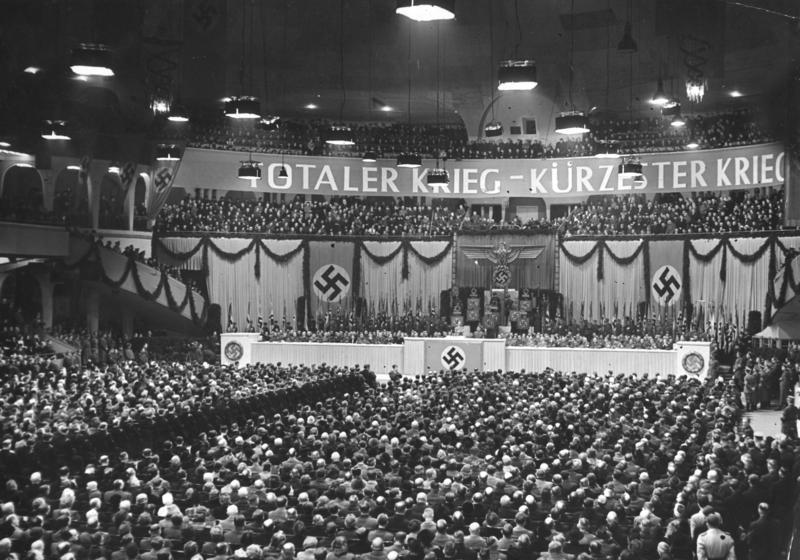
Totaler Krieg – kürzester Krieg (Total War – Shortest War): the Sportpalast rally of 18 February 1943: the Berlin Sportpalast during Goebbels's "total war" speech, 18 February 1943. Bundesarchiv, Bild 183-J05235, photo: Schwahn, CC BY-SA 3.0 DE.
Then and now
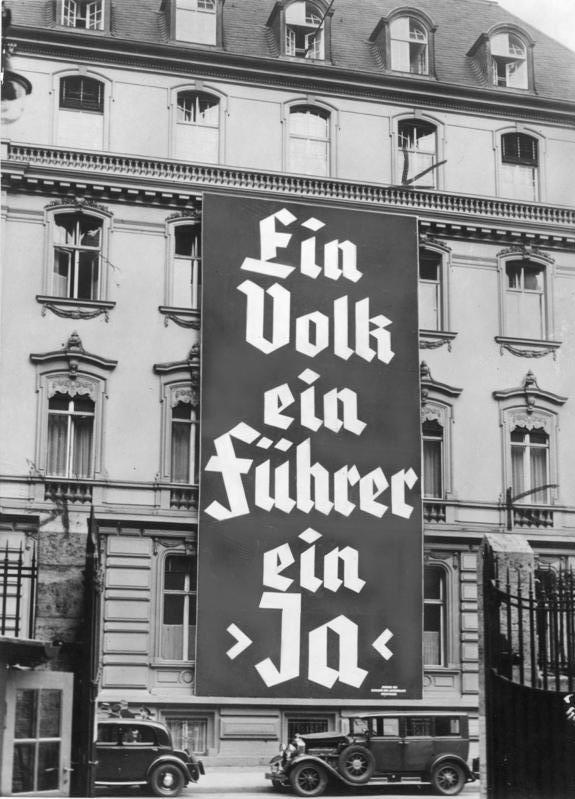
Ein Volk, ein Führer, ein Ja (One People, One Leader, One Yes): "One people, one leader, one Yes", Berlin, November 1933. Bundesarchiv, Bild 183-K0930-502, CC BY-SA 3.0 DE.
The banner went up eight months after the ministry was founded, for a single-list election and referendum. It fuses nation, leader and vote, so that voting No means leaving the people. FRAME's case study Alaj: the portal Iranian state media promoted for reporting 'traitors abroad' finds a similar fusion in 2026 Iranian state media, which presented reporting on fellow citizens as a patriotic duty. The differences are large. In 1933 the RMVP was building a monopoly: it licensed every journalist and artist, controlled the only national news agency and would soon make listening to foreign radio a crime. The Iranian outlets in 2026 compete with satellite channels, VPNs and diaspora media their audience can reach. The German campaign served the consolidation of a one-party state that went on to wage a war of conquest and genocide. The Iranian case is a security campaign during a regional conflict. The technique is comparable; the scale and the surrounding system are not.
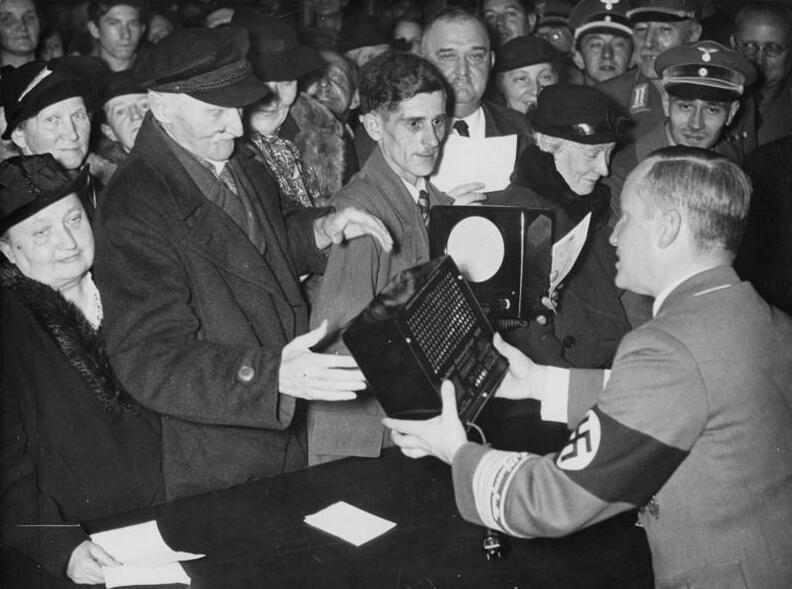
Party officials hand out 500 new small radio receivers to "needy national comrades" in Berlin on Goebbels's birthday, October 1938 (original press caption). Bundesarchiv, Bild 183-H14243, photo: Nau, CC BY-SA 3.0 DE.
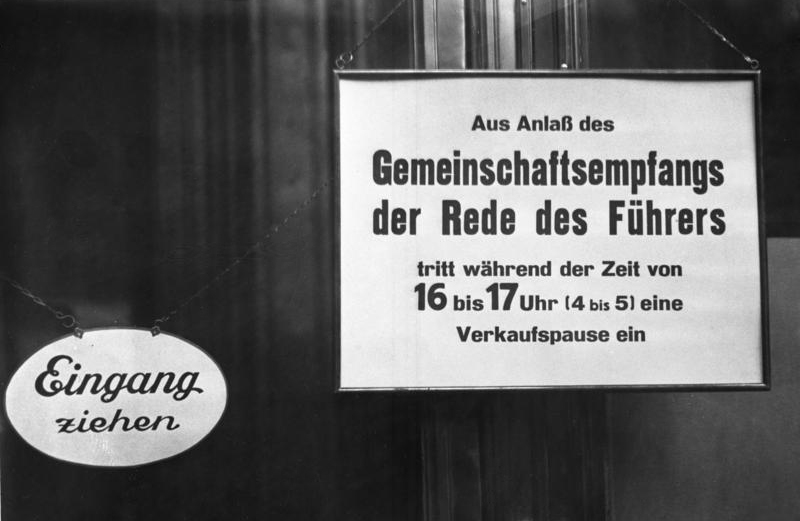
Gemeinschaftsempfang der Rede des Führers (communal listening to the Führer's speech): shop notice: a shop closes from 4 to 5 pm "on the occasion of the communal reception of the Führer's speech", 1935 (an election speech, per the archive caption). Bundesarchiv, B 145 Bild-P046302, photo: Carl Weinrother, CC BY-SA 3.0 DE.
Positions on the record
- The ministry's own rationale. In his speeches to the press on 15 and 25 March 1933 (translated in German History in Documents and Images), Goebbels described the ministry's task (paraphrased here) as winning the whole people over to the government, so that the press and the other media would follow the government's direction rather than stand outside it as critics. He presented the Chamber of Culture as a self-governing professional body and the Editors Law as raising journalism to a public office. The Sportpalast speech presented total war as the only way to save Europe from Bolshevism.
- Contemporaries' criticism. Inside Germany, open criticism was a crime; the SD's secret reports are the best record of doubt. These Meldungen aus dem Reich (1939-44) recorded rumours, mistrust of the press, the spread of foreign-radio news and, after Stalingrad, sharp falls in trust. The historian Randall Bytwerk calls them "relatively objective as Nazi sources go". The reports were reorganised in mid-1943 and ended in summer 1944, in part because the leadership disliked their pessimism. Abroad, the ministry's claims were answered daily by the BBC and, from 1942, by the U.S. Office of War Information.
- Later historians. Z. A. B. Zeman (Nazi Propaganda, Oxford 1964) and Ernest K. Bramsted (Goebbels and National Socialist Propaganda 1925-1945, Michigan State 1965) described the apparatus. David Welch (The Third Reich: Politics and Propaganda, Routledge 2002; "Propaganda and Indoctrination in the Third Reich: Success or Failure?", European History Quarterly, 1987) argues that it worked best when it reinforced existing beliefs, such as anti-communism, national grievance and the Hitler cult, and worst when it contradicted what people could see, as with the air raids and the eastern front after 1942. Ian Kershaw (The "Hitler Myth", Oxford 1987) uses the SD reports to trace how Hitler's popularity rose with cheap victories and fell after Stalingrad, and how trust in the party and its propaganda fell earlier than trust in Hitler himself. Peter Longerich (Goebbels, 2010; English 2015) documents the rivalries with Dietrich, Rosenberg and Ribbentrop; Daniel Uziel (The Propaganda Warriors, 2008) the Propagandakompanien; Jeffrey Herf (The Jewish Enemy, Harvard 2006) the antisemitic line; Bernhard Fisch (Nemmersdorf, Oktober 1944, 1997) the Nemmersdorf story.
- Rivalries. The ministry never had the monopoly its organisation chart suggests. Dietrich's press office reached Hitler first. Alfred Rosenberg, Hitler's commissioner for ideological training from 1934 and minister for the occupied eastern territories from 1941, fought Goebbels over cultural policy and over propaganda in the East. Joachim von Ribbentrop's Foreign Office built its own press and radio departments from 1939 and disputed control of foreign propaganda. The army ran the Propagandakompanien, and Max Amann's Eher Verlag owned most of the party press.
- This archive's reading. Documented: the founding decrees, the licensing laws, the daily press instructions (tens of thousands of which survive in journalists' notes), the merger of the news agencies, the radio programme and the foreign-radio ban, the size of the propaganda companies, the Sportpalast speech, and the Katyn, Nemmersdorf and V-weapon campaigns. Documented by the government's own reports: the limits of belief, especially after 1942. Not shown: that propaganda alone produced support for the government or the war. The historical record points to a mix of propaganda, coercion (the foreign-radio ban, the camps, the courts), early military success, material benefits and beliefs many Germans already held, and historians differ on the weight of each.
Same-method test
Every belligerent built a wartime information ministry, and the same ids apply to each.
- Britain. The Ministry of Information (from 4 September 1939) ran censorship and home publicity, and the Political Warfare Executive ran leaflets and black radio against Germany (Britain's Ministry of Information and Political Warfare Executive: posters at home, black radio abroad). In the air war, Bomber Command's area-bombing directive of 14 February 1942 made the "morale of the enemy civil population" a target, while the Air Minister told the Commons that the targets were military and industrial. That is scored as Euphemism / doublespeak, the same id used above for Frontbegradigung.
- United States. The Office of War Information (June 1942) coordinated domestic and foreign information, and the Office of Censorship ran a voluntary press code; the Army Signal Corps' combat photographers and film units did the work of the Propagandakompanien (The U.S. Office of War Information and the Writers' War Board: a 'strategy of truth' meets the advertising men).
- Soviet Union. Sovinformburo's daily war summaries and the Red Army's political administration set the line through a party-controlled press, and the Soviet Katyn denial is the mirror of the German Katyn campaign (Soviet wartime propaganda, 1939-1945: Sovinformburo, Agitprop and the Red Army press). Italy's Ministry of Popular Culture was modelled partly on the German ministry (Fascist Italy's propaganda machine: from the Duce's Press Office to the Ministry of Popular Culture).
The differences are as plain as the similarities. British and U.S. newspapers stayed privately owned and could and did criticise their governments; British censorship was formally voluntary and was challenged in Parliament; listening to German radio was legal in Britain, while in Germany listening to the BBC could lead to prison or death. Neither the MoI nor the OWI licensed who could work as a journalist or artist, and neither ran a racial exclusion from the professions. The Soviet system was closer to the German one in control, but its war propaganda was made during an invasion of its own territory. A "terror flyer" headline and a Commons answer about "industrial targets" are both frames on the same bombing campaigns; the German one came with a licensing and punishment system, and the British one with a Parliament that could question it.
How to spot it
- When many outlets say the same thing in the same week, ask whether they reached it separately or were given it. The Reich press conference existed so that the answer could not be seen.
- Ask who licenses the speakers. Where working as a journalist or artist requires official approval, the absence of dissent is a result of that approval, not evidence of agreement.
- Watch for a switch from promise to threat. When "we are winning" becomes "if we lose, you will be destroyed", the message has stopped describing events and started managing fear.
- A true atrocity can be used selectively. Katyn was real; what the campaign left out is part of the evidence.
- Compare what is said with what people can see for themselves. The SD reports show that belief fell fastest where propaganda contradicted experience: the bomb damage, the casualty lists, the "wonder weapons" that did not change the war.
Images
| Image | Source | Licence |
|---|---|---|
| Mechanism diagram (above) | Drawn for FRAME from this page's sourced facts (make_diagrams.py) |
CC BY 4.0, FRAME |
| Ein Volk, ein Führer, ein Ja banner, 1933 | FRAME gallery; Bundesarchiv, Bild 183-K0930-502 | CC BY-SA 3.0 DE |
| Sportpalast rally, 18 February 1943 | FRAME gallery; Wikimedia Commons, Bundesarchiv, Bild 183-J05235, photo: Schwahn | CC BY-SA 3.0 DE |
| Shop notice for communal listening, 1935 | FRAME gallery; Wikimedia Commons, Bundesarchiv, B 145 Bild-P046302, photo: Carl Weinrother | CC BY-SA 3.0 DE |
| The ministry from Wilhelmplatz, July 1936 | Wikimedia Commons, Bundesarchiv, Bild 146-1993-020-32A, Bittner Bilderdienst | CC BY-SA 3.0 DE |
| Radio sets handed out in Berlin, October 1938 | Wikimedia Commons, Bundesarchiv, Bild 183-H14243, photo: Nau | CC BY-SA 3.0 DE |


.jpg)
Image gaps
- German posters and the Parole der Woche sheets. Dropped: their U.S. copyright status is unclear, and FRAME hosts German wartime posters only when their status is verified.
- The ministry in ruins (1945) and a Propagandakompanie film cameraman (1942). Openly licensed Bundesarchiv photos exist on Wikimedia Commons (Bild 183-J313336, Bild 169-0336), but Commons rate-limited downloads from the build environment. This gap can be filled.
- U.S. Army photographs of the ministry or its records after 1945. None was found on loc.gov in the time available. Could be filled from NARA.
- The press directives themselves. The Brammer and Sänger collections are in the Bundesarchiv and not online as openly licensed images.
Sources
- Decree establishing the Reich Ministry for Public Enlightenment and Propaganda, 13 March 1933 (German History Intersections, GHI)
- Joseph Goebbels, two speeches on the tasks of the ministry, 15 and 25 March 1933 (German History in Documents and Images)
- Verordnung über die Aufgaben des Reichsministeriums für Volksaufklärung und Propaganda, 30 June 1933 (verfassungen.de)
- Reichsministerium für Volksaufklärung und Propaganda (Beamte nationalsozialistischer Reichsministerien) and Bundesarchiv holding R 55 (Archivportal-D)
- The Holocaust Explained: The Reich Ministry of Public Enlightenment and Propaganda
- USHMM Holocaust Encyclopedia: Ministry of Propaganda and Public Enlightenment and Editors Law
- Arolsen Archives: Nazi Germany's Schriftleitergesetz
- Zukunft braucht Erinnerung: Presselenkung im Dritten Reich; NS-Presseanweisungen der Vorkriegszeit, ed. Hans Bohrmann and Gabriele Toepser-Ziegert (K. G. Saur, 1984-2001)
- Decree on "Extraordinary Radio Measures", September 1939 (German History in Documents and Images)
- Deutsches Historisches Museum, LeMO: Propagandakompanien; Daniel Uziel, The Propaganda Warriors: The Wehrmacht and the Consolidation of the German Home Front (Peter Lang, 2008)
- Randall Bytwerk, German Propaganda Archive: Parole der Woche and Anti-Bolshevist Propaganda Plan (1943); Bytwerk, Bending Spines: The Propagandas of Nazi Germany and the German Democratic Republic (Michigan State University Press, 2004)
- "Total War": excerpt from Goebbels's Sportpalast speech, 18 February 1943 (German History in Documents and Images); German text (GHDI PDF)
- The Germans and Katyn, 1943 (Case Western Reserve Journal of International Law); Institute of National Remembrance: The Katyn lie
- Smithsonian National Air and Space Museum: The Myth of the German "Wonder Weapons"
- Bernhard Fisch, Nemmersdorf, Oktober 1944: Was in Ostpreußen tatsächlich geschah (edition ost, 1997)
- Yad Vashem: "An Antisemitic People": The Press Campaign After 9 November 1938
- Stadtmuseum Halle (museum-digital): leaflet "Die Juden sind schuld"; Jeffrey Herf, The Jewish Enemy: Nazi Propaganda During World War II and the Holocaust (Harvard University Press, 2006)
- David Welch, The Third Reich: Politics and Propaganda (Routledge, 2nd ed. 2002); Welch, "Propaganda and Indoctrination in the Third Reich: Success or Failure?", European History Quarterly 17 (1987)
- Ian Kershaw, The "Hitler Myth": Image and Reality in the Third Reich (Oxford University Press, 1987); Heinz Boberach (ed.), Meldungen aus dem Reich 1938-1945 (Pawlak, 1984)
- Ernest K. Bramsted, Goebbels and National Socialist Propaganda 1925-1945 (Michigan State University Press, 1965); Z. A. B. Zeman, Nazi Propaganda (Oxford University Press, 1964); Peter Longerich, Goebbels: A Biography (Random House, 2015)