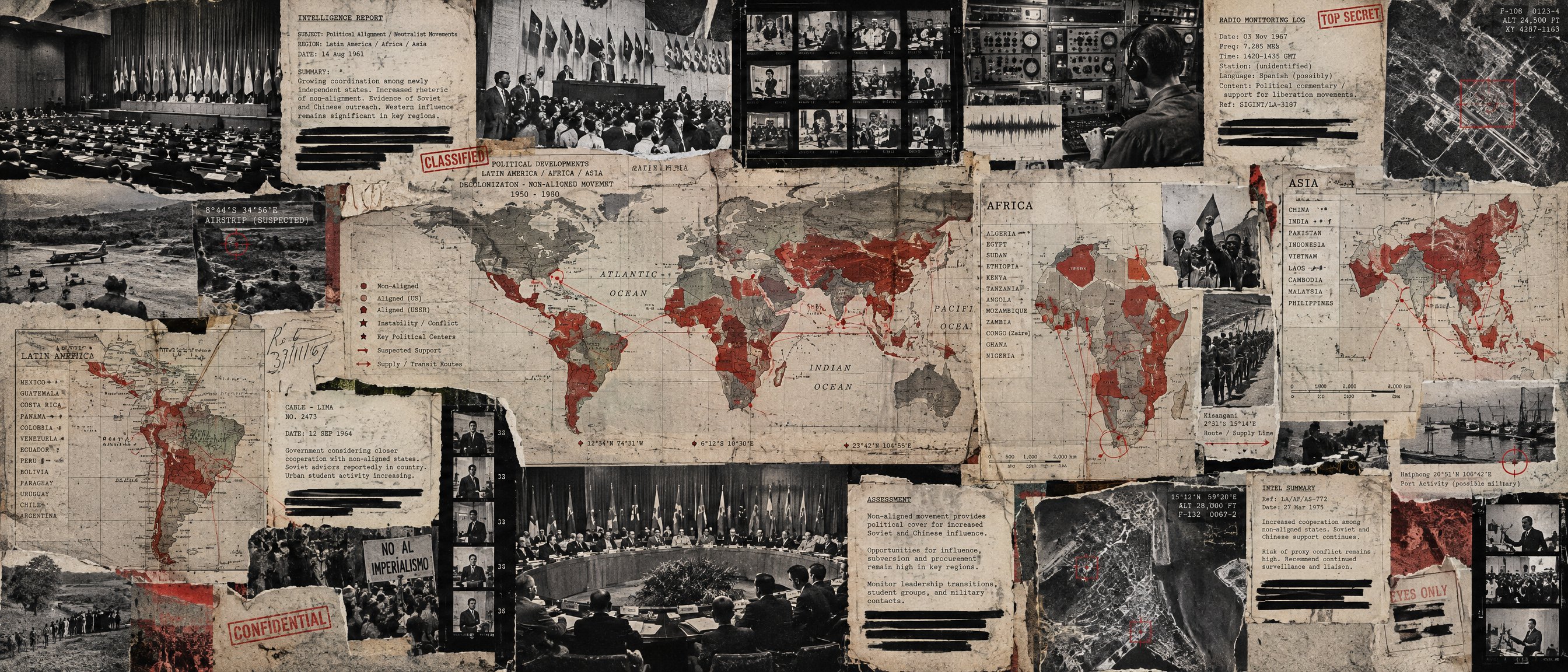
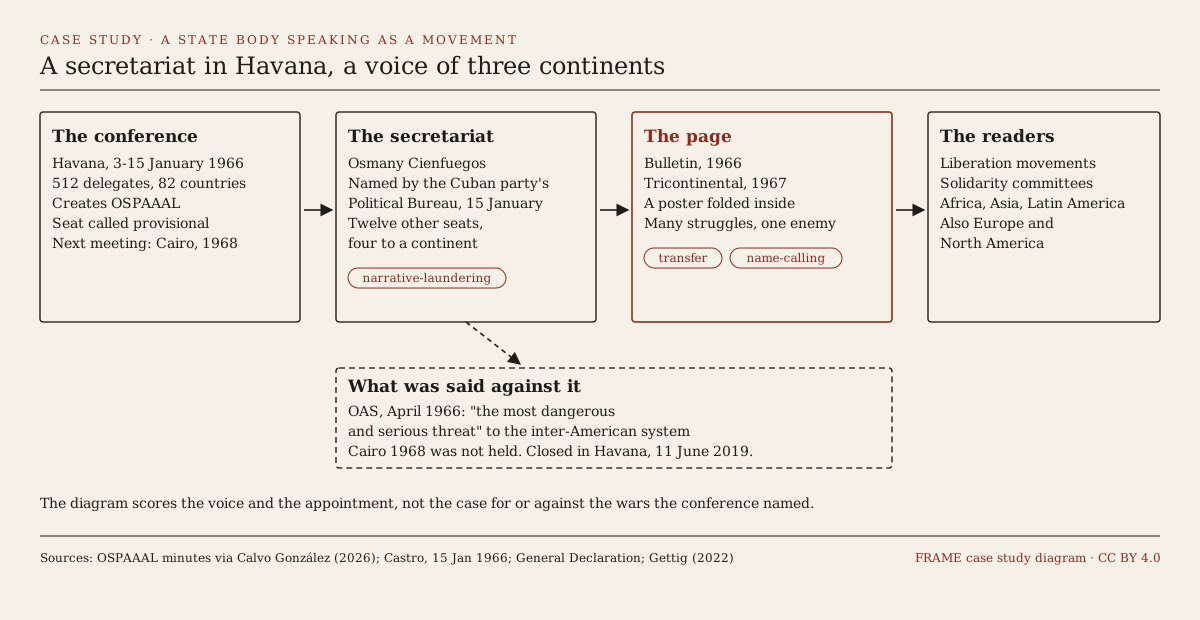
In one line: in January 1966 a conference of 512 delegates from 82 countries created an organization of the peoples of Africa, Asia and Latin America and gave it a provisional secretariat in Havana; the Cuban party's Political Bureau named the secretary general, and the magazine and the posters folded into it spoke as those peoples while naming one enemy.
What happened
- 29 October 1965. Mehdi Ben Barka, the Moroccan opposition leader who chaired the preparatory committee and was to preside, is kidnapped on a Paris street and is not seen again. On 5 June 1967 a French court sentences Morocco's interior minister, General Mohammed Oufkir, to life in absentia for the kidnapping and presumed murder. The conference meets without Ben Barka. On 3 January 1966 the heads of delegation give the chair to Cuba's foreign minister, Raúl Roa.
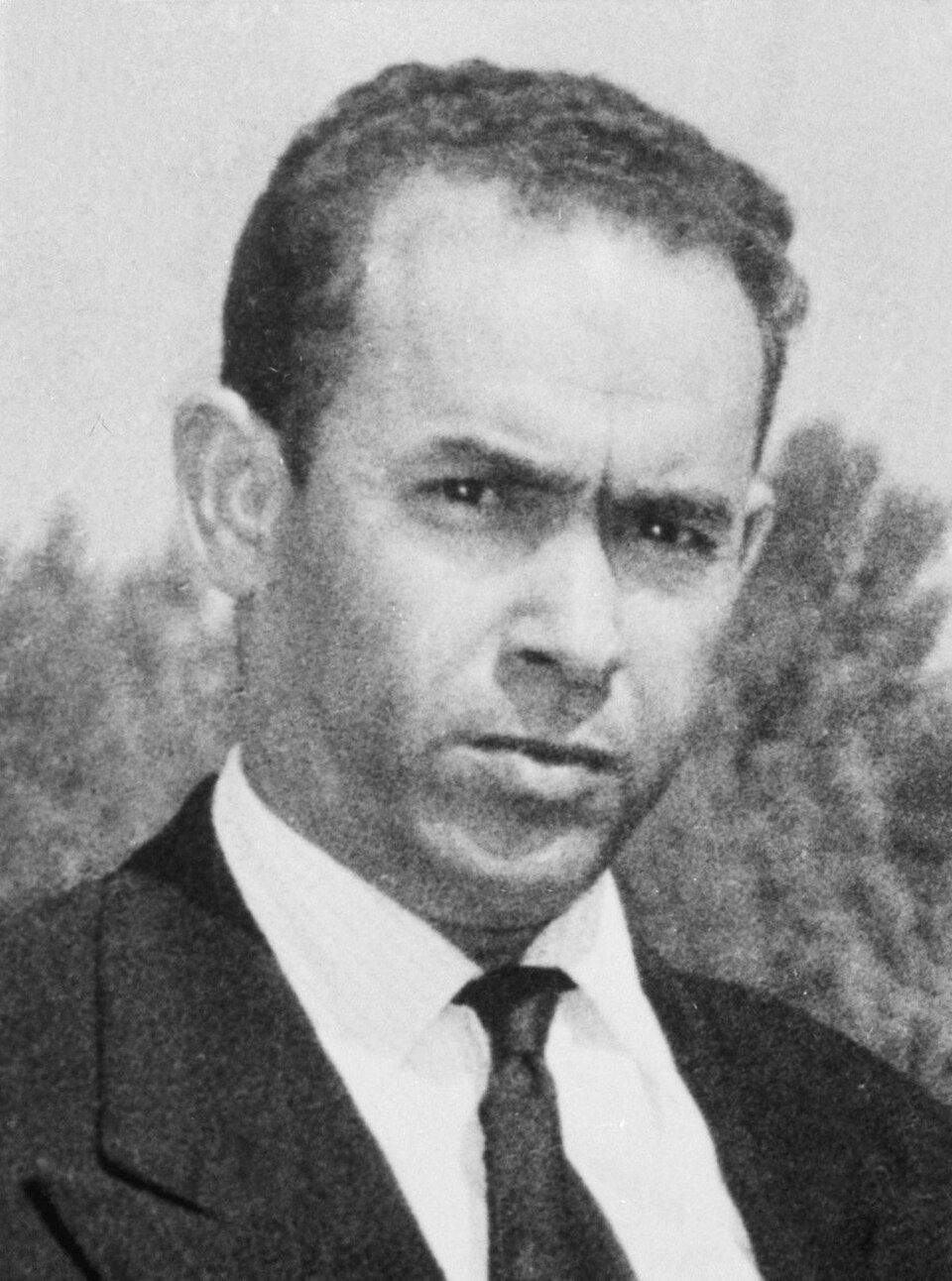
Mehdi Ben Barka, portrait dated 1965. Photographer unknown; Fotocollectie Algemeen Nederlands Persbureau (ANEFO), Nationaal Archief, The Hague, via Wikimedia Commons; CC0. Commons crops it from a larger original.
- 3-15 January 1966, Havana. The First Solidarity Conference of the Peoples of Africa, Asia and Latin America. An OSPAAAL balance of the meeting, cited by Patricia Calvo González from the organization's archive, counts 782 accredited participants: 512 delegates, 64 observers, 77 guests and 129 foreign journalists. Castro, closing the meeting, says "the revolutionary representations of 82 peoples" have met. Of the delegates, 165 are from Latin America, 150 from Africa and 197 from Asia, the Asian figure including the Soviet and Chinese delegations. Cuba's delegation is the largest, 41 people, then the Soviet Union with 40 and China with 34. A daily directing group of the Cuban delegation includes Armando Hart, Roa, Osmany Cienfuegos, Carlos Rodríguez and Manuel Piñeiro.
- 14 January 1966. Heads of delegation agree to create OSPAAAL as a new body, not a simple enlargement of the Afro-Asian People's Solidarity Organisation, and to set up a provisional executive secretariat in Havana. The twelve seats, four to a continent, are the United Arab Republic, Guinea, the Portuguese colonies and Congo-Leopoldville; Venezuela, the Dominican Republic, Puerto Rico and Chile; South Vietnam, Korea, Syria and Pakistan. Cuba is not on that list. A separate aid committee, also seated in Havana, does include Cuba, with one Latin American seat left empty because those delegations have not agreed. The same compromise sets a second conference for Cairo in 1968 and leaves the final shape of the organization until then. Cienfuegos, reporting to Raúl Castro, calls the outcome a diplomatic success for Cuba and says the new body will be "dirigido fundamentalmente por los movimientos de liberación nacional" ("directed fundamentally by the national liberation movements"). Calvo González records that the Cairo meeting failed. The Havana seat was never moved.
- 15 January 1966, Chaplin Theater. Fidel Castro's closing speech. He says Cuba has been chosen as the headquarters of the executive secretariat until the next conference, and that with the headquarters went the post of secretary general: "the Political Bureau of our party agreed to appoint Comrade Osmani Cienfuegos as secretary general." The OSPAAAL archive and later Cuban usage spell the name Osmany. He calls the struggle against imperialism, "whose center, axis, and principal support" is "Yankee imperialism," the thing the three continents have in common, and he says Cuban fighters "can be counted on by the revolutionary movement in any corner of the earth." Eric Gettig quotes him arguing that sooner or later nearly all peoples "will have to fight, arms in hand, for their liberation." The General Declaration says: "To destroy the domination of Yankee imperialism is an imperative issue for the complete and definitive victory of the anti-imperialist struggle in the three continents, and all efforts of the peoples should converge toward this aim."
- Inside the hall. President Osvaldo Dorticós, in his welcoming speech, calls U.S. imperialism "the center of world reaction and the foremost enemy of peace and progress." A resolution on peaceful coexistence, which Gettig describes as hotly contested, restricts that idea to relations between socialist and capitalist states, denies it between imperialists and their victims, and upholds the right of oppressed peoples to fight and to receive aid. Gettig reads the vote as a win for the Cuban hosts and the Maoist delegations over the Soviet line of gradual revolution. China, for its part, has resisted burying the Afro-Asian organization and a planned Afro-Asian conference in Beijing. The Soviet Union does not stay away: it has the second-largest delegation in the room.
- April 1966. OSPAAAL's Tricontinental Bulletin begins as a short newsletter to affiliated organizations. A file of issue 2 is dated May 1966, which fits a start in April. The longer magazine, presented as the theoretical organ, follows in 1967. Accounts place the first number in July or in August; this page does not settle the month. Language editions are Spanish, English and French. Josh MacPhee gives the early split as 25,000, 15,000 and 10,000. A later Cuban retrospective uses those three figures and also says 60,000. Arabic is added in 1968. Most issues include a poster, folded into the magazine rather than pasted up in Cuban streets, and the magazine authorizes reproduction of its articles. Natália Schmiedecke counts about 300 different posters by 1990, and some dozens more after that, and says the magazine went to about 90 countries through Cuban government bodies and redistribution centers abroad. It stops in 1990 and resumes in 1995, in Spanish and English, until the organization closes.
- 16 April 1967. The Executive Secretariat publishes Ernesto Guevara's "Message to the Tricontinental," under the watchword "Crear dos, tres... muchos Vietnam" ("Create two, three... many Vietnams"). He writes that the aim is "the total destruction of imperialism by armed struggle" and "eliminating its firmest bulwark: the oppression exercized by the United States of America." Where he wrote it, in Cuba before he left or from Bolivia, is disputed. The secretariat in Havana is the publisher. He is killed in Bolivia on 9 October 1967. Alfredo Rostgaard directs OSPAAAL's printed work from 1966; one account ends that tenure in 1975, another in 1976. Schmiedecke names the later heads of the Department of Information and Propaganda as Rafael Enríquez (1977-1987 and 2005-2019) and Eladio Rivadulla (1991-1997). The department is one of four. This page does not describe how the posters were printed.
- The critics, 1965-66. On 14 December 1965 Under Secretary of State George Ball tells U.S. embassies to expose the coming conference "for what it really is and whom it actually represents," and not to build public interest in it. In April 1966 an OAS committee's preliminary report says OSPAAAL "constitutes a positive threat to the free peoples of the world, and, on the hemispheric level, represents the most dangerous and serious threat that international communism has yet made against the inter-American system." A staff study for the Senate Internal Security Subcommittee, printed in 1966, frames its chapters as "U.S.A.--The Main Target" and "The Basic Goal--More Vietnams on a Tricontinental Scale." Gettig reports that the study treats Cuba as a headquarters for international revolutionary subversion. On 19 September 1966 Public Law 89-583 amends the Foreign Assistance Act so that the president may cut aid, and certain food sales, to any country he determines is "officially represented at any international conference when that representation includes the planning of activities involving insurrection or subversion" against the United States or against countries receiving that aid. The statute does not name OSPAAAL. Gettig places the amendment in the same season as the Senate study.
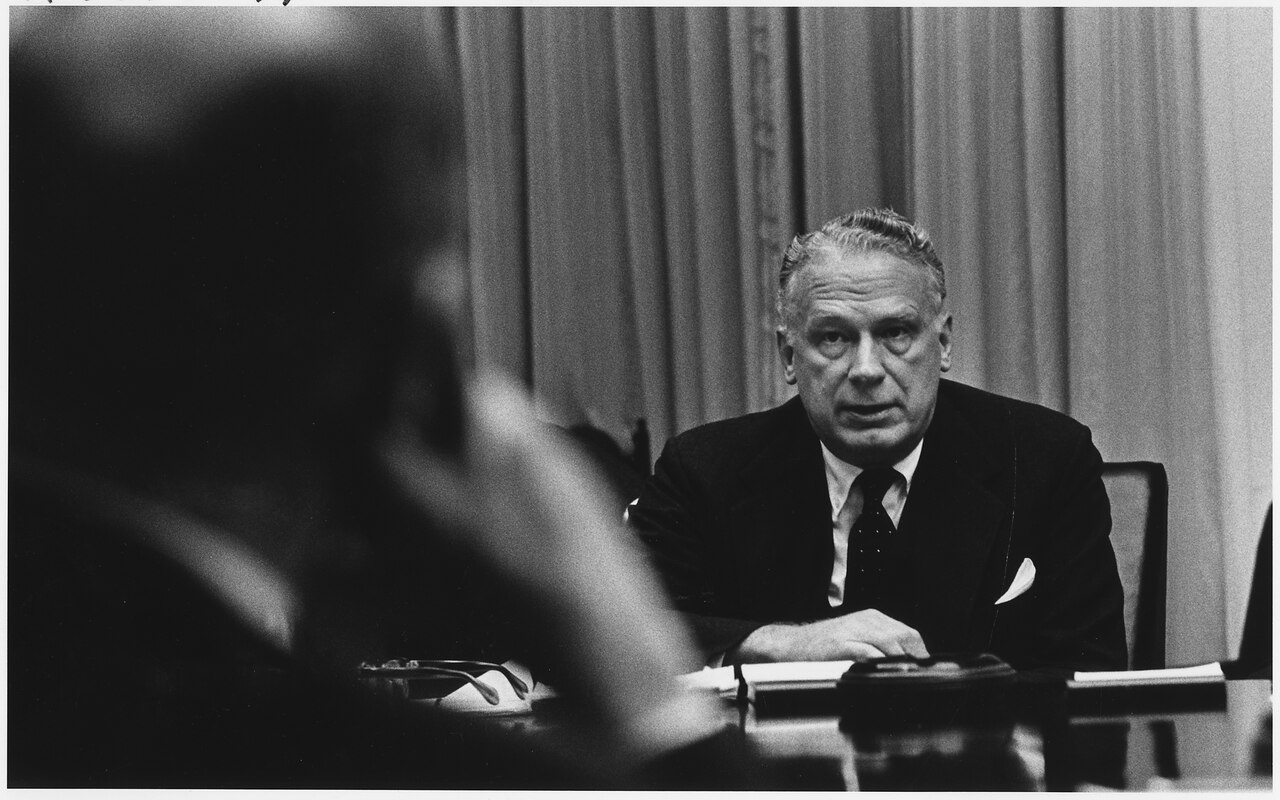
Under Secretary of State George Ball at a meeting in the White House Cabinet Room, 11 May 1966, four months after the conference. Photograph by Yoichi Okamoto, White House photographer; National Archives (NAID 192528), via Wikimedia Commons; public domain (U.S. federal government work).
- 11 June 2019. The Cuban government announces that OSPAAAL is closing. Eugenia Palieraki and Fernando Camacho Padilla, who were in the office that month, report the statement: "The organization has fulfilled its foundational mission of standing in solidarity with the struggles of Third World countries in their battles for decolonization and of promoting unity around the just causes of their peoples." They read the decision as a turn in Cuban foreign policy under Miguel Díaz-Canel and as a saving of money, and they list nine secretaries general, each appointed by the Cuban Communist Party: Osmany Cienfuegos Gorriarán (1966-1980), Melba Hernández Rodríguez del Rey (1980-1983), René Anillo Capote (1984-1994), Ramón Pez Ferro (1994-2000), Juan Carretero Ibáñez (2000-2003), Humberto Hernández Reinoso (2003-2005), Alfredo León Álvarez (2005-2006), Alfonso Fraga Pérez (2006-2012) and Lourdes Cervantes Vázquez (2013-2019). Their list leaves 1983-84 unnamed.
How it works
- Transfer: the magazine and the folded poster put Vietnam, the Portuguese colonies, Palestine, southern Africa and Latin American guerrillas in one series, then set Guevara's "many Vietnams" over that series. The prestige of those wars is borrowed for a secretariat whose secretary general a single party has just named.
- Name-calling: "Yankee imperialism," in Dorticós's welcome, in Castro's closing line and in the General Declaration, is the name toward which "all efforts of the peoples should converge." Vietnam, the Dominican occupation, apartheid and Cuba's own conflict are not the same fact. The label asks the reader to treat them as one before each is checked.
- Narrative laundering: the surface is an organization of three continents, with twelve seats assigned to other countries and movements. The pen is a secretary general named, in public, by the Political Bureau of the Cuban party, in a city the magazine does not hide. Havana on the page keeps this from being a false imprint. What the surface adds is the right to say "the peoples" rather than "the party that appointed the secretary general." It is not Astroturfing: the delegations were accredited organizations, not rented crowds.
Then and now
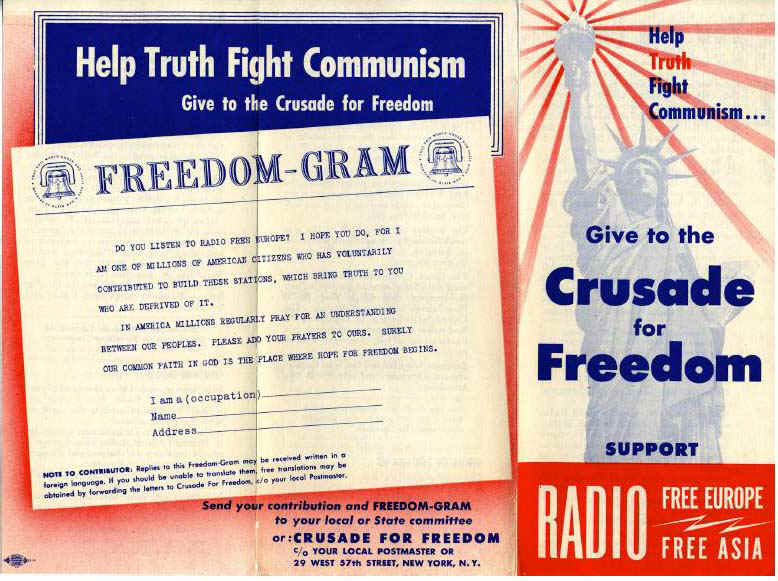
Freedom-Gram: Help Truth Fight Communism, Crusade for Freedom, 1952. Public domain.
In 1952 the Crusade for Freedom asked Americans to sign a card saying they had "voluntarily contributed" to build Radio Free Europe, when the station's main funder was the CIA. The Congress for Cultural Freedom: a CIA-funded intellectuals' network, 1950-1967 used the same layer from 1950 to 1967: an international association of writers, paid through foundations, whose members were mostly not told. OSPAAAL is the same method only up to the surface. A state keeps an international body and lets that body speak as something wider than the state. The differences are the ones that decide the color. The Crusade and the Congress hid the funder. OSPAAAL printed Havana, and Castro named Cienfuegos in a speech the next day's Granma carried. The people in the Havana hall were delegates of movements engaged in real wars, not scholars unaware of who paid. The Cuba-United States radio war: Radio Swan's cover story and Havana's 'gusanos' is the other direction in the same years: a station that called itself commercial, owned on paper by a shipping firm with no ships, and run by the CIA. That imprint was false. OSPAAAL's was incomplete.
Positions on the record
- The organization, and the Cuban party. The conference's own declaration makes destroying "Yankee imperialism" the common task of three continents. Cienfuegos tells Raúl Castro that the secretariat will be directed by national liberation movements, and also that Havana as the provisional seat is a Cuban success. In 2019 the government says the mission has been fulfilled.
- The United States and the OAS. Ball's December 1965 cable, the OAS preliminary report of April 1966, and the Senate staff study treat the conference as a propaganda forum and a headquarters for armed subversion. A National Security Council note of 18 February 1966, quoted by Gettig, calls the meeting a source of "excellent propaganda mileage" for Washington, "much of it generated by the Cubans and Soviets themselves."
- Inside the conference. The Soviet delegation is large, and it loses the argument on peaceful coexistence as Gettig reconstructs the vote. China fights to keep a separate Afro-Asian track. Calvo González, working from the OSPAAAL archive, finds the Cuban delegation decisive in the compromise that put the provisional seat in Havana. She also writes that those files privilege the Cuban view, and that she has not studied why Cairo 1968 failed.
- On the pictures. Schmiedecke argues that the posters fixed one reading of the "Third World," as oppressed, resistant and revolutionary, and that this reading framed Cuba's military and financial support abroad. That is a claim about the frame, not a finding that the colonial wars pictured were invented.
- What is documented: the dates of the conference, the archive's headcount, the 14 January compromise and the twelve seats, Castro's public appointment of Cienfuegos, the General Declaration's sentence on "Yankee imperialism," the bulletin and the magazine, Guevara's message as published on 16 April 1967, the OAS sentence, and the 11 June 2019 closure as two historians on the spot report it.
- What is contested: the day a Wikipedia entry should call the "founding" (the opening was 3 January, the heads of delegation agreed on 14 January, Castro spoke on 15 January; a 12 January date circulates without a citation in the minutes used here); Osmany against Osmani; where Guevara wrote the message; whether Rostgaard's tenure ended in 1975 or 1976; July or August 1967 for the first magazine, and 50,000 against 60,000 copies; how long the twelve non-Cuban seats actually met.
- What is not shown: a Cuban personnel order for each later secretary general, the text of the 2019 announcement in Granma rather than in the historians' English, or that every war named in the magazine was a fraud. This page does not score the military record of Cuba in Africa, or the merits of the wars against Portugal, apartheid and the United States in Vietnam.
Same-method test
A government of any bloc that hosted a real conference of movements, kept the secretariat after the next meeting failed, filled the secretary general's chair from its own party's bureau, and published a magazine in the name of those peoples would be scored the same way here. Hiding the funder, as the Congress for Cultural Freedom did, would be a further step, not a requirement. Inventing the member organizations would be a different method, and it is not what the Havana minutes show.
How to spot it
- Ask who names the secretary general after the group photograph. A founding conference and a permanent chair are not the same fact.
- Try to replace "the peoples" with the name of the body that can hire and fire the editor. If the sentence only works with the larger name, the larger name is doing the work.
- Count the enemies. One label covering several wars is a sorting device. Each war still has its own record.
- A line that says the magazine may be reproduced freely tells you the publisher wants the text to travel. It does not tell you who holds the press.
Images
| Image | Source | Licence |
|---|---|---|
| Mechanism diagram (above) | Drawn for FRAME from the sources below | CC BY 4.0, FRAME |
| Mehdi Ben Barka (1965) | Wikimedia Commons (Nationaal Archief, ANEFO) | CC0 |
| George Ball, Cabinet Room (1966) | Wikimedia Commons (National Archives, Yoichi Okamoto) | Public domain (U.S. federal government work) |

Image gaps
OSPAAAL poster art and the magazine covers are not hosted. The files below are on Wikimedia Commons and are tagged PD-Cuba. That tag is not a clear U.S. public-domain finding. The template's own table says Cuban corporate and government works do not expire, and that a Cuban work is public domain in the United States only if its Cuban term had already expired before Cuba joined Berne on 20 February 1997. Named designers, including Alfredo Rostgaard (died 2004), keep a term measured from the author's death. One file also reproduces Alberto Korda's photograph of Guevara, a separate copyright.
- File:OSPAAAL logo.jpg, tagged
PD-Cuba, 100 pixels wide, author given as OSPAAAL. - File:Inside outside.jpg, a 1967 poster ("We will destroy imperialism from the outside"), tagged
PD-Cuba, author given as OSPAAAL. - File:CheTriContinental.jpg, dated 1969, tagged
PD-Cuba, and built on the Guerrillero Heroico photograph. - File:Tricontinental bulletin issue 2 cover.jpg, dated May 1966, tagged
PD-Cuba. - File:Tricontinental issue 10 cover.jpg, dated 1969, tagged
PD-Cuba. - File:Tricontinental bulletin 60 front cover.jpg, dated March 1971, tagged
PD-Cuba. The category Tricontinental also lists the back cover of that issue. The category OSPAAAL has no other poster files.


Sources
- Patricia Calvo González, "Dirigir, mediar, proponer: la delegación cubana y la consolidación del internacionalismo revolucionario en la Conferencia Tricontinental", Tiempos de América 24 (2026). Cites the OSPAAAL historical archive, including "Control de delegados a la 1ª Conferencia Tricontinental" (1966) and the heads-of-delegation minutes of 14 January 1966.
- Fidel Castro, "At the Closing Session of the Tricontinental Conference", 15 January 1966, Chaplin Theater. FBIS translation from Havana domestic radio, 16 January 1966. The same appointment, in the English Granma of 16 January, is reprinted in World Outlook (February 1966).
- General Declaration, First Solidarity Conference of the Peoples of Africa, Asia and Latin America, quoted in Eric Gettig, "A Propaganda Boon for Us," in R. Joseph Parrott and Mark Atwood Lawrence, eds., The Tricontinental Revolution (Cambridge University Press, 2022). Gettig also cites the OAS preliminary report of April 1966, Ball's airgram A-6200 of 14 December 1965, and the NSC note of 18 February 1966.
- Ernesto Guevara, "Message to the Tricontinental", Executive Secretariat of OSPAAAL, Havana, 16 April 1967.
- Public Law 89-583, 19 September 1966, amending section 620(i) of the Foreign Assistance Act.
- U.S. Senate, Committee on the Judiciary, The Tricontinental Conference of African, Asian, and Latin American Peoples: A Staff Study (Government Printing Office, 1966). Chapter titles checked at latinamericanstudies.org/tricontinental.htm.
- "French Impose Life Terms on 6 in Ben Barka Case", New York Times, 6 June 1967.
- Natália Schmiedecke, "Oppressed, Resistant, and Revolutionary: The Third World as Designed in the OSPAAAL Graphic Art," Antíteses 16, no. 31 (2023).
- Josh MacPhee, "Constructing Third World Struggle: the Design of the OSPAAAL & Tricontinental", The Funambulist 22 (2019).
- Eugenia Palieraki and Fernando Camacho Padilla, "Hasta Siempre, OSPAAAL!", NACLA Report on the Americas (2019), doi:10.1080/10714839.2019.1693002.
- "Tricontinental Bulletin", Revolutionary Papers. The August-September 1966 number (5-6) is at the Internet Archive.