Content note. The stenographic record quoted below includes the crowd's shout "¡Paredón!" ("to the wall") and Castro's words "lacayos" and "parásitos." They are evidence of how the rally and the institution named opponents. They are not this archive's description of anyone.
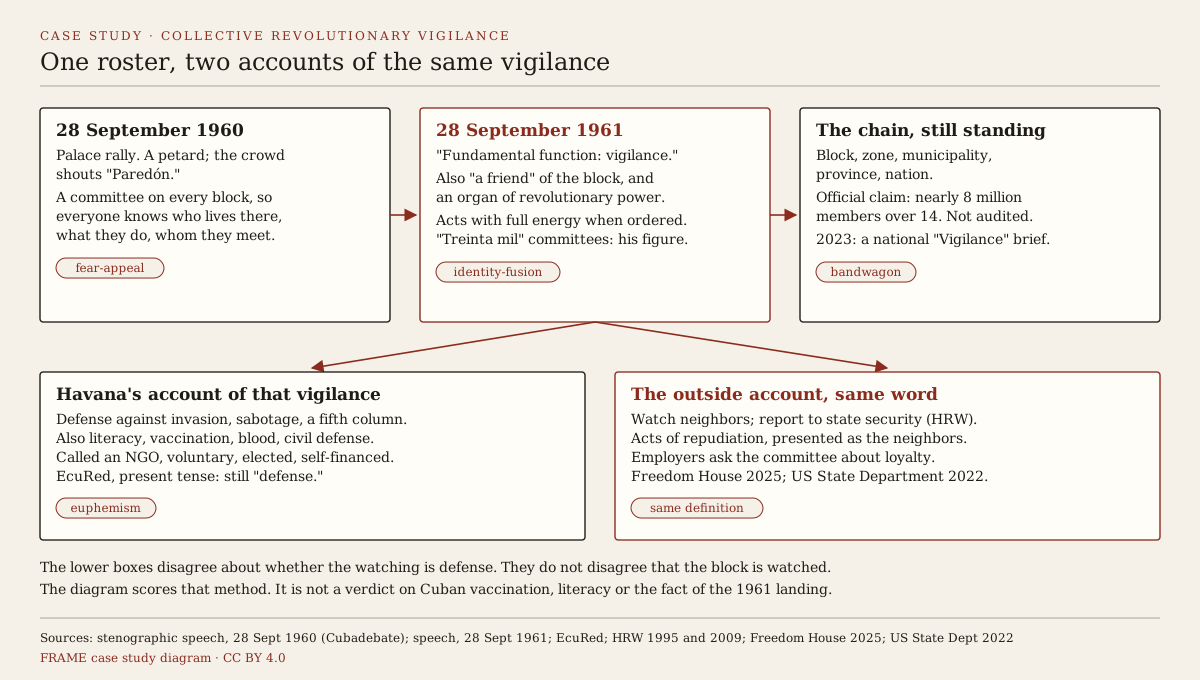
In one line: on 28 September 1960, outside Havana's Presidential Palace, Fidel Castro answered a petard in the crowd by announcing a system of collective revolutionary vigilance, a committee on every block so that everyone would know who lived there, what they did and whom they met; Havana still describes that body as the neighborhood's defense against invasion and sabotage, and outside reports describe the same committees as a standing network of surveillance and social pressure.
What happened
The announcement, 28 September 1960
- 28 September 1960, night. Fidel Castro, prime minister, speaks at a rally in front of the Presidential Palace on his return from the UN General Assembly. The text used here is the revolutionary government's stenographic version, as published by Cubadebate. During the speech the record marks a petard exploding. Castro calls the blasts "petarditos" paid for by imperialism. The crowd shouts "¡Paredón!" The 2025 Cubadebate introduction to the same text says two petards went off. This page does not decide who set them off. EcuRed's later account says nearly a million people were there; that is an official claim, not an independent count.
- The sentence that founds the committees. Castro says: "Vamos a establecer un sistema de vigilancia colectiva, ¡vamos a establecer un sistema de vigilancia revolucionaria colectiva! [...] Vamos a implantar, frente a las campañas de agresiones del imperialismo, un sistema de vigilancia colectiva revolucionaria que todo el mundo sepa quién vive en la manzana, qué hace el que vive en la manzana y qué relaciones tuvo con la tiranía; y a qué se dedica; con quién se junta; en qué actividades anda. [...] les implantamos un comité de vigilancia revolucionaria en cada manzana [...], para que el pueblo vigile, para que el pueblo observe." In this page's translation: a system of collective revolutionary vigilance, against imperialism's campaigns of aggression, so that everyone knows who lives on the block, what they do, what relations they had with the tyranny (the Batista government), what they devote themselves to, whom they meet and what activities they are in; a committee of revolutionary vigilance on every block, so that the people watch and observe. The government's own English site, Fidel Soldier of Ideas, renders "vigilancia" in this passage as "surveillance."
- Not the militia. The next sentences of the same speech call for militia battalions, zone by zone. The committees and the militias are announced together and are not the same body. EcuRed says the first committees were born at the end of the speech that night. Its list of national coordinators begins in 1961, with José Matar Franyie.
What Havana said the institution was, one year later
- 28 September 1961. At the first great assembly of the committees, in the Plaza de la Revolución, Castro says thirty thousand defense committees would not fit easily in the square. That is a rally figure, not a published registry.
- His definitions, in one speech. "No se olviden que los Comités de Defensa tienen por función fundamental la vigilancia, pero además la Revolución les ha asignado una serie de tareas." He also calls them "órganos de la Revolución" and "órganos del poder revolucionario." The neighborhood should see the committee as "una organización que es amiga," "dispuesta a ayudar," and at the same time "dispuesta a actuar con toda la energía que sea necesario cuando se lo ordene la Revolución." The task is proselytism and recruitment together with "una vigilancia severa e implacable sobre los enemigos de la Revolución."
- People leaving, and Girón. In that speech he tells the committees to watch people he calls "parásitos" who are preparing to leave, selling appliances and furniture, and he warns that those houses are for worker families. He assigns the watch "en colaboración con la CTC y el Ministerio de Seguridad." He also says that many of those arrested at the time of Girón have since "rectified," and that some have joined the Revolution. He does not give a number of arrests.
- 17 to 19 April 1961, Playa Girón. The landing itself, and the US covert broadcasts around it, are on The Cuba-United States radio war: Radio Swan's cover story and Havana's 'gusanos'. On the committees, a 2012 Cubahora article drawing on CDR founders says Castro that day ordered the committees to redouble vigilance, and it prints a participant's memory of searches and detentions alongside State Security under the phrase "A la limpia de los gusanos en las ciudades." The same piece calls Juan Ronda Lazcano, killed on the night of 10 April 1961, the first CDR martyr. That is commemorative testimony, not a vital record checked here. EcuRed says the committees dismantled a fifth column that would have supported the landing. This page does not adopt a detainee total. Figures in circulation differ by an order of magnitude, and no primary count was opened for this page.
A standing institution
- Structure, in the official description. EcuRed organizes the committees from the place of residence: in cities by block or apartment building, in the countryside from clusters of houses, then by zone, municipality, province and nation. It says they group the great majority of the population over 14, "casi ocho millones" of people in 133,000 base committees, without distinction of sex, race or religion, and that block and zone leaders serve voluntarily, are proposed and elected by the neighbors, and that the organization is a self-financed "organización no gubernamental" living on members' dues. Those membership figures are a stock claim on that page. They are not an independent audit. A 1995 Human Rights Watch report described the same committees as operating in neighborhoods and workplaces under national coordination; EcuRed's present-tense structure is by residence.
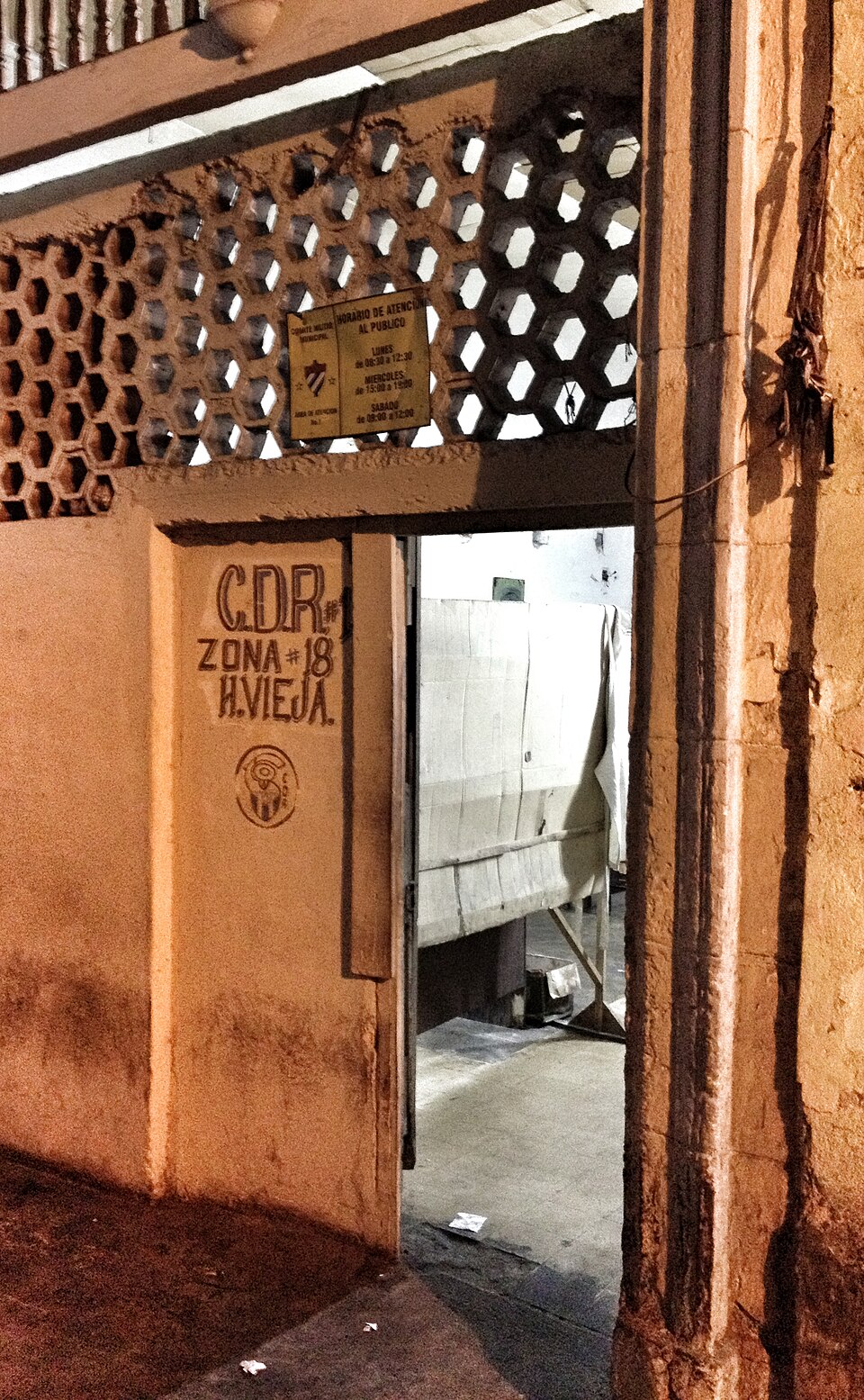
Doorway of a Committee for the Defense of the Revolution office in Old Havana (Paseo de Martí, facing Parque Central), 30 March 2012: hand-painted "C.D.R. Zona #18 H. Vieja" and a notice of public opening hours. Photograph by Keizers, Wikimedia Commons; CC BY-SA 3.0.
- Tasks Havana lists beside vigilance. EcuRed adds the 1961 literacy campaign, polio and other vaccinations, voluntary blood donation, collection of raw materials for recycling, neighborhood cleanup, help to children and the elderly, electoral processes of Poder Popular, and civil-defense evacuation in hurricanes. EcuRed states a blood-donation rate, from 1997, of one donation per 20 inhabitants. That rate was not checked here against World Health Organization figures. The same page still describes the mission as defense of the Revolution, and it illustrates a "guardia cederista" beside the health and cleanup tasks.
- Law, without the name. Article 7 of the 1976 Constitution, in the 2002 consolidated text, and Article 14 of the Constitution proclaimed in 2019, recognize and encourage "organizaciones de masas y sociales" and bring them into "la edificación, consolidación y defensa de la sociedad socialista." Neither article names the CDR.
- National coordinators, as EcuRed lists them. José Matar Franyie (1961-1966), Luís González Marturel (1966-1972), Jorge Lezcano Pérez (1972-1980), Armando Acosta Cordero (1980-1990), Sixto Batista Santana (1990-1994), Juan Contino Aslán (1994-2003), Juan José Rabilero Fonseca (2003-2011), Carlos Rafael Miranda Martínez (2011-2020), Gerardo Hernández Nordelo (2020-). A 2021 Cubadebate piece dates Lezcano 1973-1980 and Contino 1994-2002. The edges are not settled here.
- 28 September 2023. Granma reports that the national leadership re-elected Hernández, "Héroe de la República de Cuba" and a member of the Party's Central Committee and of the Council of State. It says all 475 delegates voted, that 473 ballots were valid, three selective and two blank, and that every candidate passed 99.5 percent of valid votes. Counted as separate piles, 473, 3 and 2 do not equal 475. The same article says the new executive secretariat named a head of "Vigilancia y Prevención."
- Acts of repudiation after 1980. The printed slogans and the 1 May 1980 rally at Mariel are on The Cuba-United States radio war: Radio Swan's cover story and Havana's 'gusanos' and are not repeated here. Human Rights Watch in 1995 and again in 2009 describes later "acts of repudiation" in which CDR members, among others, surround dissidents' homes. The 2009 report says the acts are presented as civilian, that victims described state vehicles and people they had not met, and that police did not protect the people targeted.
How it works
- Fear appeal: the 28 September 1960 speech pairs petards, a rumor that the marines are coming, and "campañas de agresiones" with one remedy, a committee on every block, in the same breath. A real landing followed at Girón in April 1961, so the danger was not invented. What the technique names is the remedy: not a dated alert with an end, but a permanent block institution whose founding sentence is knowledge of each resident's associations. Five months after the landing, the 1961 assembly still calls vigilance fundamental and "implacable," not a wartime measure being closed.
- Euphemism / doublespeak: the founding speech does not hide the watching. Castro says the people will observe, and the state's English site translates the verb as surveillance. The softening comes later. EcuRed leads with an NGO, voluntary and self-financed, and with vaccination, blood and cleanup, for a body Castro in 1961 called an organ of revolutionary power whose fundamental function was vigilance, and which outside reports describe as reporting to state security.
- Identity fusion: the 1961 speech wants the block to see the committee as a friend that helps, and as a body that will use "toda la energía que sea necesario" when the Revolution orders it. Neighbor and revolutionary office are the same membership. People who would "moverse" are named in the founding speech as lackeys, people sold to imperialism, and instruments of imperialism, so that asking what the committee reports is staged as taking the invasion's side.
- Bandwagon: scale is offered as the proof that the people and the Revolution are the same thing. Castro's "treinta mil" committees in a year, EcuRed's "inmensa mayoría" over age 14 and nearly eight million members, the line "en cada barrio, Revolución," and a national leadership Granma reported above 99.5 percent, all treat enrollment and a near-unanimous internal vote as consent. The membership total is unaudited, and the 2023 ballot sentence does not add up as printed.
Then and now
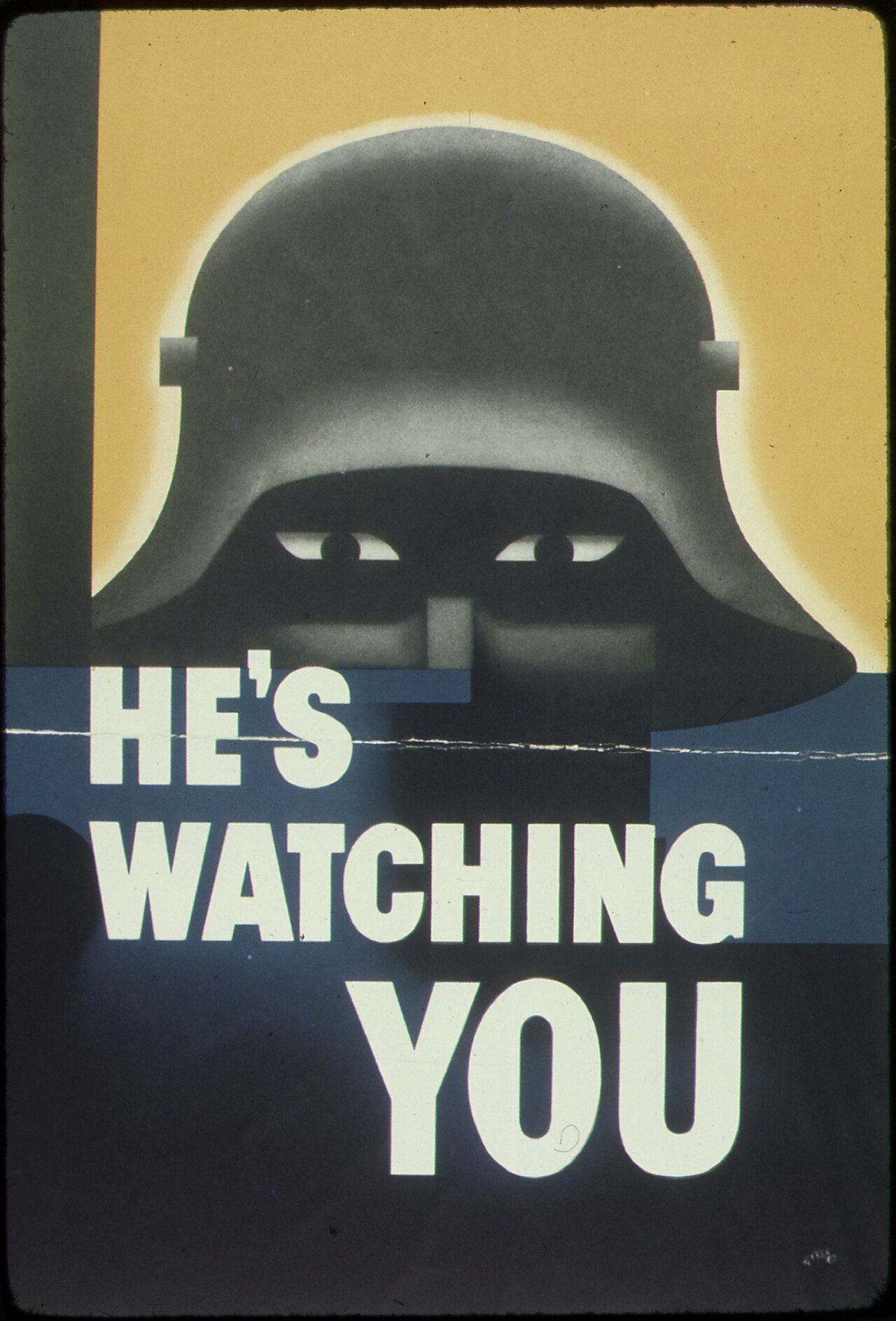
He's Watching You. U.S. government, 1942. Public domain.
He's Watching You tells a population at war that a hidden enemy is listening, and makes every person a lookout. The CDR does that too, in the register of vigilance. The institutions are not the same and this page does not score them as equal. The 1942 poster is a message. It does not put a committee on every block, keep a national office sixty years on, or sit in the chain Human Rights Watch and the US State Department describe between neighbors and state security. A workplace that also holds the personnel file is a different institution again, documented on The danwei: how the work unit became China's basic unit of political control, 1951-2003. A secret-police denunciation apparatus is documented on The Gestapo's Denunciation Apparatus: Policing by Public Tip-Off, 1933-1945. The archive's milder US pair, the wartime poster beside "If You See Something, Say Something," is Then and now: making every citizen a lookout (US home front 1942, "If You See Something, Say Something" 2010s): a slogan asking people to report suspicious activity, not a block committee.
The scale difference runs the other way as well. Girón was a seaborne landing, seven months after the speech, organized from outside Cuba. A vigilance poster in a country that has not just been invaded is not this institution, and neither is a public-health drive that happens to use volunteers.
Positions on the record
- Havana, on the institution: the 1960 and 1961 speeches, EcuRed and Granma present the committees as the people's defense against invasion, sabotage and a fifth column; as a mass organization, voluntary and elected by neighbors; and as the body that also carries literacy, vaccination, blood donation, recycling and civil defense. Castro's 1961 speech adds that they are organs of revolutionary power, that vigilance is the fundamental function, and that they watch people preparing to leave.
- Havana, in English: the official English fragment of the founding speech translates "vigilancia" as "surveillance." The disagreement with outside accounts is not over whether the block is watched. It is over whether that watching is legitimate defense.
- Human Rights Watch (1995 and 2009): government-sponsored committees in every neighborhood, watching neighbors and reporting to state security; mobilized for acts of repudiation presented as spontaneous; employers checking with the CDR on political loyalty before hiring. The 2009 researchers entered Cuba without a government visa after written requests went unanswered, and they interviewed dissidents. That is the method of the report, not a hidden one.
- Freedom House, Freedom in the World 2025: the committees "assist security agencies by monitoring, reporting, and suppressing dissent."
- Washington, 2022 Country Report on Human Rights Practices: the Ministry of the Interior "employed a system of informants and neighborhood groups, known as the Committees for the Defense of the Revolution, to monitor government opponents." The United States is a party to the conflict documented on The Cuba-United States radio war: Radio Swan's cover story and Havana's 'gusanos'. This sentence is that government's annual finding, not a court judgment.
- What is documented: the stenographic text and date of the founding speech, the petard marked in it, the crowd's "¡Paredón!", the 1961 definitions (fundamental function, organ of revolutionary power, houses of people leaving, arrests at Girón with no number), the official structure and coordinator list, the 2023 Granma vote as printed, and the HRW, Freedom House and State Department descriptions above.
- What is not shown here: who set off the petard; an independent count of the crowd, of the "treinta mil" committees, or of the nearly eight million members; a settled detainee total for Girón; whether every block committee reports to state security or only some do; whether the logo is the machete-and-flag mark Tribuna de La Habana credits to Cándido Justiz Pileta or the "Cederito" figure EcuRed credits to the cartoonist Rider; and any link from CDR lists to the UMAP camps, which this page does not adopt because the records opened here do not document it. The page takes no position on Cuba's health or education record except where a committee task is cited above.
Same-method test
A government of any party that stood up a block-level body whose stated job was to know each resident's activities and associations, kept it after the invasion crisis that justified it, and used the same roster for community tasks and for reporting opponents to a security service, would be scored the same way here. A civil-defense warden system limited to air raids, with a published end and no brief to know political associations, would not. A poster or a slogan that asks people to report a defined threat, and stops there, is the weaker relative already scored on Then and now: making every citizen a lookout (US home front 1942, "If You See Something, Say Something" 2010s), not this institution.
How to spot it
- Read the founding sentence. If the unit is defined as knowing who lives on the block, what they do and whom they meet, the later brochure about vaccination has not replaced that definition. It has been added to it.
- Notice when the same office is described as the neighbor's friend and as the body that will act "with all the energy necessary" when ordered. Help and the file are one membership.
- Ask what the membership total is evidence of. "Nearly everyone over 14" is not consent unless someone has also published how many declined, and what declining changed about work, housing or travel.
- A crowd at a door, chanting, is not by itself the block's spontaneous view. Ask who was transported, and whether the state's own paper printed the lines in advance. For the 1980 case of that second test, see The Cuba-United States radio war: Radio Swan's cover story and Havana's 'gusanos'.
- Separate the health drive and the hurricane evacuation from the report to security. The method is the single roster doing both, not the blood donation on its own.
Images
| Image | Source | Licence |
|---|---|---|
| Mechanism diagram (above) | Drawn for FRAME from the sources below | CC BY 4.0, FRAME |
| Committee office doorway, Old Havana (2012) | Wikimedia Commons (Keizers) | CC BY-SA 3.0 |
| He's Watching You (1942) | FRAME gallery | Public domain |

Image gaps
- The 28 September 1960 rally. No openly licensed photograph of the palace-steps speech was used.
- CDR billboards and the emblem. As on The Cuba-United States radio war: Radio Swan's cover story and Havana's 'gusanos', recent photographs of Cuban billboards on Commons are under a licence for the photograph, not for the artwork, and Cuba's freedom-of-panorama status is unclear. The emblem was not drawn here: EcuRed and Tribuna de La Habana do not describe the same mark.
- Night-watch and repudiation photographs. Not used. A picture of a patrol or a crowd would need a licence this page did not establish, and it would not show what the committees report.
Sources
- Fidel Castro, speech of 28 September 1960, stenographic version, Cubadebate, 28 September 2025 (Departamento de Versiones Taquigráficas del Gobierno Revolucionario).
- English fragment of the same speech, Fidel Soldier of Ideas, translating "vigilancia" as "surveillance."
- Fidel Castro, speech of 28 September 1961, first great assembly of the CDR, Plaza de la Revolución, Fidel Soldado de las Ideas.
- Comités de Defensa de la Revolución, EcuRed (Cuban state-affiliated encyclopedia), for the official structure, tasks, membership claim and coordinator list.
- "Girón: primera prueba de fuego de los CDR", Cubahora, 19 April 2012.
- "¡Esos son los CDR también!", Cubadebate, 27 September 2021, for the Lezcano and Contino dates that differ from EcuRed.
- "Ratificado Gerardo Hernández Nordelo como Coordinador Nacional de los CDR", Granma, 28 September 2023.
- Human Rights Watch, Cuba: Improvements without Reform (October 1995).
- Human Rights Watch, New Castro, Same Cuba (18 November 2009).
- Freedom House, Freedom in the World 2025: Cuba.
- US Department of State, 2022 Country Reports on Human Rights Practices: Cuba.
- Constitution of the Republic of Cuba, 1976, as amended through 2002, Article 7, Political Database of the Americas.
- Constitution of the Republic of Cuba, 2019, Article 14, Constitute Project.
- "Historia del logotipo y el lema de los CDR", Tribuna de La Habana (motto "Con la Guardia en Alto"; a different account of the emblem from EcuRed's).