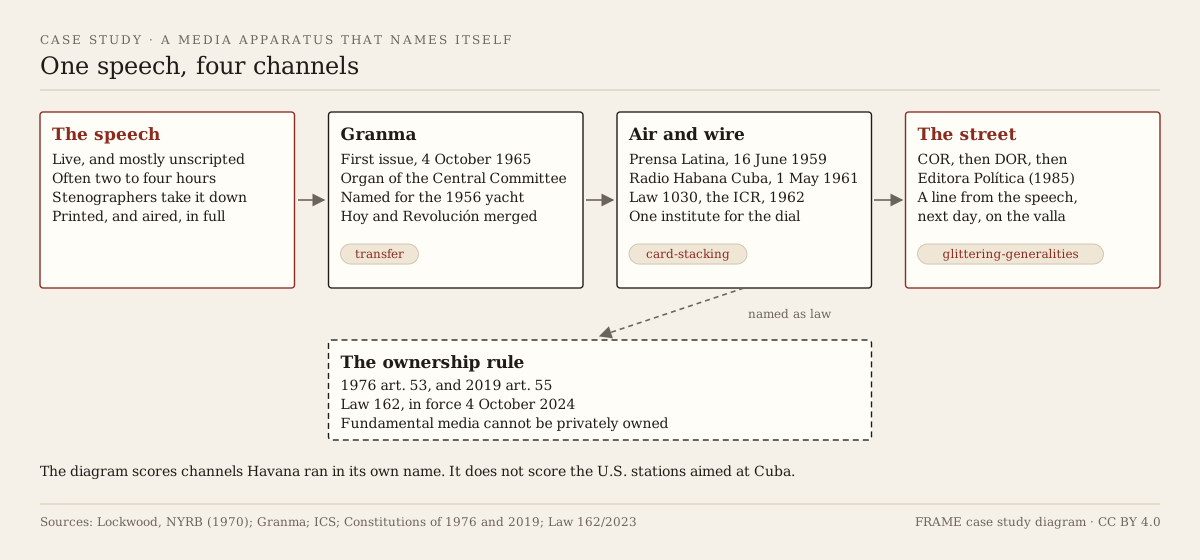
In one line: From 1959 Havana replaced a competitive daily press and the large private radio chains with institutions that spoke in the state's own name — Prensa Latina (1959), Radio Habana Cuba (1961), one broadcasting institute (1962), and from 4 October 1965 a party paper named for the yacht that had landed the expedition — and used the leader's long speeches as the text those channels, and the highway billboards, then carried.
What happened
- 1 January 1959. Fidel Castro's forces take power. José Ignacio Rivero, last owner-editor of the conservative daily Diario de la Marina, later put the press he had worked in at 58 newspapers and a combined daily run of about 800,000 copies. The figure is his, reported by the media historian Salvador Salazar Navarro, not an audited census. By the end of 1965 Salazar counts three national dailies.
- Late January 1959. The new government invites several hundred foreign journalists to Havana for what it calls Operación Verdad. Out of that meeting, Cuban and Latin American journalists are set to build a wire service that would not depend on the U.S. agencies. The agency's own history names Ernesto "Che" Guevara as a sponsor and says he proposed the name.
- 16 April and 16 June 1959. Prensa Latina's constitutive act is signed on 16 April. On 16 June the first dispatch goes out under the slug "PL", the date the agency treats as its founding. Its first director is the Argentine journalist Jorge Ricardo Masetti. The agency's histories name Gabriel García Márquez and Rodolfo Walsh among the early correspondents. The stated purpose is a Latin American wire with its own reading of the continent, filed from Havana.
- January to May 1960. Printers and union committees fight the "battle of the coletilla": a signed tail-piece, appended to copy the new authorities dispute. Time reports on 23 May 1960 that armed members of the newspaper unions had seized Diario de la Marina the previous week, which the magazine calls the last daily still criticising the government. Prensa Libre is taken after it objects. Salazar's survey finds that by May 1960 the old market in dailies has closed: Avance, Diario de la Marina, El País, Excelsior and others stop; Bohemia, Prensa Libre and El Mundo are intervened and change line.
- Autumn 1960. The state takes over CMQ, the largest private radio and television circuit, owned by the brothers Goar and Abel Mestre. Cuban institutional chronologies do not agree on a single day: one dates a confiscation resolution to 12 September 1960, another the intervention to 5 October 1960. Radio Guamá's own history treats the CMQ intervention as the point at which the national chains passed to the government.
- 24 February and 1 May 1961. An experimental shortwave service, "Onda Corta Experimental Cubana", goes on the air on 24 February. On 1 May, carrying the rally after the failed landing at Playa Girón, it is inaugurated as Radio Habana Cuba. The station's own account says it was built to answer what it calls a U.S. information blockade, and describes a current schedule in seven languages (Spanish, English, French, Portuguese, Haitian Creole, Esperanto and Arabic). The stations Washington aimed at Cuba, and the labels Havana used for people who left, are a different case, The Cuba-United States radio war: Radio Swan's cover story and Havana's 'gusanos', and are not retold here.
- 24 May 1962. Law 1030 of the Council of Ministers creates the Instituto Cubano de Radiodifusión (ICR), one body for radio and television. The successor institute dates the renaming, to Instituto Cubano de Radio y Televisión (ICRT), to 1975, with the same remit. In the same period a stenographic office is set up to take the leader's speeches down: in February 2017 Granma honours the Council of State's Departamento de Versiones Taquigráficas on what it calls 55 years of work, and credits the office to an initiative of Celia Sánchez.
- 1962 to 1985, the wall. Poster archivist Lincoln Cushing's chronology of the party's own graphic shop runs: the Comisión de Orientación Revolucionaria (COR; he gives it in English as the Commission of Revolutionary Orientation), 1962-1974; the Departamento de Orientación Revolucionaria (DOR), 1974-1984; Editora Política from 1985. Books, pamphlets, posters and the highway vallas come out of that shop. David Kunzle's 1975 essay in Latin American Perspectives is the art-historical account of these boards as a public graphic rather than as commercial advertising. A later essay in the Cuban cultural magazine La Jiribilla remembers designers kept on duty when Castro spoke: the next day an offset poster was up, and the same design was adapted, turned horizontal, onto the road boards. A COR poster for the revolution's fourth anniversary, by Mario Sandoval, carries the line "La soberanía de Cuba jamás será negociada" ("Cuba's sovereignty will never be negotiated").
- 3 and 4 October 1965. At the Teatro Chaplin (now the Teatro Karl Marx) the United Party of the Socialist Revolution is renamed the Communist Party of Cuba and a first Central Committee is presented. Castro reads Guevara's farewell letter and announces a new daily in place of Revolución (the 26 July Movement) and Hoy (the old communist Popular Socialist Party). It will be called Granma, he says, "como símbolo de nuestra concepción revolucionaria y nuestro camino" ("as a symbol of our revolutionary conception and of our road") — the name of the yacht that had brought 82 expeditionaries from Mexico, landing on 2 December 1956. The paper's own account says he picked the masthead from several drawings of the boat, and that the first issue, directed by Isidoro Malmierca, is printed in the early hours of 4 October: 498,784 copies, 12 pages. The masthead line is "Órgano Oficial del Comité Central del Partido Comunista de Cuba". Juventud Rebelde, the youth organisation's paper, is the other new national title. With Granma and the surviving El Mundo it makes up the three national dailies Salazar counts at the end of 1965. El Mundo, the last republican survivor, stops after a fire in 1968.
- The speech as the edition. Lee Lockwood, writing in the New York Review of Books in September 1970, quotes Carlos Franqui, who had edited Revolución and by then had broken with the government: "In Cuba there is only one newspaper. It appears irregularly, from time to time. It is Fidel, when he speaks to the people." Lockwood treats the mechanism, not only the gibe, as observable: speeches of two to four hours, almost none written out, more than three hundred of them in eleven years, printed verbatim in the press the next day and carried continuously on radio and television. Later biographers' totals, including figures above 2,500, are estimates; Granma's 2017 note, as carried by EFE, says the exact number is not known.
- 24 February 1976. The socialist constitution is adopted. Article 53, in the text as amended through 2002, recognises freedom of speech and of the press "conforme a los fines de la sociedad socialista" ("in keeping with the aims of socialist society"), and states the material condition of that right: "la prensa, la radio, la televisión, el cine y otros medios de difusión masiva son de propiedad estatal o social y no pueden ser objeto, en ningún caso, de propiedad privada" ("the press, radio, television, cinema and other mass media are state or social property and can never be private property").
- 10 April 2019. A new constitution is proclaimed, after a referendum on 24 February. Article 55 again recognises freedom of the press, "de conformidad con la ley y los fines de la sociedad", and narrows the ownership sentence onto the "medios fundamentales": they "son de propiedad socialista de todo el pueblo o de las organizaciones políticas, sociales y de masas; y no pueden ser objeto de otro tipo de propiedad" ("are socialist property of the whole people or of the political, social and mass organisations, and cannot be the object of any other kind of property"). The article's closing sentence says the state sets the principles of organisation and functioning for all medios de comunicación social.
- 24 August 2021. Decree-Law 41 extinguishes the ICRT and creates the Instituto de Información y Comunicación Social (ICS) as a central body of the state administration. The institute's name changes. The ownership rule does not.
- 25 May 2023, in force 4 October 2024. The National Assembly passes Law 162, "De Comunicación Social". It is published in the Gaceta Oficial of 5 June 2024 and, by its own final provision, takes effect 120 days later. Article 28 defines the fundamental media — news agencies, radio, television, and print and digital outlets of that class — as organisations with "un carácter estratégico en la construcción del consenso" ("a strategic character in the construction of consensus"), and repeats that they cannot be any other kind of property. The law also describes a second tier, "other" media, tied to a recognised state body, association or economic actor, whose funds may not be aimed at subverting the constitutional order. That is not a private national press sitting beside Granma.
How it works
- Transfer: naming the party daily after the yacht moves the prestige of the 1956 landing onto every issue. Putting a sentence from a speech onto a highway board the next day moves the rally onto the commute. The reader is asked to take the paper, and the roadside, as continuations of the landing rather than as channels with a selection of their own.
- Card stacking: by the end of 1965 the national dailies a reader can buy are the party paper, the youth paper and, for three more years, a intervened El Mundo. The wire, the dial and the shortwave service sit in the same hands. Lockwood's point is the last step of the stack: the speech is printed in full and aired in full, so the next day's paper is not a report on the speech so much as the speech again.
- Glittering generalities: "La soberanía de Cuba jamás será negociada" is a virtue sentence. It names no term, no counterpart and no date. Repeated on a poster and a billboard, it stands in for a checkable claim about policy.
- Euphemism / doublespeak: "Orientación Revolucionaria" is the name of the office that designs the political posters and the vallas. Law 162's "construcción del consenso" is the statute's name for what the fundamental media are for. In both phrases the operational fact — a party shop produces the boards; the fundamental press cannot belong to anyone else — is replaced by a softer noun.
Then and now
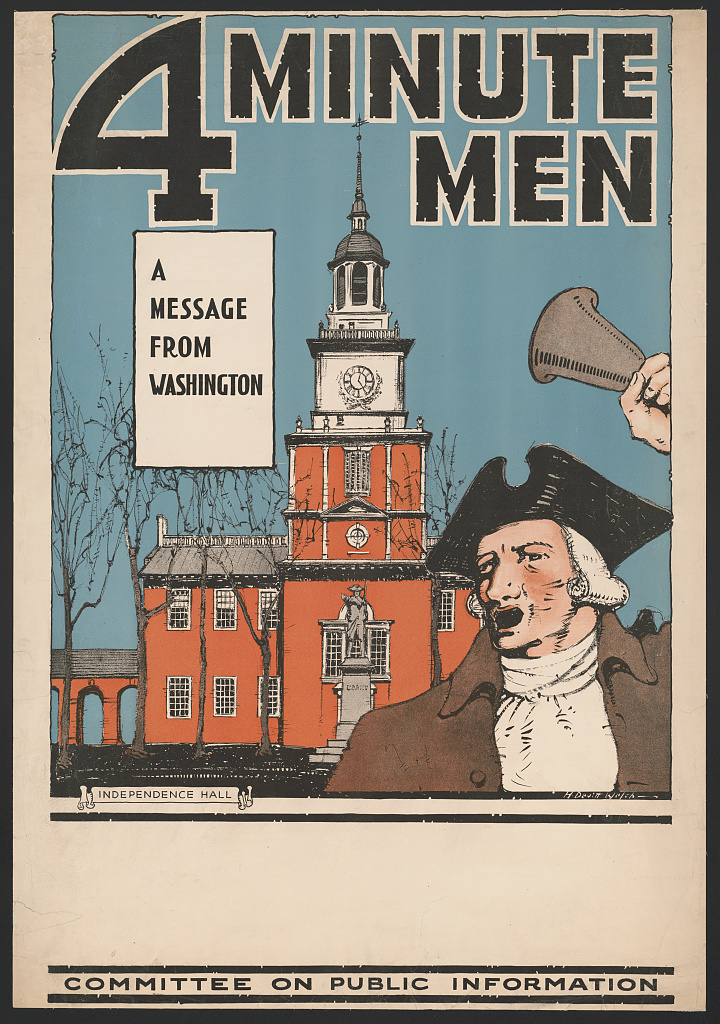
4 Minute Men: A Message from Washington, Committee on Public Information, 1917. Public domain.
The Four Minute Men were a disclosed speakers' programme: four minutes, in a cinema interval, from a model text assigned in Washington, introduced by a slide that named the Committee on Public Information. Havana's apparatus is also white, not hidden. Granma's masthead says whose organ it is, and Law 1030 put the dial under a named institute. The difference of scale is the whole point. The CPI counted tens of thousands of volunteer speakers reading a bulletin. Lockwood's 1970 account of Cuba is one speaker, two to four hours, printed verbatim the next day and carried on the country's radio and television, with a line from the same text on the road. A wartime government adding a short talk at the movies is not a one-party state whose constitution says the fundamental press cannot be private property. A party paper that prints the leadership's text and says so on the masthead is the form described on Pravda, Izvestia and TASS: the institutional structure of the Soviet press monopoly, 1912-1991. What is distinct here is how often that text was a single unscripted speech. The U.S. stations aimed at Cuba, which hid a government behind a commercial name, are The Cuba-United States radio war: Radio Swan's cover story and Havana's 'gusanos', not this page.
Positions on the record
- Havana, on its own institutions: Granma, Prensa Latina, Radio Habana Cuba and the ICS present the apparatus as the way a blockaded country tells its own story and breaks a foreign wire monopoly. Article 53 of the 1976 text presents state or social ownership as the material condition of press freedom, not as its cancellation. The poster shop presents the valla as public graphic art and political education.
- The papers that were closed, and later critics: Time in May 1960 reads the seizure of Diario de la Marina as the end of the last daily still willing to criticise. Franqui's line, quoted by Lockwood, treats the speech as a substitute for a newspaper. Freedom House's 2025 country report, an NGO index with its own method, scores Cuba's independent media at the bottom of its scale and reads Law 162, in force from October 2024, as a further restriction; it describes the independent press as operating outside the law.
- What is documented: the dates of Prensa Latina's first dispatch, Radio Habana Cuba's inauguration, Law 1030, Granma's first issue and the yacht it is named for; the May 1960 seizures; the COR-DOR-Editora Política sequence; Lockwood's account of verbatim reprint and continuous broadcast; Article 53 (1976 text as amended through 2002), Article 55 (2019) and Law 162's Article 28.
- What is not shown here: Radio Swan, Radio and TV Martí, the word "gusanos", and the Mariel demonstrations, all on The Cuba-United States radio war: Radio Swan's cover story and Havana's 'gusanos'. Not shown either is the day-to-day newsroom routine, which this page does not reconstruct. Rivero's count of 58 newspapers and later biographers' counts of the speeches are labelled as theirs. This page takes no position on the revolution's record in health, education or the economy.
Same-method test
A government of any party that closed the independent dailies, put the party's name on the remaining national paper, ran the only wire and the only broadcaster, and turned one leader's unscripted speech into the next day's paper, the day's broadcasts and the next day's billboard, would be scored the same way here. A constitution or a statute that defined the fundamental press as property no one else may own, and as an instrument for "constructing consensus", would be scored on the same terms whichever country wrote it.
How to spot it
- Read the masthead. "Official organ of the Central Committee" is a disclosure, not a secret. The question is whether any other national daily is allowed to exist beside it.
- When the same sentence appears in a speech, in the next day's paper and on a highway board, count sources. Three surfaces can still be one text.
- A law that says the fundamental media "cannot be the object of any other kind of property" is the monopoly stated in legal form. "Orientation" and "the construction of consensus" are the softer names for that fact.
Images
| Image | Source | Licence |
|---|---|---|
| Mechanism diagram (above) | Drawn for FRAME from the sources below | CC BY 4.0, FRAME |
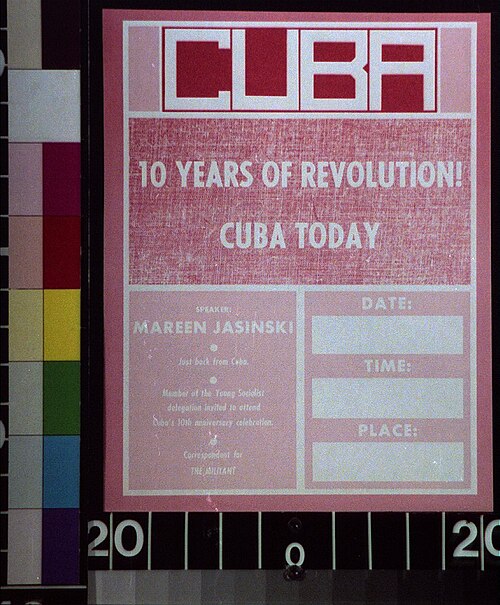
| "Cuba: 10 years of revolution!" handbill (1969) | Yanker Poster Collection, Library of Congress, via Wikimedia Commons; also on The Cuba-United States radio war: Radio Swan's cover story and Havana's 'gusanos' | Public domain (no copyright notice) |
| 4 Minute Men: A Message from Washington (1917) | FRAME gallery; Library of Congress, LC-DIG-ppmsca-53577 | Public domain (published before 1931) |
Image gaps
- The front page of Granma, 4 October 1965, and the yacht masthead. The paper has published photographs of both. The 1965 design is a Cuban party publication. No holding institution tags it public domain, and a 1965 foreign work is not in the public domain in the United States merely for lacking a U.S. copyright notice. Not downloaded.
- COR, DOR and Editora Política posters, and the highway vallas. Photographs of boards such as "Patria o Muerte" circulate on Commons under a Creative Commons licence for the photograph only. The artwork has no public-domain tag. Cuba's freedom-of-panorama status does not clear the underlying design. OSPAAAL and ICAIC posters are a different producer and are also not used: many remain in copyright, and a scan on a dealer or fan site is not a licence. No unverified downloads.
- The yacht Granma in its Havana memorial, and the CMQ / Radio Centro building. No openly licensed photograph was verified for this page, so none was retrieved.
Sources
- Salvador Salazar Navarro, "The state control of the Cuban printed press (1959-1965): A systemic analysis", Comunicación y Sociedad (2025).
- "¿Quiénes somos?", Granma.
- "Las 55 travesías del periódico Granma", Granma, 3 October 2020.
- "Prensa Latina, 64 years at the service of the truth", Prensa Latina, 16 June 2023.
- "Prensa Latina, nacimiento de una agencia al servicio de la Verdad", Prensa Latina, 14 April 2023.
- "The Press: Truth in Cuba", Time, 23 May 1960.
- "José Ignacio Rivero, último director del Diario de la Marina", Cuban Studies, University of Florida.
- "La radio en Revolución (I)", Radio Guamá.
- "1960: Confiscación del Circuito CMQ y Radio Reloj", Radio Cadena Agramonte.
- "About Us", Radio Habana Cuba.
- "Sobre el Instituto", Instituto de Información y Comunicación Social.
- Lee Lockwood, "'This Shame Will Be Welcome…' A Speech by Fidel Castro", New York Review of Books, 24 September 1970.
- "Cuba homenajea a los taquígrafos que soportaron los discursos de Fidel Castro", ABC / EFE, 27 February 2017.
- David Kunzle, "Public Graphics in Cuba: A Very Cuban Form of Internationalist Art", Latin American Perspectives 2, no. 4 (1975).
- Lincoln Cushing, Cuban poster art, Docs Populi (COR 1962-1974, DOR 1974-1984, Editora Política from 1985).
- "Testimonio visual invaluable", La Jiribilla.
- Constitution of Cuba, 1976, with amendments through 2002, Article 53, Constitute Project.
- Constitution of Cuba, 2019, Article 55, Constitute Project.
- Ley 162 de 2023, "De Comunicación Social", Gaceta Oficial No. 48 Ordinaria, 5 June 2024 (GOC-2024-338-O48).
- "En vigor: Ley 162/2023", Instituto de Información y Comunicación Social (in force 4 October 2024).
- Freedom in the World 2025: Cuba, Freedom House.